production
/viewbook/list/all/?page=3982
/
/static/
None

Ending Civil Wars: The Implementation of Peace Agreements
Authors:
Not Available
Publisher:
Lynne Rienner Pub
Publication Date:
Not available
ISBN:
1588260836
Most experts agree that international involvement is necessary to help end civil wars, but few have looked at how, when, and where the United Nations... and outside governments should do so. Here a team of scholars examines the varied experiences of the last 20 years to offer practical advice. They find that the local conditions surrounding settlements vary widely. In relatively benign environments, such as Guatemala and Namibia, traditional peacekeeping approaches involving confidence building and dialogue are possible. In more demanding environments, such as Bosnia and Sierra Leone, outside states need to compel and deter local factions to ensure they comply with the peace agreement. But the most important source of failures is the presence of "spoilers" -- factions that continue to resist peace -- and unhelpful neighboring states that oppose a settlement.
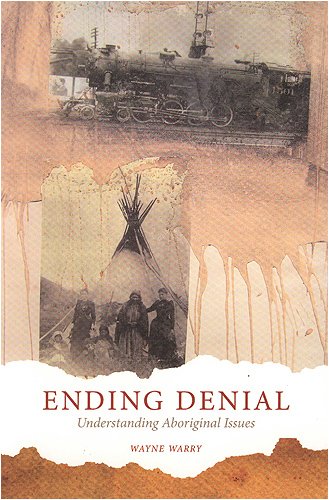
Ending Denial: Understanding Aboriginal Issues
Authors:
Wayne Warry
Publisher:
University of Toronto Press, Higher Education Division
Publication Date:
Not available
ISBN:
1442600055
There is an unconscious racism at work in Canada—an ignorance of Aboriginal peoples and culture that breeds indifference to, and ambivalence about,... Aboriginal poverty and ill health. Warry examines conservative arguments and mainstream views that promote assimilation and integration as the solution to Aboriginal marginalization. He argues that we must acknowledge our denial of colonialism in order to reach a deeper understanding of contemporary Aboriginal culture and identity, both on and off the reserve. Only then can we fully recognize Aboriginal peoples' rights and the path to self-determination.In short related essays Warry counters arguments found in mainstream academic and popular writing and critiques conservative attitudes from a perspective informed by social science research. From this viewpoint he examines colonialism and history, land claims and resource rights, culture and contemporary identity, urban Aboriginal communities, and the nature of self-government and Aboriginal citizenship.
Ending Dirty Energy Policy: Prelude to Climate Change
Authors:
Joseph P. Tomain
Publisher:
Cambridge University Press
Publication Date:
Not available
ISBN:
0521127858
Climate change presents the United States, and the world, with regulatory problems of a magnitude, complexity, and scope unseen before. The United... States, however, particularly after the mid-term elections of 2010, lacks the political will necessary to aggressively address climate change. Most current books focus on climate change. Ending Dirty Energy Policy argues that the country will not adequately address climate change until we transform our fossil fuel energy policy. Yet there are signs that the country will support the transformation of our country's century-old energy policy from one that is dependent on fossil fuels to a low-carbon energy portfolio. A transformative energy policy that favors energy efficiency and renewable resources can occur only after we have abandoned the traditional fossil fuel energy policy, have redesigned regulatory systems to open new markets and promoted competition among new energy providers, and have stimulated private-sector commercial and venture capital investment in energy innovations that can be brought to commercial scale and marketability.
Ending Global Poverty: A Guide to What Works
Authors:
Stephen C. Smith
Publisher:
Palgrave Macmillan
Publication Date:
Not available
ISBN:
0230606156
Over 800 million people suffer from chronic hunger, and over ten million children die each year from preventable causes. These may seem like... overwhelming statistics, but as Stephen Smith shows in this call to arms, global poverty is something that we can and should solve within our lifetimes. Ending Global Poverty explores the various traps that keep people mired in poverty, traps like poor nutrition, illiteracy, lack of access to health care, and others and presents eight keys to escaping these traps. Smith gives readers the tools they need to help people overcome poverty and to determine what approaches are most effective in fighting it. For example, celebrities in commercials who encourage viewers to "adopt" a poor child really seem to care, but will sending money to these organizations do the most good? Smith explains how to make an informed decision. Grass-roots programs and organizations are helping people gain the capabilities they need to escape from poverty and this book highlights many of the most promising of these strategies in some of the poorest countries in the world, explaining what they do and what makes them effective.
Ending Mozambique's War: The Role of Mediation and Good Offices
Authors:
Cameron Hume
Publisher:
United States Institute of Peace
Publication Date:
Not available
ISBN:
1878379372
Fifteen years after winning independence in 1975, Mozambique was wracked by insurgency, devastated by drought, and battered by conflicts with its... neighbors. A less auspicious beginning for a new nation could hardly have been imagined.But the signing of the 1992 peace agreement led to a new beginning. And a team of mediators, operating outside the framework of traditional diplomacy, helped the parties along the path of peace and reconciliation.This first-hand account of the Mozambique mediations offers intriguing details that illustrate the complexity of the multi-track mediation process. Hume, who was a participant observer in the Rome-based peace talks, relates the stages of the process to the principles of conflict management, negotiation, and mediation in a clear and graceful style. He delineates the separate roles played by the parties themselves (the government and RENAMO), the outside governments that intervened, and the mediators, with a special focus on the unique element in this peace process: the involvement of a private voluntary organization, the Community of Sant'Egidio.This compelling story of the Mozambican peace process also provides useful lessons for addressing other hostilities in Africa, the Balkans, and the emerging polities of the former Soviet republics.
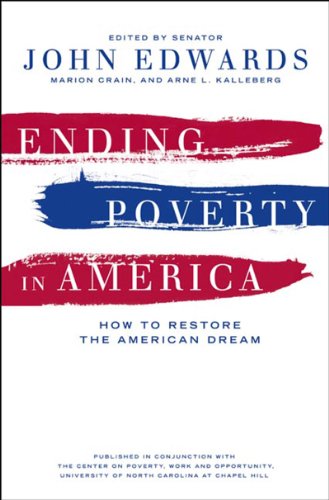
Ending Poverty in America
Authors:
John Edwards
Publisher:
New Press
Publication Date:
Not available
ISBN:
1595581766
John Edwards puts a seminal issue back on the map, presenting blueprints for ending poverty in America."This is one of the great moral issues of our... time. The day after Katrina hit, new government statistics showed that 37 million Americans live in poverty, up for the fourth year in a row."—Senator John EdwardsIs poverty a fact of life? Can the wealthiest nation in the world do nothing to combat the steadily rising numbers of Americans living in poverty—or the 50 million Americans living in "near poverty"? Senator John Edwards and some of the country's most prominent scholars, businesspeople, and community activists say otherwise.Published in conjunction with one of the country's leading anti-poverty centers, Ending Poverty in America brings together some of America's most respected social scientists, including William Julius Wilson, Katherine S. Newman, and Richard B. Freeman, alongside journalists, neighborhood organizers, and business leaders. The voices heard here are both liberal and conservative, and tackle hot-button issues such as job creation, schools, housing, and family-friendly social policy.The contributors explain why poverty is growing and outline concrete steps that can be taken now to start turning the tide. In a political landscape seemingly bereft of daring and forward-thinking ideas, this new book lays out a path toward eliminating poverty in America—a template for a renewed public debate for an issue of intense urgency.Contributors include: Jared Bernstein, Anita Brown-Graham, Carol Mendez Cassell, Richard Freeman, Angela Glover-Blackwell, Jacob Hacker, Harry Holzer, Jack Kemp, Glenn Loury, Ron Mincy, Katherine S. Newman, Melvin Oliver, Dennis Orthner, David Shipler, Beth Shulman, Michael Stegman, Elizabeth Warren, William Julius Wilson.

Endings (Interlink World Fiction)
Authors:
Abd Al-Rahman Munif
Publisher:
Interlink Pub Group Inc
Publication Date:
Not available
ISBN:
156656669X
''Drought. Drought again! When drought seasons come, things begin to change. Life and objects change. Humans change too, and no more so than in their... moods!' It is not long before the reader of Endings discovers that this drought is not just an occasional but an enduring condition faced by a community on the edge of the desert, the village of al-Tiba. Nowhere do we discover exactly where this village is on the map of the Arab world and al-Tiba thus becomes a symbol for all villages facing nature unaided by modern technology. We hear of Abu Zaku, the village carpenter; of the Mukhtar; and above all of 'Assaf and his dog; and of the creatures that share the life of the community. But it is the people of al-Tiba as a group who discuss and argue about their past, present, and future, and the forces of change. The portrayal of the desert environment and its customs is as vivid as the hunting of animals and the sandstorm that led to 'Assaf's death. A series of stories accompanies the wake that follows -stories that borrow from the pre-Islamic tradition of expressing a particular vision through descriptions of animals. Endings is striking not only for its setting and style of narrative, but for being a vivid commentary on the emergence of the modern city and its urban middle class.
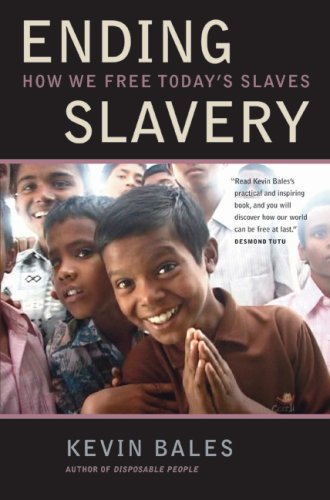
Ending Slavery: How We Free Today's Slaves
Authors:
Kevin Bales
Publisher:
University of California Press
Publication Date:
Not available
ISBN:
0520257960
In his 1999 book, Disposable People, Kevin Bales brought to light the shocking fact of modern slavery and described how, nearly two hundred years after... the slave trade was abolished (legal slavery would have to wait another fifty years), global slavery stubbornly persists. In Ending Slavery, Bales again grapples with the struggle to end this ancient evil and presents the ideas and insights that can finally lead to slavery's extinction. Recalling his own involvement in the antislavery movement, he recounts a personal journey in search of the solution and explains how governments and citizens can build a world without slavery.
Ending the Mendel-Fisher Controversy
Authors:
Allan Franklin
Publisher:
University of Pittsburgh Press
Publication Date:
Not available
ISBN:
0822959860
In 1865, Gregor Mendel presented “Experiments in Plant-Hybridization,” the results of his eight-year study of the principles of inheritance through... experimentation with pea plants. Overlooked in its day, Mendel's work would later become the foundation of modern genetics. Did his pioneering research follow the rigors of real scientific inquiry, or was Mendel's data too good to be true-the product of doctored statistics? In Ending the Mendel-Fisher Controversy, leading experts present their conclusions on the legendary controversy surrounding the challenge to Mendel's findings by British statistician and biologist R. A. Fisher. In his 1936 paper “Has Mendel's Work Been Rediscovered?” Fisher suggested that Mendel's data could have been falsified in order to support his expectations. Fisher attributed the falsification to an unknown assistant of Mendel's. At the time, Fisher's criticism did not receive wide attention. Yet beginning in 1964, about the time of the centenary of Mendel's paper, scholars began to publicly discuss whether Fisher had successfully proven that Mendel's data was falsified. Since that time, numerous articles, letters, and comments have been published on the controversy.This self-contained volume includes everything the reader will need to know about the subject: an overview of the controversy; the original papers of Mendel and Fisher; four of the most important papers on the debate; and new updates, by the authors, of the latter four papers. Taken together, the authors contend, these voices argue for an end to the controversy-making this book the definitive last word on the subject.

Ending the War on Drugs: A Solution for America
Authors:
Dirk Chase Eldridge
Publisher:
Bridgeworks
Publication Date:
Not available
ISBN:
1882593383
Ending Welfare as We Know It
Authors:
R. Kent Weaver
Publisher:
Brookings Institution Press
Publication Date:
Not available
ISBN:
0815792476
Bill Clintons first presidential term was a period of extraordinary change in policy toward low-income families. In 1993 Congress enacted a major... expansion of the Earned Income Tax Credit for low-income working families. In 1996 Congress passed and the president signed the Personal Responsibility and Work Opportunity Reconciliation Act. This legislation abolished the sixty-year-old Aid to Families with Dependent Children (AFDC) program and replaced it with a block grant program, Temporary Assistance for Needy Families. It contained stiff new work requirements and limits on the length of time people could receive welfare benefits.Dramatic change in AFDC was also occurring piecemeal in the states during these years. States used waivers granted by the federal Department of Health and Human Services to experiment with a variety of welfare strategies, including denial of additional benefits for children born or conceived while a mother received AFDC, work requirements, and time limits on receipt of cash benefits. The pace of change at the state level accelerated after the 1996 federal welfare reform legislation gave states increased leeway to design their programs. Ending Welfare as We Know It analyzes how these changes in the AFDC program came about. In fourteen chapters, R. Kent Weaver addresses three sets of questions about the politics of welfare reform: the dismal history of comprehensive AFDC reform initiatives; the dramatic changes in the welfare reform agenda over the past thirty years; and the reasons why comprehensive welfare reform at the national level succeeded in 1996 after failing in 1995, in 199394, and on many previous occasions. Welfare reform raises issues of race, class, and sex that are as difficult and divisive as any in American politics. While broad social and political trends helped to create a historic opening for welfare reform in the late 1990s, dramatic legislation was not inevitable. The interaction of contextual factors with short-term political and policy calculations by President Clinton and congressional Republicansalong with the cascade of repositioning by other policymakersturned ending welfare as we know it from political possibility into policy reality.

Endless Feasts: Sixty Years of Writing from Gourmet (Modern Library...
Authors:
Gourmet Magazine Editors
Publisher:
Modern Library
Publication Date:
Not available
ISBN:
0375759921
Contributors to endless feasts include:James Beard/Cooking with James Beard: PastaRay Bradbury/Dandelion WineRobert P. Coffin/Night of LobsterLaurie... Colwin/A Harried Cook’s Guide to Some Fast FoodPat Conroy/The Romance of UmbriaElizabeth David/Edouard de PomianeM.F.K. Fisher/Three Swiss InnsRuth Harkness/In a Tibetan LamaseryMadhur Jaffrey/An Indian ReminiscenceAnita Loos/Cocktail Parties of the TwentiesGeorge Plimpton/I, Bon Vivant, Who, Me?E. Annie Proulx/The Garlic WarClaudia Roden/The Arabian PicnicJane and Michael Stern/Two for the Road: Havana, North DakotaPaul Theroux/All Aboard! Cross the Rockies in Style
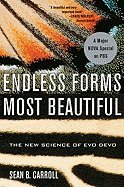
Endless Forms Most Beautiful : New Science of Evo Devo
Authors:
Sean BCarol
Publisher:
W.W. Norton
Publication Date:
Not available
ISBN:
0393327795
“A beautiful and very important book.”—Lewis Wolpert, American ScientistFor over a century, opening the black box of embryonic development was... the holy grail of biology. Evo Devo—Evolutionary Developmental Biology—is the new science that has finally cracked open the box. Within the pages of his rich and riveting book, Sean B. Carroll explains how we are discovering that complex life is ironically much simpler than anyone ever expected.

Endless Love: A Novel (P.S.)
Authors:
Scott Spencer
Publisher:
Ecco
Publication Date:
Not available
ISBN:
0061926000
The classic novel that has been translated into over twenty languages and has sold more than two million copies worldwide One of the most... celebrated novels of its time, Endless Love remains perhaps the most powerful book ever written about young love. Riveting, compulsively readable, and ferociously sexual, Endless Love tells the story of David Axelrod and his overwhelming love for Jade Butterfield. David and Jade are consumed with each other: their rapport, their desire, their sexuality, take them further than they understand. And when Jade's father banishes David from the home, he fantasizes the forgiveness his rescue of the family will bring, and he sets a "perfectly safe" fire to their house. What unfolds is a nightmare, a dark world in which David's love is a crime and a disease, a world of anonymous phone calls, crazy letters, and new fears—and the inevitable and punishing pursuit of the one thing that remains most real to him: his endless love for Jade and her family. Published in 1979 and hailed as "one of the best books of the year" by the New York Times, Endless Love is the novel that first established Scott Spencer as "the contemporary American master of the love story" (Publishers Weekly).
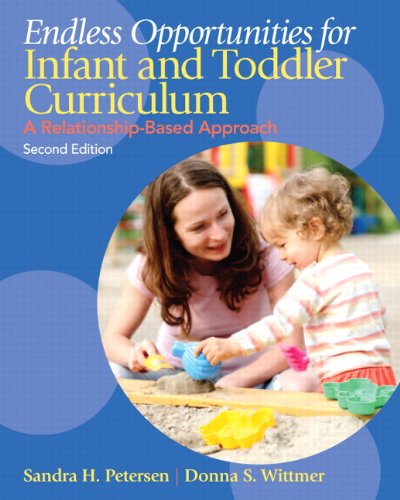
Endless Opportunities for Infant and Toddler Curriculum: A...
Authors:
Sandra H. Petersen
Publisher:
Pearson
Publication Date:
Not available
ISBN:
0132613123
This new edition helps parents, caregivers, and early interventionists prepare curriculum for our youngest learners. To encourage learning, the... authors use a three-step approach - Respect, Reflect, and Relate. This book will help all those who care for infants and toddlers to translate their knowledge of child development into effective, individualized curriculum; it will not tell them what to do on Monday, but rather will help them to ask: "How will I make decisions on Monday that truly come from the child’s interests?" Through observation, they will choose a response that supports learning and the relationship and therefore achieve the primary goal of an infant/toddler care teacher- to support the parent-child relationship.
 '





