production
/viewbook/list/all/?page=3997
/
/static/
None
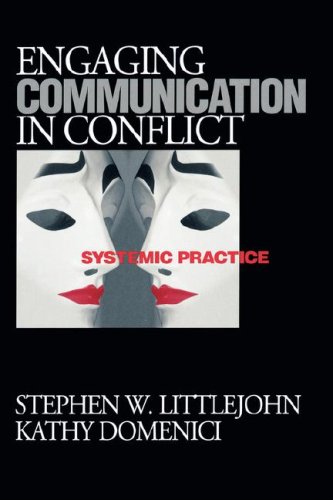
Engaging Communication in Conflict: Systemic Practice
Authors:
Stephen Littlejohn
Publisher:
Sage Publications, Inc
Publication Date:
Not available
ISBN:
0761921877
Written from the authors' experience in conflict intervention in their private consulting practice, Engaging Communication in Conflict uses a... communication perspective to address insights and methods in private mediation, small group facilitation, system design, large-scale interventions, and public-issue management. This book offers encouragement for a world sometimes overwhelmed by conflict and presents an expanded and pragmatic definition of peace. Stephen Littlejohn and Kathy Domenici discuss numerous methods and principles in conflict resolution. They explore transformative mediation, the team mediation system, assessment and evaluation, systemic design, gaming methodology, issue framing and public deliberation, study circles, dialogue groups, and many other interventions. These methods and principles are adapted from a spectrum of theory and practice and include fresh and innovative approaches designed by the authors and their colleagues.
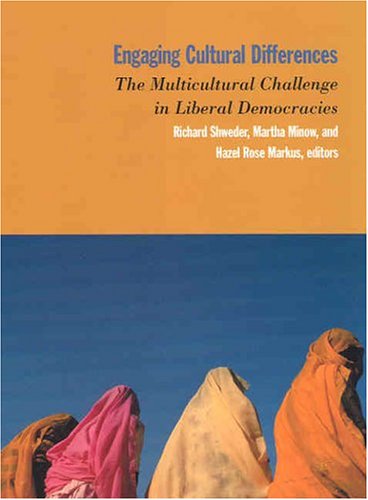
Engaging Cultural Differences: The Multicultural Challenge in...
Authors:
Not Available
Publisher:
Russell Sage Foundation Publications
Publication Date:
Not available
ISBN:
0871547953
Liberal democracies are based on principles of inclusion and tolerance. But how does the principle of tolerance work in practice in countries such as... Germany, France, India, South Africa, and the United States, where an increasingly wide range of cultural groups holds often contradictory beliefs about appropriate social and family life practices? As these democracies expand to include peoples of vastly different cultural backgrounds, the limits of tolerance are being tested as never before. Engaging Cultural Differences explores how liberal democracies respond socially and legally to differences in the cultural and religious practices of their minority groups. The contributors -- an interdisciplinary group of legal scholars, anthropologists, psychologists, and political theorists -- explore several interrelated questions: Does the law in these countries presuppose and codify the beliefs and values of the cultural mainstream? To what extent does the law affect the customs of ethnic minority groups, and how do these groups react to official attempts to force compliance with the dominant norms? How much cultural diversity in family practices ought to be permissible within the framework of a pluralistic, democratic society? Some of the practices addressed include ethnic traditions about selecting marital partners, parent-child relationships, religiously-based clothing requirements for women, genital alteration, and religion and schooling. Building on such examples, the contributors examine the role of tolerance in practical encounters between state officials and immigrants, and between members of longstanding majority groups and increasing numbers of minority groups. The volume also considers the theoretical implications of expanding the realm of tolerance. Some contributors are reluctant to broaden the scope of tolerance, while others insist that the notion of "tolerance" is itself potentially confining and demeaning and that modern nations should aspire to celebrate cultural differences. Coming to terms with ethnic diversity and cultural differences has become a major public policy concern in contemporary liberal democracies, as they struggle to adjust to burgeoning immigrant populations. Engaging Cultural Differences provides a compelling examination of the challenges of multiculturalism and reveals a deep understanding of the challenges democracies face as they seek to accommodate their citizens’ diverse beliefs and practices.
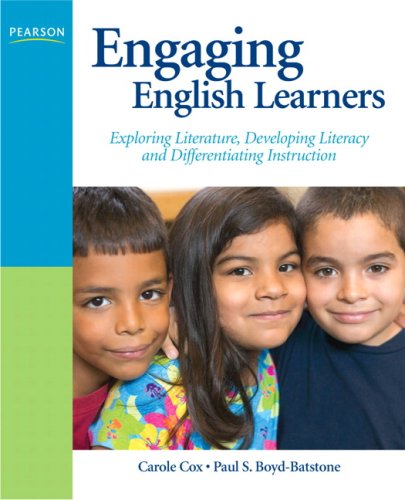
Engaging English Learners: Exploring Literature, Developing...
Authors:
Carole Cox
Publisher:
Pearson
Publication Date:
Not available
ISBN:
0135130883
Written with a captivating voice, Engaging English Learners: Exploring Literature, Developing Literacy and Differentiating Instruction, 1/e presents... teachers with a charming recital of the conversations and advice that are sure to engage every learner in an active role to glean meaning from text. Together, the authors highlight the use of reader-response theory in classrooms and uncover how it can affect literacy learning and second language acquisition. This book is a testament to their philosophical approach, illustrating how student-centered instruction using literature, can differentiate instruction for English learners, engaging them in purposeful reading and writing.
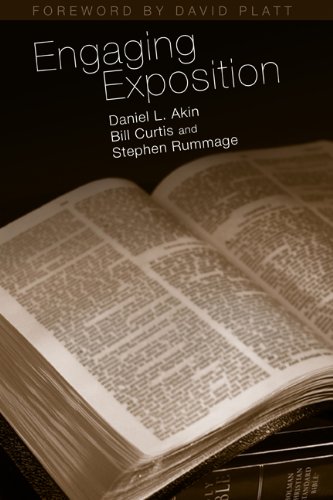
Engaging Exposition
Authors:
Daniel L. Akin
Publisher:
B&H Academic
Publication Date:
Not available
ISBN:
0805446680
In the homiletics field, a text has been needed that blends hermeneutics, sermon development, and sermon delivery. Engaging Exposition fills that gap... with what its experienced authors call a "3-D approach" to preaching.Bill Curtis writes about the Discovery process—how to equip the student to discover the meaning of a biblical text by using sound principles of interpretation, and to move from biblical analysis to biblical interpretation. Danny Akin addresses the Development process—how to equip the student to develop expository sermons based upon results of the interpretive process, and to move from the Main Idea of the Text (MIT) to the completed sermon. Stephen Rummage explains the Delivery process—how to equip students to deliver expository messages using the completed sermon, and to move from an understanding of speech communication principles to persuasive delivery.
Engaging God's World: A Christian Vision of Faith, Learning, and...
Authors:
Cornelius Plantinga
Publisher:
Eerdmans Pub Co
Publication Date:
Not available
ISBN:
0802839819
The Bible admonishes Christians to love God with the mind as well as with the heart. Engaging Gods World clearly links this scriptural mandate with the... pursuit of academic life, extolling the crucial role of Christian higher education in the intellectual and spiritual formation of believers. Chiefly intended to serve as a primer for students beginning college careers but valuable to thoughtful Christians at every stage of life, this volume spells out the central themes of the Christian faith from a Reformed perspective. More important, however, the book shows how Christian higher education fits inside a view of the world and of human life that is formed by these ideas. Learning, Cornelius Plantinga writes, is a spiritual calling; properly done, it attaches us to God. Approaching the topic of education from a variety of angles, Plantinga shows that Christ-centered learning teaches people to correctly see the world as Gods creation, to see providence in history, to handle secular knowledge critically, to develop good judgment and, ultimately, to use faith-filled learning in the service of Gods kingdom.
Engaging God's World (A Reformed Vision of Faith, Learning, and...
Authors:
Cornelius Plantinga Jr.
Publisher:
William B. Eerdmans Publishing
Publication Date:
Not available
ISBN:
0802839827
At the end of his landmark 1994 book, The Soul of the American University, historian George Marsden asserted that religious faith does indeed have a... place in today's academia. Marsden's contention sparked a heated debate on the role of religious faith and intellectual scholarship in academic journals and in the mainstream media. The contributors to Confessing History: Explorations in Christian Faith and the Historian's Vocation expand the discussion about religion's role in education and culture and examine what the relationship between faith and learning means for the academy today.The contributors to Confessing History ask how the vocation of historian affects those who are also followers of Christ. What implications do Christian faith and practice have for living out one's calling as an historian? And to what extent does one's calling as a Christian disciple speak to the nature, quality, or goals of one's work as scholar, teacher, adviser, writer, community member, or social commentator? Written from several different theological and professional points of view, the essays collected in this volume explore the vocation of the historian and its place in both the personal and professional lives of Christian disciples."Confessing History fills a large gap in the literature on Christian and especially evangelical historiography. I know of no other book or anthology of scholarly articles that so carefully analyzes how believing historians should work within the intellectual expectations of the guild. And it does so with pristine prose, impressive erudition, and charity of spirit. After reading Confessing History, I find myself compelled to take the prescriptions and proscriptions of the secular academy less seriously and my identity as a Christian historian more seriously." --Grant Wacker, Duke University"How to reconcile religious commitment with the practices of the guild is one of the really big questions for believing historians. Confessing History is essential reading not only for them, but also for any wishing to understand the important issues at stake. In its pages we witness the concerns, questions, and yearnings of a new generation of believing historiansÑand perhaps even the contours of a new approach to Christian historical scholarship." --Donald Yerxa, Director, The Historical Society "This collection of essays represents serious, sustained, multivalent, and cogent reflection on challenges for Christian historians as experienced by a mostly younger set of scholars. The volume acknowledges foundational work on such subjects carried out by a collection of older evangelical and Reformed scholars--including Ronald Wells, Darryl Hart, and George Marsden--but also moves well beyond these earlier voices, sometimes critiquing what they have written, but also sometimes venturing off into new directions." --Mark Noll, University of Notre Dame
Engaging Grammar: Practical Advice for Real Classrooms
Authors:
Amy Benjamin with Tom Oliva
Publisher:
National Council of Teachers of English
Publication Date:
Not available
ISBN:
0814123384
Does grammar instruction have to elicit moans and groans from students and teachers alike? Only when it's taught the old-fashioned way: as a series of... rules to follow and errors to "fix" that have little or no connection to practical application or real-world writing.Teacher, researcher, and consultant Amy Benjamin challenges the idea of "skill and drill" grammar in this lively, engaging, and immensely practical guide. Her enlightened view of grammar is grounded in linguistics and teaches us how to make informed decisions about teaching grammar--how to move beyond fixing surface errors to teaching how grammar can be used as the building blocks of sentences to create meaning.In addition to Benjamin's sage advice, you'll find the voice of Tom Oliva--an experienced teacher inexperienced in teaching grammar--who writes a teacher's journal chronicling how the concepts in this book can work in a real classroom. The perspectives of Benjamin and Oliva combine to provide a full picture of what grammar instruction can be: an exciting and accessible way to take advantage of students' natural exuberance about language.Although she does not advocate for teaching to the test, Benjamin acknowledges the pressures students face when taking high-stakes tests such as the SAT and ACT. Included is a chapter on how to improve students' editing skills to help prepare them for the short-answer portion of these tests. By using sentence patterns, mapping, visuals, and manipulatives, Benjamin and Oliva present an approach to grammar instruction that is suitable for a variety of student populations.
Engaging Heidegger
Authors:
Richard M Capobianco
Publisher:
University of Toronto Press, Scholarly Publishing Division
Publication Date:
Not available
ISBN:
1442612649
One of the most important philosophers of the twentieth century, Martin Heidegger was primarily concerned with the ‘question of Being.’ However,... recent scholarship has tended to marginalize the importance of the name of Being in his thought. Through a focused reading of Heidegger's texts, and especially his late and often overlooked Four Seminars (1966-1973), Richard Capobianco counters this trend by redirecting attention to the centrality of the name of Being in Heidegger's lifetime of thought.Capobianco gives special attention to Heidegger's resonant terms Ereignis and Lichtung and reads them as saying and showing the very same fundamental phenomenon named ‘Being itself ’. Written in a clear and approachable manner, the essays in Engaging Heidegger examine Heidegger's thought in view of ancient Greek, medieval, and Eastern thinking, and they draw out the deeply humane character of his ‘meditative thinking.’
Engaging Ideas: The Professor's Guide to Integrating Writing,...
Authors:
John C. Bean
Publisher:
Jossey-Bass
Publication Date:
Not available
ISBN:
0470532904
Learn to design interest-provoking writing and critical thinking activities and incorporate them into your courses in a way that encourages inquiry,... exploration, discussion, and debate, with Engaging Ideas, a practical nuts-and-bolts guide for teachers from any discipline. Integrating critical thinking with writing-across-the-curriculum approaches, the book shows how teachers from any discipline can incorporate these activities into their courses. This edition features new material dealing with genre and discourse community theory, quantitative/scientific literacy, blended and online learning, and other current issues.
Engaging in Astronomical Inquiry
Authors:
Stephanie J. Slater
Publisher:
W.H. Freeman & Company
Publication Date:
Not available
ISBN:
1429258608
Are we alone in the Universe? What is our place in it? How did we get here? We have long searched for the answers to questions such as these, and... scientists are beginning to find some of the answers. In this beautifully illustrated book, Daniel Altschuler provides the reader with the elements to understand the questions and their answers as far as we know them. He explores subjects from physics and astronomy, to geology and paleontology. Along the way he touches on topics such as the search for life on other worlds and the hazards of asteroid impacts. Written in an engaging and readable style, readers will be intrigued by the surprising connections among the stars, our planet, and life itself. Daniel Altschuler is Director of the Arecibo Observatory in Arecibo, Puerto Rico, the site of the world's largest single-dish radio telescope.

ENGAGING INQUIRY
Authors:
Not Available
Publisher:
Not available
Publication Date:
Not available
ISBN:
Not available
Engaging in the Language Arts: Exploring the Power of Language (2nd...
Authors:
Donna Ogle
Publisher:
Pearson
Publication Date:
Not available
ISBN:
0132595370
Engaging in the Language Arts: Exploring the Power of Language, written by distinguished authors Donna Ogle and Jim Beers, brings the language arts to... life for teachers through a focus on contemporary communication and visual literacy, coupled with varied genre and electronic resources. The guide unique in that it is all about helping teachers ensure that students learn to use language to communicate with others in our increasingly culturally and linguistically diverse society–and to draw upon a great language resource in their classrooms to do this: the language power of their students themselves.
Engaging in the Language Arts: Exploring the Power of Language Plus...
Authors:
Donna Ogle
Publisher:
Pearson
Publication Date:
Not available
ISBN:
013299531X
Engaging in the Language Arts: Exploring the Power of Language, written by distinguished authors Donna Ogle and Jim Beers, brings the language arts to... life for teachers through a focus on contemporary communication and visual literacy, coupled with varied genre and electronic resources. The guide unique in that it is all about helping teachers ensure that students learn to use language to communicate with others in our increasingly culturally and linguistically diverse society–and to draw upon a great language resource in their classrooms to do this: the language power of their students themselves.
Engaging in the Language Arts: Exploring the Power of Language with...
Authors:
Donna Ogle
Publisher:
Allyn & Bacon
Publication Date:
Not available
ISBN:
0132723638
This package contains the following components: -0132598515: MyEducationLab Pegasus -0132595370: Engaging in the Language Arts: Exploring the Power... of Language
Engaging Learners Through Artmaking: Choice-Based Art Education in...
Authors:
Katherine M. Douglas
Publisher:
Teachers College Press
Publication Date:
Not available
ISBN:
0807749761
This dynamic resource details the philosophy, rationale, and implementation of choice-based authentic art education in elementary and middle schools. To... do the work of artists, children need opportunities to behave, think, and perform as artists. The heart of this curriculum is to facilitate independent learning in studio centers designed to support student choices in subject matter and media. The authors address theory, instruction, assessment, and advocacy in a user-friendly format that includes color photos of classroom set-ups and student work, sample demonstrations, and reflections on activities. Book Features: Introduces artistic behaviors that sustain engagement, such as problem finding, innovation, play, representation, collaboration, and more. Provides instructional modes for differentiation, including whole group, small group, individual, and peer coaching. Offers management strategies for choice-based learning environments, structuring time, design of studio centers, and exhibition. Illustrates shifts in control from teacher-directed to learner-directed. Highlights artist statements by children identifying personal relevancy, discovery learning, and reflection.
 '





