production
/viewbook/list/all/?page=4003
/
/static/
None

Engineering Administration
Authors:
Not Available
Publisher:
Not available
Publication Date:
Not available
ISBN:
1121278299

Engineering (Alfred State College Custom) ((Math 7113 Economic...
Authors:
Not Available
Publisher:
Pearson Custom Publishing
Publication Date:
Not available
ISBN:
0558619592
“Powerful . . . A combustible mixture of science and mysticism, a high-altitudethriller fizzing with intrigue.” –JOHN CASE, Author of The Eighth... DayIn a breathless thriller that explores the relationship between science and the divine, good and evil, space and time, Jane Jensen takes us from the world we know into a reality we could only scarcely imagine. Until now.Rabbi Aharon Handalman’s expertise with Torah code–rearranging words and letters in the Bible–has uncovered a man’s name. Who is Yosef Kobinski, and why did God hide his name in His sacred text? To find the answers, Aharon begins an investigation, and discovers that Kobinski, a Polish rabbi, was not only a mystic but also a brilliant physicist who authored what may be the most important lost work in human history.In Seattle, Jill Talcott’s work with energy wave equations is being linked to Yosef Kobinski, now deceased, who claimed nearly fifty years ago that he discovered an actual physical law of good and evil. But when Jill’s lab explodes, she is forced to flee for her life, realizing that her cutting-edge research is far more dangerous than she ever has imagined. And that powerful people have a stake in what she may have uncovered.Now Jill, her research partner, and a writer fascinated by Kobinski are about to meet Handalman in Poland–all four desperate to solve the astonishing riddle. Searching through the past, they trace Kobinski to a clearing in the woods near Auschwitz. And in that clearing they come face-to-face with the inexplicable: that Kobinski, drawing on his own alchemy of science and the Kabbalah, made himself vanish from the death camp in a blaze of fire. Now, with intelligence agents hot on their trail, the investigators have no choice. They must follow Kobinski –to wherever he may have gone. . . .From the Trade Paperback edition.
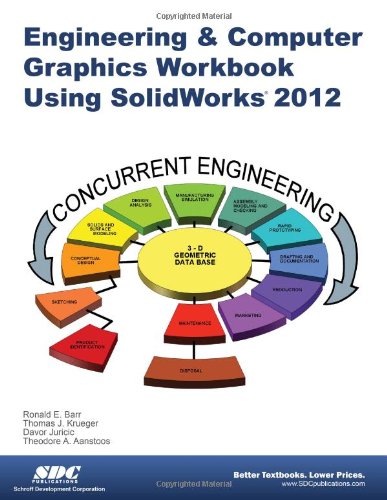
Engineering & Computer Graphics Workbook Using SolidWorks 2012
Authors:
Theodore A. Aanstoos
Publisher:
SDC Publications
Publication Date:
Not available
ISBN:
1585037036
Engineering & Computer Graphics Workbook Using SolidWorks 2012 is an exercise-based workbook that uses step-by-step tutorials to cover the... fundamentals of SolidWorks 2012. The intended audience is college undergraduate engineering majors, but it could also be used in pre-college introductory engineering courses or by self learners. The text follows an educational paradigm that was researched and developed by the authors over many years. The paradigm is based on the concurrent engineering approach to engineering design in which the 3-D solid model data serves as the central hub for all aspects of the design process. The workbook systematically instructs the students to develop 3-D models using the rich tools afforded in SolidWorks. The exercises then proceed to instruct the students on applications of the solid model to design analysis using finite elements, to assembly modeling and checking, to kinematic simulation, to rapid prototyping, and finally to projecting an engineering drawing. The workbook is ideally suited for courses in which a reverse engineering design project is assigned. This book contains clear and easy to understand instructions that enable the students to robustly learn the main features of SolidWorks, with little or no instructor input. Table of Contents Computer Graphics Labs: 1. 2-D Computer Sketching I 2. 2-D Computer Sketching II 3. 3-D Solid Modeling of Parts I 4. 3-D Solid Modeling of Parts II 5. Assembly Modeling and Mating 6. Analysis and Design Modification I 7. Analysis and Design Modification II 8. Kinematics Animation and Rapid Prototyping 9. Section Views in 3-D and 2-D 10. Generating and Dimensioning Three-View Drawings Appendix A: Example of a TitleBlock with Dimensions
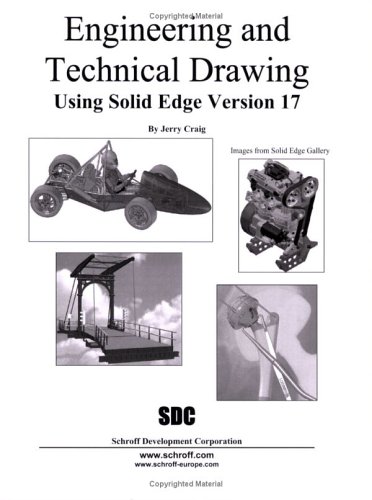
Engineering & Technical Drawing Using Solid Edge 17
Authors:
Jerry W. Craig
Publisher:
Schroff Development Corporation
Publication Date:
Not available
ISBN:
1585032530
Table of Contents 1. Introduction 2. 2D Drawing 3. Geometry 4. Normal Surfaces 5. Inclined Surfaces 6. Oblique Surfaces 7. Curved Surfaces ... 8. Thin Surfaces 9. Assembly Drawings 10. Detail Drawings 11. Sheet Metal Appendix A - Parametric Design Appendix B - Mechanisms Appendix C - Bent Tubing Design Appendix D - 2D to 3D Index
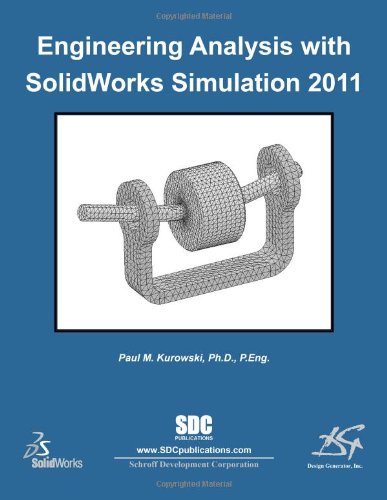
Engineering Analysis with SolidWorks Simulation 2011
Authors:
Paul Kurowski
Publisher:
SDC Publications
Publication Date:
Not available
ISBN:
1585036323
Engineering Analysis with SolidWorks Simulation 2011 goes beyond the standard software manual because its unique approach concurrently introduces... you to the SolidWorks Simulation 2011 software and the fundamentals of Finite Element Analysis (FEA) through hands-on exercises. A number of projects are presented using commonly used parts to illustrate the analysis features of SolidWorks Simulation. Each chapter is designed to build on the skills, experiences and understanding gained from the previous chapters. The following FEA functionality of SolidWorks Simulation 2011 is covered: Linear static analysis of parts and assemblies Contact stress analysis Frequency (modal) analysis Buckling analysis Thermal analysis Drop test analysis Nonlinear analysis Dynamic analysis h and p adaptive solution methods Table of Contents 1. Introduction 2. Static analysis of a plate 3. Static analysis of an L-bracket 4. Stress and frequency analysis of a pipe support 5. Static analysis of a link 6. Frequency analysis of a tuning fork and a plastic part 7. Thermal analysis of a pipeline component and heater 8. Thermal analysis of a heat sink 9. Static analysis of a hanger 10. Analysis of contact stress between two plates 11. Thermal stress analysis of a bi-metal beam 12. Buckling analysis of an L-beam 13. Static analysis of a bracket using adaptive solution methods 14. Drop test of a porcelain ring 15. Selected nonlinear problems 16. Mixed meshing problem 17. Analysis of a weldment using beam elements 18. Vibration Analysis - Modal Time History and Harmonic 19. Analysis of random vibration 20. Miscellaneous topics 21. Implementation of FEA into the design process 22. Glossary of terms 23. Resources available to FEA Users
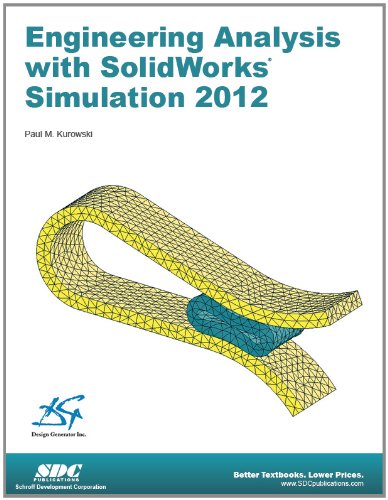
Engineering Analysis with SolidWorks Simulation 2012
Authors:
Paul Kurowski
Publisher:
SDC Publications
Publication Date:
Not available
ISBN:
1585037109
Engineering Analysis with SolidWorks Simulation 2012 goes beyond the standard software manual. Its unique approach concurrently introduces you to the... SolidWorks Simulation 2012 software and the fundamentals of Finite Element Analysis (FEA) through hands-on exercises. A number of projects are presented using commonly used parts to illustrate the analysis features of SolidWorks Simulation. Each chapter is designed to build on the skills, experiences and understanding gained from the previous chapters. Topics covered: Linear static analysis of parts and assemblies Contact stress analysis Frequency (modal) analysis Buckling analysis Thermal analysis Drop test analysis Nonlinear analysis Dynamic analysis Random vibration analysis h and p adaptive solution methods Modeling techniques Implementation of FEA in the design process Management of FEA projects FEA terminology Table of Contents 1. Introduction 2. Static analysis of a plate 3. Static analysis of an L-bracket 4. Stress and frequency analysis of a pipe support 5. Static analysis of a link 6. Frequency analysis of a tuning fork and a plastic part 7. Thermal analysis of a pipeline connector and heater 8. Thermal analysis of a heat sink 9. Static analysis of a hanger 10. Analysis of contact stress 11. Thermal stress analysis of a bi-metal loop 12. Buckling analysis of an I-beam 13. Static analysis of a bracket using adaptive solution methods 14. Drop test 15. Selected nonlinear problems 16. Mixed meshing problem 17. Analysis of a weldment using beam elements 18. Review of 2D problems 19. Vibration Analysis - Modal Time History and Harmonic 20. Analysis of random vibration 21. Miscellaneous topics 22. Implementation of FEA into the design process 23. Glossary of terms 24. Resources available to FEA Users 25. List of exercises

Engineering and Chemical Thermodynamics
Authors:
Milo D. Koretsky
Publisher:
Wiley
Publication Date:
Not available
ISBN:
0471385867
Designed to support the way you learnWhether you learn best by applying knowledge, assimilating information through visuals, working equations, or... reading explanations of concepts, Milo Koretsky’s Engineering and Chemical Thermodynamics provides the support you need to develop a deeper and more complete understanding of thermodynamics and its application to real-world problems.HighlightsAn integrated presentation of molecular concepts with thermodynamic principles provides greater access to the material than mathematical derivations alone.Learning objectives and chapter summaries are organized from the most significant concepts down.Schematic presentations of key concepts help visual learners.End-of-chapter problems promote real synthesis and conceptual understanding.Questions about key points and examples provide opportunities for reflection.Coverage of equilibrium in the solid phase brings you up-to-speed on this increasingly important topic.ThermoSolver software—solve complex problems quickly and easily!Improve tour ability to solve problems and understand key concepts with ThermoSolver software! This easy-to-use, menu-driven software enables you to perform more complex calculations, so you can explore a wide range of problems. ThermoSolver software is integrated with equations from the text, allowing you to make connections between thermodynamic concepts and the software output. ThermoSolver is FREE for download from the Student Companion Site at www.wiley.com/college/koretsky.
Engineering and Construction Law & Contracts
Authors:
Janet K. Yates
Publisher:
Prentice Hall
Publication Date:
Not available
ISBN:
0135033527
ENGINEERING AND CONSTRUCTION LAW & CONTRACTS, 1/e is a comprehensive and up-to-date guide to engineering and construction law and contracts,... written from the perspective of practicing engineers and construction professionals. Dr. J. K. Yates covers key issues through examples and case studies, minimizing the use of legal terminology, and explaining all essential legal terms in the common vernacular. This text’s broad coverage encompasses these and many other topics: labor, environmental, and sustainability law; professional ethics; tort law; agency relationships; real property law; firm ownership; contracts, including terms and conditions; government contracting; change orders; dispute resolution; risk management and construction insurance; and international legal issues, including arbitration.

Engineering and Scientific Computations Using MATLAB
Authors:
Sergey E. Lyshevski
Publisher:
Wiley-Interscience
Publication Date:
Not available
ISBN:
0471462004
Master MATLAB(r) step-by-stepThe MATLAB-- "MATrix LABoratory"--computational environment offers a rich set of capabilities to efficiently solve a... variety of complex analysis, simulation, and optimization problems. Flexible, powerful, and relatively easy to use, the MATLAB environment has become a standard cost-effective tool within the engineering, science, and technology communities. Excellent as a self-teaching guide for professionals as well as a textbook for students, Engineering and Scientific Computations Using MATLAB helps you fully understand the MATLAB environment, build your skills, and apply its features to a wide range of applications.Going beyond traditional MATLAB user manuals and college texts, Engineering and Scientific Computations Using MATLAB guides you through the most important aspects and basics of MATLAB programming and problem-solving from fundamentals to practice. Augmenting its discussion with a wealth of practical worked-out examples and qualitative illustrations, this book demonstrates MATLAB's capabilities and offers step-by-step instructions on how to apply the theory to a practical real-world problem. In particular, the book features:* Coverage of a variety of complex physical and engineering systems described by nonlinear differential equations* Detailed application of MATLAB to electromechanical systemsMATLAB files, scripts, and statements, as well as SIMULINK models which can be easily modified for application-specific problems encountered in practice Readable, user-friendly, and comprehensive in scope this is a welcome introduction to MATLAB for those new to the program and an ideal companion for engineers seeking in-depth mastery of the high-performance MATLAB environment.
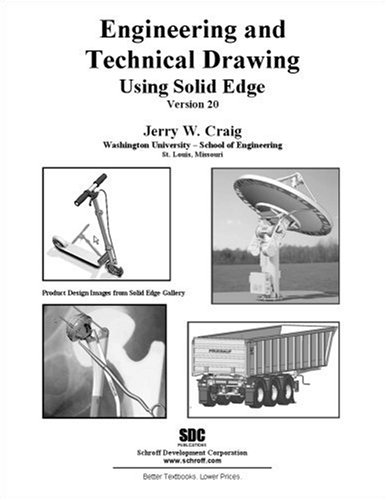
Engineering and Technical Drawing Using SolidEdge Version 20
Authors:
Jerry Craig
Publisher:
Schroff Development Corporation
Publication Date:
Not available
ISBN:
1585034843
Table of Contents 1. Introduction 2. 2D Drawing 3. Geometry 4. Normal Surface Modeling 5. Inclined Surface Modeling 6. Oblique Surface... Modeling 7. Curved Surface Modeling 8. Thin Surface Modeling 9. Assembly Modeling and Drawings 10. Detail Production Drawings 11. Sheet Metal Modeling and Flat Patterns 12. Standard Parts Realistic Rendering Parametric Design Bent Tubing and Wire Routing 2D Views to 3D Model Finite Element Analysis PMI - Part Manufacturing Information
Engineering and Technology Management Tools and Applications
Authors:
B.S. Dhillon
Publisher:
Artech House Publishers
Publication Date:
Not available
ISBN:
1580532659
This text aims to provide engineers with an understanding of contemporary management concepts and their applications in a technical organization. It... covers: product selection and management; engineering design and product costing; concurrent engineering; value management; configuration management; risk management; re-engineering strategies and benefits; managing creativity and innovation; information technology management; and software management. There are a large number of solved examples highlighted throughout the text. This book is intended for use by: professional engineers; technology managers; senior-level undergraduate and graduate students; and instructors of engineering / technology management.
Engineering and Technology (Texas Science)
Authors:
Michael Hacker
Publisher:
Delmar Cengage Learning
Publication Date:
Not available
ISBN:
141807389X
Driven by the Standards for Technological Literacy, this National Science Foundation-sponsored book is written by national leaders in engineering and... technology education and addresses the most contemporary technological content using engaging, pedagogically sound "informed design" activities. This unique approach encourages students to develop a thorough understanding of engineering and technology before they ever attempt to develop detailed design solutions. The activities present students with a design problem, and prompt students to begin the solution-finding process with research, inquiry, and analysis. Only after this important step can students begin to discuss specifications and constraints, propose alternatives, and select an optimal design. This process fosters a strong student-teacher discourse and cultivates language proficiency, both with the end result of enhancing student's overall knowledge. Testing, evaluation, and modifications are addressed next, followed by a communication of achievements in a class presentation and final design report. Woven throughout the text are passages that will acquaint students with the requirements, responsibilities, necessary personal attributes and attitudes, and educational pathways that will lead to success in the various technological areas.
Engineering and the Mind's Eye
Authors:
Eugene S. Ferguson
Publisher:
The MIT Press
Publication Date:
Not available
ISBN:
026256078X
The things that engineers design are everywhere, and the influence that engineers have on daily life is far out of proportion to their numbers. In this... expanded version of a remarkable essay published in Science more than a decade ago, Eugene Ferguson takes a probing look at the process of engineering design, arguing that despite modern technical advances, good engineering is still as much a matter of intuition and nonverbal thinking as of equations and computation.Ferguson, who has been successively a mechanical engineer, a technical museum curator, and a teacher of the history of technology, uses examples ranging from the development of the American axe to the collapse of the Hartford Coliseum and the performance of the Hubble space telescope to illustrate the ways in which visual thinking enriches engineering and the ways in which engineering that relies solely on technical sophistication can go wrong. He argues that a system of engineering education that ignores this heritage of nonverbal thinking will produce engineers who are dangerously ignorant of the many ways in which the real world differs from the mathematical models constructed in academic minds.In Engineering and the Mind's Eye, Ferguson discusses the nature of engineering design and traces the development of visual and other nonverbal thinking, offering examples of how engineers and other technologists have used such strategies since the Renaissance. Accompanying these examples, and demonstrating the ways in which engineers have shared their knowledge, is a parallel text of illustrations showing how visual thinking has been expressed over the past five centuries. Ferguson concludes his provocative account by arguing that engineering education since 1945 has been skewed toward analytical techniques - which are easiest to teach and evaluate - and away from the art of engineering design as taught by experienced engineers.Eugene Ferguson is Professor of History Emeritus at the University of Delaware.
ENGINEERING AN EMPIRE 6-DISC DVD SET
Authors:
Not Available
Publisher:
Not available
Publication Date:
Not available
ISBN:
Not available

Engineering--An Endless Frontier
Authors:
Sunny Y. Auyang
Publisher:
Harvard University Press
Publication Date:
Not available
ISBN:
0674019784
Genetic engineering, nanotechnology, astrophysics, particle physics: We live in an engineered world, one where the distinctions between science and... engineering, technology and research, are fast disappearing. This book shows how, at the dawn of the twenty-first century, the goals of natural scientists--to discover what was not known--and that of engineers--to create what did not exist--are undergoing an unprecedented convergence. Sunny Y. Auyang ranges widely in demonstrating that engineering today is not only a collaborator with science but its equal. In concise accounts of the emergence of industrial laboratories and chemical and electrical engineering, and in whirlwind histories of the machine tools and automobile industries and the rise of nuclear energy and information technology, her book presents a broad picture of modern engineering: its history, structure, technological achievements, and social responsibilities; its relation to natural science, business administration, and public policies. Auyang uses case studies such as the development of the F-117A Nighthawk and Boeing 777 aircraft, as well as the experiences of engineer-scientists such as Oliver Heaviside, engineer-entrepreneurs such as Henry Ford and Bill Gates, and engineer-managers such as Alfred Sloan and Jack Welch to give readers a clear sense of engineering's essential role in the future of scientific research.
 '





