production
/viewbook/list/all/?page=4007
/
/static/
None
Engineering Design Graphics with Solidworks 2011
Authors:
James Bethune
Publisher:
Prentice Hall
Publication Date:
Not available
ISBN:
0132740508
Engineering Design and Graphics with SolidWorks 2011 shows students how to use SolidWorks to create engineering drawings and designs. The book... focuses on the creation of engineering drawings, including dimensions and tolerances and the use of standard parts and tools. Each chapter contains step-by-step sample problems that show students how to apply the concepts presented in the chapter.

ENGINEERING DESIGN HNDBK PT.1 A700200
Authors:
Not Available
Publisher:
Not available
Publication Date:
Not available
ISBN:
Not available
Engineering Design Methods: Strategies for Product Design
Authors:
Nigel Cross
Publisher:
Wiley
Publication Date:
Not available
ISBN:
0470519266
Written in a clear and readable style by an experienced author of teaching texts, Engineering Design Methods is an integrated design textbook that... presents specific methods within an overall strategy from concept to detail design. It also outlines the nature of design thinking, and sets it within broader contexts of product development and design process management. The book is much more than a manual of procedures; throughout, there is discussion and explication of the principles and practice of design.Building on the outstanding success of the previous three editions, this new edition cements the position of Engineering Design Methods at the forefront of engineering and industrial design as an essential text not only for students and lecturers but also for practitioners. The book promotes a flexible approach to the design process, and provides explicit, step-by-step advice on how to implement several separate design methods that have been shown to be of value in both education and practice.This revised fourth edition -promotes a flexible approach to the design process,provides explicit, step-by-step advice on how to implement several separate design methods that have been shown to be of value in both education and practice,contains new case studies and examples from industry that further broaden the scope of the book from engineering design into product design,includes a significant new chapter presenting user scenarios; a procedure for investigating potential product user wants and needs, that culminates in a design brief identifying an opportunity for developing a new product concept,features a book companion website with powerpoint slides for instructors.Reviewers’ comments:“Engineering Design Methods… is a valuable contribution to the engineering design literature. The engineering design methods presented are those that are of practical significance and the book is a must for anyone wishing to raise the standard of their design work. The design methods are described clearly and succinctly, examples are used to illustrate principles and design strategies are presented that show how the methods are best employed”. Professor Graham Thompson, Department of Mechanical Engineering, UMIST, UK“Professor Nigel Cross’ treatment of Engineering Design is a singularly successful treatment for my courses because it is short and concise enough to be read by virtually all students. Furthermore, his interpretations are open enough to allow the inquiring mind to fill out the picture, incorporating and extending the ideas to fit the reflective designer’s own needs.” Professor Larry Leifer, Stanford Center for Design Reseach, Stanford University, USA“This book is an excellent book as a textbook for design methodology both for undergraduate and graduate level… Students will gain a firm foundation of design methods from problem definition to design evaluations from this book”. Professor Kun-Pyo Lee, Department of Industrial Design, Korea Institute of Science and Technology, Korea
Engineering Design Process
Authors:
Yousef Haik
Publisher:
CL Engineering
Publication Date:
Not available
ISBN:
0495668141
This book is dedicated to the essential components of the design process and uses case studies, labs, and group projects to show their application. With... explicit guidance, students learn that the design process is a set of procedures that will help them solve engineering problems. Yousef Haik and Tamer Shahin illustrate the critical steps of the design process, including articulating the problem, market analysis, function analysis, developing concepts, evaluating alternatives, and marketing, while facilitating hands-on learning and teamwork opportunities through labs and class-tested design problems.
Engineering Design with Polymers and Composites (Materials...
Authors:
James C. Gerdeen PhD PE
Publisher:
CRC Press
Publication Date:
Not available
ISBN:
0824723791
There are many books available on polymer chemistry, properties, and processing, but they do not focus on the practicalities of selecting and using them... correctly in the design of structures. Engineering students require an understanding of polymers and composites as well as viscoelasticity, adhesion, damping applications, and tribology in order to successfully integrate these materials into their designs. Based on more than twenty years of classroom experience, Engineering Design with Polymers and Composites is the first textbook to unite these topics in a single source.The authors take a bottom-up functional approach rather than a top-down analytical approach to design. This unique perspective enables students to select the proper materials for the application rather than force the design to suit the materials. The text begins with an introduction to polymers and composites, including historical background. Detailed coverage of mechanical properties, viscoelastic behavior of polymers, composite materials, creep and fatigue failure, impact, and related properties follows. Discussion then turns to selection of materials, design applications of polymers, polymer processing, adhesion, tribology, and damping and isolation. Abundant examples, homework problems, tables, and illustrations reinforce the concepts.Accompanied by a CD-ROM containing materials databases, examples in Excel®, and a laminate analysis program, Engineering Design with Polymers and Composites builds a strong background in the underlying concepts necessary for engineering students to successfully incorporate polymers and composites into their designs.
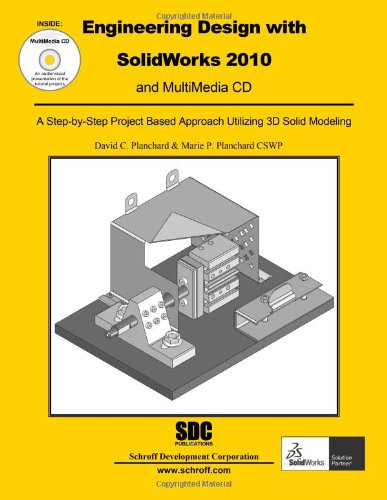
Engineering Design with SolidWorks 2010 and Multimedia CD
Authors:
David C. Planchard
Publisher:
Schroff Development Corporation
Publication Date:
Not available
ISBN:
1585035726
Engineering Design with SolidWorks 2010 & Multi-media CD is written to assist students, designers, engineers and professionals. The book provides a... solid foundation in SolidWorks by utilizing projects with Step-by-Step instructions for the beginning to intermediate SolidWorks user. Explore the user interface, CommandManager, menus, toolbars and modeling techniques to create parts, assemblies and drawings in an engineering environment. Follow the Step-by-Step instructions and develop multiple parts and assemblies that combine machined, plastic and sheet metal components. Formulate the skills to create, modify and edit sketches and solid features. Learn the techniques to reuse features, parts, and assemblies through symmetry, patterns, copied components, Design tables, Bills of Materials, Properties and Configurations. Address various SolidWorks analysis tools: SimulatinoXpress, SustainabilityXpress and DFMXpress. Learn by doing, not just by reading! Desired outcomes and usage competencies are listed for each project. Know your objective up front. Follow the steps in Project 1 through Project 7 to achieve the design goals. Work between multiple documents, features, commands and custom properties that represent how engineers and designers utilize SolidWorks in industry. Review individual features, commands and tools for each project with the enclosed Multi-media CD. Each project contains exercises. The exercises analyze and examine usage competencies. Collaborate with leading industry suppliers such as SMC Corporation of America, Boston Gear and 80/20 Inc. Collaborative information translates into numerous formats such as paper drawings, electronic files, rendered images and animations. On-line intelligent catalogs guide designers to the product that meets both their geometric requirements and performance functionality. The authors developed the industry scenarios by combining their own industry experience with the knowledge of engineers, department managers, vendors and manufacturers. These professionals are directly involved with SolidWorks everyday. This book is designed to compliment the SolidWorks Tutorials contained in SolidWorks 2010. Separate editions of this textbook are available for SolidWorks 99, 2000, 2001, 2001Plus, 2003, 2004, 2005, 2006, 2007, 2008, and 2009. Table of Contents Introduction 1. Fundamentals of Part Modeling 2. Fundamentals of Assembly Modeling 3. Fundamentals of Drawing 4. Extrude and Revolve Features 5. Swept, Lofted and Additional Features 6. Top Down Assembly Modeling and Sheet Metal 7. SolidWorks SimulationXpress, Sustainability and DFMXpress Appendix Index
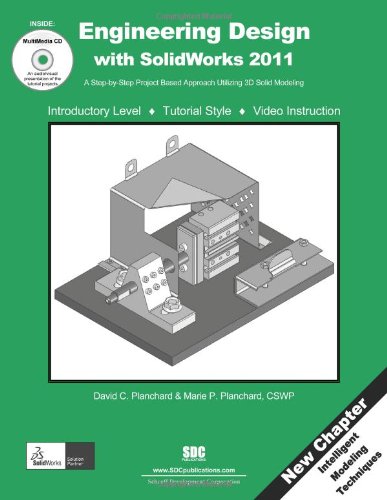
Engineering Design with SolidWorks 2011 and Multimedia CD
Authors:
David C. Planchard
Publisher:
SDC Publications
Publication Date:
Not available
ISBN:
1585036234
Engineering Design with SolidWorks 2011 is written to assist students, designers, engineers and professionals. The book provides a solid foundation... in SolidWorks by utilizing projects with step-by-step instructions for the beginning to intermediate SolidWorks user. Explore the user interface, CommandManager, menus, toolbars and modeling techniques to create parts, assemblies and drawings in an engineering environment. Follow the step-by-step instructions and develop multiple parts and assemblies that combine machined, plastic and sheet metal components. Formulate the skills to create, modify and edit sketches and solid features. Learn the techniques to reuse features, parts and assemblies through symmetry, patterns, copied components, design tables, Bills of Materials, Custom Properties and Configurations. Address various SolidWorks analysis tools: SimulationXpress, Sustainability / SustainabilityXpress and DFMXpress and Intelligent Modeling techniques. Learn by doing, not just by reading! Desired outcomes and usage competencies are listed for each project. Know your objective up front. Follow the steps in Project 1 - 8 to achieve the design goals. Work between multiple documents, features, commands and custom properties that represent how engineers and designers utilize SolidWorks in industry. Review individual features, commands and tools with the enclosed Multi-media CD. The projects contain exercises. The exercises analyze and examine usage competencies. Collaborate with leading industry suppliers such as SMC Corporation of America, Boston Gear and 80/20 Inc. Collaborative information translates into numerous formats such as paper drawings, electronic files, rendered images and animations. On-line intelligent catalogs guide designers to the product that meets both their geometric requirements and performance functionality. The authors developed the industry scenarios by combining their own industry experience with the knowledge of engineers, department managers, vendors and manufacturers. These professionals are directly involved with SolidWorks everyday. Their responsibilities go far beyond the creation of just a 3D model. The book is designed to compliment the SolidWorks Tutorials contained in SolidWorks 2011. Introduction 1. Fundamentals of Part Modeling 2. Fundamentals of Assembly Modeling 3. Fundamentals of Drawing 4. Extrude and Revolve Features 5. Swept, Lofted and Additional Features 6. Top Down Assembly Modeling and Sheet Metal 7. SimulationXpress, Sustainability and DFMXpress 8. Intelligent Modeling Techniques Appendix Index
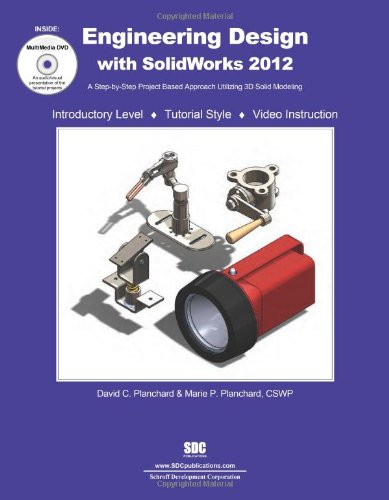
Engineering Design with SolidWorks 2012
Authors:
David Planchard
Publisher:
SDC Publications
Publication Date:
Not available
ISBN:
1585036978
Engineering Design with SolidWorks 2012 is written to assist students, designers, engineers and professionals. The book provides a solid foundation in... SolidWorks by utilizing projects with step-by-step instructions for the beginning to intermediate SolidWorks user. Explore the user interface, CommandManager, menus, toolbars and modeling techniques to create parts, assemblies and drawings in an engineering environment. Follow the step-by-step instructions and develop multiple parts and assemblies that combine machined, plastic and sheet metal components. Formulate the skills to create, modify and edit sketches and solid features. Learn the techniques to reuse features, parts and assemblies through symmetry, patterns, copied components, design tables, Bills of Materials, Custom Properties and Configurations. Address various SolidWorks analysis tools: SimulationXpress, Sustainability / SustainabilityXpress and DFMXpress and Intelligent Modeling techniques. Learn by doing, not just by reading! Desired outcomes and usage competencies are listed for each project. Know your objective up front. Follow the steps in Projects 1 - 8 to achieve the design goals. Work between multiple documents, features, commands and custom properties that represent how engineers and designers utilize SolidWorks in industry. Review individual features, commands and tools with the enclosed multimedia DVD. The projects contain exercises. The exercises analyze and examine usage competencies. Collaborate with leading industry suppliers such as SMC Corporation of America, Boston Gear and 80/20 Inc. Collaborative information translates into numerous formats such as paper drawings, electronic files, rendered images and animations. On-line intelligent catalogs guide designers to the product that meets both their geometric requirements and performance functionality. The authors developed the industry scenarios by combining their own industry experience with the knowledge of engineers, department managers, vendors and manufacturers. These professionals are directly involved with SolidWorks everyday. Their responsibilities go far beyond the creation of just a 3D model. The book is designed to compliment the SolidWorks Tutorials contained in SolidWorks 2012. Table of Contents Introduction 1. Fundamentals of Part Modeling 2. Fundamentals of Assembly Modeling 3. Fundamentals of Drawing 4. Extrude and Revolve Features 5. Swept, Lofted and Additional Features 6. Top Down Assembly Modeling and Sheet Metal 7. SimulationXpress, Sustainability and DFMXpress 8. Intelligent Modeling Techniques Appendix Index
Engineering Differential Equations: Theory and Applications
Authors:
Bill Goodwine
Publisher:
Springer
Publication Date:
Not available
ISBN:
1441979182
This book is a comprehensive treatment of engineering undergraduate differential equations as well as linear vibrations and feedback control. While this... material has traditionally been separated into different courses in undergraduate engineering curricula. This text provides a streamlined and efficient treatment of material normally covered in three courses. Ultimately, engineering students study mathematics in order to be able to solve problems within the engineering realm. Engineering Differential Equations: Theory and Applications guides students to approach the mathematical theory with much greater interest and enthusiasm by teaching the theory together with applications. Additionally, it includes an abundance of detailed examples. Appendices include numerous C and FORTRAN example programs. This book is intended for engineering undergraduate students, particularly aerospace and mechanical engineers and students in other disciplines concerned with mechanical systems analysis and control. Prerequisites include basic and advanced calculus with an introduction to linear algebra.
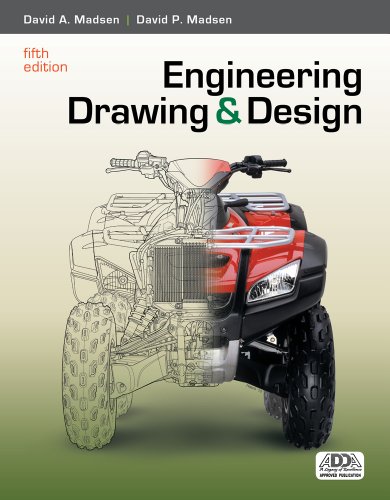
Engineering Drawing and Design
Authors:
David A. Madsen
Publisher:
Delmar Cengage Learning
Publication Date:
Not available
ISBN:
1111309574
ENGINEERING DRAWING AND DESIGN, 5E provides readers with an easy-to-read, A-to-Z coverage of drafting and design instruction that complies with the... latest ANSI & ASME standards. This fifth edition continues its twenty year tradition of excellence with a multitude of actual quality industry drawings that demonstrate content and provide problems for real world, practical application. The engineering design process featured in ENGINEERING DRAWING AND DESIGN, 5E follows an actual product design from concept through manufacturing, and provides readers with a variety of design problems for challenging applications or for use as team projects. Also included in this book is coverage of Civil Drafting, 3D CADD, solid modeling, parametric applications, and more.
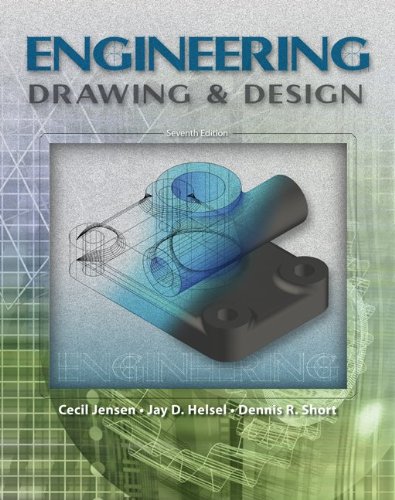
Engineering Drawing And Design
Authors:
Cecil Jensen
Publisher:
McGraw-Hill Science/Engineering/Math
Publication Date:
Not available
ISBN:
0073521515
Engineering Drawing and Design, combines engineering graphics and drafting in one accessible product. Technical drafting, like all technical areas, is... constantly changing; the computer has revolutionized the way in which drawings and parts are made. This 4-color text covers the most current technical information available, including graphic communication, CAD, functional drafting, material positioning, numerical control, electronic drafting, and metrication, in a manner useful to both the instructor and student. The authors synthesize, simplify, and convert complex drafting standards and procedures into understandable instructional units.
Engineering Drawing for Manufacture (Manufacturing Engineering...
Authors:
Brian Griffiths
Publisher:
Butterworth-Heinemann
Publication Date:
Not available
ISBN:
185718033X
The processes of manufacture and assembly are based on the communication of engineering information via drawing. These drawings follow rules laid down... in national and international standards. The organisation responsible for the international rules is the International Standards Organisation (ISO). There are hundreds of ISO standards on engineering drawing because drawing is very complicated and accurate transfer of information must be guaranteed. The information contained in an engineering drawing is a legal specification, which contractor and sub-contractor agree to in a binding contract. The ISO standards are designed to be independent of any one language and thus much symbology is used to overcome any reliance on any language. Companies can only operate efficiently if they can guarantee the correct transmission of engineering design information for manufacturing and assembly.This book is a short introduction to the subject of engineering drawing for manufacture. It should be noted that standards are updated on a 5-year rolling programme and therefore students of engineering drawing need to be aware of the latest standards. This book is unique in that it introduces the subject of engineering drawing in the context of standards.
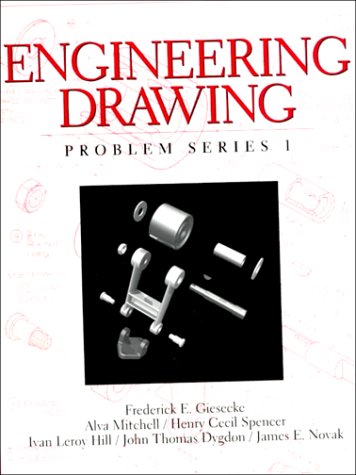
Engineering Drawing: Problems Series 1
Authors:
Frederick E. Giesecke
Publisher:
Prentice Hall
Publication Date:
Not available
ISBN:
0136585361
The first set of worksheets to accompany the Giesecke series. This book will feature "traditional" problems, emphasize hand drawing, and not contain... descriptive geometry.
Engineering Drawing Problems Workbook (Series 4) for Technical...
Authors:
Frederick E. Giesecke
Publisher:
Prentice Hall
Publication Date:
Not available
ISBN:
0135024773

Engineering Dynamics
Authors:
Jerry Ginsberg
Publisher:
Cambridge University Press
Publication Date:
Not available
ISBN:
0521883032
This text is a modern vector oriented treatment of classical dynamics and its application to engineering problems. Based on Ginsberg's Advanced... Engineering Dynamics Second Edition, it develops a broad spectrum of kinematical concepts, which provide the framework for formulations of kinetics principles following the Newton-Euler and analytical approaches. This fresh treatment features many expanded and new derivations, with an emphasis on both breadth and depth and a focus on making the subject accessible to individuals from a broad range of backgrounds.
 '





