production
/viewbook/list/all/?page=405
/
/static/
None

After Babel: Aspects of Language and Translation
Authors:
George Steiner
Publisher:
Oxford University Press, USA
Publication Date:
Not available
ISBN:
0192880934
When it first appeared in 1975, After Babel created a sensation, quickly establishing itself as both a controversial and seminal study of literary... theory. In the original edition, Steiner provided readers with the first systematic investigation since the eighteenth century of the phenomenology and processes of translation both inside and between languages. Taking issue with the principal emphasis of modern linguistics, he finds the root of the "Babel problem" in our deep instinct for privacy and territory, noting that every people has in its language a unique body of shared secrecy. With this provocative thesis he analyzes every aspect of translation from fundamental conditions of interpretation to the most intricate of linguistic constructions. For the long-awaited second edition, Steiner entirely revised the text, added new and expanded notes, and wrote a new preface setting the work in the present context of hermeneutics, poetics, and translation studies. This new edition brings the bibliography up to the present with substantially updated references, including much Russian and Eastern European material. Like the towering figures of Derrida, Lacan, and Foucault, Steiner's work is central to current literary thought. After Babel, Third Edition is essential reading for anyone hoping to understand the debates raging in the academy today.
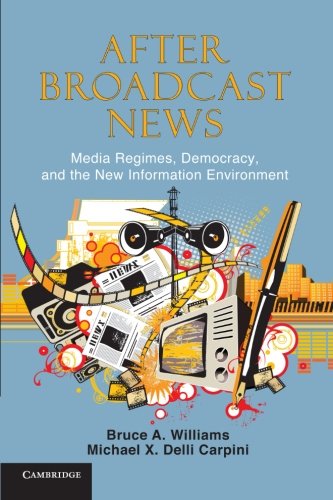
After Broadcast News: Media Regimes, Democracy, and the New...
Authors:
Bruce A. Williams
Publisher:
Cambridge University Press
Publication Date:
Not available
ISBN:
0521279836
The new media environment has challenged the role of professional journalists as the primary source of politically relevant information. After Broadcast... News puts this challenge into historical context, arguing that it is the latest of several critical moments, driven by economic, political, cultural, and technological changes, in which the relationship among citizens, political elites, and the media has been contested. Out of these past moments, distinct "media regimes" eventually emerged, each with its own seemingly natural rules and norms, and each the result of political struggle with clear winners and losers. The media regime in place for the latter half of the twentieth century has been dismantled, but a new regime has yet to emerge. Assuring this regime is a democratic one requires serious consideration of what was most beneficial and most problematic about past regimes and what is potentially most beneficial and most problematic about today's new information environment.
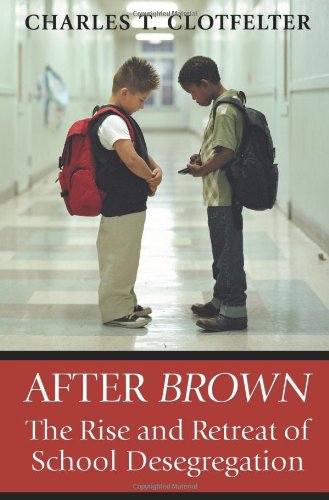
After "Brown": The Rise and Retreat of School Desegregation
Authors:
Charles T. Clotfelter
Publisher:
Princeton University Press
Publication Date:
Not available
ISBN:
0691126372
The United States Supreme Court's 1954 landmark decision, Brown v. Board of Education, set into motion a process of desegregation that would eventually... transform American public schools. This book provides a comprehensive and up-to-date assessment of how Brown's most visible effect--contact between students of different racial groups--has changed over the fifty years since the decision. Using both published and unpublished data on school enrollments from across the country, Charles Clotfelter uses measures of interracial contact, racial isolation, and segregation to chronicle the changes. He goes beyond previous studies by drawing on heretofore unanalyzed enrollment data covering the first decade after Brown, calculating segregation for metropolitan areas rather than just school districts, accounting for private schools, presenting recent information on segregation within schools, and measuring segregation in college enrollment. Two main conclusions emerge. First, interracial contact in American schools and colleges increased markedly over the period, with the most dramatic changes occurring in the previously segregated South. Second, despite this change, four main factors prevented even larger increases: white reluctance to accept racially mixed schools, the multiplicity of options for avoiding such schools, the willingness of local officials to accommodate the wishes of reluctant whites, and the eventual loss of will on the part of those who had been the strongest protagonists in the push for desegregation. Thus decreases in segregation within districts were partially offset by growing disparities between districts and by selected increases in private school enrollment.
After Capitalism (New Critical Theory)
Authors:
David Schweickart
Publisher:
Rowman & Littlefield Publishers
Publication Date:
Not available
ISBN:
0742564983
Since first published in 2002, After Capitalism has offered students and political activists alike a coherent vision of a viable and desirable... alternative to capitalism. David Schweickart calls this system Economic Democracy, a successor-system to capitalism which preserves the efficiency strengths of a market economy while extending democracy to the workplace and to the structures of investment finance. In the second edition, Schweickart recognizes that increased globalization of companies has created greater than ever interdependent economies and the debate about the desirability of entrepreneurship is escalating. The new edition includes a new preface, completely updated data, reorganized chapters, and new sections on the economic instability of capitalism, the current economic crisis, and China. Drawing on both theoretical and empirical research, Schweickart shows how and why this model is efficient, dynamic, and applicable in the world today.
After Capitalism (New Critical Theory)
Authors:
David Schweickart
Publisher:
Rowman & Littlefield Publishers
Publication Date:
Not available
ISBN:
0742513009
In After Capitalism, David Schweickart moves beyond the familiar arguments against globalizing capitalism to contribute something absolutely necessary... and long overdue--a coherent vision of a viable, desirable alternative to capitalism. He names this system Economic Democracy, a successor-system to capitalism which preserves the efficiency strengths of a market economy while extending democracy to the workplace and to the structures of investment finance. Drawing on both theoretical and empirical research, Schweickart shows how and why this model is efficient, dynamic, and superior to capitalism along a range of values.

After Christendom?: How the Church Is to Behave If Freedom,...
Authors:
Stanley Hauerwas
Publisher:
Abingdon Press
Publication Date:
Not available
ISBN:
0687009294
Liberal/conservative and modern/postmodern concepts define contemporary theological debate. Yet what if these categories are grounded in a set of... assumptions about what it means to be the church in the world, presuming we must live as though God's existence does not matter? What if our theological discussion distracts us from the fact that the church is no longer able to shape the desires and habits of Christians? Hauerwas wrestles with these and similar questions constructing a theological politics necessary for the church to be the church in the world. In so doing, he challenges liberal notions of justice and freedom.
After Collapse: The Regeneration of Complex Societies
Authors:
Not Available
Publisher:
University of Arizona Press
Publication Date:
Not available
ISBN:
0816529361
From the Euphrates Valley to the southern Peruvian Andes, early complex societies have risen and fallen, but in some cases they have also been reborn.... Prior archaeological investigation of these societies has focused primarily on emergence and collapse. This is the first book-length work to examine the question of how and why early complex urban societies have reappeared after periods of decentralization and collapse. Ranging widely across the Near East, the Aegean, East Asia, Mesoamerica, and the Andes, these cross-cultural studies expand our understanding of social evolution by examining how societies were transformed during the period of radical change now termed “collapse.” They seek to discover how societal complexity reemerged, how second-generation states formed, and how these re-emergent states resembled or differed from the complex societies that preceded them. The contributors draw on material culture as well as textual and ethnohistoric data to consider such factors as preexistent institutions, structures, and ideologies that are influential in regeneration; economic and political resilience; the role of social mobility, marginal groups, and peripheries; and ethnic change. In addition to presenting a number of theoretical viewpoints, the contributors also propose reasons why regeneration sometimes does not occur after collapse. A concluding contribution by Norman Yoffee provides a critical exegesis of “collapse” and highlights important patterns found in the case histories related to peripheral regions and secondary elites, and to the ideology of statecraft. After Collapse blazes new research trails in both archaeology and the study of social change, demonstrating that the archaeological record often offers more clues to the “dark ages” that precede regeneration than do text-based studies. It opens up a new window on the past by shifting the focus away from the rise and fall of ancient civilizations to their often more telling fall and rise.CONTRIBUTORS Bennet Bronson, Arlen F. Chase, Diane Z. Chase, Christina A. Conlee, Lisa Cooper, Timothy S. Hare, Alan L. Kolata, Marilyn A. Masson, Gordon F. McEwan, Ellen Morris, Ian Morris, Carlos Peraza Lope, Kenny Sims, Miriam T. Stark, Jill A. Weber, Norman Yoffee

After Confession: Poetry as Autobiography
Authors:
Not Available
Publisher:
Graywolf Press
Publication Date:
Not available
ISBN:
1555973558
In an age of memoir, the distinction between fiction and nonfiction has become increasingly blurred, sparking controversy among writers and readers... alike. But what about the autobiographical impulse in poetry? In this groundbreaking collection, some of our best contemporary poets contemplate the legacy of the confessional poets such as Plath, Sexton, and Lowell. They also tackle such fiery topics as the nature of authorial responsibility in telling the truth, the focus on issues of self in relation to others and to the natural world, the very essence of craft as transformation, and the role female poets have played in breaking the code of silence. Rich in opinion and theory, After Confession offers the first thorough discussion on the lyric "I"--the boundaries between literal and emotional truth, memory and imagination, person and persona, narcissism and revelation. Contributors: Joan Aleshire Frank Bidart Kimberly Blaeser Joseph Bruchac Marilyn Chin Billy Collins Stephen Dunn Annie Finch Carol Frost Brendan Galvin Pamela Gemin Louise Glück David Graham Kimiko Hahn Judith Harris Andrew Hudgins Colette Inez Yusef Komunyakaa Ted Kooser Sydney Lea William Matthews Thylias Moss Carol Muske-Dukes Sharon Olds Alicia Ostriker Stanley Plumly Claudia Rankine Adrienne Rich Kate Sontag Alan Williamson
After Crime and Punishment
Authors:
Not Available
Publisher:
Willan
Publication Date:
Not available
ISBN:
1843920573
The issue of resettling ex-prisoners and ex-offenders into the community has become an increasingly important one on both sides of the Atlantic. In the... USA the former Attorney General Janet Reno identified the issue as 'one of the most pressing problems we face as a nation' in view of the massive prison population and the rapid increase in rates of incarceration, while in the UK it has become an increasingly important issue for similar reasons, and the subject of recent reports by HM Inspectorate of Prisons and HM Inspectorate of Probation, as well as from the Social Exclusion Unit of the Home Office. Yet this issue has not been well served by the criminological literature, and the new policies and programmes that have been set up to address the problem have not been well grounded in criminological thinking. This book seeks to address the important set of issues involved by bringing together the best of recent thinking and research into desistance from crime, drawing upon research in both the UK and the USA, and with a distinct focus on how this might impact upon the design and implementation of ex-offender reintegration policy.

After Dark
Authors:
Haruki Murakami
Publisher:
Green Cat Press
Publication Date:
Not available
ISBN:
0307278735

After Dark
Authors:
Haruki Murakami
Publisher:
Knopf
Publication Date:
Not available
ISBN:
0307265838
A short, sleek novel of encounters set in Tokyo during the witching hours between midnight and dawn, and every bit as gripping as Haruki Murakami’s... masterworks The Wind-Up Bird Chronicle and Kafka on the Shore.At its center are two sisters—Eri, a fashion model slumbering her way into oblivion, and Mari, a young student soon led from solitary reading at an anonymous Denny’s toward people whose lives are radically alien to her own: a jazz trombonist who claims they’ve met before, a burly female “love hotel” manager and her maid staff, and a Chinese prostitute savagely brutalized by a businessman. These “night people” are haunted by secrets and needs that draw them together more powerfully than the differing circumstances that might keep them apart, and it soon becomes clear that Eri’s slumber—mysteriously tied to the businessman plagued by the mark of his crime—will either restore or annihilate her.After Dark moves from mesmerizing drama to metaphysical speculation, interweaving time and space as well as memory and perspective into a seamless exploration of human agency—the interplay between self-expression and empathy, between the power of observation and the scope of compassion and love. Murakami’s trademark humor, psychological insight, and grasp of spirit and morality are here distilled with an extraordinary, harmonious mastery.

After-Dinner Declarations
Authors:
Nicanor Parra
Publisher:
Host Publications
Publication Date:
Not available
ISBN:
0924047631
In the 235 poems that make up these collected declarations, renowned Chilean 'antipoet' Nicanor Parra provides an entertaining and enlightening... perspective on the modern world. Delivered as a series of five 'verse speeches' during the 1990s, the poems in After-Dinner Declarations eschew literary ostentation in favor of playful, conversational musings. In a language steeped in colloquialisms, Parra's declarations employ a diverse range of discourses - from puns and allusions to diatribes and eulogies - in order to expose the hypocrisy of human institutions and offer a quipping challenge to those who remain satisfied with the status quo. Parra uses his linguistic brilliance and logical ingenuity to confront some of the most serious problems of our day, addressing perennial motifs such as ecology, human rights and responsibilities, and the limits of scientific knowledge. As the antipoet moves deftly from one topic to another with unbounded inventiveness, he discovers for us a wealth of political, philosophical, and literary insights, as well as unexpected connections between ideas that shape our lives.
After Disaster: Agenda Setting, Public Policy, and Focusing Events...
Authors:
Thomas A. Birkland
Publisher:
Georgetown University Press
Publication Date:
Not available
ISBN:
0878406530
Disasters like earthquakes are known as focusing events -- sudden calamities that cause both citizens and policymakers to pay more attention to a public... problem and often to press for solutions. This book, the first comprehensive analysis of these dramatic events, explains how and why some public disasters change political agendas and, ultimately, public policies.Thomas A. Birkland explores important successes and failures in the policy process by analyzing the political outcomes of four types of events: earthquakes, hurricanes, oil spills, and nuclear accidents. Using this empirical data to go beyond an intuitive understanding of focusing events, he presents a theory of where and when these events will gain attention and how they trigger political reactions. Birkland concludes that different types of disasters result in different kinds of agenda politics. Public outrage over the highly visible damage caused by the Exxon Valdez oil spill, for example, ended a fourteen-year logjam holding back Congressional legislation to regulate oil spill cleanups. On the other hand, the intangible effects of Three Mile Island had less concrete results in a political arena that was already highly polarized.Integrating a variety of theories on the policy process, including agenda setting, policy communities, advocacy coalitions, the political aspects of the news media, and the use of symbols in political debate, Birkland illuminates the dynamics of event-driven policy activity. As the first extensive study of its kind, this book offers new insights into the policy process.

After Easter - Acting Edition
Authors:
Anne Devlin
Publisher:
Dramatists Play Service, Inc.
Publication Date:
Not available
ISBN:
082221671X
Examines the personal and social backgrounds of Northern Irish citizens living in Ulster and on the British mainland. The play is not political, more... psychological and humorous, offering a contemporary portrait of a woman who reaches an important turning point in her life.
After Eden: The Evolution of Human Domination
Authors:
Kirkpatrick Sale
Publisher:
Duke University Press Books
Publication Date:
Not available
ISBN:
0822339382
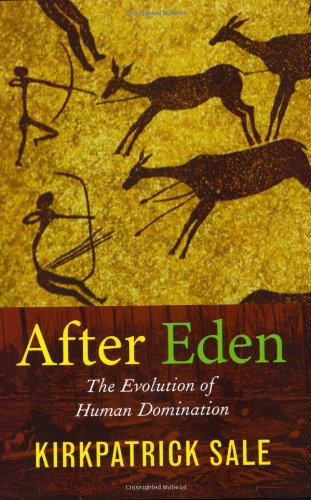
When did the human species turn against the planet that we depend on for survival? Human industry and consumption of resources have altered the climate,... polluted the water and soil, destroyed ecosystems, and rendered many species extinct, vastly increasing the likelihood of an ecological catastrophe. How did humankind come to rule nature to such an extent? To regard the planet’s resources and creatures as ours for the taking? To find ourselves on a seemingly relentless path toward ecocide?In After Eden, Kirkpatrick Sale answers these questions in a radically new way. Integrating research in paleontology, archaeology, and anthropology, he points to the beginning of big-game hunting as the origin of Homo sapiens’ estrangement from the natural world. Sale contends that a new, recognizably modern human culture based on the hunting of large animals developed in Africa some 70,000 years ago in response to a fierce plunge in worldwide temperature triggered by an enormous volcanic explosion in Asia. Tracing the migration of populations and the development of hunting thousands of years forward in time, he shows that hunting became increasingly adversarial in relation to the environment as people fought over scarce prey during Europe’s glacial period between 35,000 and 10,000 years ago. By the end of that era, humans’ idea that they were the superior species on the planet, free to exploit other species toward their own ends, was well established.After Eden is a sobering tale, but not one without hope. Sale asserts that Homo erectus, the variation of the hominid species that preceded Homo sapiens and survived for nearly two million years, did not attempt to dominate the environment. He contends that vestiges of this more ecologically sound way of life exist today—in some tribal societies, in the central teachings of Hinduism and Buddhism, and in the core principles of the worldwide environmental movement—offering redemptive possibilities for ourselves and for the planet.
 '
'