production
/viewbook/list/all/?page=4054
/
/static/
None

ENPIPE LINE Ed: 1ST
Authors:
Not Available
Publisher:
Not available
Publication Date:
Not available
ISBN:
Not available
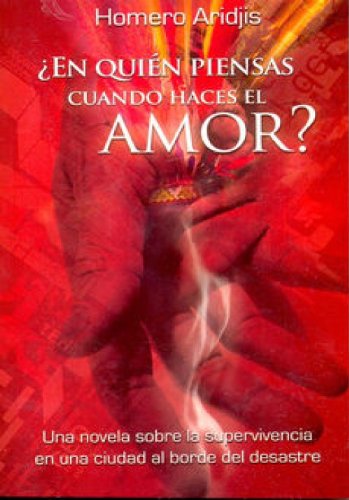
En quien piensas cuando haces el amor?/ Who Do You Think About When...
Authors:
Homero Aridjis
Publisher:
Not available
Publication Date:
Not available
ISBN:
9708120634
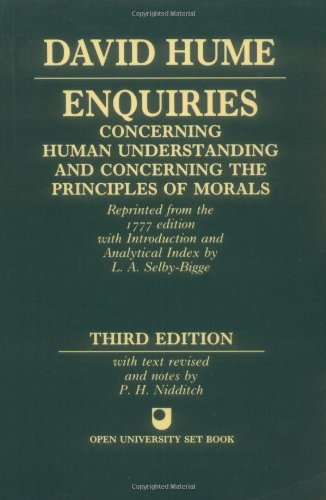
Enquiries Concerning Human Understanding and Concerning The...
Authors:
David Hume
Publisher:
Clarendon Press
Publication Date:
Not available
ISBN:
019824536X
Reprinted from the posthumous edition of 1777 and edited with introduction, comparative tables of contents, and analytical index by L. A. Selby-Bigge.... Third edition with text revised and notes by P. H. Nidditch.
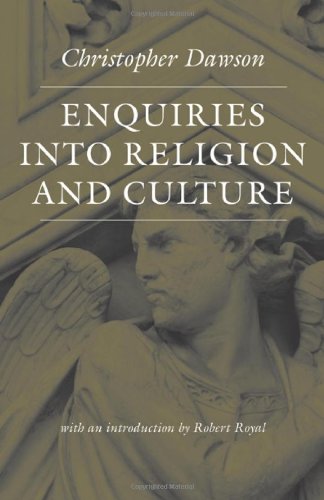
Enquiries Into Religion and Culture (Works of Christopher Dawson)
Authors:
Christopher Dawson
Publisher:
Catholic University of America Press
Publication Date:
Not available
ISBN:
0813215439
The essays presented in this volume are among the most wide-ranging, intellectually rich, and diverse of Christopher Dawson's reflections on the... relations of faith and culture. In them, he explores the contact between the spiritual life of the individual and the social and economic organization of modern culture. His focus ranges from the passing of industrialism to the Catholic understanding of the human person, to Islamic mysticism, to a Christian account of sexuality. Dawson argues that modern Western culture is unique in its tendency to ignore its spiritual roots and its once close contact with nature and tradition, and to substitute for them an impersonal economic and materialist organization of mass society. In these essays, he warns against the increasingly secular preoccupations of modern sociological accounts of European culture and insists that they require the supplement and corrective of theology and philosophy. But he is equally insistent on the dangers of a false spiritualism that ignores emerging sociological insights. Widely praised as one of the most important Catholic historians of the twentieth century, Christopher Dawson, in all of his writings, masterfully brings various disciplinary perspectives and historical sources into a complex unity of expression and applies them to concrete conditions of modern society. Enquiries into Religion and Culture includes an introduction by Robert Royal.
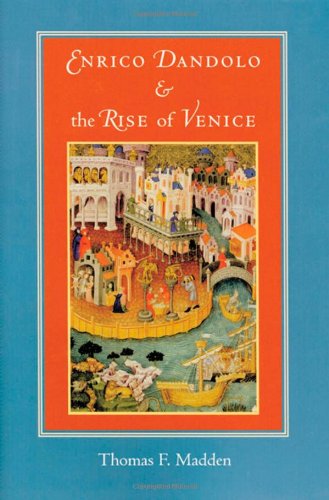
Enrico Dandolo and the Rise of Venice
Authors:
Thomas F. Madden
Publisher:
The Johns Hopkins University Press
Publication Date:
Not available
ISBN:
0801885396
Between the eleventh and thirteenth centuries, Venice transformed itself from a struggling merchant commune to a powerful maritime empire that would... shape events in the Mediterranean for the next four hundred years. In this magisterial new book on medieval Venice, Thomas F. Madden traces the city-state's extraordinary rise through the life of Enrico Dandolo (c. 1107–1205), who ruled Venice as doge from 1192 until his death. The scion of a prosperous merchant family deeply involved in politics, religion, and diplomacy, Dandolo led Venice's forces during the disastrous Fourth Crusade (1201–1204), which set out to conquer Islamic Egypt but instead destroyed Christian Byzantium. Yet despite his influence on the course of Venetian history,we know little about Dandolo, and much of what is known has been distorted by myth.The first full-length study devoted to Dandolo's life and times, Enrico Dandolo and the Rise of Venice corrects the many misconceptions about him that have accumulated over the centuries, offering an accurate and incisive assessment of Dandolo's motives, abilities, and achievements as doge, as well as his role—and Venice's—in the Fourth Crusade. Madden also examines the means and methods by which the Dandolo family rose to prominence during the preceding century, thus illuminating medieval Venice's singular political, social, and religious environment. Culminating with the crisis precipitated by the failure of the Fourth Crusade, Madden's groundbreaking work reveals the extent to which Dandolo and his successors became torn between the anxieties and apprehensions of Venice's citizens and its escalating obligations as a Mediterranean power.
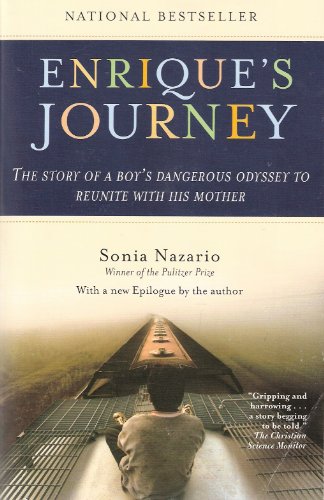
Enrique's Journey
Authors:
Sonia Nazario
Publisher:
Random House
Publication Date:
Not available
ISBN:
0812971787
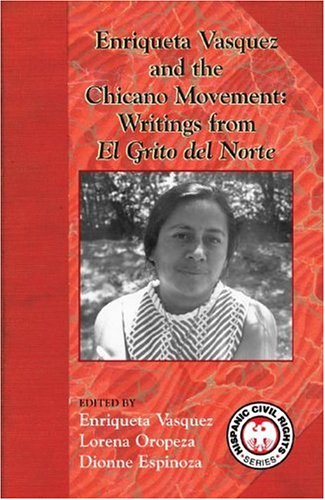
Enriqueta Vasquez and the Chicano Movement: Writings from El Grito...
Authors:
Enriqueta Vasquez
Publisher:
Arte Público Press
Publication Date:
Not available
ISBN:
1558854797
As a teenager, long before Enriqueta Vasquez became a writer and activist, she wrote her first letter to complain against the injustice she saw around... her while growing up in the Southwest. Why was she, a Mexican American, not allowed to eat in local restaurants, while her brothers were fighting to preserve their country’s principles of freedom and democracy? Why were Mexican Americans good enough to fight and die for their country but not good enough to be treated as equals at home? And so began Enriqueta Vasquez’s life-long fight for justice. Highlighting the involvement of women in the Chicano Movement, this anthology combines for the first time in one volume the columns written by Enriqueta Vasquez from 1968-1972 for the path-breaking Chicano newspaper, El Grito del Norte. Enriqueta Vasquez’s columns written during the peak of the civil rights movement provided a platform for her fierce but hopeful voice of protest. In her column, entitled ¡Despierten Hermanos! [Awaken, Brothers and Sisters!], she used both anger and humor in her efforts to stir her fellow Chicanos to action. Drawing upon her own experiences as a Chicana, she wrote about such issues as racism, sexism, imperialism, and poverty, issues that remain pressing today. With introductory and concluding essays by editors Lorena Oropeza and Dionne Espinoza, this collection of 44 of Vasquez’s original articles arranged thematically into six chapters seeks to inform and inspire a new generation. Each is annotated to clarify references to people and events, and the editors have included English-language translations of any essays that appeared originally in Spanish. The text is complemented by six drawings by activist and artist Rini Templeton that originally appeared in El Grito del Norte. The volume includes a foreword by John Nichols and a preface by Enriqueta Vasquez.
Enron
Authors:
Lucy Prebble
Publisher:
Dramatist's Play Service
Publication Date:
Not available
ISBN:
0822224747
One of the most infamous scandals in financial history becomes a theatrical epic. At once a case study and an allegory, the play charts the notorious... rise and fall of Enron and its founding partners Ken Lay and Jeffrey Skilling, who became reviled figures from the financial scandal of the century, with quotes like, "The only difference between me and the people judging me is they weren't smart enough to do what we did." Mixing classical tragedy with savage comedy, Enron follows a group of flawed men and women in a narrative of greed and loss which reviews the tumultuous 1990s and casts a new light on the financial turmoil in which the world finds itself in today.
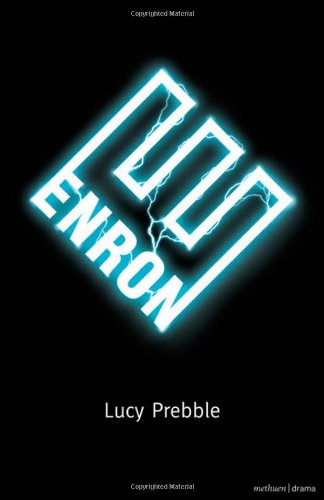
Enron (Modern Plays)
Authors:
Lucy Prebble
Publisher:
Methuen Drama
Publication Date:
Not available
ISBN:
140812467X
One of the most infamous scandals in financial history becomes a theatrical epic. At once a case study and an allegory, the play charts the notorious... rise and fall of Enron and its founding partners Ken Lay and Jeffrey Skilling, who became reviled figures from the financial scandal of the century, with quotes like, "The only difference between me and the people judging me is they weren't smart enough to do what we did." Mixing classical tragedy with savage comedy, Enron follows a group of flawed men and women in a narrative of greed and loss which reviews the tumultuous 1990s and casts a new light on the financial turmoil in which the world finds itself in today.
ENS 110 NOTES HLADEK
Authors:
Not Available
Publisher:
Not available
Publication Date:
Not available
ISBN:
Not available
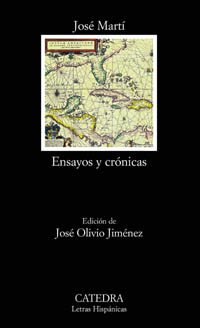
Ensayos y cronicas (COLECCION LETRAS HISPANICAS) (Spanish Edition)
Authors:
Marti
Publisher:
Catedra
Publication Date:
Not available
ISBN:
8437621313
En EL PERRO DEL HORTELANO (1613) la noble Diana, condesa de Belflor, lucha contra su amor por su secretario Tedodoro, pero una anagnorisis inventada por... el criado Tristan (figura del gracioso) permitira la boda desigual y el triunfo del amor.En EL CASTIGO SIN VENGANZA (1631) el amor de Federico y su madrasta Casandra se sabe que los condenara a muerte, y esto conmueve al espectador. Federico dirigira (acto segundo) a su amada una bellisima glosa de un viejo mote, que muestra una vez mas la genialidad versificatoria y dramatica de Lope:""En fin, senora, me veosin mi, sin vos y sin Dios:sin Dios, por lo que os deseo;sin mi, porque estoy sin vos;sin vos, porque no os poseo....En tantos males me empleo,despues que mi ser perdi,que, aunque no verme deseo,para ver si soy quien fui,en fin, senora, me veo....Culpa tenemos los dosdel no ser que soy agora,pues olvidado por vosde mi mismo, estoy, senora,sin mi, sin vos y sin Dios....Si en searos me empleo,y el manda no desearla hermosura que en vos veo,claro esta que vengo a estarsin Dios, por lo que os deseo....¿Que habremos de hacer los dos´pues a Dios por vos perdidespues que os tengo por Dios,sin Dios, porque estais en mi,sin mi, porque estoy sin vos?...Sin vos y sin mi peleocon tanta desconfianza:sin mi, porque en vos ya veoimposible mi esperanza,sin vos, porque no os poseo.""A. David Kossoff, doctor en Filosofia y Letras y profesor de la Universidad de Brown (USA), se ha especializado en la literatura del Siglo de Oro espanol.
ENSC 245 LAB MANUAL
Authors:
Not Available
Publisher:
Not available
Publication Date:
Not available
ISBN:
Not available
ENSC 353 NUTRIENT CYCLING SUPPLEMENTAL
Authors:
Not Available
Publisher:
Not available
Publication Date:
Not available
ISBN:
Not available
ENSC 448-STREAM CORRIDOR RESTORATION
Authors:
Not Available
Publisher:
Not available
Publication Date:
Not available
ISBN:
Not available
ENSC 454-FIELD BK.F/DESC+SAMP.SOILS
Authors:
Not Available
Publisher:
Not available
Publication Date:
Not available
ISBN:
Not available
 '





