production
/viewbook/list/all/?page=4057
/
/static/
None
Enterprise Architecture As Strategy: Creating a Foundation for...
Authors:
Jeanne W. Ross
Publisher:
Harvard Business Review Press
Publication Date:
Not available
ISBN:
1591398398
Enterprise architecture defines a firm's needs for standardized tasks, job roles, systems, infrastructure, and data in core business processes. Thus, it... helps a company to articulate how it will compete in a digital economy and it guides managers' daily decisions to realize their vision of success. This book clearly explains enterprise architecture's vital role in enabling--or constraining--the execution of business strategy. The book provides clear frameworks, thoughtful case examples, and a proven-effective structured process for designing and implementing effective enterprise architectures.
Enterprise Architecture A to Z: Frameworks, Business Process...
Authors:
Daniel Minoli
Publisher:
Auerbach Publications
Publication Date:
Not available
ISBN:
0849385172
Driven by the need and desire to reduce costs, organizations are faced with a set of decisions that require analytical scrutiny. Enterprise Architecture... A to Z: Frameworks, Business Process Modeling, SOA, and Infrastructure Technology examines cost-saving trends in architecture planning, administration, and management. To establish a framework for discussion, this book begins by evaluating the role of Enterprise Architecture Planning and Service-Oriented Architecture (SOA) modeling. It provides an extensive review of the most widely deployed architecture framework models. In particular, the book discusses The Open Group Architecture Framework (TOGAF) and the Zachman Architectural Framework (ZAF) in detail, as well as formal architecture standards and all four layers of these models: the business architecture, the information architecture, the solution architecture, and the technology architecture. The first part of the text focuses on the upper layers of the architecture framework, while the second part focuses on the technology architecture. In this second section, the author presents an assessment of storage technologies and networking and addresses regulatory and security issues. Additional coverage includes high-speed communication mechanisms such as Ethernet, WAN and Internet communication technologies, broadband communications, and chargeback models. Daniel Minoli has written a number of columns and books on the high-tech industry and has many years of technical hands-on and managerial experience at top financial companies and telecom/networking providers. He brings a wealth of knowledge and practical experience to these pages. By reviewing the strategies in this book, CIOs, CTOs, and senior managers are empowered by a set of progressive approaches to designing state-of-the-art IT data centers.
Enterprise Architecture at Work: Modelling, Communication and Analysis
Authors:
Marc Lankhorst
Publisher:
Springer
Publication Date:
Not available
ISBN:
3642013090
An enterprise architecture tries to describe and control an organisation’s structure, processes, applications, systems and techniques in an integrated... way. The unambiguous specification and description of components and their relationships in such an architecture requires a coherent architecture modelling language. Lankhorst and his co-authors present such an enterprise modelling language that captures the complexity of architectural domains and their relations and allows the construction of integrated enterprise architecture models. They provide architects with concrete instruments that improve their architectural practice. As this is not enough, they additionally present techniques and heuristics for communicating with all relevant stakeholders about these architectures. Since an architecture model is useful not only for providing insight into the current or future situation but can also be used to evaluate the transition from ‘as-is’ to ‘to-be’, the authors also describe analysis methods for assessing both the qualitative impact of changes to an architecture and the quantitative aspects of architectures, such as performance and cost issues. The modelling language presented has been proven in practice in many real-life case studies and has been adopted by The Open Group as an international standard. So this book is an ideal companion for enterprise IT or business architects in industry as well as for computer or management science students studying the field of enterprise architecture.
Enterprise Architecture Good Practices Guide: How to Manage the...
Authors:
Jaap Schekkerman
Publisher:
Trafford Publishing
Publication Date:
Not available
ISBN:
1425156878
The purpose of this guide is to provide guidance to organization's in initiating, developing, using, and maintaining their enterprise ... architecture (EA) practice. This guide offers a set of Enterprise Architecture Good Practices that have proven their benefits to organizations and that addresses an end-to-end process to initiate, implement, and sustain an EA program, and describes the necessary roles and associated responsibilities for a successful EA program. Enterprise Architecture is a complete expression of the enterprise; a master plan which “acts as a collaboration force” between aspects of business planning such as goals, visions, strategies and governance principles; aspects of business operations such as business terms, organization structures, processes and data; aspects of automation such as information systems and databases; and the enabling technological infrastructure of the business such as computers, operating systems and networks. While EA frameworks and models provide valuable guidance on the content of enterprise architectures, there is literally no guidance how to successfully manage the process of creating, changing, and using Enterprise Architecture. This guidance is crucially important. Without it, it is highly unlikely that an organization can successfully produce a complete and enforceable EA for optimizing its business value and mission performance of its systems. For example, effective development of a complete EA needs a corporate commitment with senior management sponsorship. Enterprise Architecture development should be managed as a formal program by an Enterprise Architecture Department that is held accountable for success. Since that EA facilitates change based upon the changing business environment of the organization, the enterprise architect is the organization’s primary change agent. Effective implementation requires establishment of business and system compliance with the enterprise architecture, as well as continuous assessment and enforcement of compliance. Waiver of these requirements may occur only after careful, thorough, and documented business case analysis. Without these commitments, responsibilities, and tools, the risk is great that business changes or new systems will not meet organizations business needs, will be incompatible, will perform poorly, and will cost more to develop, integrate, and maintain than is warranted.
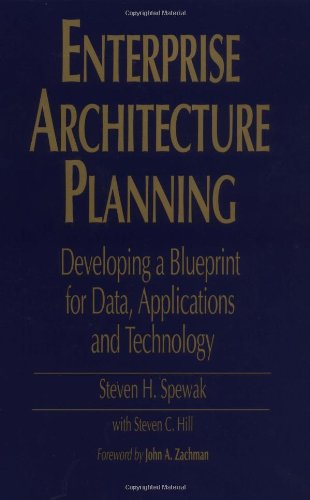
Enterprise Architecture Planning: Developing a Blueprint for Data,...
Authors:
Steven H. Spewak
Publisher:
Wiley
Publication Date:
Not available
ISBN:
0471599859
About This Book Praise for Enterprise Architecture Planning-- ". the book has given me a wealth of good, fresh ideas about every facet of the... architecture process . makes a substantive contribution to the body of IS planning knowledge." --John A. Zachman Zachman Information Systems Enterprise Architecture Planning is more advanced than traditional system planning approaches because you:* define a stable business model independent of organizational boundaries, systems, and procedures,* define data before application, and* let data determine the sequence for implementing applications systems.Here the authors give you a common-sense approach to Enterprise Architecture Planning. You'll find dozens of examples of architectures, procedures, checklists, and useful guidelines to support these techniques. This is the best guide available to help you ensure a cost-effective, long-term solution.
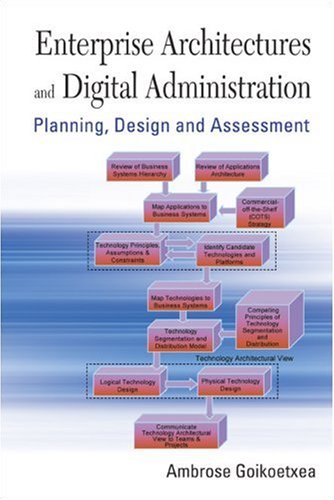
ENTERPRISE ARCHITECTURES AND DIGITAL ADMINISTRATION: PLANNING,...
Authors:
Ambrose Goikoetxea
Publisher:
World Scientific Publishing
Publication Date:
Not available
ISBN:
9812700277
This is the first book that addresses all three main activities in improving business and technology decisions: the planning, design and assessment of... enterprise architectures (EAs). Emphasis is on medium and large-size organizations in the private sector (such as banks, airlines and auto industries) and the public sector (such as federal agencies, local government organizations and military services in the Department of Defense). The book addresses the challenges faced by EA builders through an organized presentation of the issues and a step-by-step approach. The material is based on real-life EA project experience and lessons learned over a decade working in multiple-contractor, multiple-discipline teams, and multiple-agency environments.
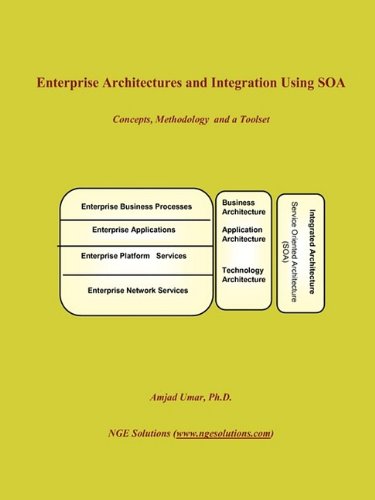
Enterprise Architectures and Integration Using SOA: Concepts,...
Authors:
Amjad Umar
Publisher:
NGE Solutions
Publication Date:
Not available
ISBN:
0972741402
This book covers enterprise architectures and integration using SOA principles. This book is based on corporate experience, consulting assignments,... teaching university courses and also research on computer aided consulting. The salient features of this classroom tested book are: a) emphasis on recent and relevant issues; b) mixture of business and technologies, not just buiness or pure technology; c) a systematic approach that defines an enterprise architecture into broad building blocks and then covers each building block in depth; d) several case studies and examples to illustrate the key points; e) a step by step methodology that shows how all the pieces fit together; and f) a computer aided decision support system (PISA) that can be used in classroom exercises.
Enterprise Governance of Information Technology: Achieving...
Authors:
Wim Van Grembergen
Publisher:
Springer
Publication Date:
Not available
ISBN:
0387848819
Enterprise governance of information technology is a relatively new concept that is gaining traction in both the academic and practitioner worlds. Going... well beyond the implementation of a superior IT infrastructure, “Enterprise Governance of Information Technology” is about defining and embedding processes and structures throughout the organizations that enable both business and IT people to execute their responsibilities, while maximizing the value created from their IT-enabled investments. At the forefront of the field, the authors draw from years of research and advising corporate clients to present the first comprehensive resource on the topic. Featuring numerous case examples from companies around the world, the book integrates theoretical advances and empirical data with practical application, including in-depth discussion of such frameworks as COBIT and VALIT, which are used to measure and audit the value of IT investments and ensuring regulatory compliance. A variety of elements, including executive summaries and sidebars, extensive references, and questions and activities (with additional materials available on-line) ensure that the book will be an essential resource for professionals, researchers, and students alike.

ENTERPRISE INFORMATION SYSTEMS
Authors:
Not Available
Publisher:
Not available
Publication Date:
Not available
ISBN:
Not available
Enterprise Information Systems: A Pattern-Based Approach
Authors:
Cheryl Dunn
Publisher:
McGraw-Hill/Irwin
Publication Date:
Not available
ISBN:
0072404299
Enterprise Information Systems: A Pattern Based Approach, 3e, by Dunn/Cherrington/Hollander presents a pattern-based approach to designing enterprise... information systems with a particular emphasis on the enterprise-wide database. This edition is built on the idea that a separation between accounting information systems and management information systems should not exist. We believe patterns help people see the "big picture" of enterprises more clearly and therefore help design better systems. We believe you cannot identify anything that we need to account for that we do not also need to manage; nor can we identify anything we need to manage that we do not also need to account for. In this edition, we will show how a well-designed REA-based Accounting Information System is the Enterprise Information System.
Enterprise Information Systems Assurance and System Security:...
Authors:
Merrill Warkentin
Publisher:
Idea Group Publishing
Publication Date:
Not available
ISBN:
159140911X
Enterprise Information Systems Assurance and System Security: Managerial and Technical Issues brings together authoritative authors to address one of... the most pressing challenges in the IT field how to create secure environments for the application of technology to serve future needs. This book bridges the gap between theory and practice, academia and industry, computer science and MIS. The chapters provide an integrated, holistic perspective on this complex set of challenges, supported with practical experiences of leading figures from all realms. Enterprise Information Systems Assurance and System Security: Managerial and Technical Issues provides an excellent collection for corporate executives who are charged with securing their systems and data, students studying the topic of business information security, and those who simply have an interest in this exciting topic.
ENTERPRISE INFORMATION SYSTEMS [CUSTOM]
Authors:
Not Available
Publisher:
Not available
Publication Date:
Not available
ISBN:
Not available
Enterprise Integration
Authors:
Kent Sandoe
Publisher:
Wiley
Publication Date:
Not available
ISBN:
0471359939
In this groundbreaking book, two acknowledged experts explore the underlying principles of systems integration, and, with the help of numerous case... studies show IT managers, systems analysts, and project managers how to apply those principles to solving complex business problems. The authors reveal the linkages between business processes and how they can be supported in enterprise-wide integrated systems. Rather than review specific products and tools, the authors use real-life examples to provides readers with a practical understanding of integrated system architectures and how they function within the framework of an Enterprise Planning System.
Enterprise Integration: An Architecture for Enterprise Application...
Authors:
Fred A. Cummins
Publisher:
Wiley
Publication Date:
Not available
ISBN:
0471400106
An expert guide to solving real business problems using componentsThis groundbreaking book gets developers up to speed on Enterprise JavaBeans, CORBA... components, and other cutting edge technologies that are making it easier and cheaper than ever for companies to integrate all of their applications into unified systems to support corporate decision-making. Fred Cummins presents an overview of the integration architecture and then dives right into the details, including communications messaging techniques for integrating application components, the "publish and subscribe" mechanism for linking components and monitoring business activities, using "adapters" to integrate applications, integrating Web services, work-flow management, and he also supplies proven code solutions for an array of problems associated with integrating packaged and custom applications across the enterprise.Companion Web site features source code and updates on the EAI architecture and underlying technologies.
Enterprise Integration: The Essential Guide to Integration Solutions
Authors:
Beth Gold-Bernstein
Publisher:
Addison-Wesley Professional
Publication Date:
Not available
ISBN:
032122390X
“The book’s use of real-world case study vignettes really does go to the heart of the subject matter. This stuff is real, it has real applicability... to real problems, and, as with most things in life, it shows how it all comes down to real money in the final analysis. This book shows you what your peers are doing to drive costs out of integration projects and to build new applications without re-inventing the entire wheel—just a few new spokes and off you go. This is a good book. Read it.” —Peter Rhys Jenkins, Complex Systems Architect, Candle Corporation“When you get two long-term, acknowledged experts on integration and interoperability together to lay out the current state of the IT universe you expect an immediate return on investment—and this book delivers. It’s common knowledge that 90% of total software lifecycle cost is in maintenance and integration, and that needs to drive IT decision-making. With comprehensive coverage of the integration technology landscape, and clear case studies presented at every turn, this book belongs on every IT manager’s, every system architect’s, and every software developer’s bookshelf.” —Richard Mark Soley, chairman and CEO, Object Management Group“Today’s myriad of integration technologies and alternatives can be daunting. This book presents a framework and process for the evaluation, design, and selection of the appropriate integration technologies to meet your strategic business needs. You will find the templates a particularly useful mechanism to jump-start documentation and drive your decision-making process.” —Ron Zahavi, CIO, Global Business Transformation, Unisys Global Transformation Team; author of Enterprise Application Integration with CORBA “It is refreshing to read a book that presents a good business approach to the integration challenge facing most business leaders today, while at the same time educating them about the major components of the required technologies and management practices changes required. The narrative, examples, and templates establish a common reference point between the business and the technology organizations. A must-read for senior business leaders challenged with the complexities of business integration, as well as Senior IT Leaders challenged with shrinking budgets and lower tolerances for failures.” —Chuck Papageorgiou, managing partner, Ideasphere“Integration has, and will continue to be, one of the success indicators of any enterprise project. Failing to understand the nuances of integration is a critical mistake managers cannot afford to make.” —Marcia Robinson, author of Services Blueprint: Roadmap for Execution “A much-needed book; it ties together the business and technology aspects of information system implementation, emphasizing best practices for really getting things done. I believe that both the technical and business communities will benefit from the in-depth material provided in this book.” —Dr. Barry Horowitz, professor of systems and information engineering, University of Virginia (former CEO, Mitre Corporation)Integration of applications, information, and business process has become today’s #1 IT investment priority. Most enterprise integration books simply explain the technology. This one shows exactly how to apply it. It’s a step-by-step roadmap for your entire project—from the earliest exploratory stages through analysis, design, architecture, and implementation. Renowned enterprise integration experts Beth Gold-Bernstein and William Ruh present best practices and case studies that bring their methodology to life. They address every stage from the decision-maker’s and implementer’s point of view—showing how to align business requirements to specific solutions, systematically reduce risk, and maximize ROI throughout the entire lifecycle. Coverage includes: Supporting strategies, tactics, and business planning: enterprise integration from the business perspective Defining realistic project success indicators and metrics Establishing integration architectures: supporting near-term needs while building reusable infrastructure services for the long-term Adopting metadata architecture and standards Implementing four essential implementation patterns: application, information, composite, and process integration Understanding service integration and implementing service-oriented architectures Providing organizational structure and governance to support effective integration The authors provide detailed plans and specification templates for application integration projects—both in the book and on the CD-ROM. These projects include identifying business drivers and requirements; establishing strategy; and integrating services, information, process, and applications. Enterprise Integration was written for every member of the integration team: business and IT leaders, strategists, architects, project managers, and technical staff. Regardless of your role, you’ll discover where you fit, what to do, and how to drive maximum business value from your next integration project.
 '





