production
/viewbook/list/all/?page=4098
/
/static/
None

Envisioning Women in World History: Prehistory to 1500...
Authors:
Catherine Clay
Publisher:
McGraw-Hill Humanities/Social Sciences/Languages
Publication Date:
Not available
ISBN:
0073513229
Part of McGraw-Hill's Explorations in World History series, this brief and accessible volume presents a comparative survey of the early history of women... from a global perspective. Each chapter, which can be read independently of the others, examines the experiences of women in one of seven civilizations typically covered in an introductory world history text: pre-agricultural societies, the Ancient Mediterranean, Gupta India/Southeast Asia, Tang/Song China, Maya and Aztec cultures, early Islam through the Abbasid caliphate, and Europe in the Late Middle Ages. Within these cultures, the authors explore a variety of issues impacting the lives of females in pre-modern history, including the ideal woman, female life cycles, women's roles in work and economy, female sexuality and spirituality, and women and politics. The book's brevity makes it an excellent companion text for students in world history, women's history, introductory sociology and anthropology courses, and women’s studies courses.

ENVISION PACKAGE FOR SYRACUSE UNIVERSITY
Authors:
Not Available
Publisher:
Not available
Publication Date:
Not available
ISBN:
Not available

Envision: Writing and Researching Arguments (3rd Edition)
Authors:
Christine Alfano
Publisher:
Longman
Publication Date:
Not available
ISBN:
0205758479
A concise and practical guide, Envision teaches core skills in analysis, argument, and research, using both contemporary examples to capture student... interest and key principles from classical rhetoric.

Envision: Writing and Researching Arguments, Books a la Carte...
Authors:
Christine Alfano
Publisher:
Longman
Publication Date:
Not available
ISBN:
0205238874
ENVR 2340 F12 CPAC F/BAILEY ]CUSTOM[
Authors:
Not Available
Publisher:
Not available
Publication Date:
Not available
ISBN:
Not available
ENVR 305 ENVIRONMENTAL IMPACT ASSESSMENT
Authors:
Not Available
Publisher:
Not available
Publication Date:
Not available
ISBN:
Not available
ENVR 5242 F12 CPAC F/BAILEY ]CUSTOM[
Authors:
Not Available
Publisher:
Not available
Publication Date:
Not available
ISBN:
Not available
ENVS 50 ]CUSTOM[
Authors:
Not Available
Publisher:
Not available
Publication Date:
Not available
ISBN:
Not available

Envy (New York Review Books Classics)
Authors:
Yuri Olesha
Publisher:
NYRB Classics
Publication Date:
Not available
ISBN:
1590170865
A NEW YORK REVIEW BOOKS ORIGINALOne of the delights of Russian literature, a tour de force that has been compared to the best of Nabokov and Bulgakov,... Yuri Olesha's novella Envy brings together cutting social satire, slapstick humor, and a wild visionary streak. Andrei is a model Soviet citizen, a swaggeringly self-satisfied mogul of the food industry who intends to revolutionize modern life with mass-produced sausage. Nikolai is a loser. Finding him drunk in the gutter, Andrei gives him a bed for the night and a job as a gofer. Nikolai takes what he can, but that doesn't mean he's grateful. Griping, sulking, grovelingly abject, he despises everything Andrei believes in, even if he envies him his every breath.Producer and sponger, insider and outcast, master and man fight back and forth in the pages of Olesha's anarchic comedy. It is a contest of wills in which nothing is sure except the incorrigible human heart.Marian Schwartz's new English translation of Envy brilliantly captures the energy of Olesha's masterpiece.

Envy: The Seven Deadly Sins
Authors:
Joseph Epstein
Publisher:
Oxford University Press, USA
Publication Date:
Not available
ISBN:
019531204X
Malice that cannot speak its name, cold-blooded but secret hostility, impotent desire, hidden rancor and spite--all cluster at the center of envy. Envy... clouds thought, writes Joseph Epstein, clobbers generosity, precludes any hope of serenity, and ends in shriveling the heart. Of the seven deadly sins, he concludes, only envy is no fun at all. Writing in a conversational, erudite, self-deprecating style that wears its learning lightly, Epstein takes us on a stimulating tour of the many faces of envy. He considers what great thinkers--such as John Rawls, Schopenhauer, and Nietzsche--have written about envy; distinguishes between envy, yearning, jealousy, resentment, and schadenfreude ("a hardy perennial in the weedy garden of sour emotions"); and catalogs the many things that are enviable, including wealth, beauty, power, talent, knowledge and wisdom, extraordinary good luck, and youth (or as the title of Epstein's chapter on youth has it, "The Young, God Damn Them"). He looks at resentment in academia, where envy is mixed with snobbery, stirred by impotence, and played out against a background of cosmic injustice; and he offers a brilliant reading of Othello as a play more driven by Iago's envy than Othello's jealousy. He reveals that envy has a strong touch of malice behind it--the envious want to destroy the happiness of others. He suggests that envy of the astonishing success of Jews in Germany and Austria may have lurked behind the virulent anti-Semitism of the Nazis. As he proved in his best-selling Snobbery, Joseph Epstein has an unmatched ability to highlight our failings in a way that is thoughtful, provocative, and entertaining. If envy is no fun, Epstein's Envy is truly a joy to read.

Envy: The Seven Deadly Sins (New York Public Library Lectures in...
Authors:
Joseph Epstein
Publisher:
Oxford University Press, USA
Publication Date:
Not available
ISBN:
0195158121
Malice that cannot speak its name, cold-blooded but secret hostility, impotent desire, hidden rancor and spite--all cluster at the center of envy. Envy... clouds thought, writes Joseph Epstein, clobbers generosity, precludes any hope of serenity, and ends in shriveling the heart. Of the seven deadly sins, he concludes, only envy is no fun at all. Writing in a conversational, erudite, self-deprecating style that wears its learning lightly, Epstein takes us on a stimulating tour of the many faces of envy. He considers what great thinkers--such as John Rawls, Schopenhauer, and Nietzsche--have written about envy; distinguishes between envy, yearning, jealousy, resentment, and schadenfreude ("a hardy perennial in the weedy garden of sour emotions"); and catalogs the many things that are enviable, including wealth, beauty, power, talent, knowledge and wisdom, extraordinary good luck, and youth (or as the title of Epstein's chapter on youth has it, "The Young, God Damn Them"). He looks at resentment in academia, where envy is mixed with snobbery, stirred by impotence, and played out against a background of cosmic injustice; and he offers a brilliant reading of Othello as a play more driven by Iago's envy than Othello's jealousy. He reveals that envy has a strong touch of malice behind it--the envious want to destroy the happiness of others. He suggests that envy of the astonishing success of Jews in Germany and Austria may have lurked behind the virulent anti-Semitism of the Nazis. As he proved in his best-selling Snobbery, Joseph Epstein has an unmatched ability to highlight our failings in a way that is thoughtful, provocative, and entertaining. If envy is no fun, Epstein's Envy is truly a joy to read.
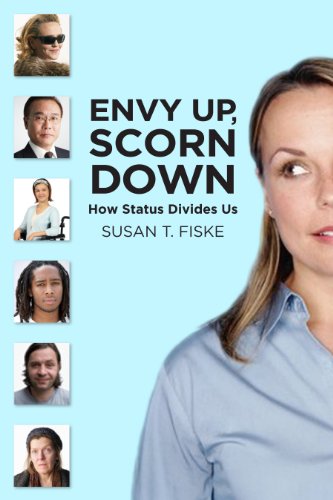
Envy Up, Scorn Down: How Status Divides Us
Authors:
Susan T. Fiske
Publisher:
Russell Sage Foundation
Publication Date:
Not available
ISBN:
0871544644
The United States was founded on the principle of equal opportunity for all, and this ethos continues to inform the nation's collective identity. In... reality, however, absolute equality is elusive. The gap between rich and poor has widened in recent decades, and the United States has the highest level of economic inequality of any developed country. Social class and other differences in status reverberate throughout American life, and prejudice based on another's perceived status persists among individuals and groups. In Envy Up, Scorn Down, noted social psychologist Susan Fiske examines the psychological underpinnings of interpersonal and intergroup comparisons, exploring why we compare ourselves to those both above and below us and analyzing the social consequences of such comparisons in day-to-day life.What motivates individuals, groups, and cultures to envy the status of some and scorn the status of others? Who experiences envy and scorn most? Envy Up, Scorn Down marshals a wealth of recent psychological studies as well as findings based on years of Fiske's own research to address such questions. She shows that both envy and scorn have distinctive biological, emotional, cognitive, and behavioral characteristics. And though we are all wired for comparison, some individuals are more vulnerable to these motives than others. Dominant personalities, for example, express envy toward high-status groups such as the wealthy and well-educated, and insecurity can lead others to scorn those perceived to have lower status, such as women, minorities, or the disabled. Fiske shows that one's race or ethnicity, gender, and education all correlate with perceived status. Regardless of whether one is accorded higher or lower status, however, all groups rank their members, and all societies rank the various groups within them. We rate each group as either friend or foe, able or unable, and accordingly assign them the traits of warmth or competence. The majority of groups in the United States are ranked either warm or competent but not both, with extreme exceptions: the homeless or the very poor are considered neither warm nor competent. Societies across the globe view older people as warm but incompetent. Conversely, the very rich are generally considered cold but highly competent. Envy Up, Scorn Down explores the nuances of status hierarchies and their consequences and shows that such prejudice in its most virulent form dehumanizes and can lead to devastating outcomes from the scornful neglect of the homeless to the envious anger historically directed at Tutsis in Rwanda or Jews in Europe.Individuals, groups, and even cultures will always make comparisons between and among themselves. Envy Up, Scorn Down is an accessible and insightful examination of drives we all share and the prejudice that can accompany comparison. The book deftly shows that understanding envy and scorn and seeking to mitigate their effects can prove invaluable in our lives, our relationships, and our society.

Enzymatic Reaction Mechanisms
Authors:
Perry A. Frey
Publisher:
Oxford University Press, USA
Publication Date:
Not available
ISBN:
0195122585
Books dealing with the mechanisms of enzymatic reactions were written a generation ago. They included volumes entitled Bioorganic Mechanisms, I and II... by T.C. Bruice and S.J. Benkovic, published in 1965, the volume entitled Catalysis in Chemistry and Enzymology by W.P. Jencks in 1969, and the volume entitled Enzymatic Reaction Mechanisms by C.T. Walsh in 1979. The Walsh book was based on the course taught by W.P. Jencks and R.H. Abeles at Brandeis University in the 1960's and 1970's. By the late 1970's, much more could be included about the structures of enzymes and the kinetics and mechanisms of enzymatic reactions themselves, and less emphasis was placed on chemical models. Walshs book was widely used in courses on enzymatic mechanisms for many years. Much has happened in the field of mechanistic enzymology in the past 15 to 20 years. Walshs book is both out-of-date and out-of-focus in todays world of enzymatic mechanisms. There is no longer a single volume or a small collection of volumes to which students can be directed to obtain a clear understanding of the state of knowledge regarding the chemicals mechanisms by which enzymes catalyze biological reactions. There is no single volume to which medicinal chemists and biotechnologists can refer on the subject of enzymatic mechanisms. Practitioners in the field have recognized a need for a new book on enzymatic mechanisms for more than ten years, and several, including Walsh, have considered undertaking to modernize Walshs book. However, these good intentions have been abandoned for one reason or another. The great size of the knowledge base in mechanistic enzymology has been a deterrent. It seems too large a subject for a single author, and it is difficult for several authors to coordinate their work to mutual satisfaction. This text by Perry A. Frey and Adrian D. Hegeman accomplishes this feat, producing the long-awaited replacement for Walshs classic text.

Enzyme Kinetics and Mechanism
Authors:
Paul F. Cook
Publisher:
Garland Science
Publication Date:
Not available
ISBN:
0815341407
Enzyme Kinetics and Mechanism is a comprehensive textbook on steady-state enzyme kinetics. Organized according to the experimental process, the text... covers kinetic mechanism, relative rates of steps along the reaction pathway, and chemical mechanism—including acid-base chemistry and transition state structure. Practical examples taken from the literature demonstrate theory throughout. The book also features numerous general experimental protocols and how-to explanations for interpreting kinetic data. Written in clear, accessible language, the book will enable graduate students well-versed in biochemistry to understand and describe data at the fundamental level. Enzymologists and molecular biologists will find the text a useful reference.

Enzyme Kinetics: Behavior and Analysis of Rapid Equilibrium and...
Authors:
Irwin H. Segel
Publisher:
Wiley-Interscience
Publication Date:
Not available
ISBN:
0471303097
Covers enzyme kinetics from its most elementary aspects to such modern subjects as steady-state, multi-reactant kinetics and isotope exchange. Offers an... understanding of the behavior of enzyme systems and the diagnostic tools used to characterize them and determine kinetic mechanisms. Illustrates and explains current subjects such as cumulative, concerted and cooperative feedback inhibition and metal ion activation.
 '





