production
/viewbook/list/all/?page=4176
/
/static/
None

ESSENTIALS OF FEDERAL TAXATION
Authors:
Not Available
Publisher:
Not available
Publication Date:
Not available
ISBN:
Not available
ESSENTIALS OF FINANCIAL LITERACY+PAC
Authors:
Not Available
Publisher:
Not available
Publication Date:
Not available
ISBN:
Not available
Essentials of Fire Fighting
Authors:
IFSTA
Publisher:
Benjamin-Cummings Publishing Company
Publication Date:
Not available
ISBN:
0879392843
Keep pace with the new benchmark for fire fighting knowledge and skills--the 5th edition of Essentials of Fire Fighting! Completely revised to include... the latest facts on safe and proper basic fire fighting techniques, this updated training manual includes all of the information needed to meet the fire fighting requirements for the 2008 NFPA 1001: Standard for Fire Fighter Professional Qualifications. Twenty chapters cover it all from building construction, PPE, and rescue and extrication to water supply, fire control, protecting fire scene evidence, and much more. New features include: Full-color photographs and illustrations A new design with key terms, definitions, and case studies throughout each chapter Skill sheets for psychomotor learning objectives Chapter-end review questions. Bonus CD with additional learning materials, animations, and learning activities.
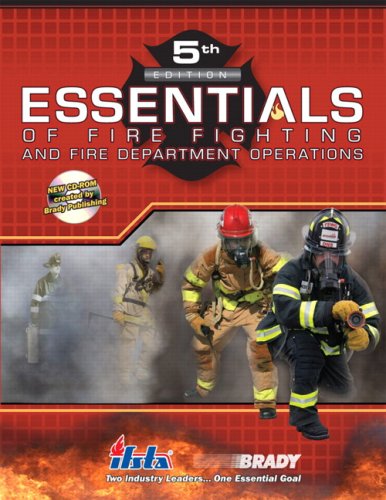
Essentials of Fire Fighting and Fire Department Operations (5th...
Authors:
IFSTA
Publisher:
Prentice Hall
Publication Date:
Not available
ISBN:
0135151112
Market-leading text for Fire Fighter I and Firefighter II training. Completely updated to meet NFPA 1001 objectives, the new 5e has been redesigned... offering both students and instructors the most comprehensive package available.
Essentials of Firefighting Student Workbook 5th Edition
Authors:
IFSTA
Publisher:
IFSTA
Publication Date:
Not available
ISBN:
0879392886
Fifth edition of the IFSTA Essentials of Fire Fighting STUDENT WORKBOOK. The student workbook is intended as a study aid for students who will be... participating in a class.The information is divided into FF 1 and FF 2 sections. References to page numbers are included in the workbook so students can use the product as a self-study tool by referring to the manual for correct answers.
Essentials of Fire Fighting Study Guide 5E
Authors:
IFTSA
Publisher:
IFSTA
Publication Date:
Not available
ISBN:
0879392878
The Essentials fifth edition study guide includes more than 1000 study questions and provides assistance with the certification exam. Each chapter in... the study guide is broken into FF I and FF II sections as appropriate.
ESSENTIALS OF FIRE FIGHTING WITH WORKBO
Authors:
Not Available
Publisher:
Not available
Publication Date:
Not available
ISBN:
Not available
Essentials of Fluid Mechanics: Fundamentals and Applications...
Authors:
John M. Cimbala
Publisher:
McGraw-Hill Higher Education
Publication Date:
Not available
ISBN:
0073138355
In a Liberal Arts Math course, a common question students ask is, “Why do I have to know this?” A Survey of Mathematics with Applications... continues to be a best-seller because it shows students how we use mathematics in our daily lives and why this is important. The Ninth Edition further emphasizes this with the addition of new “Why This Is Important” sections throughout the text. Real-life and up-to-date examples motivate the topics throughout, and a wide range of exercises help students to develop their problem-solving and critical thinking skills. Angel, Abbott, and Runde present the material in a way that is clear and accessible to non-math majors. The text includes a wide variety of math topics, with contents that are flexible for use in any one- or two-semester Liberal Arts Math course.
Essentials of Fluid Mechanics: Fundamentals and Applications w/...
Authors:
John Cimbala
Publisher:
McGraw-Hill Science/Engineering/Math
Publication Date:
Not available
ISBN:
0073301124
Lower level, but with the same "traditonal" every day examples that students identify with and that makes Cimbala/Cengel's approach unique. ... Essentials of Fluid Mechanics: Fundamentals and Applications is an abridged version of a more comprehensive text by the same authors, Fluid Mechanics: Fundamentals and Applications (McGraw-Hill 2006). The text covers the basic principles and equations of fluid mechanics in the context of numerous and diverse real-world engineering applications.
Essentials of Food Safety and Sanitation (4th Edition)
Authors:
David McSwane
Publisher:
Prentice Hall
Publication Date:
Not available
ISBN:
0131196596
If you deal with food in any capacity, whether in a deli, hotel, day care center, healthcare facility, catering, food service operation or restaurant,... it's your responsibility to make sure the food is safe to eat. Protect yourself and others by knowing the code, The Food Code. Essentials of Food Safety and Sanitation, Fourth Edition is compliant with the 2003 Supplement to the 2001 FDA Food Code and is designed to serve as a workplace reference guide to safe food handling procedures. Fully colorized, this edition features stories, and examples, expanded appendices, index and chapter references including related websites. Questions at the end of each chapter can help students prepare for exams and tests in the classroom. Use this book to prepare for any one of the national certification exams or as a teaching tool for training everyone on the basics of food safety. Essentials of Food Safety and Sanitation, Fourth Edition provides key information on these important topics: *Management of food safety and sanitation *Hazards to food safety *Factors affecting foodborne illness *Food flow *Seven steps of HACCP *Choosing tools and equipment *Cleaning and sanitizing *Accident prevention and crisis management *Training and education for line employees and management *Food safety regulations Remember, there's never been a case of foodborne illness that could not have been prevented!
Essentials of Food Science (Food Science Text Series)
Authors:
Vickie A. Vaclavik
Publisher:
Springer
Publication Date:
Not available
ISBN:
0387699392
Essentials of Food Science covers the basics of foods, food science, and food technology. The book is meant for the non-major intro course, whether... taught in the food science or nutrition/dietetics department. In previous editions the book was organized around the USDA Food Pyramid which has been replaced. The revised pyramid will now be mentioned in appropriate chapters only. Other updates include new photos, website references, and culinary alerts for culinary and food preparation students. Two added topics include RFID (Radio frequency ID) tags, and trans fat disclosures. Includes updates on: food commodities, optimizing quality, laws, and food safety.
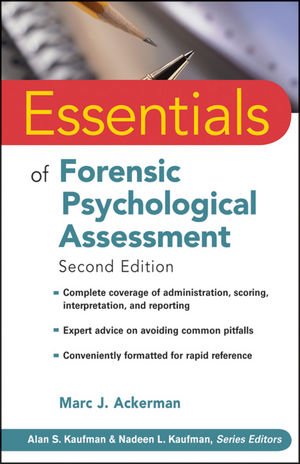
Essentials of Forensic Psychological Assessment (Essentials of...
Authors:
Marc J. Ackerman Ph.D.
Publisher:
Wiley
Publication Date:
Not available
ISBN:
0470551682
Quickly acquire the knowledge and skills you need to confidently administer, score, and interpret the key assessment instruments used by forensic... psychologistsMental health professionals are frequently called on to perform forensic assessments for a wide variety of court cases. To use these instruments properly, professionals need an authoritative source of advice and guidance on how to administer, score, and interpret them. Now fully revised and in a second edition, Essentials of Forensic Psychological Assessment is that source.The Second Edition is completely updated to reflect current research and theory in the field, including the most recent codes and standards published by the American Psychological Association. In addition, this volume offers updated coverage of the most frequently used instruments in forensic psychological assessments, including the MMPI®-2 and MMPI-2-RF, PAI®, Rorschach®, ASPECT, and various neuropsychological assessment instruments.Like all the volumes in the Essentials of Psychological Assessment series, this book is designed to help busy mental health practitioners, and those in training, quickly acquire the knowledge and skills they need to make optimal use of major psychological assessment instruments. Each concise chapter features numerous callout boxes highlighting key concepts, bulleted points, and extensive illustrative material, as well as test questions that help you gauge and reinforce your grasp of the information covered.Written by a noted forensic psychologist, the Second Edition offers in-depth coverage of maltreatment and domestic violence, as well as the assessment of recidivism, fitness to stand trial, civil commitment, substance abuse assessment, custody evaluations, personal injury assessments, and many other aspects of forensic mental health practice.

Essentials of General Chemistry
Authors:
Darrell Ebbing
Publisher:
Brooks Cole
Publication Date:
Not available
ISBN:
0618491759
"Essentials of General Chemistry "is the ideal choice for instructors who want a shorter, less expensive core text that still supports a typical one- or... two-semester general chemistry course. The text covers the same topical scope as Ebbing/Gammon, "General Chemistry, "and retains all of its hallmark qualities, including its focus on quantitative problem solving, conceptual understanding, and visualization skills. The new technology program reinforces the approach of the text and provides a complete solution for teaching and learning.The Second Edition retains the hallmark pedagogical features of the text and builds upon its conceptual focus. In addition, figures and interactive animations in the updated art program help students connect molecular-level activity to macro-scale phenomena. The new technology program offers access to tutoring, assessment, and presentation tools through the comprehensive Eduspace Course Management tool--instructors can also choose selected resources for use separately via CD or the Web.Conceptual understanding is further emphasized throughout the Second Edition and its technology program with a separate section of new "Conceptual Problems" appearing in the printed and computerized Test Bank."Answer Checks" follow selected Examples throughout the chapters in the text. They appear after the Solution and are designed to help students evaluate their answer to ensure that it is reasonable.Figures, drawings, and photos in the art program help students connect molecular-level activity to macro-scale phenomena. Animations in the student and instructor technology supplements also enhance students' ability to visualize molecular behavior.Based on instructorfeedback, 60-70 percent of the material from Chapter 13, "Materials of Technology" and from Chapter 23, "The Transition Elements and Coordination Compounds" has been divided into two new chapters: Chapter 21, "Chemistry of the Metals" and Chapter 22, "Chemistry of the Nonmetals."A suite of integrated technology tools for students and instructors includes materials (except restricted testing items) that are web accessible, with passwords included in the media guides. In addition, to meet instructor needs, the "Media Integration Guide for Instructors "includes CDs containing all teaching resources.To ensure that students devote more time to their study of chemistry, key elements of the technology are assignable. In the classroom, instructors can gauge student progress though a Classroom Response System. Online homework within Eduspace--using either end-of-chapter questions or practice exercises based on in-text examples--can be tracked and graded. Even new animations--now with skill-building exercises--can be assigned.To support you and your students as you use our technology, we offer implementation services from our TeamUP support staff, as well as media integration guides for both students and instructors, along with textbook web sites.Eduspace (powered by Blackboard) includes problems that cover all key concepts in the text. Through the Eduspace program, instructors can create their own assignments and post them for students to complete at a designated time. The problems in Eduspace include algorithmic end-of-chapter questions, exercises based on the in-text examples, and Test Bank questions to ensure consistency of level and coverage. Questions can be graded and entered into theonline gradebook automatically. Eduspace also includes additional course management and interactive communication tools.WebCT and Blackboard course cartridges include all the material on both the student and instructor web sites, as well as the HM Testing Test Bank.
ESSENTIALS OF GENERAL,ORGANIC...-ACCESS
Authors:
Not Available
Publisher:
Not available
Publication Date:
Not available
ISBN:
Not available
Essentials of General, Organic & Biochemistry & Sapling...
Authors:
Denise Guinn
Publisher:
W. H. Freeman
Publication Date:
Not available
ISBN:
1464114765
 '





