production
/viewbook/list/all/?page=4290
/
/static/
None

Everything in Its Path: Destruction of Community in the Buffalo...
Authors:
Kai T. Erikson
Publisher:
Simon & Schuster
Publication Date:
Not available
ISBN:
0671240676
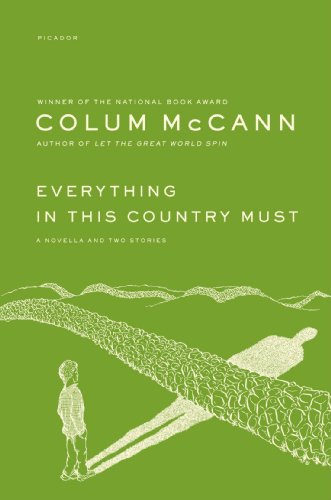
Everything in This Country Must: A Novella and Two Stories
Authors:
Colum McCann
Publisher:
Picador
Publication Date:
Not available
ISBN:
0312273185
In his fourth book, Colum McCann turns to the "troubles" in Northern Ireland and reveals the reverberations of political tragedy in the most intimate... lives of men and women, parents and children. In the title story, a teenage girl must choose between allegiance to her Catholic father and gratitude to the British soldiers who have saved the family's horse. The young hero of Hunger Strike, a novella, tries to replicate the experience of his uncle, an IRA prisoner on hunger strike. And in Wood, a small boy does his part for the Protestant marches, concealing his involvement from his blind father.

Everything Is Illuminated: A Novel
Authors:
Jonathan Safran Foer
Publisher:
Harper Perennial
Publication Date:
Not available
ISBN:
0060529709
With only a yellowing photograph in hand, a young man -- also named Jonathan Safran Foer -- sets out to find the woman who may or may not have saved his... grandfather from the Nazis. Accompanied by an old man haunted by memories of the war; an amorous dog named Sammy Davis, Junior, Junior; and the unforgettable Alex, a young Ukrainian translator who speaks in a sublimely butchered English, Jonathan is led on a quixotic journey over a devastated landscape and into an unexpected past.

Everything Is Miscellaneous: The Power of the New Digital Disorder
Authors:
David Weinberger
Publisher:
Holt Paperbacks
Publication Date:
Not available
ISBN:
0805088113
“Perfectly placed to tell us what’s really new about [the] second-generation Web.”—Los Angeles TimesBusiness visionary and bestselling author... David Weinberger charts how as business, politics, science, and media move online, the rules of the physical world—in which everything has a place—are upended. In the digital world, everything has its places, with transformative effects:• Information is now a social asset and should be made public, for anyone to link, organize, and make more valuable.• There’s no such thing as “too much” information. More information gives people the hooks to find what they need. • Messiness is a digital virtue, leading to new ideas, efficiency, and social knowledge. • Authorities are less important than buddies. Rather than relying on businesses or reviews for product information, customers trust people like themselves. With the shift to digital music standing as the model for the future in virtually every industry, Everything Is Miscellaneous shows how anyone can reap rewards from the rise of digital knowledge.
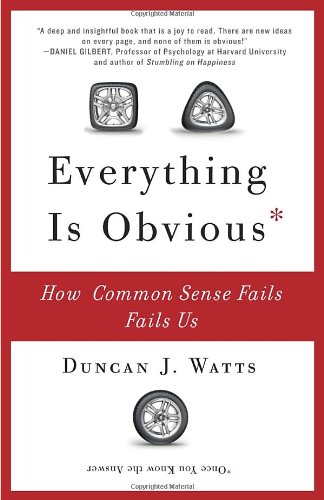
Everything Is Obvious: How Common Sense Fails Us
Authors:
Duncan J. Watts
Publisher:
Crown Business
Publication Date:
Not available
ISBN:
0307951790
Why is the Mona Lisa the most famous painting in the world? Why did Facebook succeed when other social networking sites failed? Did the surge in Iraq... really lead to less violence? How much can CEO’s impact the performance of their companies? And does higher pay incentivize people to work hard?If you think the answers to these questions are a matter of common sense, think again. As sociologist and network science pioneer Duncan Watts explains in this provocative book, the explanations that we give for the outcomes that we observe in life—explanation that seem obvious once we know the answer—are less useful than they seem.Drawing on the latest scientific research, along with a wealth of historical and contemporary examples, Watts shows how common sense reasoning and history conspire to mislead us into believing that we understand more about the world of human behavior than we do; and in turn, why attempts to predict, manage, or manipulate social and economic systems so often go awry.It seems obvious, for example, that people respond to incentives; yet policy makers and managers alike frequently fail to anticipate how people will respond to the incentives they create. Social trends often seem to have been driven by certain influential people; yet marketers have been unable to identify these “influencers” in advance. And although successful products or companies always seem in retrospect to have succeeded because of their unique qualities, predicting the qualities of the next hit product or hot company is notoriously difficult even for experienced professionals.Only by understanding how and when common sense fails, Watts argues, can we improve how we plan for the future, as well as understand the present—an argument that has important implications in politics, business, and marketing, as well as in science and everyday life.
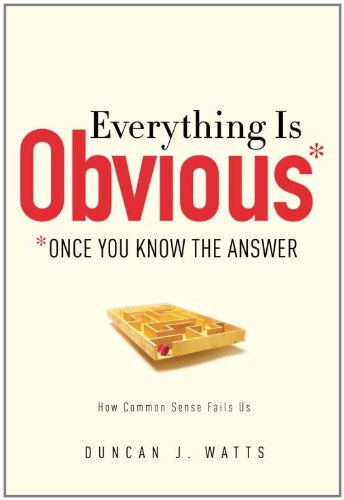
Everything Is Obvious: *Once You Know the Answer
Authors:
Duncan J. Watts
Publisher:
Crown Business
Publication Date:
Not available
ISBN:
0385531680
Why is the Mona Lisa the most famous painting in the world? Why did Facebook succeed when other social networking sites failed? Did the surge in Iraq... really lead to less violence? How much can CEO’s impact the performance of their companies? And does higher pay incentivize people to work hard?If you think the answers to these questions are a matter of common sense, think again. As sociologist and network science pioneer Duncan Watts explains in this provocative book, the explanations that we give for the outcomes that we observe in life—explanation that seem obvious once we know the answer—are less useful than they seem.Drawing on the latest scientific research, along with a wealth of historical and contemporary examples, Watts shows how common sense reasoning and history conspire to mislead us into believing that we understand more about the world of human behavior than we do; and in turn, why attempts to predict, manage, or manipulate social and economic systems so often go awry.It seems obvious, for example, that people respond to incentives; yet policy makers and managers alike frequently fail to anticipate how people will respond to the incentives they create. Social trends often seem to have been driven by certain influential people; yet marketers have been unable to identify these “influencers” in advance. And although successful products or companies always seem in retrospect to have succeeded because of their unique qualities, predicting the qualities of the next hit product or hot company is notoriously difficult even for experienced professionals.Only by understanding how and when common sense fails, Watts argues, can we improve how we plan for the future, as well as understand the present—an argument that has important implications in politics, business, and marketing, as well as in science and everyday life.

Everything Looks Impressive
Authors:
Hugh Kennedy
Publisher:
Main Street Books
Publication Date:
Not available
ISBN:
0385469063
Embarassed by his modest background, Yale freshman Alex MacDonald nevertheless falls in love with Jill Lanigan, a senior whose controversial sexual... political attitudes lead to a violent confrontation.
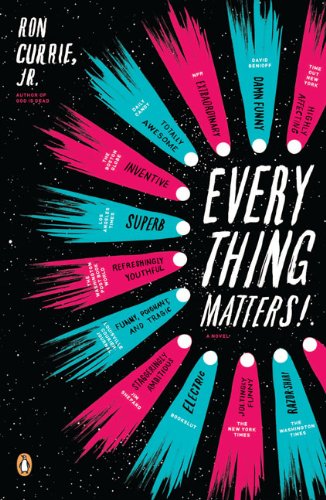
Everything Matters!: A Novel
Authors:
Ron Currie Jr.
Publisher:
Penguin Books
Publication Date:
Not available
ISBN:
0143117513
"Startlingly talented . . . he survives the inevitable, apt comparisons to Kurt Vonnegut and writes in a tenderly mordant voice all his own." -Janet... Maslin, The New York Times In this novel rich in character, Junior Thibodeau grows up in rural Maine in a time of Atari, baseball cards, pop Catholicism, and cocaine. He also knows something no one else knows-neither his exalted parents, nor his baseball-savant brother, nor the love of his life (she doesn't believe him anyway): The world will end when he is thirty-six. While Junior searches for meaning in a doomed world, his loved ones tell an all-American family saga of fathers and sons, blinding romance, lost love, and reconciliation-culminating in one final triumph that reconfigures the universe. A tour de force of storytelling, Everything Matters! is a genre-bending potpourri of alternative history, sci-fi, and the great American tale in the tradition of John Irving and Margaret Atwood.

Every Thing Must Go: Metaphysics Naturalized
Authors:
James Ladyman
Publisher:
Oxford University Press, USA
Publication Date:
Not available
ISBN:
0199573093
Every Thing Must Go aruges that the only kind of metaphysics that can contribute to objective knowledge is one based specifically on contemporary... science as it really is, and not on philosophers' a priori intuitions, common sense, or simplifications of science. In addition to showing how recent metaphysics has drifted away from connection with all other serious scholarly inquiry as a result of not heeding this restriction, they demonstrate how to build a metaphysics compatible with current fundamental phsyics ("ontic structural realism"), which, when combined with their metaphysics of the special sciences ("rainforet realism"), can be used to unify physics with the other sciences without reducing these sciences to physics intself. Taking science metaphysically seriously, Ladyman and Ross argue, means that metaphysicians must abandon the picture of the world as composed of self-subsistent individual objects, and the paradigm of causation as the collision of such objects. Every Thing Must Go also assesses the role of information theory and complex systems theory in attempts to explain the relationship between the special sciences and physics, treading a middle road between the grand synthesis of thermodynamics and information, and eliminativism about information. The consequences of the author's metaphysical theory for central issues in the philosophy of science are explored, including the implications for the realism vs. empiricism debate, the role of causation in scientific explanations, the nature of causation and laws, the status of abstract and virtual objects, and the objective reality of natural kinds
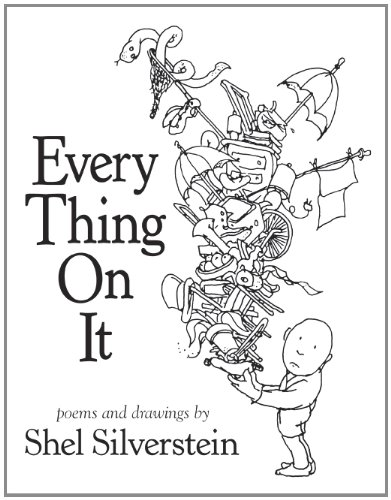
Every Thing On It
Authors:
Shel Silverstein
Publisher:
HarperCollins
Publication Date:
Not available
ISBN:
0061998168
A spider lives inside my head Who weaves a strange and wondrous web Of silken threads and silver strings To catch all sorts of flying things, Like... crumbs of thought and bits of smiles And specks of dried-up tears, And dust of dreams that catch and cling For years and years and years . . . Have you ever read a book with everything on it? Well, here it is, an amazing collection of never-before-published poems and drawings from the creator of Where the Sidewalk Ends, A Light in the Attic, and Falling Up. You will say Hi-ho for the toilet troll, get tongue-tied with Stick-a-Tongue-Out-Sid, play a highly unusual horn, and experience the joys of growing down. What's that? You have a case of the Lovetobutcants? Impossible! Just come on in and let the magic of Shel Silverstein bend your brain and open your heart.
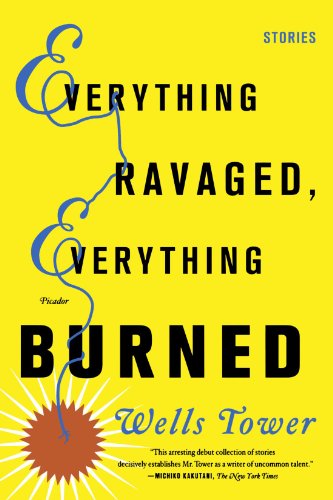
Everything Ravaged, Everything Burned: Stories
Authors:
Wells Tower
Publisher:
Picador
Publication Date:
Not available
ISBN:
0312429290
A NEW YORK TIMES BOOK REVIEW EDITORS' CHOICE Viking marauders descend on a much-plundered island, hoping some mayhem will shake off the winter blahs. ... A man is booted out of his home after his wife discovers that the print of a bare foot on the inside of his car's windshield doesn't match her own. Teenage cousins, drugged by summer, meet with a reckoning in the woods. A boy runs off to the carnival after his stepfather bites him in a brawl. Wells Tower's version of America is touched with the seamy splendor of the dropout, the misfit: failed inventors, boozy dreamers, hapless fathers, wayward sons. With electric prose and savage wit, Everything Ravaged, Everything Burned is a profound new collection of stories.

EVERYTHING'S AN ARG.- CUSTOM EDITION
Authors:
Not Available
Publisher:
Not available
Publication Date:
Not available
ISBN:
Not available

Everything's an Argument
Authors:
Andrea A. Lunsford
Publisher:
Bedford/St. Martin's
Publication Date:
Not available
ISBN:
0312447493
Everything's an Argument's unique, student-centered approach to teaching argument has made it the best-selling brief argument text on the market. The... book's engaging, informal style shows students first how to read and analyze a wide range of argumentative texts -- verbal and visual, scholarly and "real world" -- and then how to use what they learn to write their own arguments. Andrea Lunsford and John Ruszkiewicz's instruction is fresh, elegant, and jargon-free, emphasizing inclusivity (moving beyond simple pro/con positions), humor, and visual argument to make Everything's an Argument immediately accessible. Students like this book because it helps them see and understand that a world of argument already surrounds them; instructors like it because it helps students construct their own arguments about that world.

Everything's an Argument
Authors:
Andrea A. Lunsford
Publisher:
Bedford/St. Martin's
Publication Date:
Not available
ISBN:
1457606062
Microsoft Project saves you time and money by scheduling and tracking critical projects. Sams Teach Yourself Microsoft Project 2000 in 24 teaches you... exactly what they need to know in a small amount of time.

Everything's an Argument
Authors:
Andrea A. Lunsford
Publisher:
Bedford/St. Martin's
Publication Date:
Not available
ISBN:
0312538626
This best-selling brief text shows students how to analyze all kinds of arguments — not just essays and editorials, but clothes, cars, ads, and Web... site designs — and then how to use what they learn to write their own effective arguments. Andrea Lunsford and John Ruszkiewicz’s instruction is engaging, informal, and jargon-free. Emphasizing inclusiveness, humor, and visual argument, it makes Everything’s an Argument student-centered and immediately accessible. Students like this book because it helps them understand how a world of argument already surrounds them; instructors like it because it helps students construct their own arguments about that world.
 '





