production
/viewbook/list/all/?page=4293
/
/static/
None
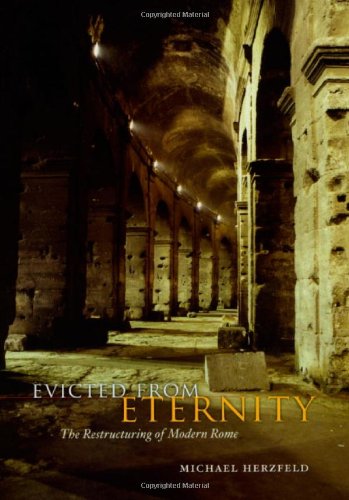
Evicted from Eternity: The Restructuring of Modern Rome
Authors:
Michael Herzfeld
Publisher:
University Of Chicago Press
Publication Date:
Not available
ISBN:
0226329127
Modern Rome is a city rife with contradictions. Once the seat of ancient glory, it is now often the object of national contempt. It plays a significant... part on the world stage, but the concerns of its residents are often deeply parochial. And while they live in the seat of a world religion, Romans can be vehemently anticlerical. These tensions between the past and the present, the global and the local, make Rome fertile ground to study urban social life, the construction of the past, the role of religion in daily life, and how a capital city relates to the rest of the nation.Michael Herzfeld focuses on Rome’s historic Monti district and the wrenching dislocation caused by rapid economical, political, and social change. Evicted from Eternity tells the story of the gentrification of Monti—once the architecturally stunning home of a community of artisans and shopkeepers now displaced by an invasion of rapacious real estate speculators, corrupt officials, dithering politicians, deceptive clerics, and shady thugs. As Herzfeld picks apart the messy story of Monti’s transformation, he ranges widely over many aspects of life there and in the rest of the city, richly depicting the uniquely local landscape of globalization in Rome.

Evidence: A Canadian Casebook
Authors:
Not Available
Publisher:
Not available
Publication Date:
Not available
ISBN:
1552394697
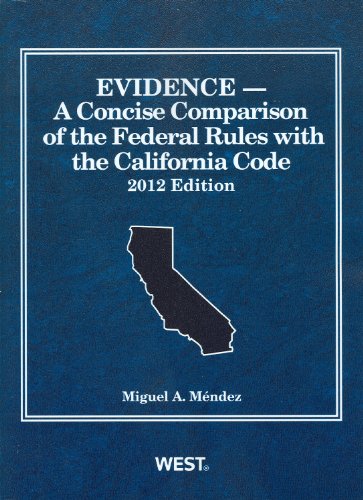
Evidence, A Concise Comparison of the Federal Rules with the...
Authors:
Miguel A. Mendez
Publisher:
West
Publication Date:
Not available
ISBN:
0314280812
This is the only rules pamphlet that concisely and systematically compares the Federal Rules of Evidence and California Evidence Code. Each chapter... corresponds to an article of the FRE. Each section contains the applicable Rules and corresponding Evidence Code Sections, as well as a concise commentary comparing the two. This edition includes the restyled FRE and the Evidence Code, including the Code Comments. It also includes the deleted Rules and a table indicating where the Rules and Evidence Code Sections are cited in the commentary.
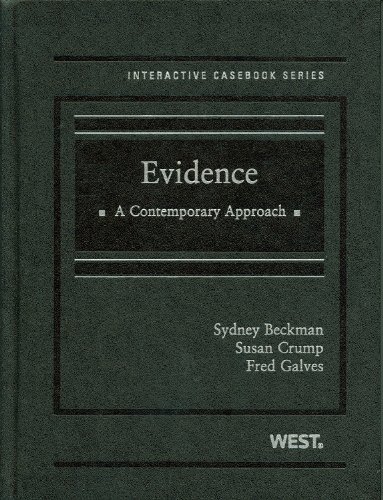
Evidence: A Contemporary Approach (Interactive Casebooks)
Authors:
Sydney Beckman
Publisher:
West
Publication Date:
Not available
ISBN:
0314191054
Evidence: A Contemporary Approach is the latest addition in a new breed of casebook. This book provides a comprehensive, engaging and effective... treatment of evidence presented in a clear and concise format that is accessible and engaging to students. The casebook features a novel visual display and layout that uses text boxes, diagrams, and color/border segregated feature sections for hypotheticals, references to scholarly debates, useful information for students, and questions to provoke thought. A major distinguishing feature of the book is its inclusion of an accompanying electronic version with extensive hyperlinking to Westlaw versions of legal materials, Black's Law Dictionary definitions, supplementary online resources, and more. PLEASE NOTE: If you purchase a used, unsealed copy of this book, access to the electronic version of this book may require a separate purchase.
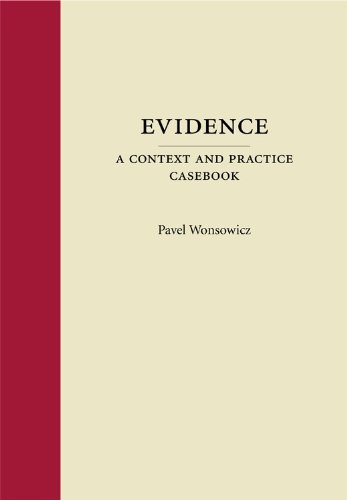
Evidence: A Context and Practice Casebook (Context and Practice...
Authors:
Pavel Wonsowicz
Publisher:
Carolina Academic Press
Publication Date:
Not available
ISBN:
1594605211
This casebook is designed to engage students with a wide range of learning styles and to explore evidence law from the eyes of an advocate. Through a... problem-centered approach that focuses on the gray areas of the Federal Rules of Evidence, students will develop a heightened sensitivity to factual and legal arguments that govern the admissibility of evidence. This focus on legal argumentation allows students to actively cultivate an understanding of the legal doctrine behind the Federal Rules of Evidence as well as the role that facts and narrative play in legal reasoning. Exercises, visual aids, and video supplements in each chapter allow students to assess their learning.A single thread that runs through the book is video and case materials surrounding a North Carolina murder trial, State v. Peterson. The trial was memorialized in an award-winning documentary, The Staircase, directed by Jean-Xavier de Lestrade. The casebook follows the trial, including the strategies undertaken by counsel and the battles over evidentiary issues that shaped both sides' narratives in the trial. Video excerpts will be provided to the instructor to add a further dimension to student learning and to reach a broad array of learning styles.This book is part of the Context and Practice Series, edited by Michael Hunter Schwartz, Professor of Law & Associate Dean for Faculty and Academic Development, Washburn University School of Law.
Evidence and Evolution: The Logic Behind the Science
Authors:
Elliott Sober
Publisher:
Cambridge University Press
Publication Date:
Not available
ISBN:
0521692741
How should the concept of evidence be understood? And how does the concept of evidence apply to the controversy about creationism as well as to work in... evolutionary biology about natural selection and common ancestry? In this rich and wide-ranging book, Elliott Sober investigates general questions about probability and evidence and shows how the answers he develops to those questions apply to the specifics of evolutionary biology. Drawing on a set of fascinating examples, he analyzes whether claims about intelligent design are untestable; whether they are discredited by the fact that many adaptations are imperfect; how evidence bears on whether present species trace back to common ancestors; how hypotheses about natural selection can be tested, and many other issues. His book will interest all readers who want to understand philosophical questions about evidence and evolution, as they arise both in Darwin's work and in contemporary biological research.
Evidence And Inquiry
Authors:
Susan Haack
Publisher:
Prometheus Books
Publication Date:
Not available
ISBN:
159102689X
Described by Hilary Putnam as both a fine introduction and a significant contribution to epistemology, and by Anthony Quinton as at once... comprehensive...and judicious, Evidence and Inquiry is unique both in its scope and in its originality. C. I. Lewis's foundationalism, BonJour's and Davidson's coherentism, Popper s critical rationalism, Quine's naturalism, and Rorty's, Stich's, and Churchland's anti-epistemological neopragmatism all come under Haack's uniquely thorough critical scrutiny. Core epistemological questions about the nature of belief, the character and structure of evidence, the determinants of evidential quality, the relation of justification, probability, and truth, among others, are given refreshingly novel, and reasonable, answers. Most books in epistemology are written only for other epistemologists. But Evidence and Inquiry has proven of interest not only to specialists but also to many other readers, from thoughtful scientists to thoughtful scholars of law and literature. This new, expanded edition--with a substantial new foreword and several additional papers on topics ranging from feminist epistemology to Peirce's critique of the adversarial legal system and Bentham's critique of exclusionary rules of evidence should attract longtime readers and newcomers alike.
Evidence and Inquiry: Towards Reconstruction in Epistemology
Authors:
Susan Haack
Publisher:
Wiley-Blackwell
Publication Date:
Not available
ISBN:
063119679X
In this important new work, Haack develops an original theory of empirical evidence or justification, and argues its appropriateness to the goals of... inquiry. In so doing, Haack provides detailed critical case studies of Lewis's foundationalism; Davidson's and Bonjour's coherentism; Popper's 'epistemology without a knowing subject'; Quine's naturalism; Goldman's reliabilism; and Rorty's, Stich's, and the Churchlands' recent obituaries of epistemology.
Evidence and Procedures for Boundary Location
Authors:
Walter G. Robillard
Publisher:
Wiley
Publication Date:
Not available
ISBN:
0470404787
Professional surveyors and many civil engineers must understand the laws of boundaries and the evidence necessary for efficient and accurate boundary... determination. This new edition of the preeminent text/reference on the subject is brought completely up to date, with new material on the use of technology in surveying and its legal ramifications, the use of forensic investigative techniques in the discovery of obscured evidence, new case law examples throughout, and new exhibits help illustrate the concepts presented.
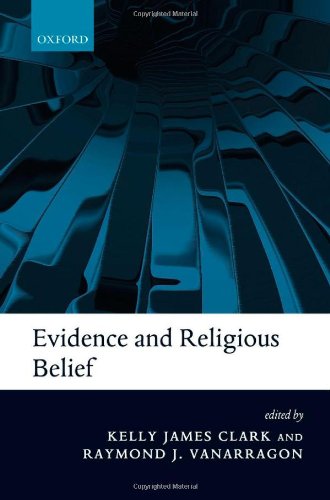
Evidence and Religious Belief
Authors:
Not Available
Publisher:
Oxford University Press, USA
Publication Date:
Not available
ISBN:
0199603715
A fundamental question in philosophy of religion is whether religious belief must be based on evidence in order to be properly held. In recent years... two prominent positions on this issue have been staked out: evidentialism, which claims that proper religious belief requires evidence; and Reformed epistemology, which claims that it does not. Evidence and Religious Belief contains eleven chapters by prominent philosophers which push the discussion in new directions. The volume has three parts. The first part explores the demand for evidence: some chapters object to it while others seek to restate it or find space for compromise between Reformed epistemology and evidentialism. The second part explores ways in which beliefs are related to evidence; that is, ways in which the evidence for or against religious belief that is available to a person can depend on that person's background beliefs and other circumstances. The third part contains chapters that discuss actual evidence for and against religious belief. Evidence for belief in God includes the so-called common consent of the human race and the way that such belief makes sense of the moral life; evidence against it includes profound puzzles about divine freedom which suggest that it is impossible for a being to be morally perfect.
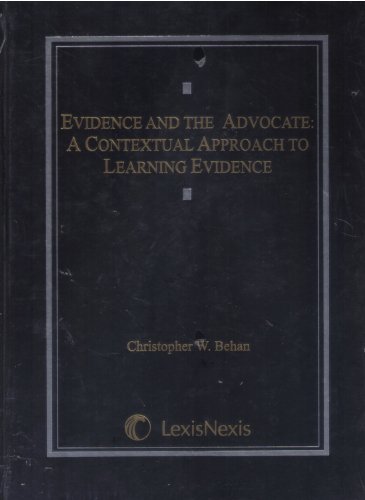
Evidence and the Advocate: A contextual Approach to Learning Evidence
Authors:
Chrtopher W. Behan
Publisher:
Not available
Publication Date:
Not available
ISBN:
142248193X
Evidence and the Advocate teaches each rule of evidence using a three pronged approach: (1) a treatise-like explanation of the rule, its purposes,... exceptions and foundations; (2) cases, discussion questions and hypothetical problems related to the rule; and (3) an application section in which the students must prepare a courtroom exercise putting the rule into action. This approach forms a teaching template for each rule of evidence. Each application exercise stands alone and has been designed to illuminate the rule being taught. The application exercises range from simple form-of-question drills to full-fledged evidentiary hearings. Some require minimal preparation, and others require significant out-of-class research and preparation. In the exercises, students serve as attorneys, witnesses, judges, and, in the more involved exercises, as a court of appeals. The exercises build on each other. The initial exercises focus on fundamental advocacy skills such as conducting a direct examination or laying the foundation for an exhibit. Later exercises incorporate these foundational skills for more complicated tasks such as writing a motion, impeaching a witness, or conducting a Daubert hearing on the reliability of expert testimony. This book also is available in a heavily discounted, three-hole punched, alternative loose-leaf version printed on 8 ½ x 11 inch paper with wider margins and with the same pagination as the hardbound book.
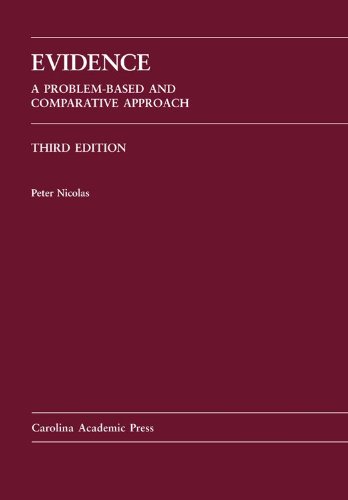
Evidence: A Problem-Based and Comparative Approach
Authors:
Peter Nicolas
Publisher:
Carolina Academic Press
Publication Date:
Not available
ISBN:
1611630959
This casebook provides a comprehensive, problem-based approach to studying the rules of evidence. Organized around the federal rules, this casebook... provides coverage of every single rule; yet, through careful case choice and editing, Professor Nicolas has produced a book that can easily be taught from cover-to-cover in as few as three semester hours. Key features of the casebook include approximately 115 in-depth problems that are designed to teach all the nuances of the rules, as well as coverage of selected state rules of evidence that differ significantly from the federal rules designed to facilitate class discussion about the policies underlying the rules of evidence. In addition, the casebook contains an enriched section on scientific evidence, in-depth coverage of the rules to electronic evidence, and a chapter on appellate review of evidentiary rulings. The third edition of the casebook builds on the strengths of the second edition while at the same time updating it to reflect recent developments. The text of the third edition has been revised to reflect the language of the Restyled Federal Rules of Evidence, which take effect in December 2011. The third edition will contain edited versions of the Supreme Court's most recent Confrontation Clause decisions, including Melendez-Diaz v. Massachusetts, Michigan v. Bryant, and Bullcoming v. New Mexico. The third edition will also include recent decisions applying the rules of evidence to electronic evidence, including cases involving information found on social networking websites. In addition, the third edition contains expanded coverage of state rules of evidence that differ significantly from the federal rules. Finally, in an effort to keep the book manageable in length, Professor Nicolas has--as a general rule--tried to remove a page of material for every new page added. An annual supplement is produced each year that includes the latest developments in evidence law so as to keep the textbook up-to-date between editions. A separate statutory supplement includes the federal rules of evidence and selected legislative history. In addition, the Teacher's Manual includes detailed answers to all of the problems contained in the casebook.
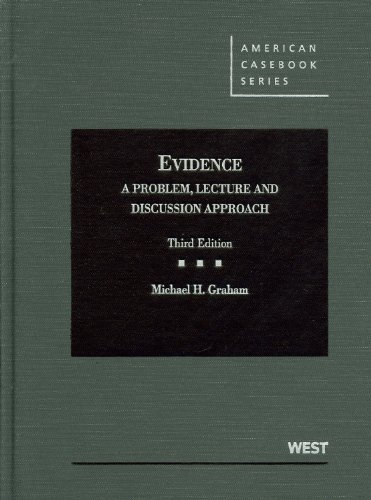
Evidence: A Problem, Lecture and Discussion Approach, 3d (American...
Authors:
Michael H. Graham
Publisher:
West
Publication Date:
Not available
ISBN:
0314273581
This textbook, reflecting the Federal Rules of Evidence as restyled effective December, 2011, facilitates a problem/lecture/discussion approach... introducing students to comprehensive evidence and Confrontation Clause textual material. Included with the text are 1,155 true-false and multiple-choice questions, along with hypothetical questions. Answers are provided in the Teacher's Manual. Overall, this textbook is designed for the astute artisan knowledgeable experienced evidence professor interested and capable of thoroughly conveying to her students the practical realities of the Federal Rules of Evidence and the Confrontation Clause. The objective is to thoroughly prepare students for trial practice courses, the bar examination, and more significantly practice.
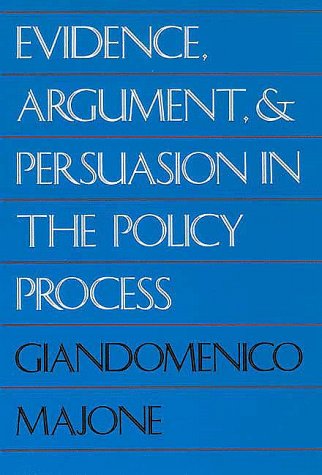
Evidence, Argument, and Persuasion in the Policy Process
Authors:
Giandomenico Majone
Publisher:
Yale University Press
Publication Date:
Not available
ISBN:
0300052596
Challenges the common assumption that policy analysts engage in a purely objective technical assessment of policy alternatives. This book argues that... what analysts really do is produce policy arguments that are based on value judgements and are used by policymakers in the course of public debate.
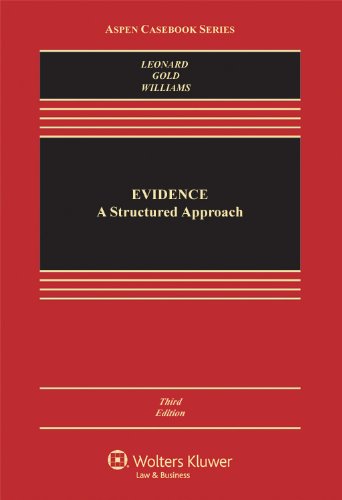
Evidence: A Structured Approach, Third Edition
Authors:
David P. Leonard
Publisher:
Aspen Publishers
Publication Date:
Not available
ISBN:
1454805412
Evidence: A Structured Approach is designed to facilitate teaching and learning. Its unique organization complements the way most professors teach... evidence law, with each section focused on one Federal Rule of Evidence. Questions are presented as a series of short, accessible hypotheticals and build upon one another to facilitate thorough student understanding of the rule at hand. Students know in advance what questions will be the focus of classroom discussion, providing a strong incentive to come to class prepared. The authors emphasize the written rules, rather than case law, as the primary source of evidence law today. Salient cases are skillfully edited to provide solid legal grounding in the topic, and author-written explanatory material and notes help bring the rules of evidence to life. The Third Edition welcomes new co-author Gary Williams, an expert in the rules of evidence. New Supreme Court cases, with questions for classroom discussion, and new FRE amendments are also included in this edition. The impact of new technology on evidence law issues is explored through cases and problems. Hallmark features: The structured approach complements the way that most professors teach evidence law: One Federal Rule of Evidence introduces each section, followed by text including numerous examples--explaining the background, rationale, and details of the rule. Questions for classroom discussion are presented as a series of short hypotheticals--each illustrating a single aspect of the rule and building on previous questions until the rule is fully explored--to facilitate learning and improve student preparation for class. Focus is on written rules, rather than cases, as the primary source of evidence law today. Skillfully edited versions of cases, including seminal cases that every literate lawyer should know. Includes hypothetical transcript exercises, charts, and diagrams . Hearsay chapter includes chains of inference (Statement Inference Conclusion) to illustrate hearsay and nonhearsay uses of statements. Streamlined, manageable length is appealing to professors and students. Students may download the questions from the authors' website for a head start on class notes. Also included on the website are additional questions and materials for students studying California law; password-protected questions, answers, and materials for professors ; and late-breaking evidence cases and FRE amendments.
 '





