production
/viewbook/list/all/?page=4301
/
/static/
None

EVIEWS 6 Student Version
Authors:
Not Available
Publisher:
Not available
Publication Date:
Not available
ISBN:
Not available

EVIEWS 7.0 STUDENT VERSION
Authors:
Not Available
Publisher:
Not available
Publication Date:
Not available
ISBN:
Not available
EVIEWS 7 STUDENT VERSION
Authors:
Not Available
Publisher:
Not available
Publication Date:
Not available
ISBN:
Not available
EVIEW STUDENT VERS 6.0
Authors:
Not Available
Publisher:
Not available
Publication Date:
Not available
ISBN:
Not available

Evil and/or/as the Good: Omnicentrism, Intersubjectivity, and Value...
Authors:
Brook Ziporyn
Publisher:
Harvard University Asia Center
Publication Date:
Not available
ISBN:
0674002482
"Other than the devil, there is no Buddha; other than the Buddha, there is no devil." The Chinese monk Siming Zhili (960-1028) uttered this remark as... part of his justification for his self-immolation. An exposition of the intent, implications, and resonances of this one sentence, this book expands and unravels the context in which the seeming paradox of the ultimate identity of good and evil is to be understood. In analyzing this idea, Brook Ziporyn provides an overview of the development of Tiantai thought from the fifth through the eleventh centuries in China and contributes to our understanding of Chinese intellectual culture and Chinese Buddhism, as well as to basic ontological, epistemological, and axiological issues of interest in modern philosophy.

Evil and the God of Love
Authors:
John Hick
Publisher:
Palgrave Macmillan
Publication Date:
Not available
ISBN:
0230252796
When first published, Evil and the God of Love instantly became recognized as a modern theological classic, widely viewed as the most important work on... the problem of evil to appear in English for more than a generation. It has continued to be at the center of discussions ever since. This reissue of the work includes a new preface by the author.
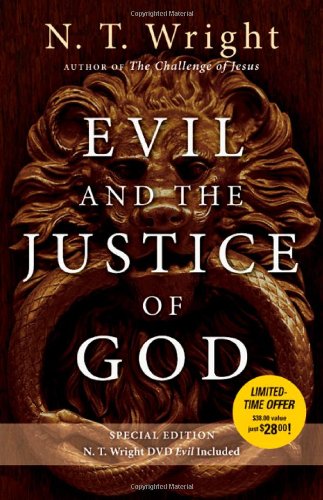
Evil and the Justice of God
Authors:
N. T. Wright
Publisher:
IVP Books
Publication Date:
Not available
ISBN:
0830833986
Merit Award, 2007 Christianity Today Theology/Ethics Book With every earthquake and war, understanding the nature of evil and our response to it... becomes more urgent. Evil is no longer the concern just of ministers and theologians but also of politicians and the media. We hear of child abuse, ethnic cleansing, AIDS, torture and terrorism, and rightfully we are shocked. But, N. T. Wright says, we should not be surprised. For too long we have naively believed in the modern idea of human progress. In contrast, postmodern thinkers have rightly argued that evil is real, powerful and important, but they give no real clue as to what we should do about it. In fact, evil is more serious than either our culture or our theology has supposed. How then might Jesus' death be the culmination of the Old Testament solution to evil but on a wider and deeper scale than most imagine? Can we possibly envision a world in which we are delivered from evil? How might we work toward such a future through prayer and justice in the present? These are the powerful and pressing themes that N. T. Wright addresses in this book that is at once timely and timeless.
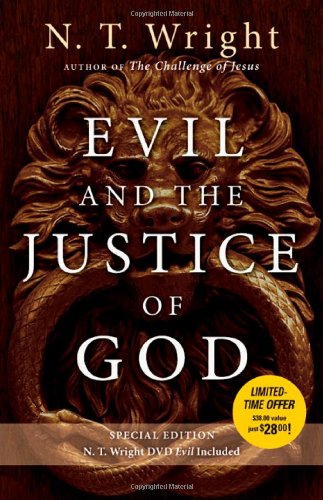
Evil and the Justice of God (with DVD)
Authors:
N. T. Wright
Publisher:
IVP Books
Publication Date:
Not available
ISBN:
0830837442
Merit Award, 2007 Christianity Today Theology/Ethics Book With every earthquake and war, understanding the nature of evil and our response to it becomes... more urgent. Evil is no longer the concern just of ministers and theologians but also of politicians and the media. We hear of child abuse, ethnic cleansing, AIDS, torture and terrorism, and rightfully we are shocked. But, N. T. Wright says, we should not be surprised. For too long we have naively believed in the modern idea of human progress. In contrast, postmodern thinkers have rightly argued that evil is real, powerful and important, but they give no real clue as to what we should do about it. In fact, evil is more serious than either our culture or our theology has supposed. How then might Jesus' death be the culmination of the Old Testament solution to evil but on a wider and deeper scale than most imagine? Can we possibly envision a world in which we are delivered from evil? How might we work toward such a future through prayer and justice in the present? These are the powerful and pressing themes that N. T. Wright addresses in this book that is at once timely and timeless. Included with the book is the companion DVD, Evil. Filmed in Israel, South Africa and England, Evil confronts some of the major issues of our time, from the Christmas Tsunami to the African AIDS pandemic, from the Iraq war and 9/11 to the murky world of violence and sexual exploitation, and puts them under the biblical spotlight. In this 50-minute film Wright explores, with Desmond Tutu in South Africa, the potential for defeating evil. There is a solution to the problem of evil, he says, if only we have the honesty and the courage to name it and understand it for what it is.
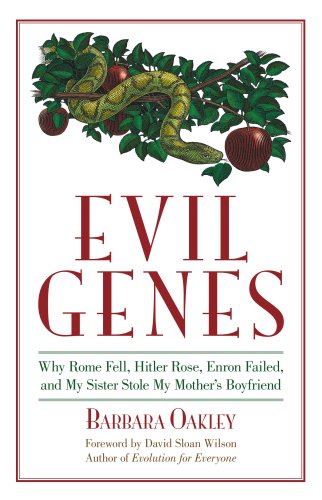
Evil Genes: Why Rome Fell, Hitler Rose, Enron Failed, and My Sister...
Authors:
Barbara Oakley
Publisher:
Prometheus Books
Publication Date:
Not available
ISBN:
1591026652
Have you ever met a person who left you wondering, 'How could someone be so twisted? So evil?' Prompted by clues in her sister's diary after her... mysterious death, author Barbara Oakley takes the reader inside the head of the kinds of malevolent people you know, perhaps all too well, but could never understand. Starting with psychology as a frame of reference, Oakley uses cutting-edge images of the working brain to provide startling support for the idea that 'evil' people act the way they do mainly as the result of a dysfunction. In fact, some deceitful, manipulative, and even sadistic behavior appears to be programmed genetically - suggesting that some people really are born to be bad. But there are unexpected fringe benefits to 'evil genes'. We may not like them - but we literally can't live without them. Oakley deftly ties together the big picture implications of revolutionary neuroscientific and genetic discoveries, showing the eerily similar behavioral tics of Mao, Stalin, Hitler, and Slobodan Milosevic. The dramatic recent scientific findings presented in "Evil Genes" shed light not only on dictators far afield, but on politics at home, as well as business, religion, and everyday life. In fact, history itself has been shaped by the strange confluence of genes and environment that science is just now beginning to understand. Oakley links the latest findings of molecular research to a wide array of seemingly unrelated historical and current phenomena, from the harems of the Ottomans and the chummy jokes of 'Uncle Joe' Stalin, to the remarkable memory of investor Warren Buffet. Throughout, she never loses sight of the personal cost of evil genes as she unravels the mystery surrounding her sister's enigmatic life - and death. "Evil Genes" is a tour-de-force of popular science writing that brilliantly melds scientific research with intriguing family history and puts both a human and scientific face to evil.
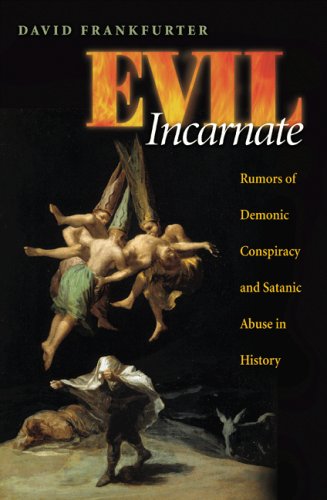
Evil Incarnate: Rumors of Demonic Conspiracy and Satanic Abuse in...
Authors:
David Frankfurter
Publisher:
Princeton University Press
Publication Date:
Not available
ISBN:
0691136297
In the 1980s, America was gripped by widespread panics about Satanic cults. Conspiracy theories abounded about groups who were allegedly abusing... children in day-care centers, impregnating girls for infant sacrifice, brainwashing adults, and even controlling the highest levels of government. As historian of religions David Frankfurter listened to these sinister theories, it occurred to him how strikingly similar they were to those that swept parts of the early Christian world, early modern Europe, and postcolonial Africa. He began to investigate the social and psychological patterns that give rise to these myths. Thus was born Evil Incarnate, a riveting analysis of the mythology of evilconspiracy. The first work to provide an in-depth analysis of the topic, the book uses anthropology, the history of religion, sociology, and psychoanalytic theory, to answer the questions "What causes people collectively to envision evil and seek to exterminate it?" and "Why does the representation of evil recur in such typical patterns?" Frankfurter guides the reader through such diverse subjects as witch-hunting, the origins of demonology, cannibalism, and the rumors of Jewish ritual murder, demonstrating how societies have long expanded upon their fears of such atrocities to address a collective anxiety. Thus, he maintains, panics over modern-day infant sacrifice are really not so different from rumors about early Christians engaging in infant feasts during the second and third centuries in Rome. In Evil Incarnate, Frankfurter deepens historical awareness that stories of Satanic atrocities are both inventions of the mind and perennial phenomena, not authentic criminal events. True evil, as he so artfully demonstrates, is not something organized and corrupting, but rather a social construction that inspires people to brutal acts in the name of moral order.
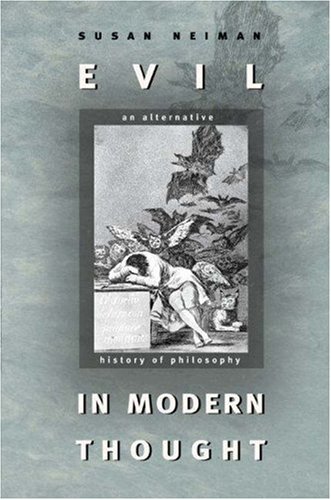
Evil in Modern Thought: An Alternative History of Philosophy
Authors:
Susan Neiman
Publisher:
Princeton University Press
Publication Date:
Not available
ISBN:
0691117926
Evil threatens human reason, for it challenges our hope that the world makes sense. For eighteenth-century Europeans, the Lisbon earthquake was manifest... evil. Today we view evil as a matter of human cruelty, and Auschwitz as its extreme incarnation. Examining our understanding of evil from the Inquisition to contemporary terrorism, Susan Neiman explores who we have become in the three centuries that separate us from the early Enlightenment. In the process, she rewrites the history of modern thought and points philosophy back to the questions that originally animated it.Whether expressed in theological or secular terms, evil poses a problem about the world's intelligibility. It confronts philosophy with fundamental questions: Can there be meaning in a world where innocents suffer? Can belief in divine power or human progress survive a cataloging of evil? Is evil profound or banal? Neiman argues that these questions impelled modern philosophy. Traditional philosophers from Leibniz to Hegel sought to defend the Creator of a world containing evil. Inevitably, their efforts--combined with those of more literary figures like Pope, Voltaire, and the Marquis de Sade--eroded belief in God's benevolence, power, and relevance, until Nietzsche claimed He had been murdered. They also yielded the distinction between natural and moral evil that we now take for granted. Neiman turns to consider philosophy's response to the Holocaust as a final moral evil, concluding that two basic stances run through modern thought. One, from Rousseau to Arendt, insists that morality demands we make evil intelligible. The other, from Voltaire to Adorno, insists that morality demands that we don't.Beautifully written and thoroughly engaging, this book tells the history of modern philosophy as an attempt to come to terms with evil. It reintroduces philosophy to anyone interested in questions of life and death, good and evil, suffering and sense.
Evil: Inside Human Violence and Cruelty
Authors:
Roy F. Baumeister Ph.D.
Publisher:
W. H. Freeman
Publication Date:
Not available
ISBN:
0716735679
The question of evil, and the answers. Part 1 Image and reality: victims and perpetrators; the myth of pure evil. Part 2 The four roots of evil: greed,... lust, ambition - evil as a means to an end; egotism and revenge; true believers and idealists; can evil be fun? the joy of hurting. Part 3 How they do it: crossing the line - how evil starts; how evil grows and spreads; dealing with guilt; ambivalence and fellow travelers. Part 4 Conclusion: why is there evil.
Evil: Inside Human Violence and Cruelty
Authors:
Roy F. Baumeister
Publisher:
Holt Paperbacks
Publication Date:
Not available
ISBN:
0805071652
Why is there evil, and what can scientific research tell us about the origins and persistence of evil behavior? Considering evil from the unusual... perspective of the perpetrator, Baumeister asks, How do ordinary people find themselves beating their wives? Murdering rival gang members? Torturing political prisoners? Betraying their colleagues to the secret police? Why do cycles of revenge so often escalate? Baumeister casts new light on these issues as he examines the gap between the victim's viewpoint and that of the perpetrator, and also the roots of evil behavior, from egotism and revenge to idealism and sadism. A fascinating study of one of humankind's oldest problems, Evil has profound implications for the way we conduct our lives and govern our society.
Evil Minds: Understanding and Responding to Violent Predators
Authors:
Robert J. Meadows
Publisher:
Prentice Hall
Publication Date:
Not available
ISBN:
0130486132
This unique, engaging book uses a multi-disciplinary approach in an effort to understand the “evil minds” of criminals that engage in predatory... violence. Evil Minds uses the study of the “monsters” among us—serial killers, mass murderers, child molesters and rapists—to introduce readers to the theories, concepts and research from the fields of psychology, sociology, criminology & criminal justice that social scientists employ to understand and respond to violent criminals. A three-part organization covers: violent crimes: types and patterns, sources of predatory violence, and investigating and prosecuting evil. For a variety of individuals working tin the criminal justice field who try to understand, analyze, investigate, and prosecute violent criminal offenders.
 '





