production
/viewbook/list/all/?page=4322
/
/static/
None

EXCERPTS FROM PLOUS' UND. PREJUDICE...
Authors:
Not Available
Publisher:
Not available
Publication Date:
Not available
ISBN:
Not available

ExCET Art Sample Test (All-Level-Secondary) 005, 006 Texas Teacher...
Authors:
Sharon Wynne
Publisher:
XAMOnline.com
Publication Date:
Not available
ISBN:
1581979258
Includes 60 competencies/skills found on both the ExCET Art All-Level and Secondary tests and 112 sample-test questions. This guide, aligned... specifically to standards prescribed by the Texas Department of Education, covers the sub-areas of Awareness, Basic Design, and Organization; Individual Expression: Tools, Materials, Techniques, and Methods; Art, Culture, and Heritage; Aesthetic Growth and Development; and Art Instruction.

Exchange and Power in Social Life
Authors:
Peter M. Blau
Publisher:
Transaction Publishers
Publication Date:
Not available
ISBN:
0887386288
In this landmark study, originally published in 1964, Peter Blau considers a basic question: How does social life become organized into increasingly... complex structures of associations among humans? "Blau's analysis represents a very important advance in the application of exchange analysis to social structure and behavior."--S. N. Eisenstadt, The American Journal of Sociology
EXCHANGE LISTS FOR DIABETES
Authors:
Not Available
Publisher:
Not available
Publication Date:
Not available
ISBN:
Not available

Exchanges: A Global History Reader, Volume 2
Authors:
Trevor R. Getz
Publisher:
Prentice Hall
Publication Date:
Not available
ISBN:
0321387481
This impressive collection of readings illustrates that the history of the world is as much about the relationships among societies as it is about... transformations and continuities within societies. Exchanges: A Global History Reader is designed as an introduction to the discipline of world history. Unlike other source collections, Exchanges helps students look beyond strictly delineated regionalism and chronological structures to understand history as a product of ongoing debate. Structured around a series of interconnected themes and debates, and pairing both primary and secondary sources, Exchanges challenges both students and teachers to rethink history.
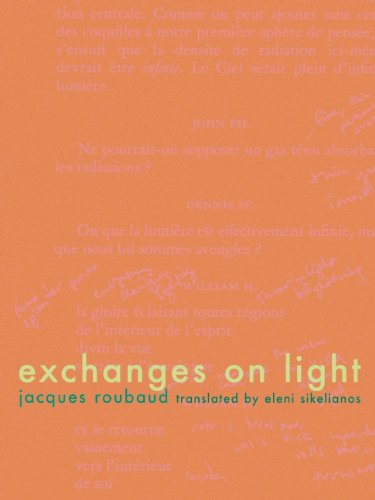
Exchanges on Light
Authors:
Jacques Roubaud
Publisher:
La Presse
Publication Date:
Not available
ISBN:
1934200026
Cast as a dialogue among six interlocuters, this lyric, pensive blend of poetry and prose considers light from a variety of perspectivesphilosophical,... physical, ethical, and metaphoricalall of them beautiful. As with so much of Roubaud’s work, a delicate humor and a deep compassion engage to create a lovely and responsible text.
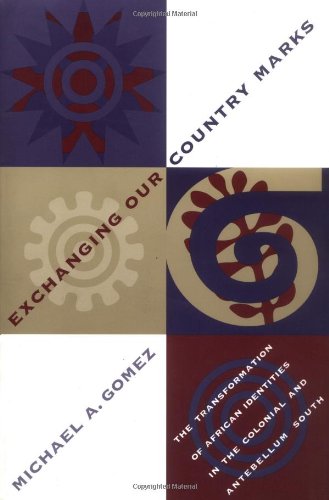
Exchanging Our Country Marks: The Transformation of African...
Authors:
Michael A. Gomez
Publisher:
The University of North Carolina Press
Publication Date:
Not available
ISBN:
0807846945
The transatlantic slave trade brought individuals from diverse African regions and cultures to a common destiny in the American South. In this... comprehensive study, Michael Gomez establishes tangible links between the African American community and its African origins and traces the process by which African populations exchanged their distinct ethnic identities for one defined primarily by the conception of race. He examines transformations in the politics, social structures, and religions of slave populations through 1830, by which time the contours of a new African American identity had begun to emerge.After discussing specific ethnic groups in Africa, Gomez follows their movement to North America, where they tended to be amassed in recognizable concentrations within individual colonies (and, later, states). For this reason, he argues, it is possible to identify particular ethnic cultural influences and ensuing social formations that heretofore have been considered unrecoverable. Using sources pertaining to the African continent as well as runaway slave advertisements, ex-slave narratives, and folklore, Gomez reveals concrete and specific links between particular African populations and their North American progeny, thereby shedding new light on subsequent African American social formation.
Excisée l'
Authors:
ACCAD EVELYNE
Publisher:
L'Harmattan
Publication Date:
Not available
ISBN:
2858022232
Our understanding of how the human brain performs mathematical calculations is far from complete, but in recent years there have been many exciting... breakthroughs by scientists all over the world. Now, in The Number Sense, Stanislas Dehaene offers a fascinating look at this recent research, in an enlightening exploration of the mathematical mind. Dehaene begins with the eye-opening discovery that animals--including rats, pigeons, raccoons, and chimpanzees--can perform simple mathematical calculations, and that human infants also have a rudimentary number sense. Dehaene suggests that this rudimentary number sense is as basic to the way the brain understands the world as our perception of color or of objects in space, and, like these other abilities, our number sense is wired into the brain. These are but a few of the wealth of fascinating observations contained here. We also discover, for example, that because Chinese names for numbers are so short, Chinese people can remember up to nine or ten digits at a time--English-speaking people can only remember seven. The book also explores the unique abilities of idiot savants and mathematical geniuses, and we meet people whose minute brain lesions render their mathematical ability useless. This new and completely updated edition includes all of the most recent scientific data on how numbers are encoded by single neurons, and which brain areas activate when we perform calculations. Perhaps most important, The Number Sense reaches many provocative conclusions that will intrigue anyone interested in learning, mathematics, or the mind. "A delight." --Ian Stewart, New Scientist"Read The Number Sense for its rich insights into matters as varying as the cuneiform depiction of numbers, why Jean Piaget's theory of stages in infant learning is wrong, and to discover the brain regions involved in the number sense." --The New York Times Book Review"Dehaene weaves the latest technical research into a remarkably lucid and engrossing investigation. Even readers normally indifferent to mathematics will find themselves marveling at the wonder of minds making numbers." --Booklist
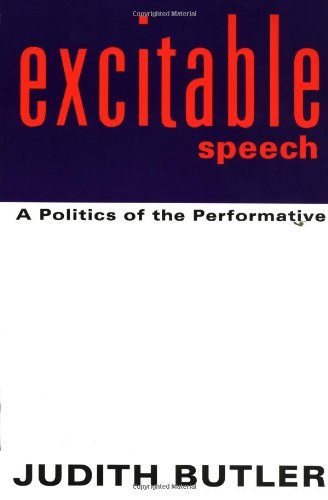
Excitable Speech: A Politics of the Performative
Authors:
Judith Butler
Publisher:
Routledge
Publication Date:
Not available
ISBN:
0415915880
With the same intellectual courage with which she addressed issues of gender, Judith Butler turns her attention to speech and conduct in contemporary... political life, looking at several efforts to target speech as conduct that has become subject to political debate and regulation. Reviewing hate speech regulations, anti-pornography arguments, and recent controversies about gay self-declaration in the military, Judith Butler asks whether and how language acts in each of these cultural sites.
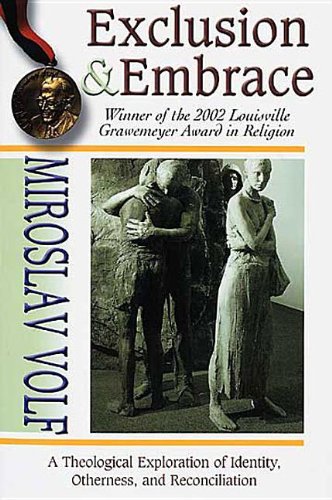
Exclusion & Embrace: A Theological Exploration of Identity,...
Authors:
Miroslav Volf
Publisher:
Abingdon Press
Publication Date:
Not available
ISBN:
0687002826
Life at the end of the twentieth century presents us with a disturbing reality. Otherness, the simple fact of being different in some way, has come to... be defined as in and of itself evil. Miroslav Volf contends that if the healing word of the gospel is to be heard today, Christian theology must find ways of speaking that address the hatred of the other. Reaching back to the New Testament metaphor of salvation as reconciliation, Volf proposes the idea of embrace as a theological response to the problem of exclusion. Increasingly we see that exclusion has become the primary sin, skewing our perceptions of reality and causing us to react out of fear and anger to all those who are not within our (ever-narrowing) circle. In light of this, Christians must learn that salvation comes, not only as we are reconciled to God, and not only as we "learn to live with one another," but as we take the dangerous and costly step of opening ourselves to the other, of enfolding him or her in the same embrace with which we have been enfolded by God. Is there any hope of embracing our enemies? Of opening the door to reconciliation? Miroslav Volf, a Yale University theologian, has won the 2002 Louisville Grawemeyer Award in Religion for his book, Exclusion & Embrace: A Theological Exploration of Identity, Otherness, and Reconciliation (Abingdon, 1996). Volf argues that “exclusion” of people who are alien or different is among the most intractable problems in the world today. He writes, “It may not be too much to claim that the future of our world will depend on how we deal with identity and difference. The issue is urgent. The ghettos and battlefields throughout the world—in the living rooms, in inner cities, or on the mountain ranges—testify indisputably to its importance.” A Croatian by birth, Volf takes as a starting point for his analysis the recent civil war and “ethnic cleansing” in the former Yugoslavia, but he readily finds other examples of cultural, ethnic, and racial conflict to illustrate his points. And, since September 11, one can scarcely help but plug the new world players into his incisive descriptions of the dynamics of interethnic and international strife. Exclusion happens, Volf argues, wherever impenetrable barriers are set up that prevent a creative encounter with the other. It is easy to assume that “exclusion” is the problem or practice of “barbarians” who live “over there,” but Volf persuades us that exclusion is all too often our practice “here” as well. Modern western societies, including American society, typically recite their histories as “narratives of inclusion,” and Volf celebrates the truth in these narratives. But he points out that these narratives conveniently omit certain groups who “disturb the integrity of their ‘happy ending’ plots.” Therefore such narratives of inclusion invite “long and gruesome” counter-narratives of exclusion—the brutal histories of slavery and of the decimation of Native American populations come readily to mind, but more current examples could also be found. Most proposed solutions to the problem of exclusion have focused on social arrangements—what kind of society ought we to create in order to accommodate individual or communal difference? Volf focuses, rather, on “what kind of selves we need to be in order to live in harmony with others.” In addressing the topic, Volf stresses the social implications of divine self-giving. The Christian scriptures attest that God does not abandon the godless to their evil, but gives of Godself to bring them into communion. We are called to do likewise—“whoever our enemies and whoever we may be.” The divine mandate to embrace as God has embraced is summarized in Paul’s injunction to the Romans: “Welcome one another, therefore, just as Christ has welcomed you” (Romans 15:7). Susan R. Garrett, Coordinator of the Religion Award, said that the Grawemeyer selection committee praised Volf’s book on many counts. These included its profound interpretation of certain pivotal passages of Scripture and its brilliant engagement with contemporary theology, philosophy, critical theory, and feminist theory. “Volf’s focus is not on social strategies or programs but, rather, on showing us new ways to understand ourselves and our relation to our enemies. He helps us to imagine new possibilities for living against violence, injustice, and deception.” Garrett added that, although addressed primarily to Christians, Volf's theological statement opens itself to religious pluralism by upholding the importance of different religious and cultural traditions for the formation of personal and group identity. The call to “embrace the other” is never a call to remake the other into one’s own image. Volf—who had just delivered a lecture on the topic of Exclusion and Embrace at a prayer breakfast for the United Nations when the first hijacked plane hit the World Trade Center—will present a lecture and receive his award in Louisville during the first week of April, 2002. The annual Religion Award, which includes a cash prize of $200,000, is given jointly by Louisville Presbyterian Theological Seminary and the University of Louisville to the authors or originators of creative works that contribute significantly to an understanding of “the relationship between human beings and the divine, and ways in which this relationship may inspire or empower human beings to attain wholeness, integrity, or meaning, either individually or in community.” The Grawemeyer awards—given also by the University of Louisville in the fields of musical composition, education, psychology, and world order—honor the virtue of accessibility: works chosen for the awards must be comprehensible to thinking persons who are not specialists in the various fields.
Exclusiveness and Tolerance: Studies in Jewish-Gentile Relations in...
Authors:
Jacob Katz
Publisher:
Behrman House
Publication Date:
Not available
ISBN:
0874413656
The author discusses the changes of attitude on the part of the Jews toward their non-Jewish environment from the middle ages to the Enlightenment. Most... of the material has been drawn from the province of Ashkenazi Jewry-- the Jews of Germany and eastern Europe.
Excptnl Learnrs: Intro S/Valu&New Myeduclab
Authors:
Not Available
Publisher:
Not available
Publication Date:
Not available
ISBN:
0133019144
EXCUR IN MOD MATH(LL)+MATHLAB+ACCESS+RB
Authors:
Not Available
Publisher:
Not available
Publication Date:
Not available
ISBN:
Not available
EXCURSION
Authors:
Not Available
Publisher:
Not available
Publication Date:
Not available
ISBN:
Not available
Excursions in Calculus: An Interplay of the Continuous and the...
Authors:
Robert M. Young
Publisher:
The Mathematical Association of America
Publication Date:
Not available
ISBN:
0883853175
The purpose of this book is to explore the rich and elegant interplay that exists between the two main currents of mathematics, the continuous and the... discrete. Such fundamental notions in discrete mathematics as induction, recursion, combinatorics, number theory, discrete probability, and the algorithmic point of view as a unifying principle are continually explored as they interact with traditional calculus. The book is addressed primarily to well-trained calculus students and those who teach them, but it can also serve as a supplement in a traditional calculus course for anyone who wants to see more. The problems, taken for the most part from probability, analysis, and number theory, are an integral part of the text. There are over 400 problems presented in this book.
 '





