production
/viewbook/list/all/?page=4325
/
/static/
None

EXCURSIONS MODERN MATH PKG UNIV KENTUCKY
Authors:
Not Available
Publisher:
Not available
Publication Date:
Not available
ISBN:
Not available
EXCURSIONS WORLD MUSIC MG PKG MUS 2863
Authors:
Not Available
Publisher:
Not available
Publication Date:
Not available
ISBN:
Not available
Executed on a Technicality: Lethal Injustice on America's Death Row
Authors:
David Dow
Publisher:
Beacon Press
Publication Date:
Not available
ISBN:
0807044199
When David Dow took his first capital case, he supported the death penalty. He changed his position as the men on death row became real people to him,... and as he came to witness the profound injustices they endured: from coerced confessions to disconcertingly incompetent lawyers; from racist juries and backward judges to a highly arbitrary death penalty system.It is these concrete accounts of the people Dow has known and represented that prove the death penalty is consistently unjust, and it's precisely this fundamental-and lethal-injustice, Dow argues, that should compel us to abandon the system altogether.
Executing Daniel Bright: Race, Loyalty, and Guerrilla Violence in a...
Authors:
Barton A. Myers
Publisher:
Louisiana State University Press
Publication Date:
Not available
ISBN:
0807143626
On December 18, 1863, just north of Elizabeth City in rural northeastern North Carolina, a large group of white Union officers and black enlisted troops... under the command of Brigadier General Edward Augustus Wild executed a local citizen for his involveme
EXECUTING STRATEGIES <CUSTOM>
Authors:
Not Available
Publisher:
Not available
Publication Date:
Not available
ISBN:
Not available
Executing Your Strategy: How to Break It Down and Get It Done
Authors:
Mark Morgan
Publisher:
Harvard Business School Press
Publication Date:
Not available
ISBN:
1591399564
Why do businesses consistently fail to execute their competitive strategies? Because leaders don't identify and invest in the full range of projects and... programs required to align the organization with its strategy. Moreover, even when strategy makers do break their plans down into doable chunks, they seldom work with project leaders to prioritize strategic investments and assure that needed resources are applied in priority order. And they often neglect to revise the strategic portfolio to fit the demands of a dynamic environment, or to stay connected to strategic projects through completion, as new products, services, skills and capabilities are transferred into operations. In Executing Your Strategy, Mark Morgan, Raymond Levitt, and William Malek present six imperatives that enable you to do the right strategic projects--and do those projects right. And it is no accident that the six imperatives combine to create the acronym INVEST:Ideation: Clarify and communicate Purpose, Identity and Long Range Intention Nature: Develop alignment between Strategy, Structure and Culture based on Ideation Vision: Create clear Goals and Metrics aligned to Strategy and guided by IdeationEngagement: Do the right projects based on the Strategy through Portfolio managementSynthesis: Do Projects and Programs right, in alignment with PortfolioTransition: Move the Project and Program outputs into Operations where benefit is realizedFull of intriguing company examples and practical advice, this crucial new resource shows you how to make strategy happen in your organization
Execution and Invention: Death Penalty Discourse in Early Rabbinic...
Authors:
Beth A. Berkowitz
Publisher:
Oxford University Press, USA
Publication Date:
Not available
ISBN:
0195179196
The death penalty in classical Judaism has been a highly politicized subject in modern scholarship. Enlightenment attacks on the Talmud's legitimacy... led scholars to use the Talmud's criminal law as evidence for its elevated morals. But even more pressing was the need to prove Jews' innocence of the charge of killing Christ. The reconstruction of a just Jewish death penalty was a defense against the accusation that a corrupt Jewish court was responsible for the death of Christ. In Execution and Invention, Beth A. Berkowitz tells the story of modern scholarship on the ancient rabbinic death penalty and offers a fresh perspective using the approaches of ritual studies, cultural criticism, and talmudic source criticism. Against the scholarly consensus, Berkowitz argues that the early Rabbis used the rabbinic laws of the death penalty to establish their power in the wake of the destruction of the Temple. Following recent currents in historiography, Berkowitz sees the Rabbis as an embattled, almost invisible sect within second-century Judaism. The function of their death penalty laws, Berkowitz contends, was to create a complex ritual of execution under rabbinic control, thus bolstering rabbinic claims to authority in the context of Roman political and cultural domination.Understanding rabbinic literature to be in dialogue with the Bible, with the variety of ancient Jews, and with Roman imperialism, Berkowitz shows how the Rabbis tried to create an appealing alternative to the Roman, paganized culture of Palestine's Jews. In their death penalty, the Rabbis substituted Rome's power with their own. Early Christians, on the other hand, used death penalty discourse to critique judicial power. But Berkowitz argues that the Christian critique of execution produced new claims to authority as much as the rabbinic embrace. By comparing rabbinic conversations about the death penalty with Christian ones, Berkowitz reveals death penalty discourse as a significant means of creating authority in second-century western religious cultures. Advancing the death penalty discourse as a discourse of power, Berkowitz sheds light on the central relationship between religious and political authority and the severest form of punishment.
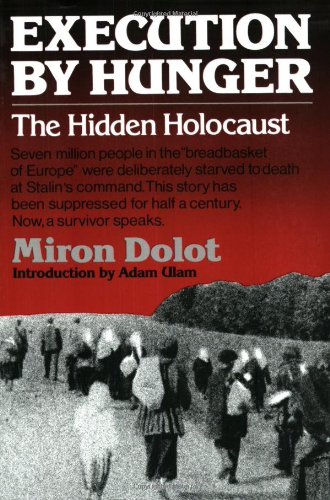
Execution By Hunger
Authors:
Miron Dolot
Publisher:
W. W. Norton & Company
Publication Date:
Not available
ISBN:
0393304167
Seven million people in the "breadbasket of Europe" were deliberately starved to death at Stalin's command. This story has been suppressed for half a... century. Now, a survivor speaks.In 1929, in an effort to destroy the well-to-do peasant farmers, Joseph Stalin ordered the collectivization of all Ukrainian farms. In the ensuing years, a brutal Soviet campaign of confiscations, terrorizing, and murder spread throughout Ukrainian villages. What food remained after the seizures was insufficient to support the population. In the resulting famine as many as seven million Ukrainians starved to death. This poignant eyewitness account of the Ukrainian famine by one of the survivors relates the young Miron Dolot's day-to-day confrontation with despair and death—his helplessness as friends and family were arrested and abused—and his gradual realization, as he matured, of the absolute control the Soviets had over his life and the lives of his people. But it is also the story of personal dignity in the face of horror and humiliation. And it is an indictment of a chapter in the Soviet past that is still not acknowledged by Russian leaders.

Execution of Justice (Acting Edition)
Authors:
Emily Mann
Publisher:
Samuel French, Inc.
Publication Date:
Not available
ISBN:
0573690022
The World: A Brief History gives students the whole story. Prentice Hall is proud to offer The World: A Brief History-the new brief version of The... World: A History adapted by author Felipe Fernandez-Armesto himself. The use of The World: A Brief History offers added flexibility in teaching World History, allowing instructors to supplement the text with additional readers or other material of their choice. And because the brief text was written by Fernandez-Armesto himself, it continues to offer the holistic, narrative approach to history that has made the comprehensive text successful at schools across the nation.

Execution Poems
Authors:
George Elliott Clarke
Publisher:
Gaspereau Pr
Publication Date:
Not available
ISBN:
1554470811
After nine years and nine trade printings, Gaspereau Press is issuing a revised and redesigned second edition of its most popular title. Originally... released in 2000 in a limited edition of 66 books handset and printed letterpress in a folio format, Execution Poems has gone on to sell over 6000 copies. It was the winner of the 2001 Governor General’s award for poetry and took first place in the poetry category of the 2001 Alcuin Awards for Excellence in Canadian Book Design. Execution Poems is a suite of poems about Clarke’s cousins, George and Rufus Hamilton, who were hanged in July 1949 for the murder of a Fredericton, New Brunswick, taxi driver. In this startling work, Clarke reminds us of racism and poverty and of their brutal, tragic results, blurring the line between the perpetrator and the victim? a line we’d prefer to be simple and clear. As all true poetry should, Clarke’s embodies both damnation and redemption, offering convoluted triumphs alongside tragedy.
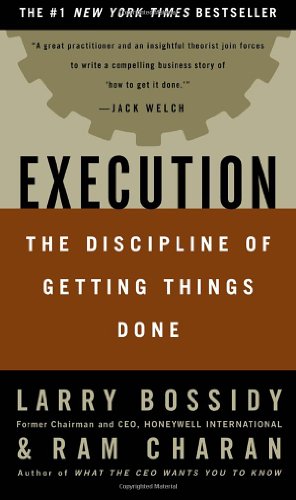
Execution: The Discipline of Getting Things Done
Authors:
Larry Bossidy
Publisher:
Crown Business
Publication Date:
Not available
ISBN:
0609610570
The book that shows how to get the job done and deliver results . . . whether you’re running an entire company or in your first management job.Larry... Bossidy is one of the world’s most acclaimed CEOs, a man with few peers who has a track record for delivering results. Ram Charan is a legendary advisor to senior executives and boards of directors, a man with unparalleled insight into why some companies are successful and others are not. Together they’ve pooled their knowledge and experience into the one book on how to close the gap between results promised and results delivered that people in business need today.After a long, stellar career with General Electric, Larry Bossidy transformed AlliedSignal into one of the world’s most admired companies and was named CEO of the year in 1998 by Chief Executive magazine. Accomplishments such as 31 consecutive quarters of earnings-per-share growth of 13 percent or more didn’t just happen; they resulted from the consistent practice of the discipline of execution: understanding how to link together people, strategy, and operations, the three core processes of every business.Leading these processes is the real job of running a business, not formulating a “vision” and leaving the work of carrying it out to others. Bossidy and Charan show the importance of being deeply and passionately engaged in an organization and why robust dialogues about people, strategy, and operations result in a business based on intellectual honesty and realism.The leader’s most important job—selecting and appraising people—is one that should never be delegated. As a CEO, Larry Bossidy personally makes the calls to check references for key hires. Why? With the right people in the right jobs, there’s a leadership gene pool that conceives and selects strategies that can be executed. People then work together to create a strategy building block by building block, a strategy in sync with the realities of the marketplace, the economy, and the competition. Once the right people and strategy are in place, they are then linked to an operating process that results in the implementation of specific programs and actions and that assigns accountability. This kind of effective operating process goes way beyond the typical budget exercise that looks into a rearview mirror to set its goals. It puts reality behind the numbers and is where the rubber meets the road. Putting an execution culture in place is hard, but losing it is easy. In July 2001 Larry Bossidy was asked by the board of directors of Honeywell International (it had merged with AlliedSignal) to return and get the company back on track. He’s been putting the ideas he writes about in Execution to work in real time.
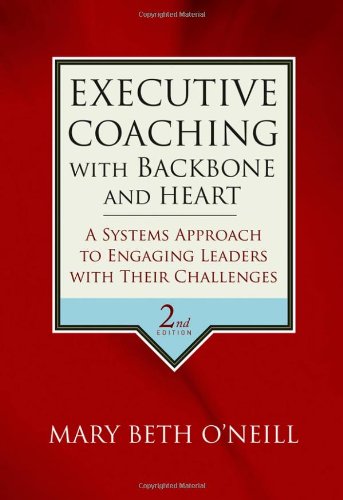
Executive Coaching with Backbone and Heart: A Systems Approach to...
Authors:
Mary Beth A. O'Neill
Publisher:
Jossey-Bass
Publication Date:
Not available
ISBN:
0787986399
Praise for Executive Coaching with Backbone and Heart"In this book, O'Neill brings form and structure to the art of executive coaching. Novices are... provided a path while seasoned practitioners will find affirmation."--Daryl R. Conner, CEO and president, ODR-USA, Inc."Mary Beth O'Neill's executive coaching gave me the tools and clarity to become a far more effective leader and change agent. The bottom line was that we succeeded with a monumental organizational turnaround that had seemed impossible to accomplish."--Eric Stevens, former CEO, Courage Center"O'Neill writes in a way that allows you to see this experienced coach in action. What a wonderful way to learn!"--Geoff Bellman, consultant and author, The Consultant's Calling"Mary Beth brings a keen business focus to coaching by not just contributing insights but through helping me and my team gain the insights that we need to solve our own problems. She has the ability to see through the sometimes chaotic dialogue and personalities in order to help a team focus on the real issues and dynamics that can impede organizations from achieving their goals."--John C. Nicol, general manager, MSN Media Network"Effective leaders require courage, compassion, and initiative. O'Neill's systems-based coaching serves as a guide for both coaches and executives to better enable good decisions and good decision-makers."--Paul D. Purcell, president, Beacon Development Group"With Mary Beth O'Neill's coaching, I've become the kind of leader who balances both the needs to get results and to develop great working relationships.?Since I started working with her, I've won accolades as the Top Innovator for my company, and as Professional of the Year for my industry.?More important, I've been able to scope my job in a way that allows me to learn and contribute at the same time, all the while delivering great results to the bottom line."--Lynann Bradbury, vice president, Waggener Edstrom
Executive Compensation (Second Edition)
Authors:
Michael Melbinger
Publisher:
CCH, Inc.
Publication Date:
Not available
ISBN:
0808017578
A critical element of any employer's business strategy and success must be to attract, retain and motivate top executive talent. The principal factor... for implementing this strategy is the employer's program for compensating its executives. Executive Compensation is a vital tool for employers, executives, boards of directors, human resources departments, legal counsel, and other executive compensation professionals and advisers. It is designed to assist these professionals in establishing and maintaining executive compensation programs that: - Attract, retain and motivate talented executives - Are cost-effective to the employer - Minimize litigation risk - Are tax-effective to the employer and the executive - Preserve all possible exist strategies and capital funding sources; and - Comply with all applicable laws and regulations. Boards of directors, the courts and judiciary, plaintiffs' class action lawyers, the IRS, the SEC, institutional investors, the press, and the U.S. Congress are all focusing on executive compensation. Executive Compensation considers the impact of the Sarbanes-Oxley Act of 2002, and other legislation resulting from Enron/WorldCom/Andersen scandals, which have dramatically altered the executive compensation landscape for the foreseeable future. This 2nd Edition also includes detailed discussions of Internal Revenue Code Sec. 409A, the SEC's redesign executive compensation disclosure rules and the legislation and regulations resulting from the stock option backdating scandals. Executive Compensation describes the numerous federal statutes that govern the terms and provisions of executive compensation, including the Internal Revenue Code, the Securities Act of 1933, the Securities Exchange Act of 1934, and the Employee Retirement Income Security Act of 1974 (ERISA). Executive Compensation also discusses court decisions, state laws, accounting standards, stock exchange requirements and governmental regulations that apply. New for this Second Edition: Since publication of the First Edition of Executive Compensation, we have seen: - The implementation of new Internal Revenue Code Sec. 409A, including 397 pages of final regulations, which impacts employment and change in control agreements, stock-based compensation, and severance pay plans, in addition to the nonqualified and deferred compensation plans it was designed to effect. - The SEC release of 436 pages of Final Rules on Disclosure of Executive Compensation and Director Independence in August 2006, together with a virtual revolution in corporate governance practices in the area of executive compensation - The Bankruptcy Abuse Prevention and Consumer Protection Act of 2005. - Two critical decisions on board of directors responsibility (and potential liability) for executive compensation relating to The Walt Disney Company Shareholder Litigation, and more than one dozen other court cases of significance. - A stock options backdating scandal, which ensnared many of the biggest technology names in corporate America, with the involvement of the courts and judiciary, plaintiffs' class action lawyers, the IRS, the SEC, institutional investors, the press, and the U.S. Congress.
Executive directors guide: The guide to successful nonprofit...
Authors:
Deborah Linnell
Publisher:
United Way of Massachusetts Bay/Third Sector New England
Publication Date:
Not available
ISBN:
097174260X
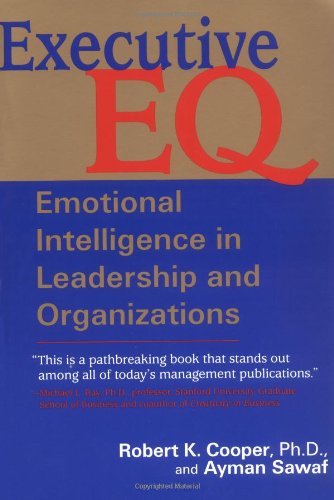
Executive E. Q.
Authors:
Robert Cooper
Publisher:
Perigee Trade
Publication Date:
Not available
ISBN:
0399524045
Executives, managers, and professionals all across America are praising Executive EQ and are putting the precepts of this book into action for raising... emotional intelligence in their leadership and at all levels of their organizations.
 '





