production
/viewbook/list/all/?page=4351
/
/static/
None
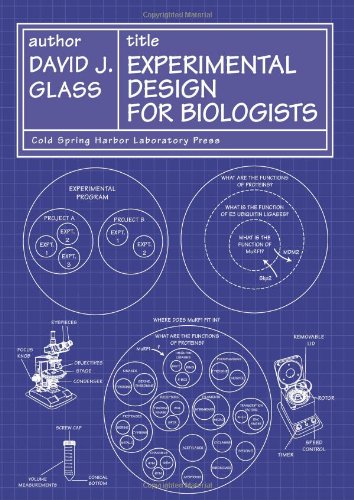
Experimental Design for Biologists
Authors:
David J. Glass
Publisher:
Cold Spring Harbor Laboratory Press
Publication Date:
Not available
ISBN:
0879697350
The effective design of scientific experiments is critical to success, yet graduate students receive very little formal training in how to do it. Based... on a well-received course taught by the author, Experimental Design for Biologists fills this gap. Experimental Design for Biologists explains how to establish the framework for an experimental project, how to set up a system, design experiments within that system, and how to determine and use the correct set of controls. Separate chapters are devoted to negative controls, positive controls, and other categories of controls that are perhaps less recognized, such as "assumption controls," and "experimentalist controls." Furthermore, there are sections on establishing the experimental system, which include performing critical "system controls." Should all experimental plans be hypothesis-driven? Is a question/answer approach more appropriate? What was the hypothesis behind the Human Genome Project? What color is the sky? How does one get to Carnegie Hall? The answers to these kinds of questions can be found in Experimental Design for Biologists. Written in an engaging manner, the book provides compelling lessons in framing an experimental question, establishing a validated system to answer the question, and deriving verifiable models from experimental data. Experimental Design for Biologists is an essential source of theory and practical guidance in designing a research plan.Related Titles from the Publisher Statistics at the Bench: A Step-By-Step Handbook for Biologists CSH Protocols Laboratory Research Notebook
Experimental Design for the Life Sciences
Authors:
Graeme Ruxton
Publisher:
Oxford University Press, USA
Publication Date:
Not available
ISBN:
0199569126
At the core of good research lies the careful design of experiments. However, all too often a successful design comes only after a painful... trial-and-error process that wastes valuable time and resources.Now in a new edition, Experimental Design for the Life Sciences teaches today's students how to effectively design experiments, equipping them with the skills they need to become tomorrow's top researchers. Employing a refreshingly approachable and articulate style, the text explains the essential elements of experimental design in clear, practical terms, so that students can grasp and apply even the most challenging concepts, including power analysis and pseudoreplication. In addition, it emphasizes the interrelatedness of experimental design, statistics, and ethical considerations throughout. A broad range of examples--drawn from the primary literature and the authors' extensive personal experience--demonstrate the practical relevance of experimental design in real-life biological research.The only undergraduate text devoted to this topic, Experimental Design for the Life Sciences, Third Edition, demonstrates how good experimental design relies on clear thinking and biological understanding, not on mathematical or statistical complexity.Pedagogical Features* Self-test questions, with answers at the end of the book, reinforce essential facts and encourage students to check their understanding as they progress* Take-home messages throughout chapters focus students' attention on the principles that they must master* Coverage of ethical issues, flagged in the margins, raises awareness of this important aspect of the fieldNew to this Edition* A new section on identifying questions worth answering and turning such questions into hypotheses and, ultimately, experiments* A new section illustrating common mistakes in experimental design (to assist with evaluating the work of others)* Expanded coverage of between-individual variation, replication, statistical power, and performing observational studies* More topical examples from a wider range of fields in the life sciences, including biomedical studies* An expanded Companion Website that offers students self-test questions and answers; additional questions; links to useful websites and free software; and fully worked examples of investigative exercises. Figures from the book are available for download by instructors.
Experimental Design: From User Studies to Psychophysics
Authors:
Douglas Cunningham
Publisher:
A K Peters/CRC Press
Publication Date:
Not available
ISBN:
1568814682
As computers proliferate and as the field of computer graphics matures, it has become increasingly important for computer scientists to understand how... users perceive and interpret computer graphics. Experimental Design: From User Studies to Psychophysics is an accessible introduction to psychological experiments and experimental design, covering the major components in the design, execution, and analysis of perceptual studies. The book begins with an introduction to the concepts central to designing and understanding experiments, including developing a research question, setting conditions and controls, and balancing specificity with generality. The book then explores in detail a number of types of experimental tasks: free description, rating scales, forced-choice, specialized multiple choice, and real-world tasks as well as physiological studies. It discusses the advantages and disadvantages of each type and provides examples of that type of experiment from the authors’ own work. The book also covers stimulus-related issues, including popular stimulus resources. It concludes with a thorough examination of statistical techniques for analyzing results, including methods specific to individual tasks.

Experimental Design & Online Marketing Rsearch
Authors:
Not Available
Publisher:
Not available
Publication Date:
Not available
ISBN:
1119935210
Experimental Design: Procedures for Behavioral Sciences (Psychology)
Authors:
Roger E. Kirk
Publisher:
Wadsworth Publishing
Publication Date:
Not available
ISBN:
0534250920
Written by a renowned psychologist Roger E. Kirk of Baylor University, this classic text provides the graduate student in experimental design with... detailed coverage of the designs and techniques with the greatest potential use in behavioral research. Kirk's book is known for its emphasis on the logical rather than the mathematical basis of experimental design; for its in-depth exploration of the relationship between analysis of variance and regression analysis; for its introduction of the concept of building block designs; and for its comprehensive scope that describes all of the ANOVA experimental designs that are potentially useful in the behavioral sciences and education.
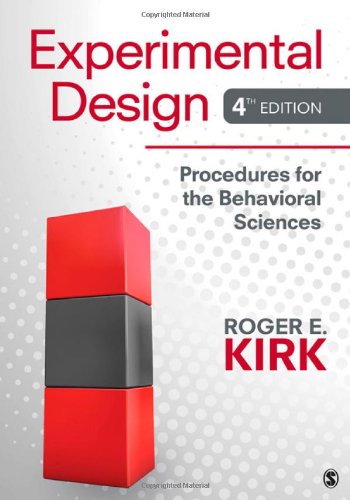
Experimental Design: Procedures for the Behavioral Sciences
Authors:
Roger E. Kirk
Publisher:
Sage Publications, Inc
Publication Date:
Not available
ISBN:
1412974453
Experimental Design: Procedures for Behavioral Sciences, Fourth Edition is a classic text with a reputuation for accessibility and readability. It has... been revised and updated to make learning design concepts even easier. Roger E. Kirk shows how three simple experimental designs can be combined to form a variety of complex designs. He provides diagrams illustrating how subjects are assigned to treatments and treatment combinations. New terms are emphasized in boldface type, there are summaries of the advantages and disadvantages of each design, and real-life examples show how the designs are used.
EXPERIMENTAL DESIGN & REGRESSION ]PKG[
Authors:
Not Available
Publisher:
Not available
Publication Date:
Not available
ISBN:
Not available
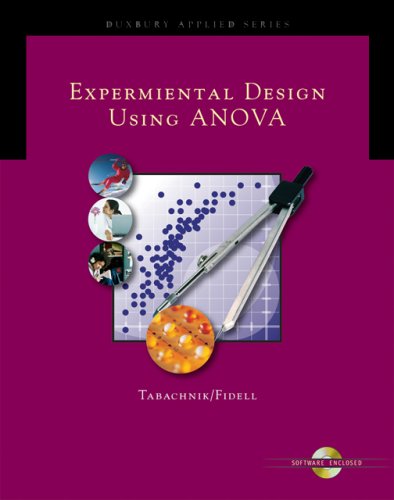
Experimental Designs Using ANOVA (with Student Suite CD-ROM)...
Authors:
Barbara G. Tabachnick
Publisher:
Duxbury Press
Publication Date:
Not available
ISBN:
0534405142
Succeed in statistics with EXPERIMENTAL DESIGN USING ANOVA with accompanying STUDENT SUITE CD-ROM! With a practical approach, this statistics text... provides you with instructions on how to perform both simple and complex analyses by hand, through regression, and through SPSS and SAS so that you will be prepared to effectively design and analyze research projects. Examples and exercises found throughout the text help clarify difficult concepts. Use the accompanying CD-ROM and the book-specific website to access data sets for these examples and exercises. All chapters follow a similar outline allowing you to readily and easily find the material you are looking for.
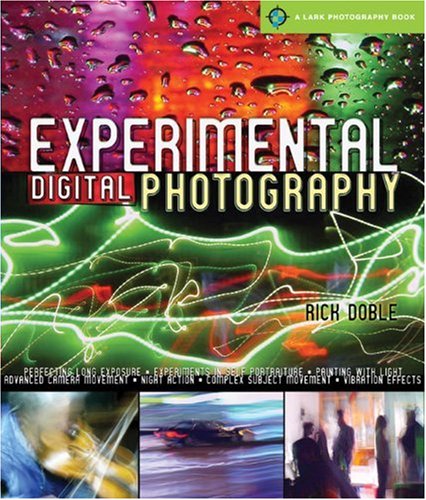
Experimental Digital Photography (Lark Photography Book)
Authors:
Rick Doble
Publisher:
Pixiq
Publication Date:
Not available
ISBN:
1600595170
Thanks to the popularity of digital photography and user-generated Internet content, interest in experimental photographic techniques continues to... build. This unique guide helps photographers go beyond the snapshot, flex their creative muscles, and push the boundaries of their art.Rick Doble presents a wealth of imaginative concepts, from creating ambience through a mix of flash and available light to panning the camera and zooming the lens during an exposure. He explains how to manipulate time and motion in an image, use inventive white balance methods, and paint” with light in time exposures. There are even original self-portrait techniques. Put these procedures in practice and you’ll make photography a riveting, even surreal, art form!
Experimental Drawing, 30th Anniversary Edition: Creative Exercises...
Authors:
Robert Kaupelis
Publisher:
Watson-Guptill
Publication Date:
Not available
ISBN:
0823016226
Stimulating exercises to help beginner to advanced students push the boundaries of traditional drawing.As with most art forms, it's best to comprehend... traditional drawing techniques before you break the rules. But once you've mastered the basics, you may find that you gravitate to more abstract ways of rendering everything from still lifes to figures. However, this book is not only about avant-garde style; it is experimental in that it forces the artist out of his or her comfort zone, whatever that might be.In this book, renowned New York University professor, Robert Kaupelis, shares the tutorials that he used with his students, offering illustrations of drawings and paintings from old masters to contemporary artists (and even some outstanding works from his students) to explain techniques.Covering everything from creating form through contour drawings to drawing with new technology, Experimental Drawing helps you zero in on concepts and form ideas that may take your work to a new and more intriguing level. Some of the innovative exercises you'll find here include: • Drawing models while blindfolded • Engaging in group drawing sessions popularized during the Dada era • Utilizing different drawing materials like glass, plastic, feathers, string, sponges, metal dust, and more • Reducing a post's brushstroke from six to one • Using cross-contour lines for a more abstract still life • Integrating a grid system on a carefully rendered scene to create an illusion of distorted space and movement • And much more...This classic volume's inventive and stimulating projects will help serious artists develop their own vision and their own way to draw. Includes more than 200 spectacular drawings by old and modern masters from Michelangelo to Jasper Johns.

Experimental Economics
Authors:
Douglas D. Davis
Publisher:
Princeton University Press
Publication Date:
Not available
ISBN:
0691043175
A small but increasing number of economists have begun to use laboratory experiments to evaluate economic propositions under carefully controlled... conditions. Experimental Economics is the first comprehensive treatment of this rapidly growing area of research. While the book acknowledges that laboratory experiments are no panacea, it argues cogently for their effectiveness in selected situations. Covering methodological and procedural issues as well as theory, Experimental Economics is not only a textbook but also a useful introduction to laboratory methods for professional economists.Although the authors present some new material, their emphasis is on organizing and evaluating existing results. The book can be used as an anchoring device for a course at either the graduate or advanced undergraduate level. Applications include financial market experiments, oligopoly price competition, auctions, bargaining, provision of public goods, experimental games, and decision making under uncertainty. The book also contains instructions for a variety of laboratory experiments.
Experimental Economics: Rethinking the Rules
Authors:
Nicholas Bardsley
Publisher:
Princeton University Press
Publication Date:
Not available
ISBN:
0691124795
Since the 1980s, there has been explosive growth in the use of experimental methods in economics, leading to exciting developments in economic theory... and policy. Despite this, the status of experimental economics remains controversial. In Experimental Economics, the authors draw on their experience and expertise in experimental economics, economic theory, the methodology of economics, philosophy of science, and the econometrics of experimental data to offer a balanced and integrated look at the nature and reliability of claims based on experimental research.The authors explore the history of experiments in economics, provide examples of different types of experiments, and show that the growing use of experimental methods is transforming economics into a genuinely empirical science. They explain that progress is being held back by an uncritical acceptance of folk wisdom regarding how experiments should be conducted, a failure to acknowledge that different objectives call for different approaches to experimental design, and a misplaced assumption that principles of good practice in theoretical modeling can be transferred directly to experimental design. Experimental Economics debates how such limitations might be overcome, and will interest practicing experimental economists, nonexperimental economists wanting to interpret experimental research, and philosophers of science concerned with the status of knowledge claims in economics.
Experimental Ethnography: The Work of Film in the Age of Video
Authors:
Catherine Russell
Publisher:
Duke University Press Books
Publication Date:
Not available
ISBN:
0822323192
Experimental film and ethnographic film have long been considered separate, autonomous practices on the margins of mainstream cinema. By exploring the... interplay between the two forms, Catherine Russell throws new light on both the avant-garde and visual anthropology. Russell provides detailed analyses of more than thirty-five films and videos from the 1890s to the 1990s and discusses a wide range of film and videomakers, including Georges Méliès, Maya Deren, Peter Kubelka, Ray Birdwhistell, Jean Rouch, Su Friedrich, Bill Viola, Kidlat Tahimik, Margaret Mead, Tracey Moffatt, and Chantal Akerman. Arguing that video enables us to see film differently—not as a vanishing culture but as bodies inscripted in technology, Russell maps the slow fade from modernism to postmodern practices. Combining cultural critique with aesthetic analysis, she explores the dynamics of historical interruption, recovery, and reevaluation. As disciplinary boundaries dissolve, Russell contends, ethnography is a means of renewing the avant-gardism of “experimental” film, of mobilizing its play with language and form for historical ends. “Ethnography” likewise becomes an expansive term in which culture is represented from many different and fragmented perspectives. Original in both its choice of subject and its theoretical and methodologicalapproaches, Experimental Ethnography will appeal to visual anthropologists, as well as film scholars interested in experimental and documentary practices.

Experimental Food Science, Third Edition (Food Science and Technology)
Authors:
Not Available
Publisher:
Academic Press
Publication Date:
Not available
ISBN:
0121579204
This textbook presents the scientific basis for understanding the nature of food and the principles of experimental methodology as applied to food. It... reviews recent research findings and specific technological advances related to food. Taking an experimental approach, exercises are included at the end of each chapter to provide the needed experience in planning experiments. Emphasizing the relationships between chemical and physical properties, basic formulas and procedures are included in the appendix. Key Features* Demonstrates the relationships among composition, structure, physical properties, and functional performance in foods* Suggested exercises at the end of each chapter provide students with needed experience in designing experiments* Extensive bibliographies of food science literature* Appendix of basic formulas and procedures
EXPERIMENTAL FOODS LAB MANUAL
Authors:
Not Available
Publisher:
Not available
Publication Date:
Not available
ISBN:
Not available
 '





