production
/viewbook/list/all/?page=4406
/
/static/
None

Eyes on Spies: Congress and the United States Intelligence...
Authors:
Amy B. Zegart
Publisher:
Hoover Institution Press
Publication Date:
Not available
ISBN:
0817912843
WHY CONGRESS'S BIGGEST INTELLIGENCE OVERSIGHT PROBLEMS LIE WITH ...CONGRESSTen years after 9/11, the least reformed part of America's intelligence... system is not the CIA or FBI but the US Congress. In Eyes on Spies, Amy Zegart examines the weaknesses of U.S. intelligence oversight and why those deficiencies have persisted, despite the unprecedented importance of intelligence in today's environment. She argues that many of the biggest oversight problems lie with Congress—the institution, not the parties or personalities—showing how Congress has collectively and persistently tied its own hands in overseeing intelligence.Supporting sound logic with extensive data, the author offers a comparative analysis of oversight activities of intelligence with other policy areas to show that Congress is not overseeing nearly as much in intelligence as in other policy domains. Electoral incentives, she reveals, explain why. Zegart also identifies two key institutional weaknesses: one, the rules, procedures, and practices that have hindered the development of legislative expertise in intelligence and, two, committee jurisdictions and policies that have fragmented Congress's budgetary power over executive branch intelligence agencies. She concludes that, unfortunately, electoral incentives on the outside and the zero-sum nature of committee power on the inside provide powerful reasons for Congress to continue hobbling its own oversight capabilities.

Eyes on the Prize: America's Civil Rights Years, 1954-1965 (African...
Authors:
Juan Williams
Publisher:
Penguin Books
Publication Date:
Not available
ISBN:
0140096531
Eyes on the Prize traces the movement from the landmark Brown v. the Board of Education case in 1954 to the march on Selma and the passage of the Voting... Rights Act in 1965. This is a companion volume to the first part of the acclaimed PBS series.
Eyes to See, Ears to Hear: An Introduction to Ignatian Spirituality...
Authors:
David Lonsdale
Publisher:
Orbis Books
Publication Date:
Not available
ISBN:
1570753369
Eyes Upside Down: Visionary Filmmakers and the Heritage of Emerson
Authors:
P. Adams Sitney
Publisher:
Oxford University Press, USA
Publication Date:
Not available
ISBN:
019533115X
Sitney analyzes in detail the work of eleven American avant-garde filmmakers as heirs to the aesthetics of exhilaration and innovative vision... articulated by Ralph Waldo Emerson and explored by John Cage, Charles Olson and Gertrude Stein. The films discussed span the sixty years since the Second World War. With three chapters each devoted to Stan Brakhage and Robert Beavers, two each to Hollis Frampton and Jonas Mekas, and single chapters on Marie Menken, Ian Hugo, Andrew Noren, Warren Sonbert, Su Friedrich, Ernie Gehr, and Abigail Child, Eyes Upside Down is the fruit of Sitney's lifelong study of visionary aspirations in the American avant-garde cinema.

Eyes Wide Open: Looking for God in Popular Culture
Authors:
William D. Romanowski
Publisher:
Brazos Press
Publication Date:
Not available
ISBN:
1587432013
Grounded in Christian principles, this accessible and engaging book offers an informed and fascinating approach to popular culture. William D.... Romanowski provides affectionate yet astute analysis of familiar, well-loved movies and television characters from Indiana Jones to Homer Simpson, and he speaks with historical depth and expertise on films from Casablanca to Crash and music from Bruce Springsteen to U2.Romanowski's confessional approach affirms a role for popular culture in faithful living. Practical, analytical approaches to content, meaning, and artistic style offer the tools to participate responsibly and imaginatively in popular cultural activities. An engaging read, this new edition introduces students and thoughtful readers to popular culture--one of the most influential forces in contemporary society.
Eye To The Sky:Exploring Our Atmosphere
Authors:
Steven Businger
Publisher:
Novus Publishing
Publication Date:
Not available
ISBN:
0978783115
This innovative book gives students of diverse academic backgrounds an opportunity to explore and understand, firsthand, the underlying physical... principles of our everyday atmospheric environment through the art of making and interpreting observations. This lab manual is different -- it teaches the scientific method through hands-on experiments that are easy to conduct and that rely on common, inexpensive materials. In addition it includes a variety of exercises that rely on analysis of provided weather observations. These activities foster understanding of the wide range of observations of our atmospheric environment, with an emphasis on recognizing patterns and anticipating the future state of the atmosphere. This lab manual is appropriate for Introduction to Weather and Climate courses at the undergraduate level. It is also suitable for middle and high school science classes with a geoscience focus. Table of Contents Chapter 1: Origin and Composition of the Atmosphere Chapter 2: Pressure And Temperature Chapter 3: Sunlight and the Earth s Climate Chapter 4: Weather s Invisible Chapter 5: Clouds And Precipitation Chapter 6: Wind, the General Circulation, and Storms Chapter 7: Weather Forecasting Chapter 8: Severe Thunderstorms and Hurricanes Chapter 9 Atmospheric Pollution and Global Warming Chapter 10: Sky Lights Appendix: Online Resources
Eye Tracking: A comprehensive guide to methods and measures
Authors:
Kenneth Holmqvist
Publisher:
Oxford University Press, USA
Publication Date:
Not available
ISBN:
0199697086
We make 3-5 eye movements per second, and these movements are crucial in helping us deal with the vast amounts of information we encounter in our... everyday lives. In recent years, thanks to the development of eye tracking technology, there has been a growing interest in monitoring and measuring these movements, with a view to understanding how we attend to and process the visual information we encounterEye tracking as a research tool is now more accessible than ever, and is growing in popularity amongst researchers from a whole host of different disciplines. Usability analysts, sports scientists, cognitive psychologists, reading researchers, psycholinguists, neurophysiologists, electrical engineers, and others, all have a vested interest in eye tracking for different reasons. The ability to record eye-movements has helped advance our science and led to technological innovations. However, the growth of eye tracking in recent years has also presented a variety of challenges - in particular the issue of how to design an eye-tracking experiment, and how to analyse the data.This book is a much needed comprehensive handbook of eye tracking methodology. It describes how to evaluate and acquire an eye-tracker, how to plan and design an eye tracking study, and how to record and analyse eye-movement data. Besides technical details and theory, the heart of this book revolves around practicality - how raw data samples are converted into fixations and saccades using event detection algorithms, how the different representations of eye movement data are calculated using AOIs, heat maps and scanpaths, and how all the measures of eye movements relate to these processes. Part I presents the technology and skills needed to perform high-quality research with eye-trackers. Part II covers the predominant methods applied to the data which eye-trackers record. These include the parsing of raw sample data into oculomotor events, and how to calculate other representations of eye movements such as heat maps and transition matrices. Part III gives a comprehensive outline of the measures which can be calculated using the events and representations describedin Part II. This is a taxonomy of the measures available to eye-tracking researchers, sorted by type of movement of the eyes and type of analysis.For anyone in the sciences considering conducting research involving eye-tracking, this book will be an essential reference work. L video-oculographic eye-tracking systems, and how to derive and use measures that giveinsights into oculomotor, cognitive and neurobiological processes. In this chapter, we will introduce the overarching concepts of the book and how they havebeen laid-out into parts and chapters.
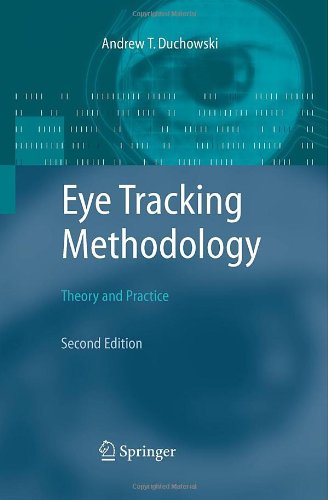
Eye Tracking Methodology: Theory and Practice
Authors:
Andrew Duchowski
Publisher:
Springer
Publication Date:
Not available
ISBN:
1846286085
Despite the availability of cheap, fast, accurate and usable eye trackers, there is little information available on how to develop, implement and use... these systems. This 2nd edition of the successful guide contains significant additional material on the topic and aims to fill that gap in the market by providing an accessible and comprehensive introduction. Additional key features of the 2nd edition include: Technical description of new (state-of-the-art) eye tracking technology; a complete whole new section describing experimental methodology including experimental design, empirical guidelines, and five case studies; and survey material regarding recent research publications.

EYEWEAR- ECONOMY SPLASH GOGGLE
Authors:
Not Available
Publisher:
Not available
Publication Date:
Not available
ISBN:
Not available
EYEWEAR GOGGLES (LAB)
Authors:
Not Available
Publisher:
Not available
Publication Date:
Not available
ISBN:
Not available
EYEWEAR GOGGLES (LAB)
Authors:
Not Available
Publisher:
Not available
Publication Date:
Not available
ISBN:
Not available
EYEWEAR_GOGGLES VENT
Authors:
Not Available
Publisher:
Not available
Publication Date:
Not available
ISBN:
Not available
EYEWEAR-S0390 ULTRASPEC 2000
Authors:
Not Available
Publisher:
Not available
Publication Date:
Not available
ISBN:
Not available
EYEWEAR-S0390 ULTRASPEC 2000
Authors:
Not Available
Publisher:
Not available
Publication Date:
Not available
ISBN:
Not available
EYEWEAR-S0390 ULTRASPEC 2000 GLASSES
Authors:
Not Available
Publisher:
Not available
Publication Date:
Not available
ISBN:
Not available
 '





