production
/viewbook/list/all/?page=4505
/
/static/
None
Feminist Anthropology: A Reader (Wiley-Blackwell Anthologies in...
Authors:
Not Available
Publisher:
Wiley-Blackwell
Publication Date:
Not available
ISBN:
1405101962
Feminist Anthropology surveys the history of feminist anthropology and offers students and scholars a fascinating collection of both classic and... contemporary articles, grouped to highlight key themes from the past and present. Offers vibrant examples of feminist ethnographic work rather than synthetic overviews of the field. Each section is framed by a theoretical and bibliographic essay. Includes a thoughtful introduction to the volume that provides context and discusses the intellectual “foremothers” of the field, including Margaret Mead, Ruth Landes, Phyllis Kaberry, and Zora Neale Hurston.
Feminist Approaches to Theory and Methodology: An Interdisciplinary...
Authors:
Sharlene Hesse-Biber
Publisher:
Oxford University Press, USA
Publication Date:
Not available
ISBN:
0195125223
Feminist Approaches to Theory and Methodology addresses the theoretical issues raised by doing feminist research from an interdisciplinary perspective.... Bringing together the work of leading scholars and emerging new critics, the editors have selected the best, most representative and recent work in feminist scholarship. The collection is organized around key issues in feminist theory and empirical research as impacted by post-structuralist dialogue. Several essays address the tensions between disciplinary and interdisciplinary knowledge building, exposing male biases embedded in disciplinary paradigms. Other essays deal with dramatic changes in two foundational concepts in feminist theory--identity and experience--which are presented not as innate and unproblematic, but as constituted by discourse, representation, and the effects of power. Additional essays examine the complex terrain in which differences within and between women are used as tools of oppression and of resistance both inside and outside feminist praxis. These essays uncover a subtext of racial anxiety, offering critical insights for academic and social change. The gender dynamics of power and resistance are taken up by several critics whose research encourages the development of a feminist scholarly methodology that focuses on women's subjective experiences, the ways in which they mediate relations of power, and their capacity for implementing personal and collective activism. These essays deal with the importance in feminist scholarship of resisting the inclination to view women as passive and powerless victims. Another major focus of the volume brings together visual and discursive representations of the female body in which heterosexuality and reproduction are imposed as the norm. The volume concludes with a set of essays which presents students with some methodological and political dilemmas feminists encounter as they expose the underlying ideological distortions in existing social policies. Distinct for its interdisciplinary scope as well as its global orientation, Feminist Approaches to Theory and Methodology is an ideal text for courses in a wide range of social science and humanities disciplines including research methods and women's studies.
Feminist Coalitions: Historical Perspectives on Second-Wave...
Authors:
Not Available
Publisher:
University of Illinois Press
Publication Date:
Not available
ISBN:
0252075390
Much of the scholarship on second-wave feminism has focused on divisions within the women's movement and its narrow conception of race and class, but... the contributors to this volume remind readers that feminists in the 1960s and 1970s also formed many strong partnerships, often allying themselves with a diverse range of social justice efforts on a local grassroots level. These essays focus on coalitions and alliances in which feminists and other activists joined forces to address crucial social justice issues such as reproductive rights, the peace movement, women's health, Christianity and other religions, and neighborhood activism, as well as alliances crossing boundaries of race, class, political views, and sexual identity. The contributors bring fresh perspectives to feminist history by calling attention to how women struggled to include and represent diverse women without minimizing the difficulties of conceptualizing a singular feminism. Contributors are Maria Bevacqua, Tamar Carroll, Marisa Chappell, Andrea Estepa, Sara M. Evans, Amy Farrell, Stephanie Gilmore, Cynthia Harrison, Elizabeth Kaminski, Wendy Kline, Premilla Nadasen, Caryn Neumann, Anne M. Valk, and Emily Zuckerman.
Feminist Contentions: A Philosophical Exchange (Thinking Gender)
Authors:
Seyla Benhabib
Publisher:
Routledge
Publication Date:
Not available
ISBN:
0415910862
This unique volume presents a debate between four of the top feminist theorists in the United States today. Seyla Benhabib, Judith Butler, Drucilla... Cornell and Nancy Fraser discuss some of the key questions facing feminist theory. Each articulates her own position in an initial essay, then responds to the others in a follow-up essay, making possible a conversation between these influential feminist thinkers. Begun as a symposium on the issue of feminism and postmodernism, the volume evolved into a discussion of broader issues such as the usefulness of postmodernism as a theoretical concept; the role of philosophy in social criticism; how historical narrative is best conceptualized; the status of the subject of feminism; and the political effects of different formulations of all these issues. Unlike many collections which assume a given topic and ask various thinkers to respond to it, this format enables the contributors themselves to articulate their own views on the key questions facing feminist theory and distinguish their views from others.
Feminist Criminology through a Biosocial Lens
Authors:
Anthony Walsh
Publisher:
Carolina Academic Press
Publication Date:
Not available
ISBN:
1594609667
The gender ratio problem (why always and everwhere males commit more criminal acts than females) has been called the single most important fact that... criminology theories must be able to explain. Feminist criminology has attempted to do this for decades without success because it has relied on conceptual and theoretical tools from a single discipline sociology. A number of famous criminologists (e.g., Travis Hirschi) have concluded that an explanation of gener differences in crime from the sociological perspective may not be possible because it excludes biological sex, the powerful underlying base of gender. It is the contention of this book that unless feminist criminology comes to grips with the evolutionary and neurological bases of fundamental gender difference it will continue to flounder around without compass. A number of other influential criminologists (e.g., Francis Cullen) have concluded that the biosocial paradigm is the paradigm of the 21st century. The biosocial paradigm is growing in strength every year, as an examination of both the number of published books and articles in professional journals in criminology and other social and behavioral science disciplines will attest. This book looks at feminist criminology in general and attempts to explain its main concerns from a biosocial perspective while showing that there is nothing illiberal about it and that biology can be a very powerful ally to criminology. The book ranges across disciplines such as sociology, anthropology, psychology, behavioral and molecular genetics, the neurosciences, and evolutionary biology to attempt to answer the gender ratio problem. It is time to apply this exciting and robust paradigm one that avers that any trait or behavior of any living thing is always the result of biological factors interacting with environmental factors to the most vexing issues of feminist criminology.
Feminist Critique of Language: second edition (World and Word)
Authors:
Deborah Cameron
Publisher:
Routledge
Publication Date:
Not available
ISBN:
0415164001
The Feminist Critique of Language provides a wide-ranging selection of writings on language, gender, and feminist thought. It serves both as a guide to... the current debates and directions and as a digest of the history of twentieth-century feminist ideas about language. This edition includes extracts from Felly Nkweto Simmonds, Trinh T. Minh-ha, Luce Irigaray, Sara Mills, Margaret Doyle, Debbie Cameron, Susan Ehrlich, Ruth King, Kate Clark, Sally McConnell-Ginet, Deborah Tannen, Aki Uchida, Jennifer Coates and Kira Hall.
Feminist Disability Studies
Authors:
Not Available
Publisher:
Indiana University Press
Publication Date:
Not available
ISBN:
0253223407
Disability, like questions of race, gender, and class, is one of the most provocative topics among theorists and philosophers today. This volume,... situated at the intersection of feminist theory and disability studies, addresses questions about the nature of embodiment, the meaning of disability, the impact of public policy on those who have been labeled disabled, and how we define the norms of mental and physical ability. The essays here bridge the gap between theory and activism by illuminating structures of power and showing how historical and cultural perceptions of the human body have been informed by and contributed to the oppression of women and disabled people.
Feminist Fieldwork Analysis (Qualitative Research Methods)
Authors:
Sherryl Kleinman
Publisher:
Sage Publications, Inc
Publication Date:
Not available
ISBN:
1412905494
Based on the author's experience with what she calls analysis block, Feminist Fieldwork Analysis offers advice for researchers who want to translate a... feminist sensibility into qualitative analysis. Each chapter provides a guiding feminist principle; studies that show the principle in action; and analytic questions that researchers can keep in mind in the field or at the desk. These widely applicable principles (which correspond with chapter titles) include: Talk is Action, Similarities Can be Deceiving, Sexism Can be Anywhere, The Personal is Political, and Everything is More than One Thing. The author has chosen engaging examples to illustrate the principles, and useful questions to bring to any feminist qualitative project. The final chapter calls on feminist researchers to apply the principles and findings of feminist research in their everyday lives, including the groups and organizations of which they are a part.

Feminist Film Studies: Writing the Woman into Cinema (Short Cuts)
Authors:
Janet McCabe
Publisher:
Wallflower Press
Publication Date:
Not available
ISBN:
1904764037
An introduction to feminist film theory as a discourse from the early seventies to the present. McCabe traces the broad ranging theories produced by... feminist film scholarship, from formalist readings and psychoanalytical approaches to debates initiated by cultural studies, race and queer theory.
Feminist Film Theorists (Routledge Critical Thinkers)
Authors:
Shohini Chaudhuri
Publisher:
Routledge
Publication Date:
Not available
ISBN:
0415324335
Focusing on the ground-breaking work of Laura Mulvey, Kaja Silverman, Teresa de Lauretis and Barbara Creed, this book explores how, since it began in... the 1970s, feminist film theory has revolutionized the way that films and their spectators can be understood. Examining the new and distinctive approaches of each of these thinkers, this book provides the most detailed account so far of their ideas. It illuminates the six key concepts and demonstrates their value as tools for film analysis: the male gaze the female voice technologies of gender queering desire the monstrous-feminine masculinity in crisis. Testing their ideas with a number of other examples from contemporary cinema and TV, Shohini Chaudhuri shows how these four thinkers construct their theories through their reading of films. An excellent study companion for all students of film theory and women’s studies.
Feminist Film Theory: A Reader
Authors:
Sue Thornham
Publisher:
NYU Press
Publication Date:
Not available
ISBN:
0814782442
For the past twenty-five years, cinema has been a vital terrain on which feminist debates about culture, representation, and identity have been fought.... This anthology charts the history of those debates, bringing together the key, classic essays in feminist film theory. Feminist Film Theory maps the impact of major theoretical developments on this growing field-from structuralism and psychoanalysis in the 1970s, to post-colonial theory, queer theory, and postmodernism in the 1990s. Covering a wide range of topics, including oppressive images, "woman" as fetishized object of desire, female spectatorship, and the cinematic pleasures of black women and lesbian women, Feminist Film Theory is an indispensable reference for scholars and students in the field. Contributors include Judith Butler, Carol J. Clover, Barbara Creed, Michelle Citron, Mary Ann Doane, Teresa De Lauretis, Jane Gaines, Christine Gledhill, Molly Haskell, bell hooks, Claire Johnston, Annette Kuhn, Julia Lesage, Judith Mayne, Tania Modleski, Laura Mulvey, B. Ruby Rich, Kaja Silverman, Sharon Smith, Jackie Stacey, Janet Staiger, Anna Marie Taylor, Valerie Walkerdine, and Linda Williams.
Feminist Frontiers
Authors:
Verta Taylor
Publisher:
McGraw-Hill Humanities/Social Sciences/Languages
Publication Date:
Not available
ISBN:
0073404306
The most widely used anthology of feminist writings and the first to incorporate issues of sexual identity and sexual diversity, Feminist Frontiers has... stood the test of time. With both classic and contemporary readings on cutting-edge topics that cut across disciplinary and generational lines, this text presents the full diversity of women's lives, exploring commonalities as well as interconnected differences. Feminist Frontiers offers analyses of the causes and consequences of gender inequality in interaction with class, race, ethnicity, sexuality, ability, and nationality. This anthology also introduces students to feminist theory and methodology. This edition maintains consistent coverage of diverse ethnicities and a global perspective, with greater attention to transgender issues and disability.
Feminist Frontiers
Authors:
Verta Taylor
Publisher:
McGraw-Hill Humanities/Social Sciences/Languages
Publication Date:
Not available
ISBN:
0078026628
The most widely used anthology of feminist writings, Feminist Frontiers has stood the test of time. Classic and contemporary readings on cutting-edge... topics cut across disciplinary and generational lines, presenting the full diversity of women’s lives and exploring commonalities and interconnected differences. Feminist Frontiers offers analyses of the causes and consequences of gender inequality in interaction with race, ethnicity, class, sexuality, ability, and nation, and introduces students to feminist theory and methodology. The ninth edition maintains a consistent coverage of diversity within a global perspective while highlighting the impact of new technologies on women’s lives and experiences.

Feminist Frontiers Psu Custom
Authors:
Not Available
Publisher:
Not available
Publication Date:
Not available
ISBN:
Not available
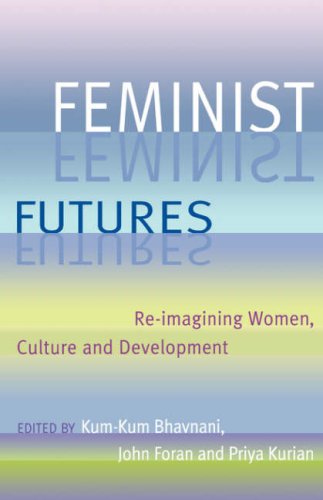
Feminist Futures: Re-Imagining Women, Culture and Development
Authors:
Not Available
Publisher:
Zed Books
Publication Date:
Not available
ISBN:
1842770292
The contributors to this volume work at the intersection of cultural studies, feminist studies, and critical development studies to articulate a new... framework that they call Women, Culture, and Development. The editors trace its genealogies and potential in their introduction, and the several parts of the book ground it by applying it to a range of issues including sexuality and the gendered body; environment, technology and science; and the cultural politics of representation. A set of shorter essays, many of them by a new generation of scholars, introduce visions of the future through the prism of exciting new work in the field.
 '





