production
/viewbook/list/all/?page=4546
/
/static/
None

FIN ACCT+BRAUN:MGRL ACCT +MAL (REV)
Authors:
Not Available
Publisher:
Not available
Publication Date:
Not available
ISBN:
Not available
FIN.ACCT.F/UNC CHARLOTTE+WILEYPLUS(PKG)
Authors:
Not Available
Publisher:
Not available
Publication Date:
Not available
ISBN:
Not available
FIN.ACCTG:BUS.PROC+MYACCOUNTIN GLAB PKG
Authors:
Not Available
Publisher:
Not available
Publication Date:
Not available
ISBN:
Not available
FIN.ACCTG.-LOOSELEAF W/ACCESS CODE
Authors:
Not Available
Publisher:
Not available
Publication Date:
Not available
ISBN:
Not available
FIN. ACCTG. STUDENT VAL.ED. LOOSE W/ACC
Authors:
Not Available
Publisher:
Not available
Publication Date:
Not available
ISBN:
Not available
FIN ACCTG W/ MAL ETEXT (CUSTOM)
Authors:
Not Available
Publisher:
Not available
Publication Date:
Not available
ISBN:
Not available
FIN ACCTNG BINDER READY PKG W/WILEYPLUS
Authors:
Not Available
Publisher:
Not available
Publication Date:
Not available
ISBN:
Not available
Fin. Acct. Pkg (Textbook And Wileyplus)
Authors:
Not Available
Publisher:
Not available
Publication Date:
Not available
ISBN:
Not available
FIN ACCT W/CUSTOM MY ACCT LAB
Authors:
Not Available
Publisher:
Not available
Publication Date:
Not available
ISBN:
Not available
FIN.ACCT.W/WILEYPLUS(LOOSELEAF )]CUSTOM[
Authors:
Not Available
Publisher:
Not available
Publication Date:
Not available
ISBN:
Not available
FINACIAL ACCT. W/CONNECT PLUS LOOSELEAF
Authors:
Not Available
Publisher:
Not available
Publication Date:
Not available
ISBN:
Not available
FINACIAL INSTITUTIONS MANAGEMENT CUSTOM
Authors:
Not Available
Publisher:
Not available
Publication Date:
Not available
ISBN:
Not available
FINACIAL MARKET AND INSTITUTION (CUSTOM)
Authors:
Not Available
Publisher:
Not available
Publication Date:
Not available
ISBN:
Not available
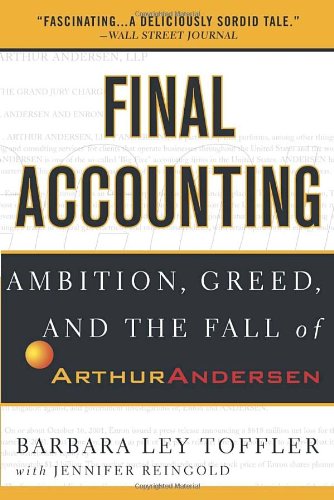
Final Accounting: Ambition, Greed and the Fall of Arthur Andersen
Authors:
Barbara Ley Toffler
Publisher:
Crown Business
Publication Date:
Not available
ISBN:
0767913833
A withering exposé of the unethical practices that triggered the indictment and collapse of the legendary accounting firm.Arthur Andersen's conviction... on obstruction of justice charges related to the Enron debacle spelled the abrupt end of the 88-year-old accounting firm. Until recently, the venerable firm had been regarded as the accounting profession's conscience. In Final Accounting, Barbara Ley Toffler, former Andersen partner-in-charge of Andersen's Ethics & Responsible Business Practices consulting services, reveals that the symptoms of Andersen's fatal disease were evident long before Enron. Drawing on her expertise as a social scientist and her experience as an Andersen insider, Toffler chronicles how a culture of arrogance and greed infected her company and led to enormous lapses in judgment among her peers. Final Accounting exposes the slow deterioration of values that led not only to Enron but also to the earlier financial scandals of other Andersen clients, including Sunbeam and Waste Management, and illustrates the practices that paved the way for the accounting fiascos at WorldCom and other major companies. Chronicling the inner workings of Andersen at the height of its success, Toffler reveals "the making of an Android," the peculiar process of employee indoctrination into the Andersen culture; how Androids—both accountants and consultants--lived the mantra "keep the client happy"; and how internal infighting and "billing your brains out" rather than quality work became the all-important goals. Toffler was in a position to know when something was wrong. In her earlier role as ethics consultant, she worked with over 60 major companies and was an internationally renowned expert at spotting and correcting ethical lapses. Toffler traces the roots of Andersen's ethical missteps, and shows the gradual decay of a once-proud culture.Uniquely qualified to discuss the personalities and principles behind one of the greatest shake-ups in United States history, Toffler delivers a chilling report with important ramifications for CEOs and individual investors alike.From the Hardcover edition.
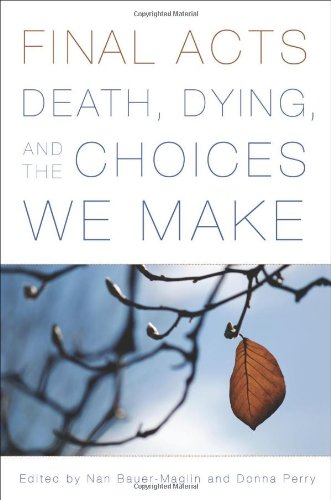
Final Acts: Death, Dying, and the Choices We Make
Authors:
Not Available
Publisher:
Rutgers University Press
Publication Date:
Not available
ISBN:
0813546281
Today most people die gradually, from incremental illnesses, rather than from the heart attacks or fast-moving diseases that killed earlier generations.... Given this new reality, the essays in Final Acts explore how we can make informed and caring end-of-life choices for ourselves and for those we loveùand what can happen without such planning.Contributors include patients, caretakers, physicians, journalists, lawyers, social workers, educators, hospital administrators, academics, psychologists, and a poet, and among them are ethicists, religious believers, and nonbelievers. Some write moving, personal accounts of "good" or 'bad" deaths; others examine the ethical, social, and political implications of slow dying. Essays consider death from natural causes, suicide, and aid-in-dying (assisted suicide).Writing in a style free of technical jargon, the contributors discuss documents that should be prepared (health proxy, do-not-resuscitate order, living will, power of attorney); decision-making (over medical interventions, life support, hospice and palliative care, aid-in-dying, treatment location, speaking for those who can no longer express their will); and the roles played by religion, custom, family, friends, caretakers, money, the medical establishment, and the government.For those who yearn for some measure of control over death, the essayists in Final Acts, from very different backgrounds and with different personal and professional experiences around death and dying, offer insight and hope.
 '





