production
/viewbook/list/all/?page=4579
/
/static/
None

FINANCIAL & MGRL ACCT VOLUME1 BUNDLE
Authors:
Not Available
Publisher:
Not available
Publication Date:
Not available
ISBN:
Not available
FINANCIAL & MGRL ACCT VOLUME 2 BUNDLE
Authors:
Not Available
Publisher:
Not available
Publication Date:
Not available
ISBN:
Not available
FINANCIAL+MGRL.ACCT.-W/CENGAGE NOW!CARD
Authors:
Not Available
Publisher:
Not available
Publication Date:
Not available
ISBN:
Not available
FINANCIAL MGT W/APLIA BUNDLE
Authors:
Not Available
Publisher:
Not available
Publication Date:
Not available
ISBN:
Not available

Financial Missionaries to the World: The Politics and Culture of...
Authors:
Emily S. Rosenberg
Publisher:
Duke University Press Books
Publication Date:
Not available
ISBN:
0822332191
Winner of the Society for Historians of American Foreign Relations Robert H. Ferrell Book PrizeFinancial Missionaries to the World establishes the broad... scope and significance of “dollar diplomacy”—the use of international lending and advising—to early-twentieth-century U.S. foreign policy. Combining diplomatic, economic, and cultural history, the distinguished historian Emily S. Rosenberg shows how private bank loans were extended to leverage the acceptance of American financial advisers by foreign governments. In an analysis striking in its relevance to contemporary debates over international loans, she reveals how a practice initially justified as a progressive means to extend “civilization” by promoting economic stability and progress became embroiled in controversy. Vocal critics at home and abroad charged that American loans and financial oversight constituted a new imperialism that fostered exploitation of less powerful nations. By the mid-1920s, Rosenberg explains, even early supporters of dollar diplomacy worried that by facilitating excessive borrowing, the practice might induce the very instability and default that it supposedly worked against."[A] major and superb contribution to the history of U.S. foreign relations. . . . [Emily S. Rosenberg] has opened up a whole new research field in international history."—Anders Stephanson, Journal of American History"[A] landmark in the historiography of American foreign relations."—Melvyn P. Leffler, author of A Preponderence of Power: National Security, the Truman Administration, and the Cold War"Fascinating."—Christopher Clark, Times Literary Supplement
FINANCIAL MODEL FOR ENGINEERS ]CUSTOM[
Authors:
Not Available
Publisher:
Not available
Publication Date:
Not available
ISBN:
Not available
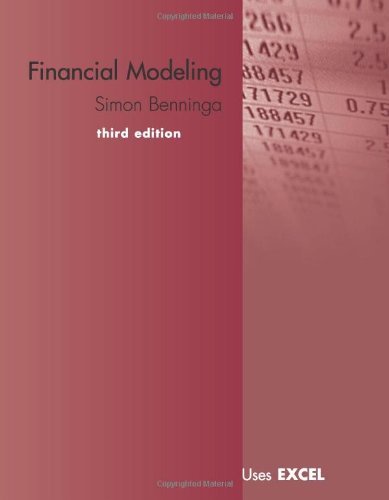
Financial Modeling
Authors:
Simon Benninga
Publisher:
The MIT Press
Publication Date:
Not available
ISBN:
0262026287
Too often, finance courses stop short of making a connection between textbook finance and the problems of real-world business. Financial Modeling... bridges this gap between theory and practice by providing a nuts-and-bolts guide to solving common financial models with spreadsheets. Simon Benninga takes the reader step by step through each model, showing how it can be solved using Microsoft Excel. The long-awaited third edition of this standard text maintains the "cookbook" features and Excel dependence that have made the first and second editions so popular. It also offers significant new material, with new chapters covering such topics as bank valuation, the Black-Litterman approach to portfolio optimization, Monte Carlo methods and their applications to option pricing, and using array functions and formulas. Other chapters, including those on basic financial calculations, portfolio models, calculating the variance-covariance matrix, and generating random numbers, have been revised, with many offering substantially new and improved material. Other areas covered include financial statement modeling, leasing, standard portfolio problems, value at risk (VaR), real options, duration and immunization, and term structure modeling. Technical chapters treat such topics as data tables, matrices, the Gauss-Seidel method, and tips for using Excel. The last section of the text covers the Visual Basic for Applications (VBA) techniques needed for the book. The accompanying CD contains Excel worksheets and solutions to end-of-chapter exercises.
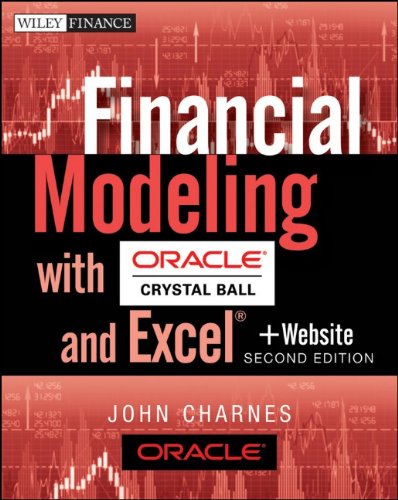
Financial Modeling with Crystal Ball and Excel, + Website (Wiley...
Authors:
John Charnes
Publisher:
Wiley
Publication Date:
Not available
ISBN:
1118175441
Updated look at financial modeling and Monte Carlo simulation with software by Oracle Crystal BallThis revised and updated edition of the bestselling... book on financial modeling provides the tools and techniques needed to perform spreadsheet simulation. It answers the essential question of why risk analysis is vital to the decision-making process, for any problem posed in finance and investment. This reliable resource reviews the basics and covers how to define and refine probability distributions in financial modeling, and explores the concepts driving the simulation modeling process. It also discusses simulation controls and analysis of simulation results.The second edition of Financial Modeling with Crystal Ball and Excel contains instructions, theory, and practical example models to help apply risk analysis to such areas as derivative pricing, cost estimation, portfolio allocation and optimization, credit risk, and cash flow analysis. It includes the resources needed to develop essential skills in the areas of valuation, pricing, hedging, trading, risk management, project evaluation, credit risk, and portfolio management. Offers an updated edition of the bestselling book covering the newest version of Oracle Crystal BallContains valuable insights on Monte Carlo simulation—an essential skill applied by many corporate finance and investment professionalsWritten by John Charnes, the former finance department chair at the University of Kansas and senior vice president of global portfolio strategies at Bank of America, who is currently President and Chief Data Scientist at Syntelli Solutions, Inc. Risk Analytics and Predictive Intelligence Division (Syntelli RAPID)Engaging and informative, this book is a vital resource designed to help you become more adept at financial modeling and simulation.
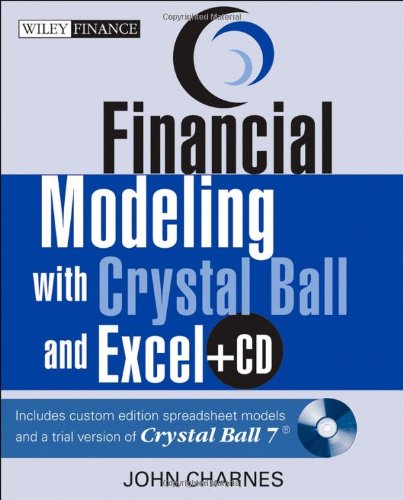
Financial Modeling with Crystal Ball and Excel (Wiley Finance)
Authors:
John Charnes
Publisher:
Wiley
Publication Date:
Not available
ISBN:
0471779725
Praise forFinancial Modeling with Crystal Ball(r) and Excel(r)"Professor Charnes's book drives clarity into applied Monte Carlo analysis using examples... and tools relevant to real-world finance. The book will prove useful for analysts of all levels and as a supplement to academic courses in multiple disciplines."-Mark Odermann, Senior Financial Analyst, Microsoft"Think you really know financial modeling? This is a must-have for power Excel users. Professor Charnes shows how to make more realistic models that result in fewer surprises. Every analyst needs this credibility booster."-James Franklin, CEO, Decisioneering, Inc."This book packs a first-year MBA's worth of financial and business modeling education into a few dozen easy-to-understand examples. Crystal Ball software does the housekeeping, so readers can concentrate on the business decision. A careful reader who works the examples on a computer will master the best general-purpose technology available for working with uncertainty."-Aaron Brown, Executive Director, Morgan Stanley, author of The Poker Face of Wall Street"Using Crystal Ball and Excel, John Charnes takes you step by step, demonstrating a conceptual framework that turns static Excel data and financial models into true risk models. I am astonished by the clarity of the text and the hands-on, step-by-step examples using Crystal Ball and Excel; Professor Charnes is a masterful teacher, and this is an absolute gem of a book for the new generation of analyst."-Brian Watt, Chief Operating Officer, GECC, Inc."Financial Modeling with Crystal Ball and Excel is a comprehensive, well-written guide to one of the most useful analysis tools available to professional risk managers and quantitative analysts. This is a must-have book for anyone using Crystal Ball, and anyone wanting an overview of basic risk management concepts."-Paul Dietz, Manager, Quantitative Analysis, Westar Energy"John Charnes presents an insightful exploration of techniques for analysis and understanding of risk and uncertainty in business cases. By application of real options theory and Monte Carlo simulation to planning, doors are opened to analysis of what used to be impossible, such as modeling the value today of future project choices."-Bruce Wallace, Nortel
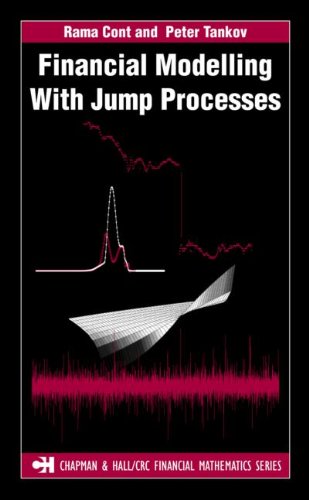
Financial Modelling with Jump Processes (Chapman & Hall/CRC...
Authors:
Peter Tankov
Publisher:
Chapman and Hall/CRC
Publication Date:
Not available
ISBN:
1584884134
WINNER of a Riskbook.com Best of 2004 Book Award!During the last decade, financial models based on jump processes have acquired increasing popularity in... risk management and option pricing. Much has been published on the subject, but the technical nature of most papers makes them difficult for nonspecialists to understand, and the mathematical tools required for applications can be intimidating. Potential users often get the impression that jump and Lévy processes are beyond their reach.Financial Modelling with Jump Processes shows that this is not so. It provides a self-contained overview of the theoretical, numerical, and empirical aspects involved in using jump processes in financial modelling, and it does so in terms within the grasp of nonspecialists. The introduction of new mathematical tools is motivated by their use in the modelling process, and precise mathematical statements of results are accompanied by intuitive explanations. Topics covered in this book include: jump-diffusion models, Lévy processes, stochastic calculus for jump processes, pricing and hedging in incomplete markets, implied volatility smiles, time-inhomogeneous jump processes and stochastic volatility models with jumps. The authors illustrate the mathematical concepts with many numerical and empirical examples and provide the details of numerical implementation of pricing and calibration algorithms. This book demonstrates that the concepts and tools necessary for understanding and implementing models with jumps can be more intuitive that those involved in the Black Scholes and diffusion models. If you have even a basic familiarity with quantitative methods in finance, Financial Modelling with Jump Processes will give you a valuable new set of tools for modelling market fluctuations.

Financial Peace
Authors:
Dave;Ramsey, Sharon Ramsey
Publisher:
Viking Press
Publication Date:
Not available
ISBN:
0670032085
This new edition will help you understand the forces behind your financial distress, create a budget you can stick to, set goals you can achieve, and... make things right for you and your family--financially, emotionally, and spiritually--for good.
FINANCIAL PLAN DEVELOPMENT
Authors:
Not Available
Publisher:
Not available
Publication Date:
Not available
ISBN:
Not available
Financial Plan Development 2012 Textbook
Authors:
Keir Educational Resources
Publisher:
Keir Educational Resources
Publication Date:
Not available
ISBN:
193740420X
Keir Educational Resources designed this textbook for use in a Financial Plan Development Course as part of a program of study leading to the CERTIFIED... FINANCIAL PLANNERTM designation. The book is intended for students who must develop a written financial plan and present it orally, according to the requirements established by Certified Financial Planner Board of Standards, Inc. The Four E s Education, Examination, Experience, Ethics Certified Financial Planner Board of Standards, Inc. requires all four E s in order for a candidate to become certified as a CFP® Certificant. The Financial Plan Development Course, alternately known as a Capstone Course or Advanced Case Study, is generally the final course in a Registered Program s educational offering. The candidate must also pass a rigorous comprehensive national certification examination, demonstrate at least three years of relevant experience, and agree to abide by the Code of Ethics and Practice Standards. This text includes ten comprehensive financial planning case study Fact Patterns. You are encouraged to complete the Questions for Discussion and the Additional Concepts to Explore for all ten cases. However, the instructor in your Registered Program will likely require you to prepare and present only one of the cases, or another case developed by you personally. Alternatively, your instructor could have you prepare and present a case based on actual clients. We recommend students develop a logical, coherent, and understandable approach to the financial plans so that clients can act on your recommendations. To make it easier for students to get comfortable with financial planning cases, Keir has written a majority of the cases in this book in a format similar to what students will encounter on the CFP® Certification Examination. Students will also find in this book other case formats that resemble more what a financial planner might encounter in practice. Your instructor has an option to use multiple choice questions to test your understanding of each of the cases. The multiple choice questions will provide additional practice in answering questions on the CFP® Certification Examination. Some of the questions are relatively straightforward, while others require a significantly higher level of thinking. Keep in mind that CFP Board of Standards does not prescribe how to prepare a financial plan, but does provide guidance through its Code of Ethics and Practice Standards. Students should read the document and incorporate the elements espoused by the Standards.
FINANCIAL POLICY
Authors:
Not Available
Publisher:
Not available
Publication Date:
Not available
ISBN:
Not available
FINANCIAL POLICY [CUTSOM]
Authors:
Not Available
Publisher:
Not available
Publication Date:
Not available
ISBN:
Not available
 '





