production
/viewbook/list/all/?page=4713
/
/static/
None

Forks Over Knives Dvd
Authors:
Not Available
Publisher:
Not available
Publication Date:
Not available
ISBN:
Not available

For Life Abundant: Practical Theology, Theological Education, and...
Authors:
Not Available
Publisher:
Wm. B. Eerdmans Publishing Company
Publication Date:
Not available
ISBN:
0802837441
What are the purposes and the priorities that really govern a theological school? What are realistic expectations of theological education? What would... be the ideal theological school, and what is theological about it? Theologian David Kelsey addresses these questions and other concerns regarding theological schooling, and offers suggestions on how to analyze and reconceive "theological schooling" in productive ways.

For Love of Common Words: Poems (Southern Messenger Poets)
Authors:
Steve Scafidi
Publisher:
Louisiana State University Press
Publication Date:
Not available
ISBN:
0807131377
The scariest sentence in the English language is brief, threatening, and hopeful. It is deceptive, simple, and as common as water: anything is possible.... This second collection by Steve Scafidi is haunted by the possible and "the bells of the verb to be" that "ring-a-ding-ding calling us / to the holy dark of this first / warm night of Spring." When anything is possible, Scafidi finds, horror is as likely as delight. In poems both meditative and defiant he mourns the eventual loss of all that we love and finds consolation, wherever possible, in the rhythm of common words and "the sacred guesswork" of the imagination. Here is the dangerous world we all have in common. Here is a brief and hopeful book. Someone told me that a god died so we don’t have to. And yet, look. Just look at us. Nothing’s fair— people screaming, the rides too rough. And Death with his huff and puff. There must be an atom always burning somewhere—a mansion in the sky to which we are returning. A place of real quiet, a bundle of straw where the wolf lies down by the door. Maybe this is what our words are for. To be a lullaby for death. To know paradise in the nonsense of the poet and the scientist—to say some theory of peace to the wolf who is law. —from "Lullaby for the Wolf" AUTHOR BIO: Steve Scafidi is the author of the poetry collection Sparks from a Nine-Pound Hammer, winner of the Larry Levis Reading Prize. He is a cabinetmaker and lives with his family in Summit Point, West Virginia.

For Love of Country?
Authors:
Martha Nussbaum
Publisher:
Beacon Press
Publication Date:
Not available
ISBN:
080704329X
After the terrorist attacks on the Pentagon and the World Trade Center, American flags appeared everywhere. Is patriotism a good response at a time of... national crisis? What does it mean for us to think of ourselves as a nation first?With our connections to the world growing stronger and more vital than ever, Martha C. Nussbaum argues that we should distrust conventional patriotism as parochial and instead see ourselves first of all as "citizens of the world." Sixteen prominent writers and thinkers respond, including Benjamin R. Barber, Sissela Bok, Nathan Glazer, Robert Pinsky, Elaine Scarry, Amartya Sen, and Michael Walzer.NEW DEMOCRACY FORUMA series of short paperback originals exploring creative solutions to our most urgent national concerns. The series editors (for Boston Review), Joshua Cohen and Joel Rogers, aim to foster politically engaged, intellectually honest, and morally serious debate about fundamental issues-both on and off the agenda of conventional politics.

For Love of Insects
Authors:
Thomas Eisner
Publisher:
Belknap Press of Harvard University Press
Publication Date:
Not available
ISBN:
0674018273
Imagine beetles ejecting defensive sprays as hot as boiling water; female moths holding their mates for ransom; caterpillars disguising themselves as... flowers by fastening petals to their bodies; termites emitting a viscous glue to rally fellow soldiers--and you will have entered an insect world once beyond imagining, a world observed and described down to its tiniest astonishing detail by Thomas Eisner. The story of a lifetime of such minute explorations, For Love of Insects celebrates the small creatures that have emerged triumphant on the planet, the beneficiaries of extraordinary evolutionary inventiveness and unparalleled reproductive capacity. To understand the success of insects is to appreciate our own shortcomings, Eisner tells us, but never has a reckoning been such a pleasure. Recounting exploits and discoveries in his lab at Cornell and in the field in Uruguay, Australia, Panama, Europe, and North America, Eisner time and again demonstrates how inquiry into the survival strategies of an insect leads to clarifications beyond the expected; insects are revealed as masters of achievement, forms of life worthy of study and respect from even the most recalcitrant entomophobe. Filled with descriptions of his ingenious experiments and illustrated with photographs unmatched for their combination of scientific content and delicate beauty, Eisner's book makes readers participants in the grand adventure of discovery on a scale infinitesimally small, and infinitely surprising.

For Love of Lakes
Authors:
Darby Nelson
Publisher:
Michigan State University Press
Publication Date:
Not available
ISBN:
1611860210
America has more than 130,000 lakes of significant size. Ninety percent of all Americans live within fifty miles of a lake, and our 1.8 billion trips to... watery places make them our top vacation choice. Yet despite this striking popularity, more than 45 percent of surveyed lakes and 80 percent of urban lakes do not meet water quality standards. For Love of Lakes weaves a delightful tapestry of history, science, emotion, and poetry for all who love lakes or enjoy nature writing. For Love of Lakes is an affectionate account documenting our species’ long relationship with lakes — their glacial origins, Thoreau and his environmental message, and the major perceptual shifts and advances in our understanding of lake ecology. This is a necessary and thoughtful book that addresses the stewardship void while providing improved understanding of our most treasured natural feature.
For Love of Money
Authors:
Tim Jeal
Publisher:
Sphere
Publication Date:
Not available
ISBN:
0722149972
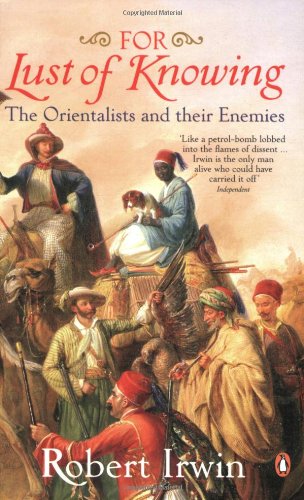
For Lust of Knowing: The Orientalists and Their Enemies
Authors:
Robert Irwin
Publisher:
Penguin Books
Publication Date:
Not available
ISBN:
0140289232
Robert Irwin's history of Orientalism leads from Ancient Greece to the present. He shows that, whether making philological comparisons between Arabic... and Hebrew, cataloguing the coins of Fatimid Egypt or establishing the basic chronology of Harun al-Rashid's military campaigns against Byzantium, scholars have been unified not by politics or ideology but by their shared obsession. "For Lust of Knowing" is an extraordinary, passionate book, both a sustained argument and a brilliant work of original scholarship.
Formal and Transcendental Logic
Authors:
Edmund Husserl
Publisher:
Springer
Publication Date:
Not available
ISBN:
9024720524
Gregory T. Doolan provides here the first detailed consideration of the divine ideas as causal principles. He examines Thomas Aquinas's... philosophical doctrine of the divine ideas and convincingly argues that it is an essential element of his metaphysics.According to Thomas, the ideas in the mind of God are not only principles of his knowledge, but they are productive principles as well. In this role, God's ideas act as exemplars for things that he creates. As Doolan shows, this theory of exemplarism is an integral part of Thomas's account of the existence and order of the created universe. It also accounts in part for the freedom of God's creative act. The volume begins with an introduction to Thomas's doctrine of exemplarism and then addresses his arguments for the existence of exemplar ideas within the mind of God. Having established the existence of divine ideas, Doolan considers how Thomas reconciles their multiplicity with God's simplicity. The work identifies the various things for which Thomas posits divine ideas. As Doolan is careful to show, Thomas does not consider all of these ideas to be exemplars because not all of them act as causal principles. After identifying the ideas that do act in this way, Doolan considers how such exemplars can be causes of natural things without compromising the causality of natural agents. The volume culminates with a consideration of the role that the divine ideas play within the structure of Thomas's theory of participation.
FORMAL DEDUCTIVE LOGIC 9E
Authors:
Not Available
Publisher:
Not available
Publication Date:
Not available
ISBN:
Not available

Formal Logic: Its Scope And Limits
Authors:
Richard Jeffrey
Publisher:
Hackett Pub Co
Publication Date:
Not available
ISBN:
0872208133
The first beginning logic text to employ the tree method - a complete formal system of first-order logic that is remarkably easy to understand and use -... this text allows students to take control of the nuts and bolts of formal logic quickly, and to move on to more complex and abstract problems. The tree method is elaborated in manageable steps over five chapters, in each of which its adequacy is reviewed; soundness and completeness proofs are extended at each step, and the decidability proof is extended at the step from truth functions to the logic of non-overlapping quantifiers with a single variable, after which undecidability is demonstrated by example. The first three chapters are bilingual, with arguments presented twice, in logical notation and in English. The last three chapters consider the discoveries defining the scope and limits of formal methods that marked logic's coming of age in the 20th century: Godel's completeness and incompleteness theorems for first and second-order logic, and the Church-Turing theorem on the undecidability of first order logic. This new edition provides additional problems, solutions to selected problems, and two new Supplements: 'Truth-Functional Equivalence' reinstates material on that topic from the second edition that was omitted in the third, and 'Variant Methods', in which John Burgess provides a proof regarding the possibility of modifying the tree method so that it will always find a finite model when there is one, and another, which shows that a different modification - once contemplated by Jeffrey - can result in a dramatic speed-up of certain proofs.
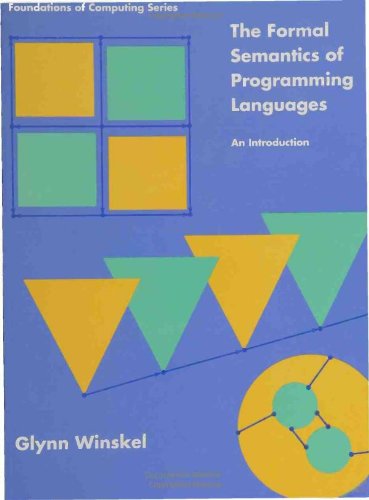
Formal Semantics of Programming Languages
Authors:
Glynn Winskel
Publisher:
The MIT Press
Publication Date:
Not available
ISBN:
0262731037
The Formal Semantics of Programming Languages provides the basic mathematical techniques necessary for those who are beginning a study of the semantics... and logics of programming languages. These techniques will allow students to invent, formalize, and justify rules with which to reason about a variety of programming languages. Although the treatment is elementary, several of the topics covered are drawn from recent research, including the vital area of concurency. The book contains many exercises ranging from simple to miniprojects.Starting with basic set theory, structural operational semantics is introduced as a way to define the meaning of programming languages along with associated proof techniques. Denotational and axiomatic semantics are illustrated on a simple language of while-programs, and fall proofs are given of the equivalence of the operational and denotational semantics and soundness and relative completeness of the axiomatic semantics. A proof of Godel's incompleteness theorem, which emphasizes the impossibility of achieving a fully complete axiomatic semantics, is included. It is supported by an appendix providing an introduction to the theory of computability based on while-programs.Following a presentation of domain theory, the semantics and methods of proof for several functional languages are treated. The simplest language is that of recursion equations with both call-by-value and call-by-name evaluation. This work is extended to lan guages with higher and recursive types, including a treatment of the eager and lazy lambda-calculi. Throughout, the relationship between denotational and operational semantics is stressed, and the proofs of the correspondence between the operation and denotational semantics are provided. The treatment of recursive types - one of the more advanced parts of the book - relies on the use of information systems to represent domains. The book concludes with a chapter on parallel programming languages, accompanied by a discussion of methods for specifying and verifying nondeterministic and parallel programs.
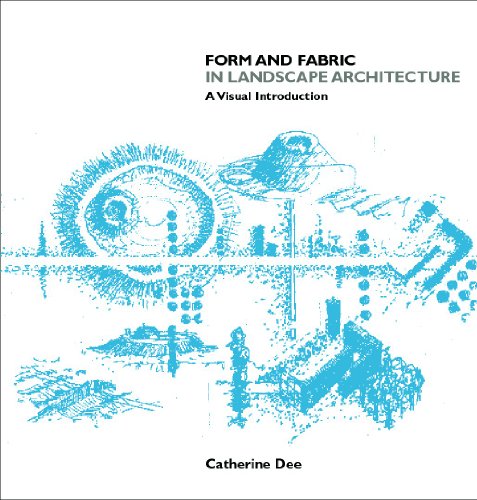
Form & Fabric in Landscape Architecture: A Visual Introduction
Authors:
Catherine Dee
Publisher:
Taylor & Francis
Publication Date:
Not available
ISBN:
0415246385
Form and Fabric in Landscape Architecture provides an original, visual approach to the study of landscape architecture by creating a spatial morphology... based on use and experience of landscapes. It explores aesthetic, spatial and experiential concepts by providing a structure through which landscapes can be understood and conceived in design. 'Fabric' is the integrated structure of whole landscapes, while 'form' refers to the components that make up this fabric. Together form and fabric create a morphology of landscape useful for the development of visual-spatial design thinking and awareness. This book is intended as both an introduction to the discipline for students of landscape architecture, architecture and planning, and a source of continuing interest for more experienced environmental designers.
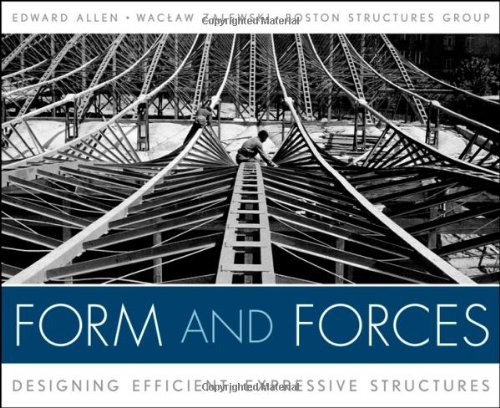
Form and Forces: Designing Efficient, Expressive Structures
Authors:
Edward Allen
Publisher:
Wiley
Publication Date:
Not available
ISBN:
047017465X
Here, in one volume, is all the architect needs to know to participate in the entire process of designing structures. Emphasizing bestselling author... Edward Allen's graphical approach, the book enables you to quickly determine the desired form of a building or other structure and easily design it without the need for complex mathematics. This unique text teaches the whole process of structural design for architects, including selection of suitable materials, finding a suitable configuration, finding forces and size members, designing appropriate connections, and proposing a feasible method of erection. Chapters are centered on the design of a whole structure, from conception through construction planning.
FORM AND FORMAT
Authors:
Not Available
Publisher:
Not available
Publication Date:
Not available
ISBN:
Not available
 '





