production
/viewbook/list/all/?page=4853
/
/static/
None
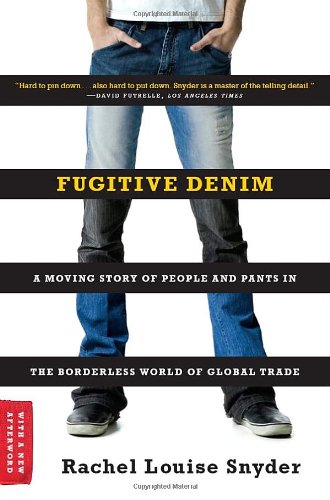
Fugitive Denim: A Moving Story of People and Pants in the...
Authors:
Rachel Louise Snyder
Publisher:
W. W. Norton & Company
Publication Date:
Not available
ISBN:
0393335429
“A fascinating chronicle of the $55-billion-a-year global denim industry.” —David Futrelle, Los Angeles TimesRachel Louise Snyder reports from... the far reaches of the multi-billion-dollar denim industry in search of the people who make your clothes. From a cotton picker in Azerbaijan to a Cambodian seamstress, a denim maker in Italy to a fashion designer in New York, Snyder captures the human, environmental, and political forces at work in a complex and often absurd world. Neither polemic nor prescription, Fugitive Denim captures what it means to work in the twenty-first century.

Fugitive Landscapes: The Forgotten History of the U.S.-Mexico...
Authors:
Samuel Truett
Publisher:
Yale University Press
Publication Date:
Not available
ISBN:
0300143311
Published in Cooperation with the William P. Clements Center for Southwest StudiesIn the nineteenth and early twentieth centuries, Mexicans and... Americans joined together to transform the U.S.Mexico borderlands into a crossroads of modern economic development. This book reveals the forgotten story of their ambitious dreams and their ultimate failure to control this fugitive terrain.Focusing on a mining region that spilled across the ArizonaSonora border, this book shows how entrepreneurs, corporations, and statesmen tried to domesticate nature and society within a transnational context. Efforts to tame a wild” frontier were stymied by labor struggles, social conflict, and revolution. Fugitive Landscapes explores the making and unmaking of the U.S.Mexico border, telling how ordinary people resisted the domination of empires, nations, and corporations to shape transnational history on their own terms. By moving beyond traditional national narratives, it offers new lessons for our own border-crossing age.

Fugitive Pieces
Authors:
Anne Michaels
Publisher:
MCCELLAND & STEWART.
Publication Date:
Not available
ISBN:
0771058837
Regional American food culture still exists and is strongest in more rural, homogenous areas of the country. Regional foods are a major component of... regional identities, and Americans make a big to-do about their home-grown favorites. The current food cultures of the major American regions-northeast/New England, the Mid-Atlantic, the South, the West, the Midwest-and subregions are illuminated here like never before. Everyone knows something about the iconic fare of a region, such as Soul Food in the South and New England clam bakes, but with this resource readers are able to delve wider and deeper into how Americans from Alaska to Hawaii to the Amish country of the Midwest to the Eastern Seaboard sustain themselves and what their food lifestyles are today.The unique regional food cultures that have developed according to natural resources and population are increasingly affected by social and economic trends. Increasingly mobile Americans generally have access to the same fast food and supermarket chain offerings, read the same mass market food magazines and watch the cable food shows, and younger generations may have less time to continue family food traditions such as baking the ethnic breads and desserts that their mothers did. Regional American Food Culture discusses the various traditions within the context of a new millennium. Narrative chapters describe the background of the regional food culture, what the primary foods are, how the food is cooked and by whom, what the typical meals are, how food is used in special occasions, and diet and health issues in the regions. A chronology, resource guide, selected bibliography, and illustrations complement the text.

Fugitive Pieces
Authors:
Anne Michaels
Publisher:
Emblem Editions
Publication Date:
Not available
ISBN:
0771058829
Anne Michaels’ spellbinding début novel has quickly become one of the most beloved and talked-about books of the decade. As a young boy during the... Second World War, Jakob Beer is rescued from the mud in Poland by an unlikely saviour, the scientist Athos Roussos, and he is taken to Greece, then, at war’s end, to Toronto. It is here that his loss gradually surfaces, as does the haunting question of his sister’s fate. Later in life, as a translator and a poet, and now with the glorious Michaela, Jakob meets Ben, a young professor whose own legacies of the war kindle within him a fascination with the older man and his writing. Fugitive Pieces is a work of rare vision that is at once lyrical, sensual, profound. With its vivid evocation of landscape and character, its unique excavation of memory and time, it is a wholly unforgettable novel that draws us into the lives of its characters with compassion and recognition.

Fugitive Pieces: A Novel
Authors:
Anne Michaels
Publisher:
Vintage
Publication Date:
Not available
ISBN:
0679776591
A New York Times Notable Book of the YearWinner of the Lannan Literary Fiction AwardWinner of the Guardian Fiction AwardIn 1940 a boy bursts from the... mud of a war-torn Polish city, where he has buried himself to hide from the soldiers who murdered his family. His name is Jakob Beer. He is only seven years old. And although by all rights he should have shared the fate of the other Jews in his village, he has not only survived but been rescued by a Greek geologist, who does not recognize the boy as human until he begins to cry. With this electrifying image, Anne Michaels ushers us into her rapturously acclaimed novel of loss, memory, history, and redemption.As Michaels follows Jakob across two continents, she lets us witness his transformation from a half-wild casualty of the Holocaust to an artist who extracts meaning from its abyss. Filled with mysterious symmetries and rendered in heart-stopping prose, Fugitive Pieces is a triumphant work, a book that should not so much be read as it should be surrendered to.

Fugitive Slave on Trial: The Anthony Burns Case and Abolitionist...
Authors:
Earl M. Maltz
Publisher:
Not available
Publication Date:
Not available
ISBN:
0700617361
When runaway slave Anthony Burns was tracked to Boston by his owner Charles Suttle, the struggle over his fate became a focal point for national... controversy. Boston, a hotbed of antislavery sentiment, provided the venue for the 1854 hearing that determined Burns's legal status, one of the most dramatic and widely publicized events in the long-running conflict over the issue of fugitive slaves. Earl Maltz's compelling chronicle of this case shows how the violent emotions surrounding it played out at both the local and national levels, focusing especially on the awkward position in which trial judge Edward Loring found himself. A unionist who also supported enforcement of the Fugitive Slave Act, Loring was committed to the idea that each individual case should be decided by reference to neutral principles, which ultimately led him to remand Burns to Suttle's custody. Although, as Maltz argues, Loring's decision was indisputably correct on the facts and justified by existing legal precedent, it also ignited a firestorm of protest. Maltz locates the Burns case in arguments over slavery going back to the Constitution's rendition clause, then follows it through two iterations of federal statutes in 1793 and 1850, a miniature legal war between the governors of Massachusetts and Virginia, and abolitionists' violent resistance to federal law. He also cites Loring's intellectual honesty and determination to apply the law as written, no matter what it might cost him. As the last of a series of high-profile disputes in Massachusetts, the Burns case underscores the abolitionist attitude of many of the state's residents toward the fugitive slave issue, providing readers with a you-are-there view of an actual fugitive slave case hearing and encouraging them to grapple with the question of how a conscientious judge committed to the rule of law should act in such a case. It also sheds light on the political costs and consequences for any judicial official attempting to deliver a decision on such a controversial issue while surrounded by a hostile public. A story as dramatic and compelling as any in our legal annals, Fugitive Slave on Trial dissects an important historical event as it sheds new light on the state of the Union in the mid-1850s and the events that led to its eventual dismemberment. This book is part of the Landmark Law Cases and American Society series.

Fugitive Slaves and the Underground Railroad in the Kentucky...
Authors:
J. Blaine Hudson
Publisher:
McFarland
Publication Date:
Not available
ISBN:
0786446854
Between 1783 and 1860, more than 100,000 enslaved African Americans escaped across the border between slave and free territory in search of freedom.... Most of these escapes were unaided, but as the American anti-slavery movement became more militant after 1830, assisted escapes became more common. Help came from the Underground Railroad, which still stands as one of the most powerful and sustained multiracial human rights movements in world history. This work examines and interprets the available historical evidence about fugitive slaves and the Underground Railroad in Kentucky, the southernmost sections of the free states bordering Kentucky along the Ohio River, and, to a lesser extent, the slave states to the immediate south. Kentucky was central to the Underground Railroad because its northern boundary, the Ohio River, represented a three hundred mile boundary between slavery and nominal freedom. The book examines the landscape of Kentucky and the surrounding states; fugitive slaves before 1850, in the 1850s and during the Civil War; and their motivations and escape strategies and the risks involved with escape. The reasons why people broke law and social convention to befriend fugitive slaves, common escape routes, crossing points through Kentucky from Tennessee and points south, and specific individuals who provided assistance--all are topics covered.

Fugitive Thought: Prison Movements, Race, And The Meaning Of Justice
Authors:
Michael Hames-García
Publisher:
Univ Of Minnesota Press
Publication Date:
Not available
ISBN:
0816643148
In Fugitive Thought, Michael Hames-García argues that writings by prisoners are instances of practical social theory that seek to transform the world.... Unlike other authors who have studied prisons or legal theory, Hames-García views prisoners as political and social thinkers whose ideas are as important as those of lawyers and philosophers. As key moral terms like "justice," "solidarity," and "freedom" have come under suspicion in the post–Civil Rights era, political discussions on the Left have reached an impasse. Fugitive Thought reexamines and reinvigorates these concepts through a fresh approach to philosophies of justice and freedom, combining the study of legal theory and of prison literature to show how the critiques and moral visions of dissidents and participants in prison movements can contribute to the shaping and realization of workable ethical conceptions. Fugitive Thought focuses on writings by black and Latina/o lawyers and prisoners to flesh out the philosophical underpinnings of ethical claims within legal theory and prison activism.

Fugue State
Authors:
Brian Evenson
Publisher:
Coffee House Press
Publication Date:
Not available
ISBN:
1566892252
“Brilliant...Evenson manages to capture madness with a masterful tone. The specific genius of Fugue State rests in subtlety, in Evenson’s ability... to maintain suspense, dread and paranoia through utter linguistic control.”—Time Out New York “19 satisfying and surreal stories...packed with subtly hilarious sentences.”—Cleveland Plain Dealer “Brian Evenson is one of the treasures of American story writing, a true successor both to the generation of Coover, Barthelme, Hawkes and Co., but also to Edgar Allan Poe.”—Jonathan Lethem "The stories in this collection will thrill, unsettle, and captivate. Like lanterns in dark rooms, paper boats carried down on subterranean waters, they lead the reader into mysterious and perilous territory. Read at your own risk."—Kelly Link Illustrated by graphic novelist Zak Sally, Brian Evenson’s hallucinatory and darkly comic stories of paranoia, pursuit, sensory deprivation, amnesia, and retribution rattle the cages of the psyche and peer into the gaping moral chasm that opens when we become estranged from ourselves. From sadistic bosses with secret fears to a woman trapped in a mime’s imaginary box, and from a post-apocalyptic misidentified Messiah to unwitting portraitists of the dead, the mind-bending world of this modern-day Edgar Allan Poe exposes the horror contained within our daily lives.Brian Evenson is the author of the Edgar and International Horror Guild award-nominated novel The Open Curtain. Visit his website at www.brianevenson.com.

Fug You: An Informal History of the Peace Eye Bookstore, the Fuck...
Authors:
Ed Sanders
Publisher:
Da Capo Press
Publication Date:
Not available
ISBN:
0306818884
Fug You is Ed Sanders's unapologetic and often hilarious account of eight key years of "total assault on the culture," to quote his novelist friend... William S. Burroughs.Fug You traces the flowering years of New York's downtown bohemia in the sixties, starting with the marketing problems presented by publishing Fuck You / A Magazine of the Arts, as it faced the aboveground's scrutiny, and leading to Sanders's arrest after a raid on his Peace Eye Bookstore. The memoir also traces the career of the Fugs--formed in 1964 by Sanders and his neighbor, the legendary Tuli Kupferberg (called "the world's oldest living hippie" by Allen Ginsberg)--as Sanders strives to find a home for this famous postmodern, innovative anarcho-folk-rock band in the world of record labels.

Fuir
Authors:
Jean-Philippe Toussaint
Publisher:
MINUIT
Publication Date:
Not available
ISBN:
2707320951

Fukushima Meltdown: The World's First Earthquake-Tsunami-Nuclear...
Authors:
Takashi Hirose
Publisher:
CreateSpace Independent Publishing Platform
Publication Date:
Not available
ISBN:
1468161253
Takashi Hirose wrote this book in a heat of passion mixed with terrible sadness in the weeks following the Fukushima nuclear disaster. But he is far... from a newcomer to this field; he has been writing books and articles warning of the terrible dangers of nuclear power since the early 1980s. In this book, which was a best seller in Japan, he not only describes the comic-if-not-so-tragic series of fumbling errors that lead to the meltdown at Fukushima, but also makes clear the absurdity of putting nuclear power plants anywhere on the earthquake and volcano prone Japanese archipelago - and by extension, anywhere in the world. This is the first translation into English of any book by this authoritative critic of nuclear power.

Fukuzawa Yukichi: From Samurai to Capitalist (Library of World...
Authors:
Helen M. Hopper
Publisher:
Pearson
Publication Date:
Not available
ISBN:
0321078020
This biography traces the career of Fukuzawa Yûkichi, who began life as a lower-level samurai and went on to become one of the leading figures in... Japan as it entered the modern era and became an industrial power. The titles in the Library of World Biography series make ideal supplements for World History survey courses or other courses in the history curriculum that explore figures in history. Paperback, brief, and inexpensive, each interpretative biography in this series focuses on a figure whose actions and ideas significantly influenced the course of world history. At the same time, each biography relates the life of its subject to the broader themes and developments of the times. Fukuzawa Yûkichi, one of Japan's best-known figures of the later half of the Nineteenth Century, broke the restrictive bonds of the Tokugawa samurai system and in his lifetime gained fame as a writer and interpreter of Western thought and customs, an educator who founded a famous university, a journalist and owner of an influential newspaper, a supporter of women's rights, and an entrepreneur with extensive and important economic influence. Although he embraced much from Western thought, he never let go of his early Confucian training. Fukuzawa never entered public office, but his influence among those who did was striking. He became a revered figure of the century, and is immortalized on the ten thousand yen bill, the largest currency denomination. The story of Fukuzawa's life takes place during a pivotal period in Japanese history, as the country was becoming an industrial power and moving toward nationhood.

Fulbright V. Americraft Industries and Parker
Authors:
Edward J. Stein
Publisher:
NITA
Publication Date:
Not available
ISBN:
1601560540
This exciting new professional responsibility casebook was designed to be teachable and versatile. New teachers and adjuncts will appreciate the... extensive instructor support (including a detailed teacher's manual with suggestions for classroom presentation), while seasoned teachers will find the materials to be contemporary, intellectually challenging and provocative. The text caters to the needs of students who will enter small-firm or solo practice as well as large-firm practice. Problems at the end of each chapter, taken from current cases and news stories, incorporate cutting-edge issues and create possibilities for enrichment and expansion in areas of the instructor's interest.
Fulfilled in Our Hearing: History and Method of Christian Preaching
Authors:
Guerric, Osb DeBona
Publisher:
Paulist Press
Publication Date:
Not available
ISBN:
0809143593
"Preaching is the gifted expression of God's saving power inside human language," writes Guerric DeBona. Now, with this groundbreaking book, he presents... an overview and synthesis of the history of preaching from a Catholic perspective. He places the major movements and historical currents in preaching that have occurred in the Christian era and places these developments in context. Fr. DeBona offers special emphasis on the emergence of the "new homiletic" in the twentieth century and examines in detail the inductive methods of preaching. Then he covers liturgical preaching, drawing from the USCCB's influential document Fulfilled in Your Hearing; multicultural preaching, with an emphasis on African-American and Hispanic preaching; and contemporary preaching, which looks at the theoretical issues at stake in "postmodernism." Concluding with an examination of the future of preaching in the electronic age and a bibliography, this book, described by Gerard Sloyan in his foreword as "a remarkable tour of the homiletic horizon," is sure to open up a discussion about where Christian preaching has been and where it might be headed.
 '





