production
/viewbook/list/all/?page=4859
/
/static/
None

FUNCTIONAL TREATMENT IDEAS AND STRATEGIES IN ADULT HEMIPLEGI
Authors:
Not Available
Publisher:
Not available
Publication Date:
Not available
ISBN:
Not available
Functional Vision: A Practitioner's Guide to Evaluation and...
Authors:
Amanda Hall Lueck
Publisher:
Amer Foundation for the Blind
Publication Date:
Not available
ISBN:
0891288716
Packed with proven strategies and ready-to-use worksheets, this practical guide leads teachers through the process of designing and presenting a... successful workshop.
FUNCTION/CHANGE MODELING APPROACH PKG
Authors:
Not Available
Publisher:
Not available
Publication Date:
Not available
ISBN:
Not available
Functioning in the Real World: A Precalculus Experience (2nd Edition)
Authors:
Sheldon P. Gordon
Publisher:
Pearson
Publication Date:
Not available
ISBN:
0201383896
This text, which grew out of a NSF grant, takes a fresh approach with a focus on the underlying concepts of precalculus, rather than sheer algebraic... manipulation. It effectively prepares students for a new generation of calculus courses and allows instructors to become actively involved in the teaching process. The authors make extensive use of real world applications, showing students how mathematics relates to their field of study, as well as including a thorough integration of technology. Additionally, the authors have incorporated a number of learning features designed to ready students for a more positive calculus experience.
Functions and Algebraic Methods
Authors:
Elizabeth Difanis Phillips
Publisher:
Addison Wesley Longman, Inc.
Publication Date:
Not available
ISBN:
0536665974
Both a companion to Introducing Sociolinguistics, Miriam Meyerhoff’s bestselling textbook, and a stand-alone Reader in sociolinguistics, this... collection includes classic foundational readings and more recent innovative articles. Intended to be highly user-friendly, The Routledge Sociolinguistics Reader includes substantial section introductions, further reading, a reader’s guide on how to use the book and an introductory chapter providing advice on how to undertake qualitative and quantitative research. This introduction is supplemented by exercises focussing on data handling and collection. The Reader is divided into six sections and each section is thematically organised. Each reading is accessible to beginning students of sociolinguistics but the entire selection is assembled to also help advanced students focus on themes, principles and concepts that cut across different researchers' work. Beginning and advanced students are supported by Content Questions to assist understanding of essential features in the readings, and Concept Questions which help advanced students make connections across readings, apply theory to data, and critically engage with the readings. A companion website supports and connects the Reader and textbook with structured exercises, links to associated websites and video examples, plus an online glossary. The Routledge Sociolinguistics Reader is essential reading for students on courses in sociolinguistics, language and society, and language and variation. Authors: Allan Bell ● Jennifer Hay ● Stefanie Jannedy ● Norma Mendoza-Denton ● Qing Zhang ● John Laver ● Sachiko Ide ● Dennis R. Preston ● Thomas Purnell ● William Idsardi ● John Baugh ● Gibson Ferguson ● Isabelle Buchstaller ● Jinny K. Choi ● Don Kulick ● Christopher Stroud ● Jan-Peter Blom ● John J. Gumperz ● David Britain ● Monica Heller ● Ben Rampton ● Miriam Meyerhoff ● Nancy Niedzielski ● William Labov ● Rika Ito ● Sali Tagliamonte ● Gillian Sankoff ● Hélène Blondeau ● Peter Trudgill ● Richard Cameron ● Lesley Milroy ● James Milroy ● Paul Kerswill ● Ann Williams ● Terttu Nevalainen ● Penelope Eckert ● Janet Holmes ● Stephanie Schnurr ● Niloofar Haeri ● Elinor Ochs ● Scott Fabius Kiesling ● Rusty Barrett Miriam Meyerhoff is Professor of Linguistics at the University of Auckland, New Zealand. Erik Schleef is lecturer in the Department of Linguistics and English Language at the University of Manchester, UK. Go to www.routledge.com/textbooks/meyerhoff for online resources supporting The Routledge Sociolinguistics Reader and Introducing Sociolinguistics (Meyerhoff 2011) ENGLISH LANGUAGE AND LINGUISTICS

Functions and Change: A Modeling Approach to College Algebra
Authors:
Bruce Crauder
Publisher:
Brooks Cole
Publication Date:
Not available
ISBN:
0547156693
FUNCTIONS AND CHANGE: A MODELING APPROACH TO COLLEGE ALGEBRA, 4E provides an alternative to a traditional college algebra course for students who either... will not take another math course or may go on to a business calculus course. The authors wrote this text for the many college algebra students who are poorly served by books that focus on preparing them for a course they will never take, traditional calculus.
Functions and Change: A Modeling Approach to College Algebra and...
Authors:
Benny Evans; Alan Noell; Bruce Crauder
Publisher:
Houghton Mifflin Company
Publication Date:
Not available
ISBN:
0618858040
FUNCTIONS AND CHANGE: A MODELING APPROACH TO COLLEGE ALGEBRA W/...
Authors:
Not Available
Publisher:
Not available
Publication Date:
Not available
ISBN:
1111019371
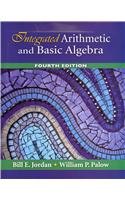
A combination of a basic mathematics or prealgebra text and an introductory algebra text, Integrated Arithmetic and Basic Algebra, Third Edition,... provides a uniquely integrated presentation of the material for these courses in a way that is extremely beneficial to students. As opposed to traditional texts that present arithmetic at the beginning and algebra at the end, this text integrates the two whenever possible, so that students see how concepts are interrelated rather than learning them in isolation and missing the "big picture." The ideas and algorithms shared by arithmetic and algebra are introduced in an arithmetic context and then developed through the corresponding algebraic concept. For example, operations with rational numbers and rational expressions are discussed together, whereas most texts discuss operations with rational numbers early on and operations with rational expressions much later. The Jordan/Palow text helps students recognize algebra as a natural extension of arithmetic using variables. This approach aligns directly with NCTM and AMATYC standards, which suggest playing upon students' previous knowledge to teach new concepts.
FUNCTIONS AND CHANGE W/ SSM & TECH GUIDE
Authors:
Not Available
Publisher:
Not available
Publication Date:
Not available
ISBN:
Not available
FUNCTIONS&CHANGE(PKG W/WEBASSIGN ACCESS)(WEBASSIGN REQ)
Authors:
Not Available
Publisher:
Not available
Publication Date:
Not available
ISBN:
Not available
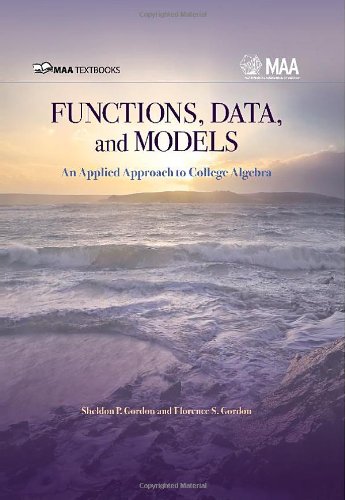
Functions, Data, and Models: An Applied Approach to College Algebra
Authors:
Sheldon P. Gordon
Publisher:
Mathematical Association of America
Publication Date:
Not available
ISBN:
0883857677
This is a college algebra-level textbook written to provide the kind of mathematical knowledge and experiences that students will need for courses in... other fields, such as biology, chemistry, business, finance, economics, and other areas that are heavily dependent on data either from laboratory experiments or from other studies. The focus is on the fundamental mathematical concepts and the realistic problem-solving via mathematical modeling rather than the development of algebraic skills that might be needed in calculus.Functions, Data, and Models presents college algebra in a way that differs from almost all college algebra books available today. Rather than going over material covered in high school courses the Gordons teach something new. Students are given an introduction to data analysis and mathematical modeling presented at a level that students with limited algebraic skills can understand. The book contains a rich set of exercises, many of which use real data. Also included are thought experiments or what if questions that are meant to stretch the student s mathematical thinking.

FUNCTIONS IN MATHEMATICS: INTRODUCTORY EXPLORATIONS
Authors:
Not Available
Publisher:
Not available
Publication Date:
Not available
ISBN:
Not available
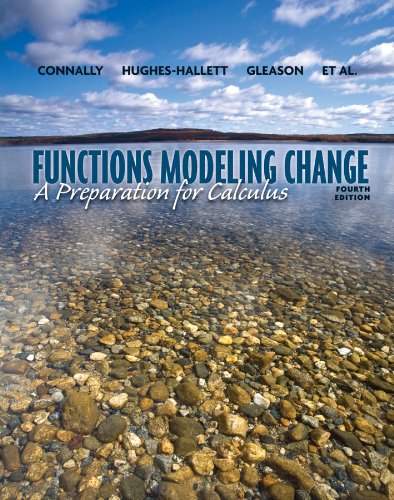
Functions Modeling Change: A Preparation for Calculus
Authors:
Eric Connally
Publisher:
Wiley
Publication Date:
Not available
ISBN:
0470484756
This text provides a strong foundation to precalculus that focuses on a small number of key topics thereby emphasising depth of understanding rather... than breath of coverage. It provides a solid way to motivate concepts and develop critical thinking skills. The new fourth edition emphasises functions as models of change. It contains superior exercises and applications that motivate the concepts students can use to fully grasp precalculus.
Functions Modeling Change: A Preparation for Calculus
Authors:
Eric Connally
Publisher:
Wiley
Publication Date:
Not available
ISBN:
0470484748
This text provides a strong foundation to precalculus that focuses on a small number of key topics thereby emphasising depth of understanding rather... than breath of coverage. It provides a solid way to motivate concepts and develop critical thinking skills. The new fourth edition emphasises functions as models of change. It contains superior exercises and applications that motivate the concepts students can use to fully grasp precalculus.
Functions Modeling Change: A Preparation for Calculus
Authors:
Eric Connally
Publisher:
Wiley
Publication Date:
Not available
ISBN:
0471793035
The third edition of this ground-breaking text continues the authors' goal - a targeted introduction to precalculus that carefully balances concepts... with procedures. Overall, this text is designed to provide a solid foundation to precalculus that focuses on a small number of key topics thereby emphasizing depth of understanding rather than breath of coverage. Developed by the Calculus Consortium, FMC 3e is flexible enough to be thought-provoking for well-prepared students while still remaining accessible to students with weaker backgrounds. As multiple representations encourage students to reflect on the material, each function is presented symbolically, numerically, graphically and verbally (the Rule of Four). Additionally, a large number of real-world applications, examples and problems enable students to create mathematical models that will help them understand and interpret the world in which they live.
 '





