production
/viewbook/list/all/?page=4883
/
/static/
None

Fundamentals of Differential Equations and Boundary Value Problems
Authors:
R. Kent Nagle
Publisher:
Pearson
Publication Date:
Not available
ISBN:
0321747747
Fundamentals of Differential Equations presents the basic theory of differential equations and offers a variety of modern applications in science and... engineering. Available in two versions, these flexible texts offer the instructor many choices in syllabus design, course emphasis (theory, methodology, applications, and numerical methods), and in using commercially available computer software. Fundamentals of Differential Equations, Eighth Edition is suitable for a one-semester sophomore- or junior-level course. Fundamentals of Differential Equations with Boundary Value Problems, Sixth Edition, contains enough material for a two-semester course that covers and builds on boundary value problems. The Boundary Value Problems version consists of the main text plus three additional chapters (Eigenvalue Problems and Sturm-Liouville Equations; Stability of Autonomous Systems; and Existence and Uniqueness Theory).

Fundamentals of Differential Equations and Boundary Value Problems...
Authors:
Kent R. Nagle
Publisher:
Addison Wesley
Publication Date:
Not available
ISBN:
020133867X

Fundamentals of Differential Equations bound with IDE CD (Saleable...
Authors:
R. Kent Nagle
Publisher:
Addison Wesley
Publication Date:
Not available
ISBN:
0321604342
Key Message: Fundamentals of Differential Equations Fundamentals of Differential Equations presents the basic theory of differential equations and... offers a variety of modern applications in science and engineering. Available in two versions, these flexible texts offer the instructor many choices in syllabus design, course emphasis (theory, methodology, applications, and numerical methods), and in using commercially available computer softwareKey Topics: Introduction, First-Order Differential Equations, Mathematical Models and Numerical Methods Involving First Order Equations, Linear Second-Order Equations, Introduction to Systems and Phase Plane Analysis, Theory of Higher-Order Linear Differential Equations, Laplace Transforms, Series Solutions of Differential Equations, Matrix Methods for Linear SystemsMarket: For all readers interested in Differential Equations.
Fundamentals of Digital and Computer Design with VHDL
Authors:
Richard Sandige
Publisher:
McGraw-Hill Science/Engineering/Math
Publication Date:
Not available
ISBN:
0073380695
This text is intended for an introductory digital design course for students at the freshman level; it also is intended for an introductory computer... design course with assembly language programming for students at the sophomore level. This text uses a spiral teaching approach by introducing a design problem and then, in the same chapter or a later chapter, either (1) reemphasizing the same concepts when a different design is presented, or (2) working the same problem using a different technique. This is done to increase the likelihood of retention.
Fundamentals of Digital Image Processing
Authors:
Anil K. Jain
Publisher:
Prentice Hall
Publication Date:
Not available
ISBN:
0133361659
Presents a thorough overview of the major topics of digital image processing, beginning with the basic mathematical tools needed for the subject.... Includes a comprehensive chapter on stochastic models for digital image processing. Covers aspects of image representation including luminance, color, spatial and temporal properties of vision, and digitization. Explores various image processing techniques. Discusses algorithm development (software/firmware) for image transforms, enhancement, reconstruction, and image coding.
Fundamentals of Digital Image Processing: A Practical Approach with...
Authors:
Chris Solomon
Publisher:
Wiley
Publication Date:
Not available
ISBN:
0470844736
This is an introductory to intermediate level text on the science of image processing, which employs the Matlab programming language to illustrate some... of the elementary, key concepts in modern image processing and pattern recognition. The approach taken is essentially practical and the book offers a framework within which the concepts can be understood by a series of well chosen examples, exercises and computer experiments, drawing on specific examples from within science, medicine and engineering.Clearly divided into eleven distinct chapters, the book begins with a fast-start introduction to image processing to enhance the accessibility of later topics. Subsequent chapters offer increasingly advanced discussion of topics involving more challenging concepts, with the final chapter looking at the application of automated image classification (with Matlab examples) .Matlab is frequently used in the book as a tool for demonstrations, conducting experiments and for solving problems, as it is both ideally suited to this role and is widely available. Prior experience of Matlab is not required and those without access to Matlab can still benefit from the independent presentation of topics and numerous examples.Features a companion website www.wiley.com/go/solomon/fundamentals containing a Matlab fast-start primer, further exercises, examples, instructor resources and accessibility to all files corresponding to the examples and exercises within the book itself.Includes numerous examples, graded exercises and computer experiments to support both students and instructors alike.
Fundamentals of Digital Imaging
Authors:
H. J. Trussell
Publisher:
Cambridge University Press
Publication Date:
Not available
ISBN:
052186853X
The multi-billion dollar industry of digital imaging technology is an active research area with applications in our everyday lives in products such as... digital cameras, scanners, printers and display systems. This book presents an introduction to the fundamentals of digital imaging, with emphasis on the basic operations of image capture and display of monochrome and colour images. The authors balance the mathematical description of real problems with practical examples. With a colour-plate section and real-world applications, this book is suitable for graduate students taking courses in digital imaging in electrical engineering and computer science departments. It will also be a useful reference for practitioners in industry.

Fundamentals of Digital Logic and Microcomputer Design, 5th Edition
Authors:
M. Rafiquzzaman
Publisher:
Wiley-Interscience
Publication Date:
Not available
ISBN:
0471727849
Fundamentals of Digital Logic and Microcomputer Design, has long been hailed for its clear and simple presentation of the principles and basic tools... required to design typical digital systems such as microcomputers. In this Fifth Edition, the author focuses on computer design at three levels: the device level, the logic level, and the system level. Basic topics are covered, such as number systems and Boolean algebra, combinational and sequential logic design, as well as more advanced subjects such as assembly language programming and microprocessor-based system design. Numerous examples are provided throughout the text.Coverage includes: Digital circuits at the gate and flip-flop levels Analysis and design of combinational and sequential circuits Microcomputer organization, architecture, and programming concepts Design of computer instruction sets, CPU, memory, and I/O System design features associated with popular microprocessors from Intel and Motorola Future plans in microprocessor development An instructor's manual, available upon request Additionally, the accompanying CD-ROM, contains step-by-step procedures for installing and using Altera Quartus II software, MASM 6.11 (8086), and 68asmsim (68000), provides valuable simulation results via screen shots. Fundamentals of Digital Logic and Microcomputer Design is an essential reference that will provide you with the fundamental tools you need to design typical digital systems.
Fundamentals of Digital Logic with Verilog Design
Authors:
Stephen Brown
Publisher:
McGraw-Hill Science/Engineering/Math
Publication Date:
Not available
ISBN:
0077211642
Fundamentals of Digital Logic With Verilog Design teaches the basic design techniques for logic circuits. It emphasizes the synthesis of circuits and... explains how circuits are implemented in real chips. Fundamental concepts are illustrated by using small examples.Use of CAD software is well integrated into the book. A CD-ROM that contains Altera's Quartus CAD software comes free with every copy of the text. The CAD software provides automatic mapping of a design written in Verilog into Field Programmable Gate Arrays (FPGAs) and Complex Programmable Logic Devices (CPLDs). Students will be able to try, firsthand, the book's Verilog examples (over 140) and homework problems. Engineers use Quartus CAD for designing, simulating, testing and implementing logic circuits. The version included with this text supports all major features of the commercial product and comes with a compiler for the IEEE standard Verilog language. Students will be able to: enter a design into the CAD systemcompile the design into a selected devicesimulate the functionality and timing of the resulting circuitimplement the designs in actual devices (using the school's laboratory facilities) Verilog is a complex language, so it is introduced gradually in the book. Each Verilog feature is presented as it becomes pertinent for the circuits being discussed. To teach the student to use the Quartus CAD, the book includes three tutorials.

Fundamentals of Digital Logic with Verilog Design
Authors:
Stephen Brown
Publisher:
McGraw-Hill Science/Engineering/Math
Publication Date:
Not available
ISBN:
0073380334
"Fundamentals of Digital Logic With VHDL Design" teaches the basic design techniques for logic circuits. It emphasizes the synthesis of circuits and... explains how circuits are implemented in real chips. Fundamental concepts are illustrated by using small examples, which are easy to understand. Then, a modular approach is used to show how larger circuits are designed. VHDL is used to demonstrate how the basic building blocks and larger systems are defined in a hardware description language, producing designs that can be implemented with modern CAD tools.The book emphasizes the concepts that should be covered in an introductory course on logic design, focusing on: Logic functions, gates, and rules of Boolean algebra; Circuit synthesis and optimization techniques; Number representation and arithmetic circuits; Combinational-circuit building blocks, such as multiplexers, decoders, encoders, and code converters; Sequential-circuit building blocks, such as flip-flops, registers, and counters; Design of synchronous sequential circuits; And use of the basic building blocks in designing larger systems.It also includes chapters that deal with important, but more advanced topics: Design of asynchronous sequential circuits; Testing of logic circuits For students who have had no exposure to basic electronics, but are interested in learning a few key concepts, there is a chapter that presents the most basic aspects of electronic implementation of digital circuits. Major changes in the second edition of the book include: new examples to clarify the presentation of fundamental concepts; over 50 new examples of solved problems provided at the end of chapters; NAND and NOR gates now introduced in Chapter 2; more complete discussion of techniques for minimization of logic functions in Chapter 4 (including the tabular method); a new chapter explaining the CAD flow for synthesis of logic circuits; Altera's Quartus II CAD software provided on a CD-ROM; and three appendices that give tutorials on the use of Quartus II software.
Fundamentals of Digital Logic with VHDL Design
Authors:
Stephen Brown
Publisher:
McGraw-Hill
Publication Date:
Not available
ISBN:
0072410442
Fundamentals of Digital Logic with VHDL Design
Authors:
Stephen D. Brown
Publisher:
Mcgraw-Hill College
Publication Date:
Not available
ISBN:
0073529532
"Fundamentals of Digital Logic with VHDL Design" teaches the basic design techniques for logic circuits. It emphasizes the synthesis of circuits and... explains how circuits are implemented in real chips. Fundamental concepts are illustrated by using small examples, which are easy to understand. Then, a modular approach is used to show how larger circuits are designed. VHDL is used to demonstrate how the basic building blocks and larger systems are defined in a hardware description language, producing designs that can be implemented with modern CAD tools. This book emphasizes CAD through the use of Altera's Quartus II CAD software, a state-of-the-art digital circuit design package. This software produces automatic mapping of designs written in VHDL into Field Programmable Gate Arrays (FPGAs) and Complex Programmable Logic Devices (CPLDs).
Fundamentals of Digital Logic with VHDL Design with CD-ROM
Authors:
Stephen Brown
Publisher:
McGraw-Hill Science/Engineering/Math
Publication Date:
Not available
ISBN:
0077221435
Fundamentals of Digital Logic with VHDL Design teaches the basic design techniques for logic circuits. The text ptovides a clear and easily... understandable discussion of logic circuit design without the use of unnecessary formalism. It emphasizes the synthesis of circuits and explains how circuits are implemented in real chips. Fundamental concepts are illustrated by using small examples, which are easy to understand. Then, a modular approach is used to show how larger circuits are designed. VHDL is a complex language so it is introduced gradually in the book. Each VHDL feature is presented as it becomes pertinent for the circuits being discussed. While it includes a discussion of VHDL, the book provides thorough coverage of the fundamental concepts of logic circuit design, independent of the use of VHDL and CAD tools. A CD-ROM containg all of the VHDL design examples used in the book, as well Altera's Quartus II CAD software, is included free with every text.
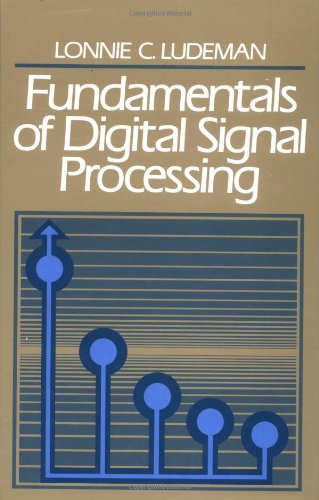
Fundamentals of Digital Signal Processing
Authors:
Lonnie C. Ludeman
Publisher:
Wiley
Publication Date:
Not available
ISBN:
0471603635
A concise introduction to the design and analysis of digital signal processors. Unique in its presentation of advanced topics at the undergraduate... level. Contains excellent graphics and includes coverage of the A/D-digital filter and D/A structures of digital systems. Each chapter includes many carefully worked-out examples and concludes with a summary and problems.
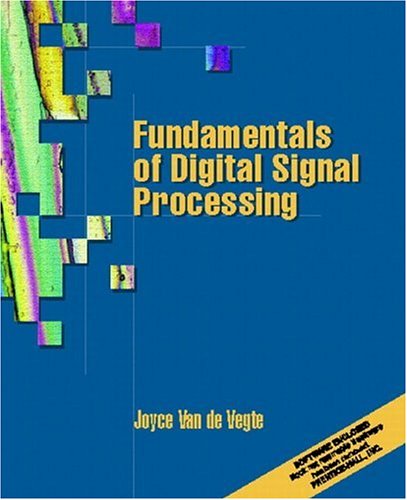
Fundamentals of Digital Signal Processing
Authors:
Joyce Van de Vegte
Publisher:
Prentice Hall
Publication Date:
Not available
ISBN:
0130160776
This professional reference provides thorough coverage of digital signal processing techniques and all essential theory—extensively supported by... examples, but not dependent on calculus. Motivated learners (even those several years out of school) will be able to master the major DSP methods presented here with step-by-step explanations. The book contains a variety of interesting and in-depth DSP explorations to help establish the link between theory and practice—and give readers a sense of how DSP is used, and an introduction to hardware and software for digital signal processors. For Electrical and Electronics Engineers, Electronics Technologists, Electronics Engineering Technologists, Computer Engineering Technologists, and Researchers.
 '





