production
/viewbook/list/all/?page=4962
/
/static/
None
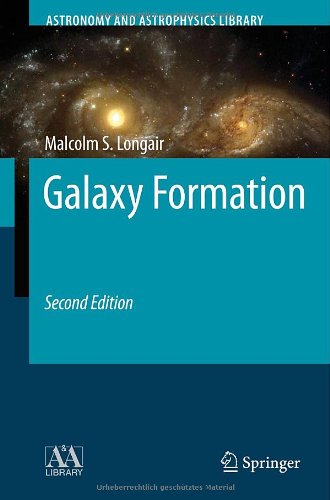
Galaxy Formation (Astronomy and Astrophysics Library)
Authors:
Malcolm S. Longair
Publisher:
Springer
Publication Date:
Not available
ISBN:
3540734775
Delineating the huge strides taken in cosmology in the past ten years, this much-anticipated second edition of Malcolm Longair's highly appreciated... textbook has been extensively and thoroughly updated. It tells the story of modern astrophysical cosmology from the perspective of one of its most important and fundamental problems – how did the galaxies come about? Longair uses this approach to introduce the whole of what may be called "classical cosmology". What’s more, he describes how the study of the origin of galaxies and larger-scale structures in the Universe has provided us with direct information about the physics of the very early Universe.
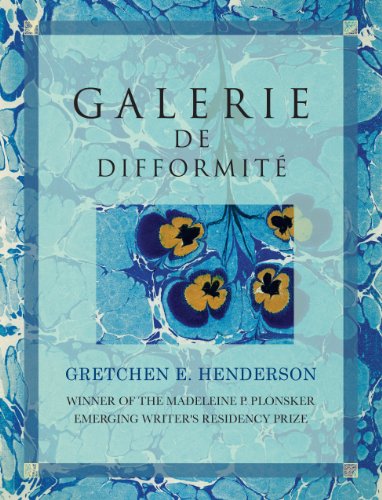
Galerie de Difformite
Authors:
Gretchen E. Henderson
Publisher:
Lake Forest College Press
Publication Date:
Not available
ISBN:
0982315635
Traces of many books mask themselves inside Gretchen E. Henderson s Galerie de Difformite. With the head of a novel and the body of a poem, this... extraordinary work interrogates the nuanced concepts of ability/disability, voyeurism/exhibition, deformity/normality all with a wry sense of self-representational humor. A lineage that bequeaths mysterious relics to an unsuspecting recipient, led through a textual labyrinth by Bea: a deformed reincarnation of Dante s muse. The story-within-a-story takes shape through the mysterious Undertaker a perhaps reanimated-yet-disabled Beatrice, intertwined with the contemporary Gloria Heys and the presumed publisher, Gretchen E. Henderson. An infamous brotherhood called Ye Ugly Face Clubb. Lushly designed with crowdsourced images, text deconstructions, and enough narrative tomfoolery to make Tristram Shandy blush, the Galerie is both funhouse and curiosity cabinet, art catalogue and choose your own adventure. This bestiary of the novel-as-poem-as-essayas- art grows outside of the bounds of the Book and, in the process, redefines deformity for the digital millennium.

Gales of November: The Sinking of the Edmund Fitzgerald
Authors:
Robert J. Hemming
Publisher:
Thunder Bay Press
Publication Date:
Not available
ISBN:
1882376331
##########... ####################################################################################################################################################################################################################################################
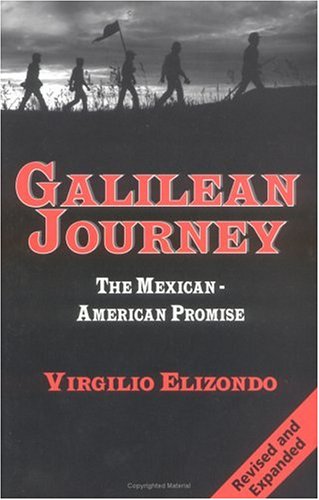
Galilean Journey: The Mexican-American Promise
Authors:
Virgilio P. Elizondo
Publisher:
Orbis Books
Publication Date:
Not available
ISBN:
1570753105
"A shining vision of the contribution Mexican-Americans can make to American culture and American life and American religion as they struggle for... acceptance and justice and offer, in return, festival and joy.--Andrew M. Greeley"

Galileo
Authors:
Bertolt Brecht
Publisher:
Grove Press
Publication Date:
Not available
ISBN:
0802130593
Considered by many to be one of Brecht's masterpieces, Galileo explores the question of a scientist's social and ethical responsibility, as the... brilliant Galileo must choose between his life and his life's work when confronted with the demands of the Inquisition. Through the dramatic characterization of the famous physicist, Brecht examines the issues of scientific morality and the difficult relationship between the intellectual and authority. This version of the play is the famous one that was brought to completion by Brecht himself, working with Charles Laughton, who played Galileo in the first two American productions (Hollywood and New York, 1947). Since then the play has become a classic in the world repertoire. "The play which most strongly stamped on my mind a sense of Brecht's great stature as an artist of the modern theatre was Galileo." - Harold Clurman; "Thoughtful and profoundly sensitive." - Newsweek.
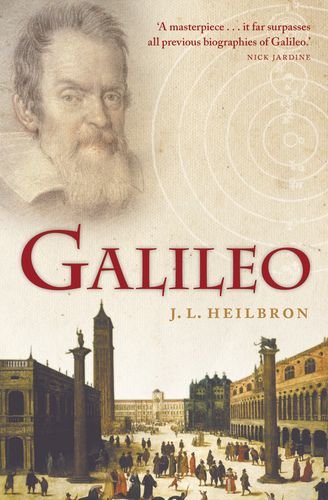
Galileo
Authors:
John L. Heilbron
Publisher:
Oxford University Press, USA
Publication Date:
Not available
ISBN:
0199655987
In 1610, Galileo published the Siderius nuncius, or Starry Messenger, a "hurried little masterpiece" in John Heilbron's words. Presenting to the world... his remarkable observations using the recently invented telescope--the craters of the moon, the satellites of Jupiter--Galileo dramatically challenged our idea of the perfection of the heavens and the centrality of the Earth in the universe. Indeed, the appearance of the little book is regarded as one of the great moments in the history of science. Here is a major new biography of Galileo, a fresh and much more rounded view of the great scientist than found in previous works. Unlike previous biographers, Heilbron shows us that Galileo was far more than a mathematician: he was deeply knowledgeable in the arts, an expert on the epic poet Ariosto, a fine lutenist. More important, Heilbron notes that years of reading the poets and experimenting with literary forms were not mere sidebars--they enabled Galileo to write clearly and plausibly about the most implausible things. Indeed, Galileo changed the world not simply because he revolutionized astronomy, but because he conveyed his discoveries so clearly and crisply that they could not be avoided or denied. If ever a discoverer was perfectly prepared to make and exploit his discovery, it was the dexterous humanist Galileo aiming his first telescope at the sky. In Galileo, John Heilbron captures not only the great scientist, but also the creative, artistic younger man who would ultimately become the champion of Copernicus, the bête-noire of the Jesuits, and the best-known of all martyrs to academic freedom.
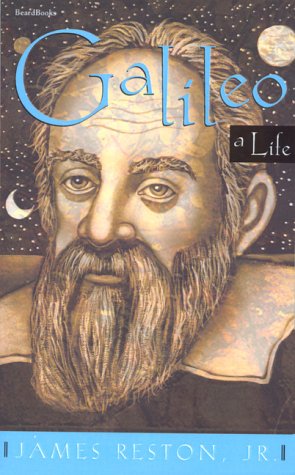
Galileo: A Life
Authors:
James Jr. Reston
Publisher:
Beard Books
Publication Date:
Not available
ISBN:
189312262X
The dramatic story of an era during which science and religion were one and where one man dared to defy the only power on earth that was able to bring... him to his knees.
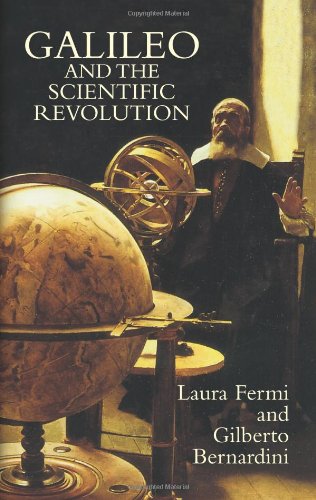
Galileo and the Scientific Revolution
Authors:
Laura Fermi
Publisher:
Dover Publications
Publication Date:
Not available
ISBN:
0486432262
An absorbing account of the origins of modern science as well as the warmly human story of a man and his pioneering work, this biography chronicles... Galileo's innovations and inventions in fascinating detail. It also recounts his clashes with dogmatists and offers a retrospective of his remarkable legacy.
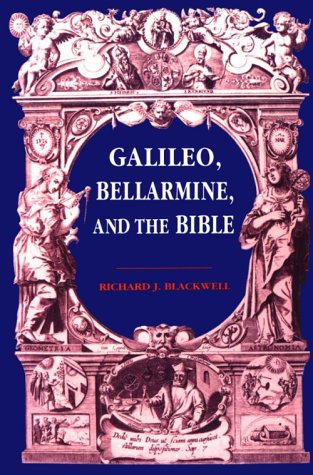
Galileo, Bellarmine, and the Bible
Authors:
Richard J. Blackwell
Publisher:
University of Notre Dame Press
Publication Date:
Not available
ISBN:
0268010277
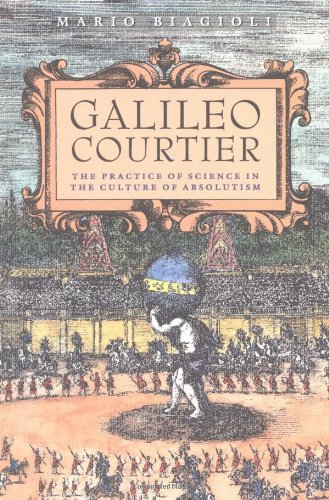
Galileo, Courtier: The Practice of Science in the Culture of...
Authors:
Mario Biagioli
Publisher:
University Of Chicago Press
Publication Date:
Not available
ISBN:
0226045609
Informed by currents in sociology, cultural anthropology, and literary theory, Galileo, Courtier is neither a biography nor a conventional history of... science. In the court of the Medicis and the Vatican, Galileo fashioned both his career and his science to the demands of patronage and its complex systems of wealth, power, and prestige. Biagioli argues that Galileo's courtly role was integral to his science--the questions he chose to examine, his methods, even his conclusions.Galileo, Courtier is a fascinating cultural and social history of science highlighting the workings of power, patronage, and credibility in the development of science.
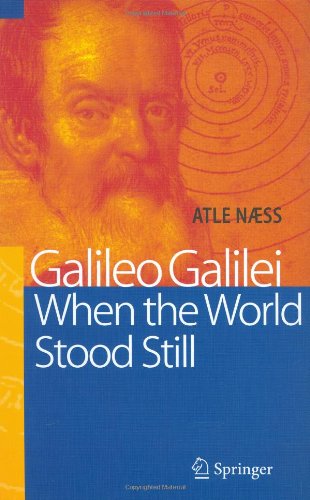
Galileo Galilei - When the World Stood Still
Authors:
Atle Naess
Publisher:
Springer
Publication Date:
Not available
ISBN:
3540219617
His biography of Galileo won the Brage Award for best Norwegian non-fiction book in 2001 The Norwegian edition has sold nearly 6000 copies Biographies... as a genre are very popular
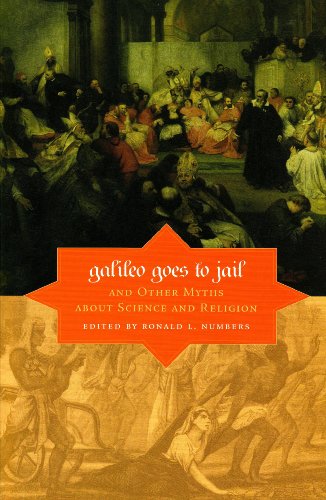
Galileo Goes to Jail and Other Myths about Science and Religion
Authors:
Not Available
Publisher:
Harvard University Press
Publication Date:
Not available
ISBN:
0674057414
If we want nonscientists and opinion-makers in the press, the lab, and the pulpit to take a fresh look at the relationship between science and... religion, Ronald Numbers suggests that we must first dispense with the hoary myths that have masqueraded too long as historical truths. Until about the 1970s, the dominant narrative in the history of science had long been that of science triumphant, and science at war with religion. But a new generation of historians both of science and of the church began to examine episodes in the history of science and religion through the values and knowledge of the actors themselves. Now Ronald Numbers has recruited the leading scholars in this new history of science to puncture the myths, from Galileo’s incarceration to Darwin’s deathbed conversion to Einstein’s belief in a personal God who “didn’t play dice with the universe.” The picture of science and religion at each other’s throats persists in mainstream media and scholarly journals, but each chapter in Galileo Goes to Jail shows how much we have to gain by seeing beyond the myths.
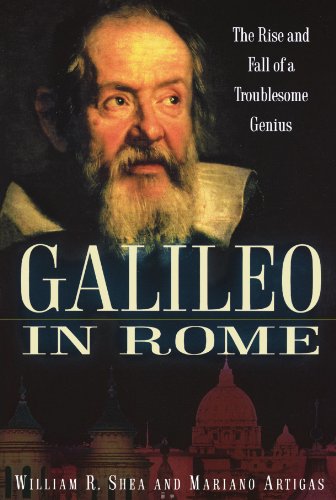
Galileo in Rome: The Rise and Fall of a Troublesome Genius
Authors:
William R. Shea
Publisher:
Oxford University Press, USA
Publication Date:
Not available
ISBN:
0195177584
Galileo's trial by the Inquisition is one of the most dramatic incidents in the history of science and religion. Today, we tend to see this event in... black and white--Galileo all white, the Church all black. Galileo in Rome presents a much more nuanced account of Galileo's relationship with Rome. The book offers a fascinating account of the six trips Galileo made to Rome, from his first visit at age 23, as an unemployed mathematician, to his final fateful journey to face the Inquisition. The authors reveal why the theory that the Earth revolves around the Sun, set forth in Galileo's Dialogue, stirred a hornet's nest of theological issues, and they argue that, despite these issues, the Church might have accepted Copernicus if there had been solid proof. More interesting, they show how Galileo dug his own grave. To get the imprimatur, he brought political pressure to bear on the Roman Censor. He disobeyed a Church order not to teach the heliocentric theory. And he had a character named Simplicio (which in Italian sounds like simpleton) raise the same objections to heliocentrism that the Pope had raised with Galileo. The authors show that throughout the trial, until the final sentence and abjuration, the Church treated Galileo with great deference, and once he was declared guilty commuted his sentence to house arrest. Here then is a unique look at the life of Galileo as well as a strikingly different view of an event that has come to epitomize the Church's supposed antagonism toward science.
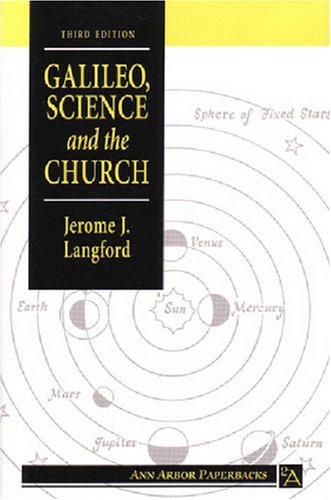
Galileo, Science and the Church (Ann Arbor Paperbacks)
Authors:
Jerome J. Langford
Publisher:
University of Michigan Press
Publication Date:
Not available
ISBN:
0472065106
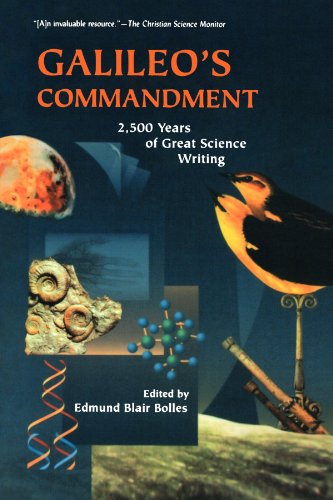
Galileo's Commandment: 2,500 Years of Great Science Writing
Authors:
Not Available
Publisher:
Holt Paperbacks
Publication Date:
Not available
ISBN:
0805073493
Bolles has scoured the literature of science to build a treasury that is accessible and riveting, and therefore appealing to readers unfamiliar with... science, yet erudite enough for the scientifically initiated to enjoy.
 '





