production
/viewbook/list/all/?page=4969
/
/static/
None
Game Theory for Applied Economists
Authors:
Robert Gibbons
Publisher:
Princeton University Press
Publication Date:
Not available
ISBN:
0691003955
This book introduces one of the most powerful tools of modern economics to a wide audience: those who will later construct or consume game-theoretic... models. Robert Gibbons addresses scholars in applied fields within economics who want a serious and thorough discussion of game theory but who may have found other works overly abstract. Gibbons emphasizes the economic applications of the theory at least as much as the pure theory itself; formal arguments about abstract games play a minor role. The applications illustrate the process of model building--of translating an informal description of a multi-person decision situation into a formal game-theoretic problem to be analyzed. Also, the variety of applications shows that similar issues arise in different areas of economics, and that the same game-theoretic tools can be applied in each setting. In order to emphasize the broad potential scope of the theory, conventional applications from industrial organization have been largely replaced by applications from labor, macro, and other applied fields in economics. The book covers four classes of games, and four corresponding notions of equilibrium: static games of complete information and Nash equilibrium, dynamic games of complete information and subgame-perfect Nash equilibrium, static games of incomplete information and Bayesian Nash equilibrium, and dynamic games of incomplete information and perfect Bayesian equilibrium.
Game Theory for Business: A Primer in Strategic Gaming
Authors:
Paul Papayoanou
Publisher:
Probabilistic Publishing
Publication Date:
Not available
ISBN:
0964793873
Business executives, managers, and negotiators regularly interact in ways that resemble a game of chess. Yet while game theory is the leading tool in... academia for analyzing such independent choices, its use in the business world has been limited by its perceived lack of practicality. Until now, that is. Game Theory for Business: A Primer in Strategic Gaming outlines a straightforward, practical approach for using game theory. The book demonstrates how Strategic Gaming has, can, and should be applied to help savvy strategists and negotiators shape and play the game of business more effectively.
Game Theory for Political Scientists
Authors:
James D. Morrow
Publisher:
Princeton University Press
Publication Date:
Not available
ISBN:
0691034303
Game theory is the mathematical analysis of strategic interaction. In the fifty years since the appearance of von Neumann and Morgenstern's classic... Theory of Games and Economic Behavior (Princeton, 1944), game theory has been widely applied to problems in economics. Until recently, however, its usefulness in political science has been underappreciated, in part because of the technical difficulty of the methods developed by economists. James Morrow's book is the first to provide a standard text adapting contemporary game theory to political analysis. It uses a minimum of mathematics to teach the essentials of game theory and contains problems and their solutions suitable for advanced undergraduate and graduate students in all branches of political science.Morrow begins with classical utility and game theory and ends with current research on repeated games and games of incomplete information. The book focuses on noncooperative game theory and its application to international relations, political economy, and American and comparative politics. Special attention is given to models of four topics: bargaining, legislative voting rules, voting in mass elections, and deterrence. An appendix reviews relevant mathematical techniques. Brief bibliographic essays at the end of each chapter suggest further readings, graded according to difficulty. This rigorous but accessible introduction to game theory will be of use not only to political scientists but also to psychologists, sociologists, and others in the social sciences.

Game Theory in Wireless and Communication Networks: Theory, Models,...
Authors:
Zhu Han
Publisher:
Cambridge University Press
Publication Date:
Not available
ISBN:
0521196965
This unified treatment of game theory focuses on finding state-of-the-art solutions to issues surrounding the next generation of wireless and... communications networks. Future networks will rely on autonomous and distributed architectures to improve the efficiency and flexibility of mobile applications, and game theory provides the ideal framework for designing efficient and robust distributed algorithms. This book enables readers to develop a solid understanding of game theory, its applications and its use as an effective tool for addressing wireless communication and networking problems. The key results and tools of game theory are covered, as are various real-world technologies including 3G networks, wireless LANs, sensor networks, dynamic spectrum access and cognitive networks. The book also covers a wide range of techniques for modeling, designing and analysing communication networks using game theory, as well as state-of-the-art distributed design techniques. This is an ideal resource for communications engineers, researchers, and graduate and undergraduate students.

GAME THEORY - MAT 304
Authors:
Not Available
Publisher:
Not available
Publication Date:
Not available
ISBN:
Not available
Game Theory: Mathematical Models of Conflict (Horwood Series in...
Authors:
A.J. Jones
Publisher:
Woodhead Publishing
Publication Date:
Not available
ISBN:
1898563144
Written engagingly and with agreeable humor, this book balances a light touch with a rigorous yet economical account of the theory of games and... bargaining models. It provides a precise interpretation, discussion and mathematical analysis for a wide range of “game-like” problems in economics, sociology, strategic studies and war. There is first an informal introduction to game theory, which can be understood by non-mathematicians, which covers the basic ideas of extensive form, pure and mixed strategies and the minimax theorem. The general theory of non-cooperative games is then given a detailed mathematical treatment in the second chapter. Next follows a “first class” account of linear programming, theory and practice, terse, rigorous and readable, which is applied as a tool to matrix games and economics from duality theory via the equilibrium theorem, with detailed explanations of computational aspects of the simplex algorithm. The remaining chapters give an unusually comprehensive but concise treatment of cooperative games, an original account of bargaining models, with a skillfully guided tour through the Shapley and Nash solutions for bimatrix games and a carefully illustrated account of finding the best threat strategies.
Game Writing: Narrative Skills for Videogames (Charles River Media...
Authors:
Not Available
Publisher:
Charles River Media
Publication Date:
Not available
ISBN:
1584504900
As computer games become more and more like Hollywood productions, the need for good story lines increases. Research shows that stories are highly... valued by game players, so today's studios and developers need good writers. Creating narrative--a traditionally static form--for games is a major challenge. Games are at their heart dynamic, interactive systems, so they don't follow the guidelines and rules of film or T.V. writing. Game Writing: Narrative Skills for Videogames addresses these issues and is the first book written to demystify this emerging field. Through the insights and experiences of practicing game writers, the book captures a snapshot of the narrative skills employed in today's game industry. This unique collection of practical articles provides the foundations to the craft of game writing. The articles, written by members of the International Game Developers Association (IGDA) Game Writing Special Interest Group, detail aspects of the process from the basics of narrative and nonlinear narrative to writing comedy for games and creating compelling characters. Throughout the articles there is a strong emphasis on the skills developers and publishers will expect a game writer to have. The book is suitable for both beginners and experienced writers, and is a detailed guide to all the techniques of game writing. This book is an essential read for anyone wishing to get into this exciting field, particularly for new game writers wanting to hone their skills, and film and T.V. scriptwriters who want to learn how to transfer their skills to the games industry. From the Editor: Tips and Tricks Game Writing was the first book by the IGDA Game Writing Special Interest Group, and remains its most popular. For writers new to games it's an indispensible guide, and for experienced writers it's full of tips and tricks from some of the industry's most successful game writers. Here are a few extra tips for anyone interested in writing for games. Stories Don't Make Games. A lot of people say to me, "I've got this great idea for a game..." and proceed to tell me a plot outline for a story. Many of the stories I hear would work better as a book or a film than a game, but even in the cases that would make a great game, there's nothing I can do to make that story become a game. Videogame projects are big business, and unlike movies, they don't begin life as a story outline. The story is something that is either developed along with the game, or that is added later. You can't start with a story and expect to finish with a game. If a Job's Worth Doing... So you can't have your great story idea turned into a game. What should you do instead? The short answer is: find a way to make your own game. If you aren't a programmer, this probably means teaming up with someone who is, or using off-the-shelf game creator software. Don't worry too much about the quality of your first game, because if you want to be a professional game writer you're committing to work on lots of games, and you should try to learn from every project you work on. If you only want to work on big-budget videogames, then game writing might not be for you. Start Small! It may sound obvious, but don't try and run before you can walk. A lot of people working on their first game story have plans to create an epic forty-chapter role-playing game with myriad twists and turns. But seriously, are you really going to be able to make a game that big as your first project? Try writing your game story as a novella or a screenplay first. If that sounds like a lot of extra work, then you're not ready to work on a game that big, because writing a game script is more work than writing a book or a screenplay. Instead, aim for something much smaller--a short story, or the equivalent of one episode of a TV show. You'll have a better chance of finishing what you start. What Does the Player Do? Creating stories is harder work than most people give credit, and game stories have an extra problem--the player has to have something to do. You need to make sure that events in your story imply activities that the player will enjoy doing, otherwise, you're not really making a game at all. How Much Can the Player Do? Also, you have to be realistic about how much choice you can offer the player. You might want to allow the player options at every step of the plot--but then you'll need to develop and test all of the possibilities that this implies. This is a lot of work! Fortunately, Game Writing has many ideas that will help you think about empowering players without generating extra work. Game writing can be rewarding work, but it is still work, and anyone who hopes to succeed in this exciting and challenging field needs to be prepared to rise to the challenge. There's no better place to start than Game Writing: Narrative Skills for Videogames. Chris Bateman Founder, IGDA Game Writing Special Interest Group Editor, Game Writing: Narrative Skills for Videogames
Gamification by Design: Implementing Game Mechanics in Web and...
Authors:
Gabe Zichermann
Publisher:
O'Reilly Media
Publication Date:
Not available
ISBN:
1449397670
What do Foursquare, Zynga, Nike+, and Groupon have in common? These and many other brands use gamification to deliver a sticky, viral, and engaging... experience to their customers. This book provides the design strategy and tactics you need to integrate game mechanics into any kind of consumer-facing website or mobile app. Learn how to use core game concepts, design patterns, and meaningful code samples to a create fun and captivating social environment.Whether you're an executive, developer, producer, or product specialist, Gamification by Design will show you how game mechanics can help you build customer loyalty.Discover the motivational framework game designers use to segment and engage consumers Understand core game mechanics such as points, badges, levels, challenges, and leaderboards Engage your consumers with reward structures, positive reinforcement, and feedback loops Combine game mechanics with social interaction for activities such as collecting, gifting, heroism, and status Dive into case studies on Nike and Yahoo!, and analyze interactions at Google, Facebook, and Zynga Get the architecture and code to gamify a basic consumer site, and learn how to use mainstream gamification APIs from Badgeville "Turning applications into games is a huge trend. This book does a great job of identifying the core lasting principals you need to inspire your users to visit again and again." —Adam Loving Freelance Social Game Developer and founder of Twibes Twitter Groups

Gaming: Essays On Algorithmic Culture (Electronic Mediations)
Authors:
Alexander R. Galloway
Publisher:
Univ Of Minnesota Press
Publication Date:
Not available
ISBN:
0816648514
Video games have been a central feature of the cultural landscape for over twenty years and now rival older media like movies, television, and music in... popularity and cultural influence. Yet there have been relatively few attempts to understand the video game as an independent medium. Most such efforts focus on the earliest generation of text-based adventures (Zork, for example) and have little to say about such visually and conceptually sophisticated games as Final Fantasy X, Shenmue, Grand Theft Auto, Halo, and The Sims, in which players inhabit elaborately detailed worlds and manipulate digital avatars with a vast—and in some cases, almost unlimited—array of actions and choices. In Gaming, Alexander Galloway instead considers the video game as a distinct cultural form that demands a new and unique interpretive framework. Drawing on a wide range of disciplines, particularly critical theory and media studies, he analyzes video games as something to be played rather than as texts to be read, and traces in five concise chapters how the “algorithmic culture” created by video games intersects with theories of visuality, realism, allegory, and the avant-garde. If photographs are images and films are moving images, then, Galloway asserts, video games are best defined as actions. Using examples from more than fifty video games, Galloway constructs a classification system of action in video games, incorporating standard elements of gameplay as well as software crashes, network lags, and the use of cheats and game hacks. In subsequent chapters, he explores the overlap between the conventions of film and video games, the political and cultural implications of gaming practices, the visual environment of video games, and the status of games as an emerging cultural form. Together, these essays offer a new conception of gaming and, more broadly, of electronic culture as a whole, one that celebrates and does not lament the qualities of the digital age. Alexander R. Galloway is assistant professor of culture and communication at New York University and author of Protocol: How Control Exists after Decentralization.
Gaming Lives in the Twenty-First Century: Literate Connections
Authors:
Not Available
Publisher:
Palgrave Macmillan
Publication Date:
Not available
ISBN:
1403972206
Gaming Lives explores the complexly rendered relationship between computer gaming environments and literacy development by focusing on in-depth case... studies of computer gamers in the United States at the beginning of the twenty-first century. This volume examines the claim that computer games can provide better literacy and learning environments than U.S. schools. Using the words and observations of individual gamers, this book offers historical and cultural analyses of their literacy development, practices, and values.
Gaming Matters: Art, Science, Magic, and the Computer Game Medium
Authors:
Judd Ethan Ruggill
Publisher:
University Alabama Press
Publication Date:
Not available
ISBN:
0817317376
In Gaming Matters, Judd Ethan Ruggill and Ken S. McAllister offer a playful and provocative look at the computer game medium, arguing that games are: *... Idiosyncratic, and thus difficult to apprehend using the traditional tools of media study* Irreconcilable, or complex to such a degree that developers, players, and scholars have contradictory ways of describing them* Boring, and therefore obligated to constantly make demandson players' attention* Anachronistic, or built on age-old tropes and forms of playwhile ironically bound to the most advanced technologies* Duplicitous, or dependent on truth-telling rhetoric even when they are about fictions, fantasies, or lies* Work, or are often better understood as labor rather than play* Alchemical, despite seeming all-too mechanical or predictableVideo games are now inarguably a major site of worldwide cultural production. In its assessments, Gaming Matters neither flatters game enthusiasts nor emboldens the medium's detractors. Instead, it provides a new set of lenses through which games can be examined, and in the process makes a significant contribution to the foundation of both computer game and new media studies.
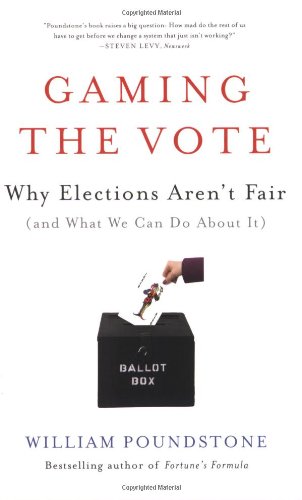
Gaming the Vote: Why Elections Aren't Fair (and What We Can Do...
Authors:
William Poundstone
Publisher:
Hill and Wang
Publication Date:
Not available
ISBN:
0809048922
At least five U.S. presidential elections have been won by the second most popular candidate, but these results were not inevitable. In fact, such an... unfair outcome need never happen again, and as William Poundstone shows in Gaming the Vote, the solution is lurking right under our noses. In all five cases, the vote was upset by a “spoiler”—a minor candidate who took enough votes away from the most popular candidate to tip the election to someone else. The spoiler effect is more than a glitch. It is a consequence of one of the most surprising intellectual discoveries of the twentieth century: the “impossibility theorem” of the Nobel laureate economist Kenneth Arrow. His theorem asserts that voting is fundamentally unfair—a finding that has not been lost on today’s political consultants. Armed with polls, focus groups, and smear campaigns, political strategists are exploiting the mathematical faults of the simple majority vote. The answer to the spoiler problem lies in a system called range voting, which would satisfy both right and left, and Gaming the Vote assesses the obstacles confronting any attempt to change the U.S. electoral system. The latest of several books by Poundstone on the theme of how important scientific ideas have affected the real world, Gaming the Vote is both a wry exposé of how the political system really works and a call to action.
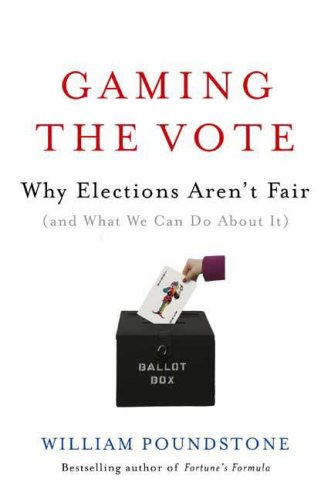
Gaming the Vote: Why Elections Aren't Fair (and What We Can Do...
Authors:
William Poundstone
Publisher:
Hill and Wang
Publication Date:
Not available
ISBN:
0809048930
Our Electoral System is Fundamentally Flawed, But There's a Simple and Fair Solution At least five U.S. presidential elections have been won by the... second most popular candidate. The reason was a "spoiler"--a minor candidate who takes enough votes away from the most popular candidate to tip the election to someone else. The spoiler effect is more than a glitch. It is a consequence of one of the most surprising intellectual discoveries of the twentieth century: the "impossibility theorem" of Nobel laureate economist Kenneth Arrow. The impossibility theorem asserts that voting is fundamentally unfair--a finding that has not been lost on today's political consultants. Armed with polls, focus groups, and smear campaigns, political strategists are exploiting the mathematical faults of the simple majority vote. In recent election cycles, this has led to such unlikely tactics as Republicans funding ballot drives for Green spoilers and Democrats paying for right-wing candidates' radio ads. Gaming the Vote shows that there is a solution to the spoiler problem that will satisfy both right and left. A systemcalled range voting, already widely used on the Internet, is the fairest voting method of all, according to computer studies. Despite these findings, range voting remains controversial, and Gaming the Vote assesses the obstacles confronting any attempt to change the American electoral system. The latest of several books by William Poundstone on the theme of how important scientific ideas have affected the real world, Gaming the Vote is a wry exposé of how the political system really works, and a call to action.
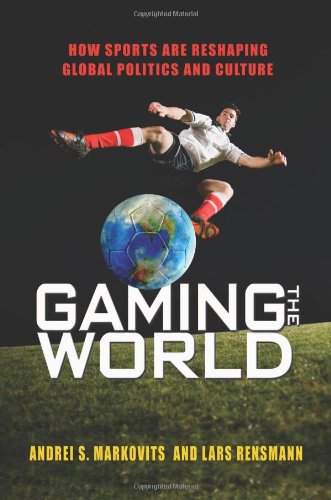
Gaming the World: How Sports Are Reshaping Global Politics and Culture
Authors:
Andrei S. Markovits
Publisher:
Princeton University Press
Publication Date:
Not available
ISBN:
069113751X
Professional sports today have truly become a global force, a common language that anyone, regardless of their nationality, can understand. Yet sports... also remain distinctly local, with regional teams and the fiercely loyal local fans that follow them. This book examines the twenty-first-century phenomenon of global sports, in which professional teams and their players have become agents of globalization while at the same time fostering deep-seated and antagonistic local allegiances and spawning new forms of cultural conflict and prejudice. Andrei Markovits and Lars Rensmann take readers into the exciting global sports scene, showing how soccer, football, baseball, basketball, and hockey have given rise to a collective identity among millions of predominantly male fans in the United States, Europe, and around the rest of the world. They trace how these global--and globalizing--sports emerged from local pastimes in America, Britain, and Canada over the course of the twentieth century, and how regionalism continues to exert its divisive influence in new and potentially explosive ways. Markovits and Rensmann explore the complex interplay between the global and the local in sports today, demonstrating how sports have opened new avenues for dialogue and shared interest internationally even as they reinforce old antagonisms and create new ones. Gaming the World reveals the pervasive influence of sports on our daily lives, making all of us citizens of an increasingly cosmopolitan world while affirming our local, regional, and national identities.

Gandhi: A Life
Authors:
Yogesh Chadha
Publisher:
Wiley
Publication Date:
Not available
ISBN:
0471350621
The Internationally Acclaimed Biography of One of History’s Monumental Figures Gandhi: A Life The first biography of this important figure in over... twenty years, Gandhi: A Life rescues the man from the myth, revealing the transformation of an ordinary, timid young man into a leader whose stand against a mighty empire brought millions together. "Until another Gandhi scholar comes along who digs deeper and can write more movingly, Gandhi scholarship will be well served by Chadha’s effort." — The Washington Post Book World "It is well-balanced, even-handed, and, like its subject, inspiring." —Kirkus Reviews "An engaging work worthy of a wide audience." —Library Journal "A sober, sensible, and notably fair account of this most quicksilver of personalities … far from uncritical … But on the whole he is approving, even reverential. Usually he convinces one that this is justified." — Daily Telegraph (London) "The first major biography to appear for twenty years … [with] a depth and authority which others have lacked." —The Independent (London)
 '





