production
/viewbook/list/all/?page=503
/
/static/
None

Alabama Moon
Authors:
Watt Key
Publisher:
Farrar, Straus and Giroux (BYR)
Publication Date:
Not available
ISBN:
0374301840
I could trap my own food and make my own clothes. I could find my way by the stars and make fire in the rain. Pap said he even figured I could whip... somebody three times my size. He wasn’t worried about me. For as long as ten-year-old Moon can remember, he has lived out in the forest in a shelter with his father. They keep to themselves, their only contact with other human beings an occasional trip to the nearest general store. When Moon’s father dies, Moon follows his father’s last instructions: to travel to Alaska to find others like themselves. But Moon is soon caught and entangled in a world he doesn’t know or understand, apparent property of the government he has been avoiding all his life. As the spirited and resourceful Moon encounters constables, jails, institutions, lawyers, true friends, and true enemies, he adapts his wilderness survival skills and learns to survive in the outside world, and even, perhaps, make his home there. In this compelling, action-packed book, Watt Key gives us the thrilling coming-of-age story of the unique and extremely appealing Moon. Alabama Moon is a 2007 Bank Street - Best Children's Book of the Year.

AlabamaNorth: African-American Migrants, Community, and...
Authors:
Kimberley L. Phillips
Publisher:
University of Illinois Press
Publication Date:
Not available
ISBN:
0252067932
"Langston Hughes called it "a great dark tide from the South": the unprecedented influx of blacks into Cleveland that gave the city the nickname... "Alabama North." In this remarkable study, Kimberley Phillips reveals the breadth of working-class black experiences and activities in Cleveland and the extent to which these were shaped by traditions and values brought from the South. Phillips shows how migrants' moves north established complex networks of kin and friends and infused the city with a highly visible southern African-American culture. She examines the wide variety of black fraternal, benevolent, social, and church-based organizations working-class migrants created and demonstrates how they prepared the way for new forms of individual and collective activism in workplaces and the city. Giving special consideration to the employment patterns and experiences of working- class black women in Cleveland, AlabamaNorth reveals how migrants' expressions of tradition and community gave them a new consciousness of themselves as organized workers in the urban North and created the underpinning for new forms of black labor activism."

Alabama Rules of Court - State, 2012 ed. (Vol. I, Alabama Court Rules)
Authors:
Thomson West
Publisher:
Thomson West
Publication Date:
Not available
ISBN:
0314942009
Find all the rules that govern practice before Alabama courts in a convenient source designed for courtroom use. Annual replacement ensures that you... have access to all state rule amendments. Among its state contents are: Rules of Civil Procedure, Small Claims Rules, Rules of Juvenile Procedure, and Standards for Imposing Lawyer Discipline.

Alabama Studio Sewing + Design: A Guide to Hand-Sewing an Alabama...
Authors:
Natalie Chanin
Publisher:
STC Craft/A Melanie Falick Book
Publication Date:
Not available
ISBN:
158479920X
Alabama Studio Sewing + Design is an invaluable reference for any woman who has dreamed of creating her own gorgeous handmade wardrobe. In this... follow-up to Alabama Stitch Book and Alabama Studio Style, author Natalie Chanin presents all of the stenciling, hand-stitching, and bead¬ing techniques her company uses to create the award-winning Alabama Chanin line of organic cotton clothing, plus more than 50 variations that lead to infinite design possibilities. Included in this encyclopedic compilation of Alabama Chanin skill and style are patterns and instructions for dresses, skirts, tops, a wrap, a poncho, a bolero, fingerless gloves, and a hat. Each piece is featured in both its basic form and with varying embellishment combinations. By mixing, matching, and layering, a stunning, unique, and versatile wardrobe can be built.Praise for Alabama Studio Sewing + Design:“Natalie is beautifully simple, yet elegant, just like her clothing. Her signature look is intricate stitching, beading and applique on basic organic cotton jersey which together make a show stopping casual look." —SF Unzipped "I'm a longtime fan of Natalie's clothing designs . . . Her sewing patterns do not disappoint. These are the same dresses, tops, skirts, and accessories that carry four-figure price tags and are coveted by ec-groovy lady rock stars. The same ones. But in her books, Natalie teaches you how to make them yourself . . . Natalie's pieces are so simple to sew together . . . They go together in a single evening, and when you pull them on they don't just make you look better than you did in whatever you were wearing before, they make you feel better." —Heather Ross, HeatherRoss.Squarespace.com "The photographs in this volume are exceptional . . . I think if quilters get this book for both technique and inspiration, it will be more than worth the money." —Meg Cox, quilter and author of The Book of New Family Traditions“I just love that Natalie has the guts to share the tricks of her trade. The reason I say guts is that you would think that sharing how your garments are made might hurt your business—but in Natalie's case it's proved to be actually quite the opposite . . . The interest in her couture line grew once she started to write books." —Cathy Callahan, Cathy of California blogger and author of Vintage Craft Workshop

Alabama: The History of a Deep South State
Authors:
William Warren Rogers Sr
Publisher:
University Alabama Press
Publication Date:
Not available
ISBN:
0817355987
Once the home of aboriginal inhabitants, Alabama was claimed and occupied by European nations, later to become a permanent part of the United States. A... cotton and slave state for more than half of the 19th century, Alabama declared its independence and joined another nation, the Confederate States of America, for its more than four-year history. The state assumed an uneasy and uncertain place in the 19th century’s last 35 years. Its role in the 20th century has been tumultuous but painfully predictable. This comprehensive history, written in the last decade of that century, presents, explains, and interprets the major events that occurred during Alabama’s history within the larger context of the South and the nation. Alabama: The History of a Deep South State is the first completely new comprehensive account of the state since A.B. Moore’s 1935 work. Divided into three main sections, the first concluding in 1865, the second in 1920, and the third bringing the story to the present, the book’s organization is both chronological and topical. General readers will welcome this modern history of Alabama, which examines such traditional subjects as politics, military events, economics, and broad social movements. Of equal value are sections devoted to race, Indians, women, and the environment, as well as detailed coverage of health, education, organized labor, civil rights, and the many cultural elements—from literature to sport—that have enriched Alabama’s history. The roles of individual leaders, from politicians to creative artists, are discussed. There is as well strong emphasis on the common people, those Alabamians who have been rightly described as the “bone and sinew” of the state. Each section of the book was written by a scholar who has devoted much of his or her professional life to the study of that period of Alabama’s past, and although the three sections reflect individual style and interpretation, the authors have collaborated closely on overall themes and organization. The result is an objective look at the colorful, often controversial, state’s past. The work relies both on primary sources and such important secondary sources as monographs, articles, and unpublished theses and dissertations to provide fresh insights, new approaches, and new interpretations.

Alabama: The History of a Deep South State
Authors:
William Warren Rogers Sr
Publisher:
University Alabama Press
Publication Date:
Not available
ISBN:
0817307141
Once the home of aboriginal inhabitants, Alabama was claimed and occupied by European nations, later to become a permanent part of the United States.... A cotton and slave state for more than half of the 19th century, Alabama declared its independence and joined another nation, the Confederate States of America, for its more than four-year history. The state assumed an uneasy and uncertain place in the 19th century’s last 35 years. Its role in the 20th century has been tumultuous but painfully predictable. This comprehensive history, written in the last decade of that century, presents, explains, and interprets the major events that occurred during Alabama’s history within the larger context of the South and the nation. Alabama: The History of a Deep South State is the first completely new comprehensive account of the state since A.B. Moore’s 1935 work. Divided into three main sections, the first concluding in 1865, the second in 1920, and the third bringing the story to the present, the book’s organization is both chronological and topical. General readers will welcome this modern history of Alabama, which examines such traditional subjects as politics, military events, economics, and broad social movements. Of equal value are sections devoted to race, Indians, women, and the environment, as well as detailed coverage of health, education, organized labor, civil rights, and the many cultural elements—from literature to sport—that have enriched Alabama’s history. The roles of individual leaders, from politicians to creative artists, are discussed. There is as well strong emphasis on the common people, those Alabamians who have been rightly described as the “bone and sinew” of the state. Each section of the book was written by a scholar who has devoted much of his or her professional life to the study of that period of Alabama’s past, and although the three sections reflect individual style and interpretation, the authors have collaborated closely on overall themes and organization. The result is an objective look at the colorful, often controversial, state’s past. The work relies both on primary sources and such important secondary sources as monographs, articles, and unpublished theses and dissertations to provide fresh insights, new approaches, and new interpretations.

Alabanza: New and Selected Poems 1982-2002
Authors:
Martín Espada
Publisher:
W. W. Norton & Company
Publication Date:
Not available
ISBN:
0393326217
"An astonishing collection of political poetry at its finest."—The Progressive, Favorite Books of 2004Alabanza is a twenty-year collection charting... the emergence of Martín Espada as the preeminent Latino lyric voice of his generation. "Alabanza" means "praise" in Spanish, and Espada praises the people Whitman called "them the others are down upon": the African slaves who brought their music to Puerto Rico; a prison inmate provoking brawls so he could write poetry in solitary confinement; a janitor and his solitary strike; Espada's own father, who was jailed in Mississippi for refusing to go to the back of the bus. The poet bears witness to death and rebirth at the ruins of a famine village in Ireland, a town plaza in México welcoming a march of Zapatista rebels, and the courtroom where he worked as a tenant lawyer. The title poem pays homage to the immigrant food-service workers who lost their lives in the attack on the World Trade Center. From the earliest out-of-print work to the seventeen new poems included here, Espada celebrates the American political imagination and the resilience of human dignity. Alabanza is the epic vision of a writer who, in the words of Russell Banks, "is one of the handful of American poets who are forging a new American language, one that tells the unwritten history of the continent, speaks truth to power, and sings songs of selves we can no longer silence." An American Library Association Notable Book of 2003 and a 2003 New York Public Library Book to Remember. "To read this work is to be struck breathless, and surely, to come away changed."—Barbara Kingsolver "Martín Espada is the Pablo Neruda of North American authors. If it was up to me, I'd select him as the Poet Laureate of the United States."—Sandra Cisneros "With these new and selected poems, you can grasp how powerful a poet Espada is—his range, his compassion, his astonishing images, his sense of history, his knowledge of the lives on the underbelly of cities, his bright anger, his tenderness, his humor. "—Marge Piercy "Espada's poems are not just clarion calls to the heart and conscience, but also wonderfully crafted gems."—Julia Alvarez "A passionate, readable poetry that makes [Espada] arguably the most important 'minority' U.S. poet since Langston Hughes."—Booklist "Neruda is dead, but if Alabanza is any clue, his ghost lives through a poet named Martín Espada."—San Francisco Chronicle

Alabi's World (Johns Hopkins Studies in Atlantic History and Culture)
Authors:
Richard Price
Publisher:
The Johns Hopkins University Press
Publication Date:
Not available
ISBN:
0801839564
In the early 18th century, the Dutch colony of Suriname was the envy of all others in the Americas. There, seven hundred Europeans lived off the labor... of over four thousand enslaved Africans. Owned by men hell-bent for quick prosperity, the rich plantations on the Suriname river became known for their heights of planter comfort and opulence—and for their depths of slave misery. Slaves who tried to escape were hunted by the planter militia. If found they were publicly tortured. (A common punishment was for the Achilles tendon to be removed for a first offense, the right leg amputated for a second.) Resisting this cruelty first in small numbers, then in an ever increasing torrent, slaves began to form outlaw communities until nearly one out of every ten Africans in Suriname was helping to build rebel villages in the jungle. Alabi's World relates the history of a nation founded by escaped slaves deep in the Latin American rain forest. It tells of the black men and women's bloody battles for independence, their uneasy truce with the colonial government, and the attempt of their great leader, Alabi, to reconcile his people with white law and a white God. In a unique historical experiment, Richard Price presents this history by weaving together four voices: the vivid historical accounts related by the slaves' descendants, largely those of Alabi's own villagers, the Saramaka; the reports of the often exasperated colonial officials sent to control the slave communities; the otherworldly diaries of the German Moravian missionaries determined to convert the heathen masses; and the historian's own, mediating voice. The Saramaka voices in these pages recall a world of powerful spirits—called obia's—and renowned heroes, great celebrations and fierce blood-feuds. They also recall, with unconcealed relish, successes in confounding the colonial officials and in bending the treaty to the benefit of their own people. From the opposite side of the negotiations, the colonial Postholders speak of the futility of trying to hold the village leaders to their vow to return any further runaway slaves. Equally frustrated, the Moravian missionaries describe the rigors of their proselytising efforts in the black villages—places of licentiousness and idol-worship that seemed to be "a foretaste of what hell must be like." Among their only zealous converts was Alabi, who stood nearly alone in his attempts to bridge the cultural gap between black and white—defiantly working to lead his people on the path toward harmony with their former enemies. From the confluence of these voices—set throughout the book in four different typefaces—Price creates a fully nuanced portrait of the collision of cultures. It is a confrontation, he suggests, that was enacted thousands of times across the slaveholding Americas as white men strained to suppress black culture and blacks resisted— determined to preserve their heritage and beliefs.

A Laboratory Book of Computational Organic Chemistry
Authors:
Warren J Hehre
Publisher:
Wavefunction, Inc
Publication Date:
Not available
ISBN:
0964349558
Chronicling the rise of Los Angeles through shifting ideas of race and ethnicity, William Deverell offers a unique perspective on how the city grew and... changed. Whitewashed Adobe considers six different developments in the history of the city--including the cementing of the Los Angeles River, the outbreak of bubonic plague in 1924, and the evolution of America's largest brickyard in the 1920s. In an absorbing narrative supported by a number of previously unpublished period photographs, Deverell shows how a city that was once part of Mexico itself came of age through appropriating--and even obliterating--the region's connections to Mexican places and people.Deverell portrays Los Angeles during the 1850s as a city seething with racial enmity due to the recent war with Mexico. He explains how, within a generation, the city's business interests, looking for a commercially viable way to establish urban identity, borrowed Mexican cultural traditions and put on a carnival called La Fiesta de Los Angeles. He analyzes the subtle ways in which ethnicity came to bear on efforts to corral the unpredictable Los Angeles River and shows how the resident Mexican population was put to work fashioning the modern metropolis. He discusses how Los Angeles responded to the nation's last major outbreak of bubonic plague and concludes by considering the Mission Play, a famed drama tied to regional assumptions about history, progress, and ethnicity. Taking all of these elements into consideration, Whitewashed Adobe uncovers an urban identity--and the power structure that fostered it--with far-reaching implications for contemporary Los Angeles.

A Laboratory Course for Programming with Java
Authors:
Nell Dale
Publisher:
Jones and Bartlett Publishers
Publication Date:
Not available
ISBN:
0763758272
The active learning approach of A Laboratory Course for Programming with Java, Second Edition engages students in the process of understanding and... implementing programming language concepts. A perfect companion to any introductory Java programming course, this manual provides 14 hands-on laboratory activities, each of which contains Prelab, In-lab, and Post-lab exercises. In each lesson students have the opportunity to apply their textbook knowledge, gain programming experience, and acquire meaningful understanding of language concepts.

A Laboratory Course in Biomaterials
Authors:
Wujing Xian
Publisher:
CRC Press Inc
Publication Date:
Not available
ISBN:
1420075829
The field of biomedical engineering has vastly expanded in the past two decades, as reflected in the increased number of bioengineering and biomaterials... programs at universities. The growth of this area has outpaced the development of laboratory courses that allow students hands-on experience, since the barriers involved in creating multidisciplinary biomaterials laboratory courses are high. A Laboratory Course in Biomaterials provides a teaching tool comprehensive in scope perspective. Multidisciplinary approach Suitable for junior or senior level laboratory courses in biomaterials and bioengineering, this volume trains students in laboratory skills, data analysis, problem solving, and scientific writing. The text takes a multidisciplinary approach, integrating a variety of principles that include materials science, chemistry, biochemistry, molecular and cell biology, and engineering. Step-by-step instructions The author presents flexible modules that allow the coursework to be adapted to the needs of different departments. Each module is organized around a central theme, such as drug delivery and natural biomaterials, to enhance student comprehension. This book provides step-by-step descriptions of lab procedures, reagents, equipment, and data processing guidelines. It also includes a series of thought-provoking questions and answers following each experiment, drawn from the author’s own experience in teaching a biomaterials laboratory course at the University of Illinois. Timely in its coverage, many of the experiments presented in the book are adapted from research papers reflecting the progress in various disciplines of bioengineering and biomaterials science.

A Laboratory Course in C++, Fifth Edition
Authors:
Nell Dale
Publisher:
Jones & Bartlett Publishers
Publication Date:
Not available
ISBN:
0763778826
Through hands-on lab exercises, this lab manual teaches the syntax and semantics of C++ constructs in a flexible framework that is perfect for both... closed lab settings and independent learning. The exercises are broken into three types of activities: Pre-Lab: Reading review and paper-and-pencil exercises designed to ensure understanding of the material to be covered in the exercises; In-Lab: Individual lessons broken into exercises specifically mapped to the concepts covered in the chapter; Post-Lab: Programming assignments which can be done independently and cover the important topics from the chapter. Checklist cover sheets allow students and instructors to track the assignments, output, and grading for each exercise. Perforated pages aid in submission and grading of exercises and homework assignments.

A Laboratory Guide to Human Anatomy
Authors:
Radke
Publisher:
Wiley
Publication Date:
Not available
ISBN:
0471414131
* Minimal Text. Specific details are available in the textbook. We will only provide text to set up and support the activities in the lab.* Variety of... Learning Activities. Within each lab exercise will be a variety of activities, including coloring and labeling anatomical figures, critical thinking and clinically-orientated questions that promote problem-solving.* Effective Use of Illustrations. Simple line drawings, that allow important features to stand out, not just duplication of figures from the text book, will support the lab activities. Histology specific to each organ system is found in that system chapter, not all lumped together in a separate section.* Active Diagrams. Many diagrams will be provided without labels, or in a coloring-book format to promote active learning of the material.
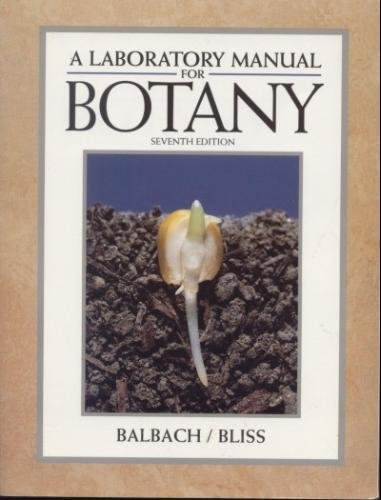
A Laboratory Manual for Botany
Authors:
Margaret Balbach
Publisher:
Saunders
Publication Date:
Not available
ISBN:
003030184X
A solid and flexible presentation has established this text as the classic botany laboratory manual for the instructor who wants to teach structure,... function, or survey of the plant kingdom. Many illustrations highlight the book. The manual includes an exercise on ecology with application to environmental topics. This manual can be used with any introductory botany text.

A Laboratory Manual of Human Anatomy and Physiology with Cat...
Authors:
Ted Namm
Publisher:
Wiley Custom Learning Solution
Publication Date:
Not available
ISBN:
0471709972
Primary Orthopedic Care, 2nd Edition offers the most practical approach to common orthopedic disorders in the primary care setting. Content is organized... from upper to lower extremities, beginning with symptoms rather than a diagnosis for use in the patient care setting. Nine major orthopedic areas are thoroughly covered, as well as injections for musculoskeletal disorders. Presentation and history, the most crucial diagnostic tools, are discussed in a separate section within each orthopedic area. In addition, anatomy and physiology, examination, diagnosis (including imaging modalities) and treatment are consistently covered in each region. Its emphasis on differential diagnosis, with clear cautions indicating when to refer a patient to a specialist, make this book a valuable guide for nurse practitioners in primary care.A unique appendix entitled Keys to Common Diagnoses assists in diagnosing the presenting orthopedic disorder with a quick "signs and symptoms" reference guide with corresponding text pages for further explanation.Red Flags boxes indicate when to refer a patient to a specialist.Each disorder is arranged to cover history, examination, diagnosis and treatment, and key recommendations for referral or consultation.Each orthopedic region includes descriptions of imaging studies (X-ray, MRI, CT and bone scans) and other evaluation modalities.A chapter on injections (chapter 10) describes indications, methods, medications and materials to use for corticosteroid and anesthetic injections.Brief anatomy and physiology reviews open each chapter.Content is organized from upper to lower extremities and includes spinal areas as well.More than 300 illustrations demonstrate techniques for diagnosis and orthopedic procedures.Coverage of Paget's disease and other metabolic bone disorders is included, as well as a section on bone tumors that describes the general clinical and radiographic characteristics of benign and malignant tumors.Additional clinical illustrations, including x-ray images, pathology photos, and photos of braces/splints highlight important findings.This edition features expanded coverage of several topics:Osteoporosis (in men, non-whites, testing/screening, vertebroplasty, kyphoplasty, differential diagnosis).Low back pain (spondylosis, spondylolisthesis, differential diagnosis, herniated nucleus pulposus, tumors).Arthritis (rheumatoid disease, fibromyalgia).Arm and elbow pathological abnormalities. Evaluation and treatment sections (such as evaluation modalities/imaging studies for knee & leg soft tissue studies).
 '
'