production
/viewbook/list/all/?page=5065
/
/static/
None
Geometrical Theory of Diffraction for Electromagnetic Waves, 3rd...
Authors:
G.L. James
Publisher:
Institution Of Engineering And Technology
Publication Date:
Not available
ISBN:
0863410626
The Institution of Engineering and Technology is one of the world's leading professional societies for the engineering and technology community. The IET... publishes more than 100 new titles every year; a rich mix of books, journals and magazines with a back catalogue of more than 350 books in 18 different subject areas including: -Power & Energy -Renewable Energy -Radar, Sonar & Navigation -Electromagnetics -Electrical Measurement -History of Technology -Technology Management
Geometric Design of Linkages (Interdisciplinary Applied Mathematics)
Authors:
J. Michael McCarthy
Publisher:
Springer
Publication Date:
Not available
ISBN:
1441978917
This book is an introduction to the mathematical theory of design for articulated mechanical systems known as linkages. The focus is on sizing... mechanical constraints that guide the movement of a work piece, or end-effector, of the system. The function of the device is prescribed as a set of positions to be reachable by the end-effector; and the mechanical constraints are formed by joints that limit relative movement. The goal is to find all the devices that can achieve a specific task. Formulated in this way the design problem is purely geometric in character. Robot manipulators, walking machines, and mechanical hands are examples of articulated mechanical systems that rely on simple mechanical constraints to provide a complex workspace for the end- effector. The principles presented in this book form the foundation for a design theory for these devices. The emphasis, however, is on articulated systems with fewer degrees of freedom than that of the typical robotic system, and therefore, less complexity. This book will be useful to mathematics, engineering and computer science departments teaching courses on mathematical modeling of robotics and other articulated mechanical systems. This new edition includes research results of the past decade on the synthesis of multi loop planar and spherical linkages, and the use of homotopy methods and Clifford algebras in the synthesis of spatial serial chains. One new chapter on the synthesis of spatial serial chains introduces numerical homotopy and the linear product decomposition of polynomial systems. The second new chapter introduces the Clifford algebra formulation of the kinematics equations of serial chain robots. Examples are use throughout to demonstrate the theory.
Geometric Design Projects for Highways: An Introduction
Authors:
John G. Schoon
Publisher:
Amer Society of Civil Engineers
Publication Date:
Not available
ISBN:
0784404259
Packed with plenty of clear illustrations, this introductory work shows how to use the matrix methods of structural analysis to predict the static... response of structures. Sack emphasizes the stiffness method while providing balanced coverage of the fundamentals of the flexibility method as well. He introduces the various topics in a logical series and develops equations from basic concepts. The result: readers will gain a firm grasp of theory as well as practical applications. Practical in approach, the well- presented material in this volume is devoted to giving a solid understanding of matrix analysis methods combined with the background to write computer programs and use production-level programs to build actual structures.
Geometric Dimensioning and Tolerancing
Authors:
David A. Madsen
Publisher:
Goodheart-Willcox (duplicate of GOODW)
Publication Date:
Not available
ISBN:
1605259381
Geometric Dimensioning and Tolerancing provides thorough coverage of GD&T practices, as established by the ASME Y14.5–2009 standard. From... understanding symbols on existing drawings to calculating the tolerances for proper size and location of features, topics are introduced in a methodical manner to establish an understanding of basic concepts before building to more advanced applications. Heavily illustrated, the use of the second color enhances learning by highlighting callouts and labels separately from the symbols and text of each drawing.· The textbook discusses the interpretation of GD&T symbology and proper representation on drawings.· Included in the textbook are Chapter Tests, Print Reading Exercises, Drafting Problems, and a comprehensive Final Exam.· Instructor’s resources include answer keys, lesson plans, Final Exam and Drawing Problem solutions, visual masters, and course syllabi.
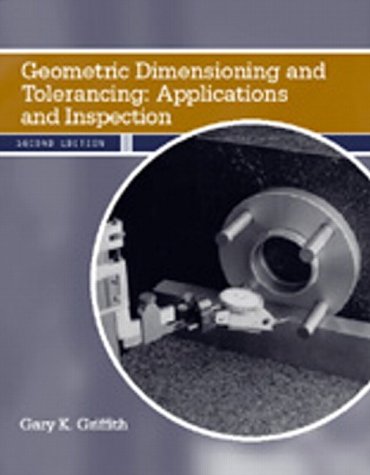
Geometric Dimensioning and Tolerancing: Applications and Inspection...
Authors:
Gary K. Griffith
Publisher:
Prentice Hall
Publication Date:
Not available
ISBN:
0130604631
This book assists readers in understanding geometric tolerancing symbols, interpretation, drawings and inspection methods. An accessible writing... style covers GTD with step-by-step instructions, and is accompanied by clear and complete photos of setups, drawings, sketches, and detailed examples. Clear and concise chapter topics include datums, inspecting size tolerances, flatness, straightness, circularity, cylindricity, parallelism, perpendicularity, angularity, circular runout, total runout, profile of a line, profile of a surface, concentricity, position tolerances, symmetry, and an introduction to functional gage design. For product engineers, design engineers, manufacturing engineers, quality engineers, and mechanical inspectors.
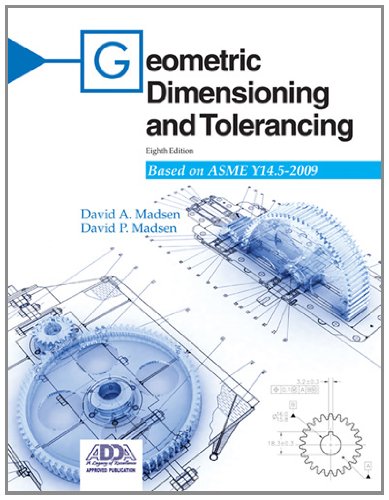
Geometric Dimensioning and Tolerancing: Based on Asme Y14.5-2009
Authors:
David A. Madsen
Publisher:
Goodheart-Willcox Co
Publication Date:
Not available
ISBN:
1605252824
Provides the complete fundamentals of geometric dimensioning and tolerancing concepts as adopted by the American National Standards Institute (ANSI) and... published by the American Society of Mechanical Engineers (ASME) for engineering and related documentation practices. Softcover. DLC: Engineering drawings--Dimensioning.
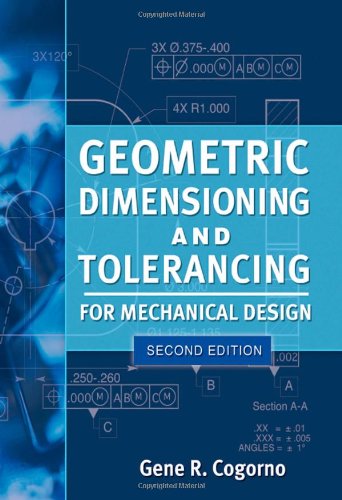
Geometric Dimensioning and Tolerancing for Mechanical Design 2/E
Authors:
Gene Cogorno
Publisher:
McGraw-Hill Professional
Publication Date:
Not available
ISBN:
007177212X
AN UP-TO-DATE GUIDE TO GEOMETRIC DIMENSIONING AND TOLERANCING Written in accordance with the latest revision of the geometric dimensioning and... tolerancing (GD&T) stanedard, ASME Y14.5-2009, this book teaches the principles and practical applications of GD&T in an easy-to-understand manner. Geometric Dimensioning and Tolerancing for Mechanical Design, Second Edition, begins the discussion of each control with a definition, and then describes how the control is specified, interpreted, and inspected. Detailed drawings illustrate the topics discussed. Study questions and problems at the end of each chapter emphasize key concepts and serve as a self-test. Ensure the proper assembly of parts, improve quality, and reduce costs with help from this authoritative resource. Coverage includes: * Dimensioning and tolerancing fundamentals * Symbols, terms, and rules * Datums * Form--flatness, straightness, circularity and cylindricity * Orientation--perpendicularity, parallelism, and angularity * Position--general, location, and coaxially * Concentricity and symmetry * Runout * Profile * Graphic analysis * Strategy for tolerancing parts

Geometric dimensioning and tolerancing workbook
Authors:
Al Neumann
Publisher:
Technical Consultants Incorporated
Publication Date:
Not available
ISBN:
0872636461
In the Russian winter of 1878 a shy, aristocratic young woman named Vera Zasulich walked into the office of the governor of St. Petersburg, pulled a... revolver from underneath her shawl, and shot General Fedor Trepov point blank. “Revenge!,” she cried, for the governor's brutal treatment of a political prisoner. Her trial for murder later that year became Russia's "trial of the century," closely followed by people all across Europe and America. On the day of the trial, huge crowds packed the courtroom. The cream of Russian society, attired in the finery of the day, arrived to witness the theatrical testimony and deliberations in the case of the young angel of vengeance. After the trial, Vera became a celebrated martyr for all social classes in Russia and became the public face of a burgeoning revolutionary fervor. Dostoyevsky (who attended the trial), Turgenev, Engels, and even Oscar Wilde all wrote about her extraordinary case. Her astonishing acquittal was celebrated across Europe, crowds filled the streets and the decision marked the changing face of Russia. After fleeing to Switzerland, Vera Zasulich became Russia's most famous "terroristka," inspiring a whole generation of Russian and European revolutionaries to embrace violence and martyrdom. Her influence led to a series of acts that collectively became part of “the age of assassinations.” In the now-forgotten story of Russia's most notorious terrorist, Ana Siljak captures Vera's extraordinary life story--from privileged child of nobility to revolutionary conspirator, from assassin to martyr to socialist icon and saint-- while colorfully evoking the drama of one of the world’s most closely watched trials and a Russia where political celebrities held sway.
Geometric Folding Algorithms: Linkages, Origami, Polyhedra
Authors:
Erik D. Demaine
Publisher:
Cambridge University Press
Publication Date:
Not available
ISBN:
0521857570
How can linkages, pieces of paper, and polyhedra be folded? The authors present hundreds of results and over 60 unsolved 'open problems' in this... comprehensive look at the mathematics of folding, with an emphasis on algorithmic or computational aspects. Folding and unfolding problems have been implicit since Albrecht Dürer in the early 1500s, but have only recently been studied in the mathematical literature. Over the past decade, there has been a surge of interest in these problems, with applications ranging from robotics to protein folding. A proof shows that it is possible to design a series of jointed bars moving only in a flat plane that can sign a name or trace any other algebraic curve. One remarkable algorithm shows you can fold any straight-line drawing on paper so that the complete drawing can be cut out with one straight scissors cut. Aimed primarily at advanced undergraduate and graduate students in mathematics or computer science, this lavishly illustrated book will fascinate a broad audience, from high school students to researchers.
Geometric Function Theory in One and Higher Dimensions (Pure and...
Authors:
Ian Graham
Publisher:
CRC Press
Publication Date:
Not available
ISBN:
0824709764
This reference details valuable results that lead to improvements in existence theorems for the Loewner differential equation in higher dimensions,... discusses the compactness of the analog of the Caratheodory class in several variables, and studies various classes of univalent mappings according to their geometrical definitions. It introduces the infinite-dimensional theory and provides numerous exercises in each chapter for further study. The authors present such topics as linear invariance in the unit disc, Bloch functions and the Bloch constant, and growth, covering and distortion results for starlike and convex mappings in Cn and complex Banach spaces.
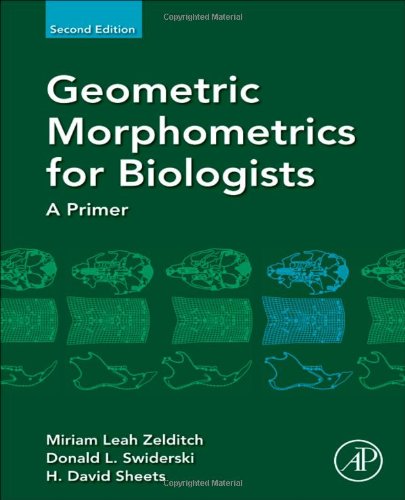
Geometric Morphometrics for Biologists, Second Edition: A Primer
Authors:
Miriam Leah Zelditch
Publisher:
Academic Press
Publication Date:
Not available
ISBN:
012386903X
The first edition of Geometric Morphometrics for Biologists has been the primary resource for teaching modern geometric methods of shape analysis to... biologists who have a stronger background in biology than in multivariate statistics and matrix algebra. These geometric methods are appealing to biologists who approach the study of shape from a variety of perspectives, from clinical to evolutionary, because they incorporate the geometry of organisms throughout the data analysis. The second edition of this book retains the emphasis on accessible explanations, and the copious illustrations and examples of the first, updating the treatment of both theory and practice. The second edition represents the current state-of-the-art and adds new examples and summarizes recent literature, as well as provides an overview of new software and step-by-step guidance through details of carrying out the analyses. Contains updated coverage of methods, especially for sampling complex curves and 3D forms and a new chapter on applications of geometric morphometrics to forensicsOffers a reorganization of chapters to streamline learning basic conceptsPresents detailed instructions for conducting analyses with freely available, easy to use software Provides numerous illustrations, including graphical presentations of important theoretical concepts and demonstrations of alternative approaches to presenting results
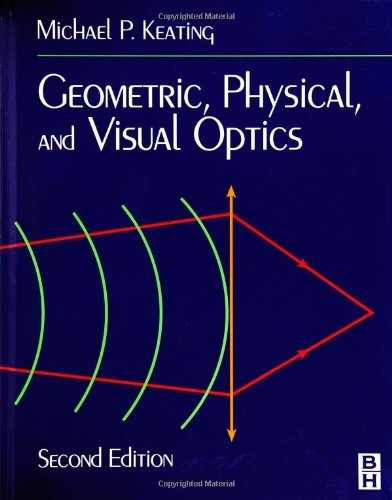
Geometric, Physical, and Visual Optics, 2e
Authors:
Michael P. Keating PhD
Publisher:
Butterworth-Heinemann
Publication Date:
Not available
ISBN:
0750672625
* Fundamental text for an optometric curriculum, a student studying for the optometry boards, or a person interested in optics and vision * Uses the... vergence-dioptric power-wavefront approach from the beginning * Emphasizes conceptual understanding and development of intuition

GEOMETRIC STRUC.+BASS GEO.(LOOSE)]CUST[
Authors:
Not Available
Publisher:
Not available
Publication Date:
Not available
ISBN:
Not available
Geometric Structures: An Inquiry-Based Approach for Prospective...
Authors:
Douglas B. Aichele
Publisher:
Pearson
Publication Date:
Not available
ISBN:
0131483927
This text provides a creative, inquiry-based experience with geometry that is appropriate for prospective elementary and middle school teachers. The... coherent series of text activities supports each student’s growth toward being a confident, independent learner empowered with the help of peers to make sense of the geometric world. This curriculum is explicitly developed to provide future elementary and middle school teachers.
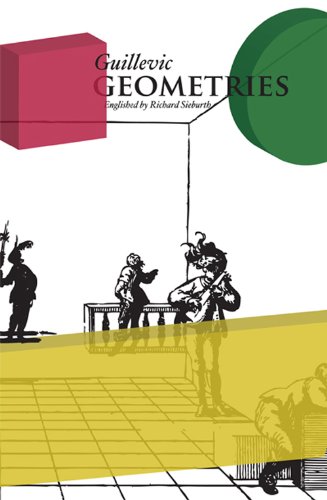
Geometries (Lost Literature)
Authors:
Guillevic
Publisher:
Ugly Duckling Presse
Publication Date:
Not available
ISBN:
1933254726
Poetry. Translated from the French by Richard Sieburth. Guillevic wrote GEOMETRIES (Euclidiennes in French) in the early sixities, after his friend, the... poet Andre Frenaud, recognizing in his poetry an inclination toward mathematics, and more specifically geometry, encouraged him to pursue this direction. Guillevic places a series of geometrical figures before our eyes, as they might appear in a schoolchild's primer, paired with poems that let us hear how these forms might speak. These talking circles, squares and angles--these articulations of space--are in turn meant to remind us of our own figures of speech. Guillevic's GEOMETRIES fits into the 1960s return to emblems, signs, and playful constraints both in art (Robert Indiana, Jasper Johns, Robert Rauschenberg and even Andy Warhol) and in writing (the Noigandres poets, Oulipo, Eugen Gomringer, the Robert Creeley of Pieces). But at the same time, the Euclidean world of forms here explored remains as timeless as the stones of Guillevic's own Carnac.
 '





