production
/viewbook/list/all/?page=5143
/
/static/
None
Globalization and the Nation State: 2nd Edition
Authors:
Robert J. Holton
Publisher:
Palgrave Macmillan
Publication Date:
Not available
ISBN:
0230274552
Does globalization mean the end of the nation state? Or are nation states able to respond to processes of global change? This impressively comprehensive... book examines the connections and conflicts that exist between global and national processes, institutions and cultures.Debating and explaining controversial and contested understandings of globalization, the second edition has new content on: * Hot and timely topics, from human rights and migration to new technologies and environmental sustainability* Connections between globalization and global events, including the rise of China, the financial crisis and 9/11* Interdisciplinary insights from sociology, political science and economics Thought-provoking and easy to follow, this text will give students across the social sciences a thorough understanding of the history, theories and debates of globalization.
Globalization and the Nation State: 2nd Edition
Authors:
Robert J. Holton
Publisher:
Palgrave Macmillan
Publication Date:
Not available
ISBN:
0230274560
Does globalization mean the end of the nation state? Or are nation states able to respond to processes of global change? This impressively comprehensive... book examines the connections and conflicts that exist between global and national processes, institutions and cultures.Debating and explaining controversial and contested understandings of globalization, the second edition has new content on: * Hot and timely topics, from human rights and migration to new technologies and environmental sustainability* Connections between globalization and global events, including the rise of China, the financial crisis and 9/11* Interdisciplinary insights from sociology, political science and economics Thought-provoking and easy to follow, this text will give students across the social sciences a thorough understanding of the history, theories and debates of globalization.

Globalization and Theology (Horizons in Theology)
Authors:
Joerg Rieger
Publisher:
Abingdon Press
Publication Date:
Not available
ISBN:
1426700652
Globalization is a catchword of our time, referring to the interdependence that affects us all. But we often meet globalization with extreme... ambivalence, recognizing that it has both positive and negative consequences for economics, politics, and culture. Joerg Rieger makes the point that even theology, itself, can be a manifestation of globalization. At its worst, theology can reflect Western intellectual imperialism and at its best, theology can encourage a compelling vision of diversity within unity. The author articulates a theology of globalization as a diverse phenomenon that respects different ways of seeing and knowing, thus encouraging harmony rather than homogeny.
Globalization and the Politics of Development in the Middle East...
Authors:
Clement Moore Henry
Publisher:
Cambridge University Press
Publication Date:
Not available
ISBN:
0521737443
In a new edition of their book on the economic development of the Middle East and North Africa, Clement Henry and Robert Springborg reflect on what has... happened to the region's economy since 2001. How have the various countries in the Middle East responded to the challenges of globalization and to the rise of political Islam, and what changes, for better or for worse, have occurred? Utilizing the country categories they applied in the previous book and further elaborating the significance of the structural power of capital and Islamic finance, they demonstrate how over the past decade the monarchies (as exemplified by Jordan, Morocco, and those of the Gulf Cooperation Council) and the conditional democracies (Israel, Turkey, and Lebanon) continue to do better than the military dictatorships or "bullies" (Egypt, Tunisia, and now Iran) and "the bunker states" (Algeria, Iraq, Libya, Sudan, Syria, and Yemen).
Globalization and the Poor in Asia: Can Shared Growth be Sustained?...
Authors:
Not Available
Publisher:
Palgrave Macmillan
Publication Date:
Not available
ISBN:
0230201881
Asia is widely regarded as having benefited most from the dynamic growth effect of the recent wave of globalization. By examining mechanisms at work in... the globalization-poverty nexus through specific case studies reflecting different settings, the book seeks to find ways to rediscover and resume a pattern of shared growth in Asia

Globalization and the Postcolonial World: The New Political Economy...
Authors:
Ankie Hoogvelt
Publisher:
The Johns Hopkins University Press
Publication Date:
Not available
ISBN:
0801866928
Globalization is at the heart of debates about the present phase of development of the world economy. In Globalization and the Postcolonial World,... Ankie Hoogvelt joins these debates to examine the ways in which globalization is affecting the countries of the developing world. Taking a new look at historical trends and theories in development studies, Hoogvelt describes the diverse impacts of globalization in sub-Saharan Africa, the Middle East, East Asia, and Latin America, identifying different postcolonial responses in each of these regions.New to this edition are sections on the new "digital" economy; the resurgence of the United States after decades of putative relative decline and the question of renewed U.S. dominance in the global system; and the volatility of the global financial markets culminating in the East Asia crisis of 1997. Part II has been thoroughly reconfigured and expanded, as have the chapters on East Asia and on Africa. Finally, the conclusions have been rethought in the light of the mushrooming cloud of antiglobalist protests.
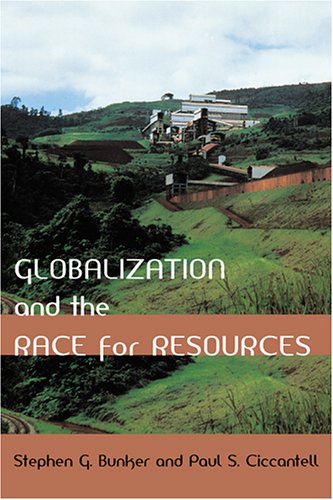
Globalization and the Race for Resources (Themes in Global Social...
Authors:
Stephen G. Bunker
Publisher:
The Johns Hopkins University Press
Publication Date:
Not available
ISBN:
0801882435
Globalization and the Race for Resources explores how five nations—Portugal, the Netherlands, Britain, the United States, and Japan—achieved trade... dominance by devising technologies, social and financial institutions, and markets to enhance their access to raw materials.Through ecological and economic explanation of resource extraction and production, Stephen G. Bunker and Paul S. Ciccantell reveal globalization as the result of the progressive extension of systematically integrated material processes across cumulatively greater space. Drawing from extensive historical research into how economic and environmental dynamics interacted in the extraction of different materials in the Amazon, especially in the development of the iron mine of Carajas, the authors also illustrate the profound connection between global dominance and control of natural resources.
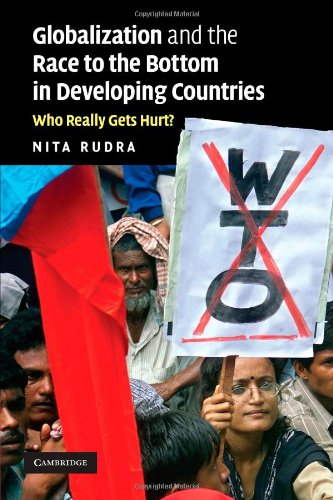
Globalization and the Race to the Bottom in Developing Countries:...
Authors:
Nita Rudra
Publisher:
Cambridge University Press
Publication Date:
Not available
ISBN:
0521715032
The advance of economic globalization has led many academics, policy-makers, and activists to warn that it leads to a 'race to the bottom'. In a world... increasingly free of restrictions on trade and capital flows, developing nations that cut public services are risking detrimental effects to the populace. Conventional wisdom suggests that it is the poorer members of these societies who stand to lose the most from these pressures on welfare protections, but this new study argues for a more complex conceptualization of the subject. Nita Rudra demonstrates how and why domestic institutions in developing nations have historically ignored the social needs of the poor; globalization neither takes away nor advances what never existed in the first place. It has been the lower- and upper-middle classes who have benefited the most from welfare systems and, consequently, it is they who are most vulnerable to globalization's race to the bottom.

Globalization and the Study of Education (Yearbook of the National...
Authors:
Thomas S. Popkewitz
Publisher:
Wiley-Blackwell
Publication Date:
Not available
ISBN:
144433431X
This yearbook brings together leading educational scholars who focus on how globalization is reshaping the study of education.Papers challenge long-held... assumptions and offer fresh perspectives on significant educational issuesPublished on behalf of the National Society for the Study of Education
Globalization and the World Ocean (Globalization And The Environment)
Authors:
Peter Jacques
Publisher:
AltaMira Press
Publication Date:
Not available
ISBN:
0759105855
Jacques offers a unique analysis of the connections between global marine and atmospheric science to global political phenomena. He shows how human... survival is intricately linked to the sustainability of the world ocean, a singular connected body of regional oceans that is by definition a global resource that touches all other ecosystems. Jacques warns that the world ocean now offers evidence of several existential crises for global human populations, including declining global fisheries, coral reef losses, and climate change, but there has been a lack of global or regional cooperation in sustaining this complex ecosystem. He suggests how we can synthesize and coordinate global ecological information, exploring three regional areas in their local and global context: the South Pacific, Caribbean basin, and Southeast Asia. His book will be a valuable resource for researchers and students in environmental studies, marine sciences, and globalization studies.
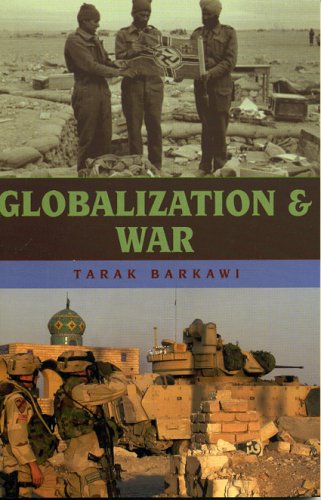
Globalization and War
Authors:
Tarak Barkawi
Publisher:
Rowman & Littlefield Publishers
Publication Date:
Not available
ISBN:
0742537013
War doesn't just tear nations apart--it brings peoples and places closer together, providing a new lens on globalization. This book offers a fresh... perspective on globalization and war, topics rarely considered together. It conceives war as a form of interconnection between home and abroad, and as an occasion for circulation and interchange. It identifies the political and military work required to create and maintain a free-trading world, while critiquing liberal and neoliberal conceptions of the pacific benefits of economic globalization. Speaking from the heart of old and new imperial orders, Tarak Barkawi exposes the Eurocentric limitations of military history and highlights the imperial dimensions of modern warfare. Britain, India, and the colonial Indian army exemplify the intertwined, global histories illuminated by attention to globalization and war. Around the world, geographies and wars are imagined differently. Cultural approaches to globalization show how popular consciousness of the world often takes military and warlike form, and how militaries spawn hybrid 'traveling cultures' wherever they go. Finally, Barkawi examines the contemporary 'war on terror' using historical and non-Eurocentric globalizations to clarify the politics and strategies involved in the purported 'clash of civilizations'. Adding a new layer of understanding, he looks at the globalization of the Israeli-Palestinian conflict and the intensifying 'Israelization' of the United States.

Globalization/Anti-Globalization: Beyond the Great Divide
Authors:
David Held
Publisher:
Polity
Publication Date:
Not available
ISBN:
0745639119
Is globalization being eclipsed by a resurgent geopolitics? Does the war on terror denote the end of globalization or a new phase of militarized... globalization? Empire or globalization - are these the right terms to describe the current global order?The second edition of this highly successful book tests the claims of those who dismiss the continuing significance of globalization through a comprehensive assessment of contemporary global trends. In the aftermath of 9/11, and the war in Iraq, there has been much talk of the end of globalization. Held and McGrew argue that these post-mortems for globalization are entirely premature. They show this by focusing upon the primary structures of world order namely: patterns of governance, organized violence, the economy, culture and environmental degradation. Patterns of inequality, exclusion and domination are also assessed.Building upon this analysis, the authors present the case for continuing to take globalization seriously as both a description and explanation of our current global condition. They also ask the vital question: can globalization be tamed? Held and McGrew explore whether a more just and stable world order is either desirable or feasible and present an alternative ethical and political agenda for the twenty-first century - a global covenant of cosmopolitan social democracy.The second edition of this powerful and original book has been comprehensively updated, with three new chapters added. The book will appeal to all those who remain intrigued, confused or simply baffled by the controversy about globalization and its consequences for the twenty-first century world order.
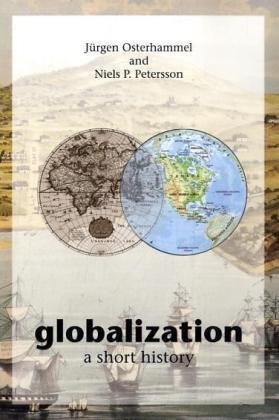
Globalization: A Short History
Authors:
Jürgen Osterhammel
Publisher:
Princeton University Press
Publication Date:
Not available
ISBN:
0691133956
"Globalization" has become a popular buzzword for explaining today's world. The expression achieved terminological stardom in the 1990s and was soon... embraced by the general public and integrated into numerous languages. But is this much-discussed phenomenon really an invention of modern times? In this work, Jürgen Osterhammel and Niels Petersson make the case that globalization is not so new, after all. Arguing that the world did not turn "global" overnight, the book traces the emergence of globalization over the past seven or eight centuries. In fact, the authors write, the phenomenon can be traced back to early modern large-scale trading, for example, the silk trade between China and the Mediterranean region, the shipping routes between the Arabian Peninsula and India, and the more frequently traveled caravan routes of the Near East and North Africa--all conduits for people, goods, coins, artwork, and ideas. Osterhammel and Petersson argue that the period from 1750 to 1880--an era characterized by the development of free trade and the long-distance impact of the industrial revolution--represented an important phase in the globalization phenomenon. Moreover, they demonstrate how globalization in the mid-twentieth century opened up the prospect of global destruction though nuclear war and ecological catastrophe. In the end, the authors write, today's globalization is part of a long-running transformation and has not ushered in a "global age" radically different from anything that came before. This book will appeal to historians, economists, and anyone in the social sciences who is interested in the historical emergence of globalization.

Globalization: A Short History of the Modern World
Authors:
William R. Nester
Publisher:
Palgrave Macmillan
Publication Date:
Not available
ISBN:
0230106919
International politics began with the emergence of the first organized states thousands of years ago. Global politics is more recent--it appeared about... five centuries ago when the European powers began to mesh the world's far corners together through conquest and trade. Today we live on a planet characterized by globalization or the ever more complex economic, cultural, technological, and environmental interdependence among all people everywhere. Until recently globalization’s development was slow. Although countries increasingly traded, allied, and negotiated with each other, the divisions among them far outweighed the ties, and nations often settled their conflicts with war or the threat of war. However, since 1945, despite or more likely because of the “Cold War,” globalization has developed rapidly and profoundly. Today all humans are formally tied to all others through their country's membership in the United Nations and numerous other international organizations, along with the immediate benefits of global trade, telecommunications, travel, and the internet. Yet globalization has a dark side—it destroys as well as creates jobs, wealth, and lives, while every human lives under the shadow of potential nuclear and ecological extinction. How did humanity reach a stage of history so filled with such an array of prospects and perils? Globalization: A Short History of the Modern World explores that all powerful force for good and evil from the Renaissance through today and beyond.

Globalization at Risk: Challenges to Finance and Trade
Authors:
Gary Clyde Hufbauer
Publisher:
Yale University Press
Publication Date:
Not available
ISBN:
0300154097
History has declared globalization the winner of the 20th century. Globalization connected the world and created wealth unimaginable in the wake of the... Second World War. But the financial crisis of 2008-09 has now placed at risk the liberal economic policies behind globalization. Engulfing the entire world, the crisis gave new fuel to the skeptics of the benefits of economic integration. Policy responses seem to favor anti-globalizers. New regulations could balkanize the global financial system, while widespread protectionist impulses might undo the Doha Round. Issues from climate change to national security may be used as convenient excuses to keep imports out, keep jobs at home, and to clamp down on global capital. Will globalization triumph or perish in the 21st century? What reforms make sense in the post-crisis world?International economists Gary Clyde Hufbauer and Kati Suominen argue that globalization has been a force of great good, one that needs to be actively advanced and honed. Drawing on the latest economic analyses, they reveal the drivers and effects of global finance and trade, lay out the key risks to globalization, and offer a practical policy roadmap for managing the challenges while increasing the gains. Vital reading for anyone in business, finance, foreign affairs, or economics, Globalization at Risk is sure to advance public debate on this defining issue of the 21st century.
 '





