production
/viewbook/list/all/?page=5159
/
/static/
None

Global Tectonics
Authors:
Philip Kearey
Publisher:
Wiley-Blackwell
Publication Date:
Not available
ISBN:
1405107774
The third edition of this widely acclaimed textbook provides a comprehensive introduction to all aspects of global tectonics, and includes major... revisions to reflect the most significant recent advances in the field. A fully revised third edition of this highly acclaimed text written by eminent authors including one of the pioneers of plate tectonic theoryMajor revisions to this new edition reflect the most significant recent advances in the field, including new and expanded chapters on Precambrian tectonics and the supercontinent cycle and the implications of plate tectonics for environmental changeCombines a historical approach with process science to provide a careful balance between geological and geophysical material in both continental and oceanic regimesDedicated website available at www.blackwellpublishing.com/kearey/

GLOBAL TECTONICS
Authors:
Not Available
Publisher:
Not available
Publication Date:
Not available
ISBN:
Not available

Global Television Marketplace (International Screen Industries)
Authors:
Timothy Havens
Publisher:
British Film Institute
Publication Date:
Not available
ISBN:
1844571041
Providing an inside look at the cultural assumptions and business practices of television merchants, this book argues that the market in television... programs responds principally to institutional needs, rather than to the wishes of the viewing public or the skills of television's creative artists.

Global Tourism, Third Edition
Authors:
Not Available
Publisher:
Butterworth-Heinemann
Publication Date:
Not available
ISBN:
0750677899
Pressure on national and local governments to rapidly develop their tourism potential to meet demand and produce benefits, makes it more essential than... ever to plan carefully and consider the human and environmental impacts of tourism development. That is why, as Secretary-General of the World Tourism Organization, I am pleased to see the serious analysis of the problems and prospects of the tourism sector as presented in this third edition.-- Francesco Frangialli, Secretary-General, World Tourism OrganizationNow in its third edition, Global Tourism draws on the insight of thirty-nine contributors to chronicle and foresee the effects of tourism on contemporary society. Contributors provide interdisciplinary, international perspectives on the critical questions, problems, and opportunities facing the tourism industry. Invaluable to academics and professionals alike, Global Tourism offers a comprehensive exploration of the key issues in tourism. Authors draw on their individual insights to assess and critique contemporary tourism and take a view of the future. Fully revised and re-developed, new chapters examine: * The future of tourism * Difference in travel characteristics of significant travel segments * Sustainability standards in the global economy * Crisis management in tourist destinations * Tourism and social identities * Tourism, mobility, and global communities CONTRIBUTORS INCLUDE: Brian Archer (University of Surrey), Gurhan Aktas (T.C. Dokuz Eylul University), Bill Bramwell (Sheffield Hallam University), Peter M Burns (University of Brighton), Nancy E. Chesworth (Mount St. Vincent University), Tim Coles (University of Exeter), Chris Cooper (The University of Queensland), Graham M.S. Dann (University of Luton), Thomas Lea Davidson (Davidson-Peterson Associates, Inc.), Sara Dolnicar (University of Wollongong), David Timothy Duval (University of Otago), Larry Dwyer (University of New South Wales), Xavier Font (Leeds Metropolitan University), Alan Fyall (Bournemouth University), Brian Garrod (University of Wales, Aberystwyth), Donald Getz (University of Calgary), Alison Gill (Simon Fraser University), Frank Go (Erasmus University), Ebru Gunlu (T.C. Dokuz Eylul University), Michael Hall (University of Otago), Simon Hudson (University of Calgary), Donald Macleod (University of Glasgow), David Mercer (RMIT University), Graham Miller (University of Surrey), Michael Morgan (Bournemouth University), Peter Murphy (La Trobe University), Philip Pearce (James Cook University), Stanley C. Plog (Plog Research and SPC Group), Garry Price (La Trobe University), Linda K. Richter (Kansas State University), Lisa Ruhanen (University of Queensland), Chris Ryan (University of Waikato), Gordon D. Taylor (Tourism Canada, retired)), William F. Theobald (Purdue University), Seldjan Timur (University of Calgary), Birgit Trauer (University of Queensland), Stephen Wanhill (Bournemouth University), Peter W. Williams (Simon Fraser University) * Provides a thorough and complete exploration of current trends and practice in the tourism industry* Issues are explored using structured framework* International contributors offer full range of perspectives
Global Transformations: Anthropology and the Modern World
Authors:
Michel-Rolph Trouillot
Publisher:
Palgrave Macmillan
Publication Date:
Not available
ISBN:
0312295219
Through an examination of such disciplinary keywords, and their silences, as the West, modernity, globalization, the state, culture, and the field, this... book aims to explore the future of anthropology in the 21st century, by examining its past, its origins, and its conditions of possibility alongside the history of the North Atlantic world and the production of the West. In this significant book, Michel-Rolph Trouillot challenges contemporary anthropologists to question dominant narratives of globalization and to radically rethink the utility of the concept of culture, the emphasis upon fieldwork as the central methodology of the discipline, and the relationship between anthropologists and the people whom they study.
Global Transformations: Politics, Economics, and Culture
Authors:
David Held
Publisher:
Stanford University Press
Publication Date:
Not available
ISBN:
0804736278
In this book, the authors set forth a new model of globalization that lays claims to supersede existing models, and then use this model to assess the... way the processes of globalization have operated in different historic periods in respect to political organization, military globalization, trade, finance, corporate productivity, migration, culture, and the environment. Each of these topics is covered in a chapter which contrasts the contemporary nature of globalization with that of earlier epochs.In mapping the shape and political consequences of globalization, the authors concentrate on six states in advanced capitalist societies (SIACS): the United States, the United Kingdom, Sweden, France, Germany, and Japan. For comparative purposes, other states—particularly those with developing economics—are referred to and discussed where relevant. The book concludes by systematically describing and assessing contemporary globalization, and appraising the implications of globalization for the sovereignty and autonomy of SIACS. It also confronts directly the political fatalism that surrounds much discussion of globalization with a normative agenda that elaborates the possibilities for democratizing and civilizing the unfolding global transformation.

Global Trends in Real Estate Finance (Real Estate Issues)
Authors:
Graeme Newell
Publisher:
Wiley-Blackwell
Publication Date:
Not available
ISBN:
1405151285
To operate effectively in today’s dynamic global real estate markets, it is essential to understand the complex processes that underpin them. This... up-to-date work, which brings together contributions from industry and academic experts from around the world, is a valuable corollary to effective investment decision-making within the property sector and will be of interest to post-graduate property students, researchers and practising real estate investors.Recent years have seen some rapid developments in the global scale and structure of real estate markets. Such transformations have been paralleled by significant changes in the financial structures, and processes that serve these markets, including sophisticated new investment and finance structures and products. Examples of these include the real estate investment trusts (REIT) products that have been developed in USA, Europe and Asia, the range of unlisted products emerging in UK and Europe, and the innovative financing structures being developed in many countries.Global Trends in Real Estate Finance addresses this emerging complexity and sophistication in contemporary real estate markets by discussing the history, merits and implications of a range of products and processes. Also examined are the changes in the practices and environment needed to ensure the success of these property products, including increased disclosure, corporate governance, market transparency and improved skills base.Chapters are written by leading international contributors, both academic and practitioner. The context is explicitly international, with a focus on UK, Europe, Asia, Australia and the USA. The aim is to identify specific market areas to describe the key innovations, rather than simply providing a description of various geographical markets.

Global TV: New Media and the Cold War, 1946-69
Authors:
James Schwoch
Publisher:
University of Illinois Press
Publication Date:
Not available
ISBN:
0252075692
James Schwoch presents a unique retelling of the Cold War period by examining the relationship of global television, diplomacy, and new electronic... communications media. Beginning with the Allied occupation of Germany in 1946 and ending with the 1969 Apollo moon landing, this book explores major developments in global media, including the postwar absorption of the International Telecommunications Union into the United Nations and its impact on both television and international policy; the rise of psychological warfare and its relations to new electronic media of the 1950s; and the role of the Ford Foundation in shaping global communication research concepts.

Global Uprising : Confronting the Tyrannies of the 21st Century :...
Authors:
Neva Welton
Publisher:
New Society Publishers
Publication Date:
Not available
ISBN:
0865714460
Just Act. Listen Up. Coolgirls. Youth for Environmental Sanity. Third Eye Movement. Heads Up. Earth Rights International. Circle of Life Foundation.... Global Youth Connect. Ruckus Society. United Students Against Sweatshops… There’s a growing new global movement for justice today, and it’s largely driven by a new generation of activists. Younger people from the US and around the first world, as well as those from developing countries, are all standing up for peace, the environment, and for social justice—and they’re demanding to be heard. Global Uprising documents this new youth movement through compelling first person narratives, interviews with both new and seasoned activists, poster art, poetry, and striking black and white photographs. Issues addressed include globalization and economic inequity, racism and women’s rights, police brutality, media control, sweatshop labor and fair trade, the prison industrial complex and the criminalization of youth, old-growth forest destruction, and biotechnology. Older activists and world leaders tell their own stories, offering historical perspective and context. Youth-run organizations are highlighted throughout, as well as other key resources. Visually and emotionally powerful, Global Uprising captures the spirit and passion of youth activism, honoring young people’s power to effect serious change. It will have wide appeal both to younger people and to a range of others who care about the state of the world today—and tomorrow. Marketing for Global Uprising: • National print advertising • National print, radio, and web publicity • Author events in Vancouver, Seattle, Portland and San Francisco • Co-op available Linda Wolf is co-author of Daughters of the Moon, Sisters of the Sun (New Society Publishers, 1997), and a distinguished photographer, and writer. Neva Welton is a therapist, facilitator and writer. Both are social activists. Introduction: Ain't No Power Like the Power of the People What is it that gets inside and moves us, until suddenly we are up on our feet, standing firm for something we believe in? What is it that gives us the juice to stay u
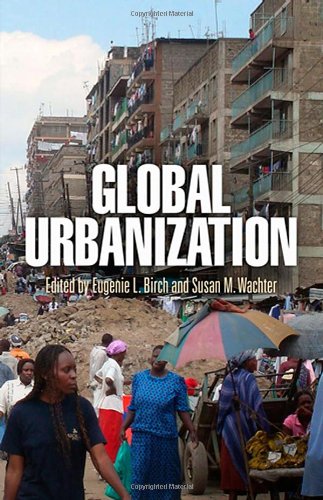
Global Urbanization (The City in the Twenty-First Century)
Authors:
Not Available
Publisher:
University of Pennsylvania Press
Publication Date:
Not available
ISBN:
081224284X
For the first time in history, the majority of the world's population lives in urban areas. Much of this urbanization has been fueled by the rapidly... growing cities of the developing world, exemplified most dramatically by booming megacities such as Lagos, Karachi, and Mumbai. In the coming years, as both the number and scale of cities continue to increase, the most important matters of social policy and economic development will necessarily be urban issues. Urbanization, across the world but especially in Asia and Africa, is perhaps the critical issue of the twenty-first century.Global Urbanization surveys essential dimensions of this growth and begins to formulate a global urban agenda for the next half century. Drawing from many disciplines, the contributors tackle issues ranging from how cities can keep up with fast-growing housing needs to the possibilities for public-private partnerships in urban governance. Several essays address the role that cutting-edge technologies such as GIS software, remote sensing, and predictive growth models can play in tracking and forecasting urban growth. Reflecting the central importance of the Global South to twenty-first-century urbanism, the volume includes case studies and examples from China, India, Uganda, Kenya, and Brazil.While the challenges posed by large-scale urbanization are immense, the future of human development requires that we find ways to promote socially inclusive growth, environmental sustainability, and resilient infrastructure. The timely and relevant scholarship assembled in Global Urbanization will be of great interest to scholars and policymakers in demography, geography, urban studies, and international development.
Global Values 101: A Short Course
Authors:
Not Available
Publisher:
Beacon Press
Publication Date:
Not available
ISBN:
0807003050
Global Values 101 grew out of one of the most popular courses ever offered at Harvard University, in which some of the most original thinkers of our day... sat down with students and explored how ideas have made them—and can make us—more engaged, involved, and compassionate citizens. They addressed the topics of war, religion, the global economy, and social change: Amy Goodman, host of the popular radio program Democracy Now as well as the author of The Exception to the Ruler, speaks about the role of the citizen and the media in a free society; Lani Guinier reveals that students' SAT scores more accurately describe the kind of car their parents drive than the grades they will earn in college and shows the way to a more equitable college admissions system; Juliet Schor, author of Born to Buy and The Overspent American, discusses the evolution of personal responsibility in a consumer culture; and Robert Reich, author of Locked in the Cabinet, tells us to get involved in politics because, if you want to see change, you have to make change happen.For anyone who has been moved by idealism and wondered how to become an engaged citizen, this collection offers a range of stories on how progressive ideals can inform, inspire, engage, and ultimately change lives.Other contributors include Harvey Cox, Katha Pollitt, Howard Zinn, Diana Eck, and Naomi Klein.

Global Warming
Authors:
Danny Harvey
Publisher:
Prentice Hall
Publication Date:
Not available
ISBN:
0582381673
Global Warming: The Hard Science presents a comprehensive, qualitatively rigorous, and critical discussion of the science underlying the global warming... issue. The major processes in the climate system needed to understand projected human-induced climatic change are presented in detail. Observational systems used to monitor changes in the climate system and the ways in which the raw data are analyzed in order to produce estimates of current trends are also critically reviewed. The author discusses the hierarchy of computer models used to project changes in the carbon cycle, in climate, and in sea level and examines the physical principles underlying the greenhouse effect and projected warming. The text also presents a detailed discussion of the carbon cycle, of climate sensitivity, and of projected patterns of climatic change through time. Sea level rise and issues of risk and potential surprises are also critically assessed. Emphasis is placed throughout on developing an intuitive understanding of those results that do not depend on the details of any one computer simulation model. A series of boxes illustrate the key points through step-by-step calculations.
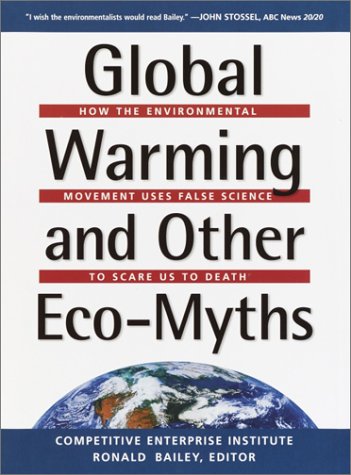
Global Warming and Other Eco Myths: How the Environmental Movement...
Authors:
Competitive Enterprise Institute
Publisher:
Prima Lifestyles
Publication Date:
Not available
ISBN:
0761536604
Includes essays by Nobel Laureate Dr. Norman E. Borlaug and other noted scientists and scholarsThe modern environmental movement began with the... publication of three seminal works, Rachel Carson's Silent Spring, Paul Ehrlich's The Population Bomb, and the Club of Rome's The Limits to Growth. These books' dismal visions of a poisoned, over-populated, resource-depleted world spiraling down toward environmental collapse are today's conventional wisdom. And every year we hear about new "conclusive" reports from special interest groups claiming that our atmosphere's temperatures are soaring, our air and water are more polluted, our cities are more crowded, and our global food supply is more precarious than ever before. However, according to a number of leading scientists from around the world, members of the environmental movement are guilty of twisting—sometimes manufacturing—the facts in an effort to frighten people into joining their cause.In this eye-opening book, some of the most respected researchers in the country explode the myths behind much of the doom and gloom of today's environmental movement. You will discover how the hysteria about global warming, overpopulation, mass extinctions, imminent famines, biotechnology, energy shortages, and more are grounded not in reason but in false science and a fear of progress. When placed beside the overwhelming facts, some of the most pervasive eco-myths crumble, including:Myth: Antarctica is melting due to global warming—threatening to raise ocean levels Fact: Antarctica has been cooling—and its glaciers thickening—for the past 30 years Myth: The global population is growing faster than our ability to produce food Fact: Global fertility rates are falling dramatically, and with advanced technology, farmers are producing more food using fewer resources than ever before Myth: Solar- and wind-powered generators are a renewable, efficient, and less intrusive alternative to gas-, oil-, and coal-burning generators Fact: Global fossil fuel supplies are in no near-term danger of being depleted, and a single 555-megawatt natural gas power plant produces more electricity than 13,000 windmills Myth: Modern pesticides and fertilizers are increasing the rates of cancer in humans Fact: No study has ever shown that anyone has developed cancer from the legal application of pesticides, and environmental pollution accounts for at most 2 percent of all cancer cases versus 30 percent caused by tobacco use And many more Ultimately, this book shows that uniting much of the environmental movement is an agenda that is not so much anti-pollution as it is anti-human. Global Warming and Other Eco-Myths lays out the true state of the planet, which, as you'll discover, is more healthy, vibrant, and clean than ideologically motivated environmentalists want you to believe.

Global Warming and Political Intimidation: How Politicians Cracked...
Authors:
Raymond S. Bradley
Publisher:
Univ. of Massachusetts Press
Publication Date:
Not available
ISBN:
1558498699
Global warming is the number one environmental issue of our time, yet some prominent politicians have refused to accept scientific evidence of human... responsibility and have opposed any legislation or international agreement that would limit greenhouse gas emissions. A few have gone even further and have tried to destroy the reputations of scientists researching climate change by deliberately undermining the credibility of their research. These politicians have sought to sow seeds of doubt in the minds of the public and to weaken public and political support for the control of fossil fuel use.In this powerful book, highly respected climate scientist Raymond Bradley provides the inside story from the front lines of the debate. In clear and direct language, he describes the tactics those in power have used to intimidate him and his colleagues part of a larger pattern of governmental suppression of scientific information, politics at the expense of empirically based discourse.Speaking from his experience, Bradley exposes the fault lines in the global warming debate, while providing a concise primer on climate change. The result is a cautionary tale of how politics and science can become fatally intertwined, written by one scientist who was unwittingly ensnared in a web of political intimidation.

Global Warming and the Political Ecology of Health: Emerging Crises...
Authors:
Hans Baer
Publisher:
Left Coast Press
Publication Date:
Not available
ISBN:
1598743546
In this groundbreaking, global analysis of the relationship between climate change and human health, Hans Baer and Merrill Singer inventory and... critically analyze the diversity of significant and sometimes devastating health implications of global warming. Using a range of theoretical tools from anthropology, medicine, and environmental sciences, they present ecosyndemics as a new paradigm for understanding the relationship between environmental change and disease. They also go beyond the traditional concept of disease to examine changes in subsistence and settlement patters, land-use, and lifeways, throwing the sociopolitical and economic dimensions of climate change into stark relief. Revealing the systemic structures of inequality underlying global warming, they also issue a call to action, arguing that fundamental changes in the world system are essential to the mitigation of an array of emerging health crises link to anthropogenic climate and environmental change.
 '





