production
/viewbook/list/all/?page=5184
/
/static/
None

Going Home to Teach (Anthony C. Winkler Collection)
Authors:
Anthony C. Winkler
Publisher:
Macmillan Caribbean
Publication Date:
Not available
ISBN:
1405068833
This autobiographical account of the year Winkler spent at a rural teacher training college flashes back to the Jamaica of the narrator's childhood,... recounting incidents and vignettes that shed light on the muddle of competing personalities, doctrines and images of self, currently vying for centre stage in the tumult of Jamaican life. Emerging form the story are the hilariously drawn characters, contrasts between the Jamaican and the American outlook, and the lessons about the perils of superimposing a foreign ideology onto a native culture.
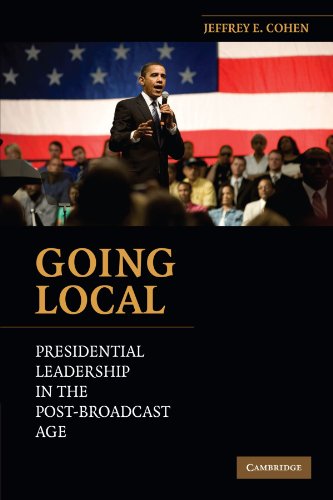
Going Local: Presidential Leadership in the Post-Broadcast Age
Authors:
Jeffrey E. Cohen
Publisher:
Cambridge University Press
Publication Date:
Not available
ISBN:
0521141435
Going public to gain support, especially through reliance on national addresses and the national news media, has been a central tactic for modern... presidential public leadership. In Going Local: Presidential Leadership in the Post-Broadcast Age, Jeffrey E. Cohen argues that presidents have adapted their going-public activities to reflect the current realities of polarized parties and fragmented media. Going public now entails presidential targeting of their party base, interest groups, and localities. Cohen focuses on localities and offers a theory of presidential news management that is tested using several new data sets, including the first large-scale content analysis of local newspaper coverage of the president. The analysis finds that presidents can affect their local news coverage, which, in turn, affects public opinion toward the president. Although the post-broadcast age presents hurdles to presidential leadership, Going Local demonstrates the effectiveness of targeted presidential appeals and provides us with a refined understanding of the nature of presidential leadership.
Going Local: Working in Communities and Neighbourhoods (The Social...
Authors:
John Pierson
Publisher:
Routledge
Publication Date:
Not available
ISBN:
0415328403
Going Local explains how social work students and practitioners can develop approaches to neighbourhood work, to engage communities and neighbourhoods... more purposefully and to work with citizens and other mainstream and community service providers to build the capacity of neighbourhoods to tackle social problems on their own. Each chapter includes objectives and key points, as well as case studies and activities where appropriate, and the topics discussed include: what we can learn from past social work practice principles, skills and tools to enhance local working joined up practice care and services for children, families, young people, older people and other vulnerable adults social cohesion and the role of practitioners in overcoming local religious and ethnic division. Going Local will appeal to practitioners working in neighbourhood based services, and is essential reading for students of social work, youth and community work, and probation work.
Going Negative
Authors:
Stephen Ansolabehere
Publisher:
Free Press
Publication Date:
Not available
ISBN:
0684837110
Political advertising has been called the worst cancer in American society. Ads cost millions, and yet the entire campaign season is now filled with... nasty and personal attacks. In this landmark six-year study, two of the nation's leading political scientists show exactly how cancerous the ad spot has become. 16 illustrations.

GOING NEGATIVE
Authors:
Not Available
Publisher:
Not available
Publication Date:
Not available
ISBN:
Not available
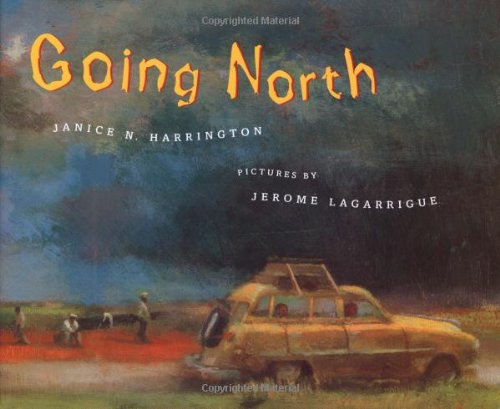
Going North (Bccb Blue Ribbon Picture Book Awards (Awards))
Authors:
Janice N. Harrington
Publisher:
Farrar, Straus and Giroux
Publication Date:
Not available
ISBN:
0374326819
An African American family becomes a new kind of pioneerLeaving behind Big Mama, loving relatives, and the familiar red soil and cotton fields of... Alabama, Jessie and her family are going north to Nebraska. They are pioneers searching for a better life, one with decent schools and jobs. But traveling through the segregated South is difficult for an African American family in the 1960s. With most public places reserved for "whites only," where will they stop to get gas and food?Lyrical free verse and evocative paintings capture the rhythm of the road and a young girl's longing as she wonders: Will I like it there? Will I like the North?
Going North Thinking West: The Intersections of Social Class,...
Authors:
Irvin Peckham
Publisher:
Utah State University Press
Publication Date:
Not available
ISBN:
0874218047
A long-time writing program administrator and well-respected iconoclast, Irvin Peckham is strongly identified with progressive... ideologies in education. However, in Going North Thinking West, Peckham mounts a serious critique of what is called critical pedagogy—primarily a project of the academic left—in spite of his own sympathies there. College composition is fundamentally a middle-class enterprise, and is conducted by middle-class professionals, while student demographics show increasing presence of the working class. In spite of best intentions to ameliorate inequitable social class relationships, says Peckham, critical pedagogies can actually contribute to reproducing those relationships in traditional forms—not only perpetuating social inequities, but pushing working class students toward self-alienation, as well. Peckham argues for more clarity on the history of critical thinking, social class structures and teacher identity (especially as these are theorized by Pierre Bourdieu), while he undertakes a critical inquiry of the teaching practices with which even he identifies. Going North Thinking West focuses especially on writing teachers who claim a necessary linkage between critical thinking and writing skills; these would include both teachers who promote the fairly a-political position that argumentation is the obvious and necessary form of academic discourse, and more controversial teachers who advocate turning a classroom into a productive site of social transformation. Ultimately, Peckham argues for a rereading of Freire (an icon of transformational pedagogy), and for a collaborative investigation of students’ worlds as the first step in a successful writing pedagogy. It is an argument for a pedagogy based on service to students rather than on transforming them.

Going Nuclear: Nuclear Proliferation and International Security in...
Authors:
Not Available
Publisher:
The MIT Press
Publication Date:
Not available
ISBN:
026252466X
The spread of nuclear weapons is one of the most significant challenges to global security in the twenty-first century. Limiting the proliferation of... nuclear weapons and materials may be the key to preventing a nuclear war or a catastrophic act of nuclear terrorism. Going Nuclear offers conceptual, historical, and analytical perspectives on current problems in controlling nuclear proliferation. It includes essays that examine why countries seek nuclear weapons as well as studies of the nuclear programs of India, Pakistan, and South Africa. The final section of the book offers recommendations for responding to the major contemporary proliferation challenges: keeping nuclear weapons and materials out of the hands of terrorists, ensuring that countries that renounce nuclear weapons never change their minds, and cracking down on networks that illicitly spread nuclear technologies.Nearly all the chapters in this book have been previously published in the journal International Security. It contains a new preface and one chapter commissioned specifically for the volume, Matthew Bunn's "Nuclear Terrorism: A Strategy for Prevention." Contributors: Samina Ahmed, Chaim Braun, Matthew Bunn, Christopher F. Chyba, Matthew Fuhrmann, Šumit Ganguly, S. Paul Kapur, Ariel E. Levite, Peter Liberman, Austin Long, Sean M. Lynn-Jones, Alexander H. Montgomery, Gaukhar Mukhatzhanova, William C. Potter, Whitney Raas, Scott D. Sagan, Etel Solingen
Going Out: The Rise and Fall of Public Amusements
Authors:
David Nasaw
Publisher:
Harvard University Press
Publication Date:
Not available
ISBN:
0674356225
David Nasaw has written a sparkling social history of twentieth-century show business and of the new American public that assembled in the city's... pleasure palaces, parks, theaters, nickelodeons, world's fair midways, and dance halls. The new amusement centers welcomed women, men, and children, native-born and immigrant, rich, poor and middling. Only African Americans were excluded or segregated in the audience, though they were overrepresented in parodic form on stage. This stigmatization of the African American, Nasaw argues, was the glue that cemented an otherwise disparate audience, muting social distinctions among "whites," and creating a common national culture.

Going Places: Transportation Redefines the Twentieth-Century West
Authors:
Carlos Arnaldo Schwantes
Publisher:
Indiana University Press
Publication Date:
Not available
ISBN:
0253342023
It seems difficult even to imagine the modern West without reference to its planes, trains, and automobiles. Freeways define modern Los Angeles, as... Route 66 still recalls the freedom of the open road. Seattle, long home to Boeing, gave birth to jetliners such as the 707. And once trains with glamorous names like The Sunset Limited and The Great Northern Flyer carried passengers in posh luxury through the grand vistas of the West. "Railways, highways, and skyways link landscapes both ordinary and sublime for tourists in search of scenic splendor," observes Carlos Arnaldo Schwantes. But those same corridors often leaven despair with opportunity for those who dream that the mobility brought by car, train, and plane will help them find better jobs or escape from their pasts.Going Places looks at three major ways in which transportation has shaped the great Western landscape. There are the transformations brought about by a railroad right-of-way, highway corridors, waterways, and airports, and the larger impacts of transportation on the landscape, such as the development that followed the iron rails westward. Finally, Schwantes considers how travelers experience the passing landscape as framed by the windows of automobiles, passenger trains, and jetliners, and what that might mean. He examines the interconnections between railroad, highway, aviation, and waterways, and between society and modes of transportation. This masterful narrative travels the length and breadth of a vast space, with marvelous anecdotes and telling details that bring the story to life. More than 100 carefully selected photographs complement the text.

Going Postal
Authors:
Terry Pratchett
Publisher:
HarperTorch
Publication Date:
Not available
ISBN:
0060502932
Suddenly, condemned arch-swindler Moist von Lipwig found himself with a noose around his neck and dropping through a trapdoor into ... a government job?... By all rights, Moist should be meeting his maker rather than being offered a position as Postmaster by Lord Vetinari, supreme ruler of Ankh-Morpork. Getting the moribund Postal Service up and running again, however, may prove an impossible task, what with literally mountains of decades-old undelivered mail clogging every nook and cranny of the broken-down post office. Worse still, Moist could swear the mail is talking to him. Worst of all, it means taking on the gargantuan, greedy Grand Trunk clacks communication monopoly and its bloodthirsty piratical headman. But if the bold and undoable are what's called for, Moist's the man for the job -- to move the mail, continue breathing, get the girl, and specially deliver that invaluable commodity that every being, human or otherwise, requires: hope.

Going Postal: Rage, Murder, and Rebellion: From Reagan's Workplaces...
Authors:
Mark Ames
Publisher:
Soft Skull Press
Publication Date:
Not available
ISBN:
1932360824
An eye-opening look at the phenomenon of school and workplace shootings in America, Going Postal explores the rage-murder phenomenon that has plagued... — and baffled — America for the last three decades, and offers some provocative answers to the oft-asked question, "Why?" By juxtaposing the historical place of rage in America with the social climate that has existed since the 1980s — when Reaganomics began to widen the gap between executive and average-worker earnings — the author crafts a convincing argument that these schoolyard and office massacres can be seen as modern-day slave rebellions. He presents many fascinating and unexpected cases in detail. Like slave rebellions, these massacres are doomed, gory, sometimes even inadvertently comic, and grossly misunderstood. Taking up where Bowling for Columbine left off, this book seeks to set these murders in their proper context and thereby reveal their meaning.

Going Public: An Organizer's Guide to Citizen Action
Authors:
Michael Gecan
Publisher:
Anchor
Publication Date:
Not available
ISBN:
1400076498
Urban decay can sap the determination—not to mention the soul—of anyone who experiences it. But there are forces that can and do reverse it. They... are not spectators, or critics, or occasional demonstrators. They are groups of citizens, encouraged and trained to take power with dignity and creativity and unrelenting determination, and to make it work for them, day by day, month by month, and year to year. For more than twenty-five years, Michael Gecan has been a professional organizer with Industrial Areas Foundation, which has trained thousands of little-known community groups from Brownsville, Texas, to Brownsville, Brooklyn. Having grown up witnessing at close range the destructive effects of political patronage on powerless, disenfranchised Chicago communities, Gecan knows from experience that strong relationships in the public sphere and sustained and disciplined organizing can spark the public and private alchemy necessary to achieve sidewalks, parks, schools, housing--and the collective renewal that results. Full of good advice and entertaining accounts of success, Going Public is the story of those who, says Gecan, “succeed in unexpected ways and in unexpected places.”
Going Public: New Strategies Of Presidential Leadership, 4th Edition
Authors:
Samuel Kernell
Publisher:
CQ Press
Publication Date:
Not available
ISBN:
1568028997
Presidents are uniquely positioned to promote themselves and their polices directly to the public. Using sympathetic crowds as a backdrop, a president... can rally public opinion to his side, along the way delivering a subtle yet unmistakable message to his intended audience in Congress. Samuel Kernell shows how "going public" remains a potent weapon in the president's arsenal, both for advancing his own agenda and blocking initiatives from his political adversaries in Congress. In his highly anticipated fourth edition, Kernell delivers thorough analysis and detailed background on how this strategy continues to evolve given the intense polarization of Congress and the electorate as well as changes in communications technology. He considers the implications of both factors--especially in combination--on the future of presidential leadership and weighs the lessons of 9/11 on "going public" in foreign affairs.
Going Public: The Changing Face of New Zealand History
Authors:
Not Available
Publisher:
Auckland University Press
Publication Date:
Not available
ISBN:
186940226X
Short think-pieces by leading writers that explore connections between aspects of public history and New Zealand history in general. Subjects include... new media, Treaty claims research, official war history, government history, the origins of public history, heritage, history and popular culture and state-funded reference histories.
 '





