production
/viewbook/list/all/?page=5211
/
/static/
None
Governing the Economy: The Politics of State Intervention in...
Authors:
Not Available
Publisher:
Oxford University Press, USA
Publication Date:
Not available
ISBN:
0195205308
For over one hundred years, the British economy has been in decline relative to other industrialized countries. This book explores the origins of... Britain's economic problems and develops a striking new argument about the sources of decline. It goes on to analyze the evolution of economic policy in postwar Britain from the development of Keynesianism to the rise of monetarism under Margaret Thatcher. France, by contrast, experienced an economic miracle in the postwar period. Hall argues that the French state transformed itself and then its society through an extensive system of state intervention. In the recent period, however, the French system has encountered many difficulties, and the book locates their sources in the complex interaction between state and society in France culminating in the socialist experiment of Francois Mitterrand. Through his insightful, comparative examination of policy-making in Britain and France, Hall develops a new approach to state-society relations that emphasizes the crucial role of institutional structures.
Governing the Global Polity: Practice, Mentality, Rationality
Authors:
Iver B. Neumann
Publisher:
University of Michigan Press
Publication Date:
Not available
ISBN:
0472050931
"There have been many attempts to adapt Foucault's arguments to the study of international relations, but this powerful and provocative book is the most... sustained, and arguably the most successful in showing how the governmentality approach can be adapted to the analysis of global politics."---Barry Hindess, Research School of Social Sciences, The Australian National UniversityA highly welcome and original contribution to contemporary debates on the shape and future of the international system and on the possibility of reconfiguring IR theory as social theory."---Mathias Albert, Bielefeld University, Germany"Iver Neumann and Ole Jacob Sending have put meat on the bones of Michel Foucault's notion of governmentality, fulfilling the hopes of long-famished students and scholars of global governance. Through their focus on specific case studies, the authors have provided a much-needed contribution to the international relations literature, one that is sure to become a staple of courses and seminars throughout the world."---Ronnie D. Lipschutz, University of California, Santa CruzWhat does globalization mean for the principle of state sovereignty and for the power and functioning of states? Whereas realists assert the continued importance of states, constructivists contend that various political entities as well as the logic of globalization itself undermine state sovereignty.Drawing on the state formation literature and on social theory, particularly the works of Weber and Foucault, Iver B. Neumann and Ole Jacob Sending question the terms of the realist-constructionist debate. Through detailed case studies, they demonstrate that states use nongovernmental organizations and international organizations indirectly to enforce social order and, ultimately, to increase their own power. At the same time, global politics is dominated by a liberal political rationality that states ignore at their peril. While states remain as strong as ever, they operate within a global polity of new hierarchies among states and between states and other actors.Iver B. Neumann is Director of Research at the Norwegian Institute of International Affairs and Professor of Russian Studies at the University of Oslo.Ole Jacob Sending is Senior Researcher at the Norwegian Institute of International Affairs, where he heads the Research Programme on Global Governance and International Organizations.Cover art credit: © iStockphoto.com/Will EvansAlso available as an e-book.
Governing the Soul: The Shaping of the Private Self
Authors:
Nikolas Rose
Publisher:
Free Association Books
Publication Date:
Not available
ISBN:
1853434442
Governing the Soul is now widely recognized as one of the founding texts in a new approach to analyzing the links between political power, expertise and... the self. This governmentality perspective has had important implications for a range of academic disciplines including criminology, political theory, sociology and psychology and has generated much theoretical innovation and empirical investigation. The second edition contains a new introduction, which sets out the methodological and conceptual bases of this approach. Also, a new final chapter has been added that considers some of the implications of recent developments in the government of subjectivity.
Governing Through Crime: How the War on Crime Transformed American...
Authors:
Jonathan Simon
Publisher:
Oxford University Press, USA
Publication Date:
Not available
ISBN:
0195181085
Across America today gated communities sprawl out from urban centers, employers enforce mandatory drug testing, and schools screen students with metal... detectors. Social problems ranging from welfare dependency to educational inequality have been reconceptualized as crimes, with an attendant focus on assigning fault and imposing consequences. Even before the recent terrorist attacks, non-citizen residents had become subject to an increasingly harsh regime of detention and deportation, and prospective employees subjected to background checks. How and when did our everyday world become dominated by fear, every citizen treated as a potential criminal?In this startlingly original work, Jonathan Simon traces this pattern back to the collapse of the New Deal approach to governing during the 1960s when declining confidence in expert-guided government policies sent political leaders searching for new models of governance. The War on Crime offered a ready solution to their problem: politicians set agendas by drawing analogies to crime and redefined the ideal citizen as a crime victim, one whose vulnerabilities opened the door to overweening government intervention. By the 1980s, this transformation of the core powers of government had spilled over into the institutions that govern daily life. Soon our schools, our families, our workplaces, and our residential communities were being governed through crime.This powerful work concludes with a call for passive citizens to become engaged partners in the management of risk and the treatment of social ills. Only by coming together to produce security, can we free ourselves from a logic of domination by others, and from the fear that currently rules our everyday life.
Governing Through Crime: How the War on Crime Transformed American...
Authors:
Jonathan Simon
Publisher:
Oxford University Press, USA
Publication Date:
Not available
ISBN:
0195386019
Across America today gated communities sprawl out from urban centers, employers enforce mandatory drug testing, and schools screen students with metal... detectors. Social problems ranging from welfare dependency to educational inequality have been reconceptualized as crimes, with an attendant focus on assigning fault and imposing consequences. Even before the recent terrorist attacks, non-citizen residents had become subject to an increasingly harsh regime of detention and deportation, and prospective employees subjected to background checks. How and when did our everyday world become dominated by fear, every citizen treated as a potential criminal?In this startlingly original work, Jonathan Simon traces this pattern back to the collapse of the New Deal approach to governing during the 1960s when declining confidence in expert-guided government policies sent political leaders searching for new models of governance. The War on Crime offered a ready solution to their problem: politicians set agendas by drawing analogies to crime and redefined the ideal citizen as a crime victim, one whose vulnerabilities opened the door to overweening government intervention. By the 1980s, this transformation of the core powers of government had spilled over into the institutions that govern daily life. Soon our schools, our families, our workplaces, and our residential communities were being governed through crime.This powerful work concludes with a call for passive citizens to become engaged partners in the management of risk and the treatment of social ills. Only by coming together to produce security, can we free ourselves from a logic of domination by others, and from the fear that currently rules our everyday life.
Governing Virginia
Authors:
Anne Marie Morgan
Publisher:
Pearson Learning Solutions
Publication Date:
Not available
ISBN:
1256426067
Governing Virginia is the winner of the 2012 Virginia Press Women's First Place Award for "Book Edited by Entrant." Governing Virginia is a... unique, reader-friendly compendium written not by academicians but by “practitioners” who have worked within the realms of the Commonwealth’s state and local governments. It was compiled for use as a textbook or reader for stand-alone courses in Virginia government, as a supplementary text for general courses in American or state and local government, or as an informational book to learn more about the Commonwealth. The contributors to Governing Virginia include five former governors, five current and former legislators, and other prominent state leaders, from whom readers can learn about how laws are made, the lengthy process of budget-making, the policy priorities of Virginia’s chief executives, the distinctive way that the General Assembly selects judges, plus many more topics. While invaluable for political science instruction, Governing Virginia is also rich with the Commonwealth’s history, and foundational information about how the state and localities are governed is recounted against this backdrop. The chapters trace the legacy of Virginia’s contributions to governing principles in the U.S. and the world, while also describing its political transformation throughout the centuries and the contemporary workings of its executive, legislative, and judicial branches. Additionally, the compilation includes features that do not always appear in Virginia government textbooks, including the evolution of women’s participation in the General Assembly, the transformation of the state’s political structure into a vigorous two-party system, the expanding role of the attorney general, and the importance of economic development to the Commonwealth’s prosperity. Beautifully illustrated in color with photos by an award-winning Richmond Times-Dispatch photographer, Governing Virginia is ideal for teachers, professors, college and advanced high school students, business and civic leaders, and anyone who wants to learn about the state that Governing Magazine has described as the “best-managed” in the U.S. Book Sections: Part 1 discusses Virginia’s metamorphosis as the Commonwealth underwent profound political and constitutional changes since the founding of the oldest representative legislature in the New World. Part 2 describes the legislative branch, including the process and vocabulary of passing laws, how the state budget is made, the election of women to the General Assembly, the pivotal role of lobbyists, and reflections from the longest-serving member of the House of Delegates. Part 3 addresses the executive branch, including the fundamentals of serving as governor, the workings of the chief executive’s cabinet, narratives by former governors on their policy priorities, and the strategic roles of the attorney general and economic development. Part 4 discusses the judicial branch, the unique way that Virginia selects its judges, and a concise explanation of the state’s court system. Part 5 introduces the news media as an integral component of the political and governmental landscape in Virginia and their essential role in informing the public, written from both the newspaper and broadcast perspectives. Part 6 features Virginia’s local governments, including the critical functions and challenges of cities and counties as they govern close to home. Part 7 explores the dynamics of Virginia’s electoral system, how elections are conducted, the use of money in campaigns, and the role of political parties in waging electoral contests.
Governing Water: Contentious Transnational Politics and Global...
Authors:
Ken Conca
Publisher:
The MIT Press
Publication Date:
Not available
ISBN:
0262532735
Water is a key component of critical ecosystems, a marketable commodity, a foundation of local communities and cultures, and a powerful means of social... control. It has become a source of contentious politics and social controversy on a global scale, and the management of water conflicts is one of the biggest challenges in the effort to achieve effective global environmental governance.In Governing Water, Ken Conca examines political struggles to create a global framework for the governance of water. Threats to the world's rivers, watersheds, and critical freshwater ecosystems have resisted the establishment of effective global agreements through intergovernmental bargaining because the conditions for successful interstate cooperation -- effective state authority, stable knowledge frameworks, and a territorialized understanding of nature -- cannot be imposed upon water controversies. But while interstate water diplomacy has faltered, less formalized institutions -- socially and politically embedded rules, roles, and practices -- have emerged to help shape water governance locally and globally.Conca examines the politics of these institutions, presenting a framework for understanding global environmental governance based on key institutional presumptions about territoriality, authority, and knowledge. He maps four distinct processes of institution building: formal international regimes for shared rivers; international networking among water experts and professionals; social movements opposing the construction of large dams; and the struggle surrounding transnational water "marketization." These cases illustrate the potential for alternative institutional forms in situations where traditional interstate regimes are ineffective.
Governing with Judges: Constitutional Politics in Europe
Authors:
Alec Stone-Sweet
Publisher:
Oxford University Press, USA
Publication Date:
Not available
ISBN:
0198297718
This is the first comparative study written by a social scientist on the topic of European constitutional courts and their role in protecting human... rights and defending new democratic institutions. Focusing on France, Germany, Italy, Spain, and the European Union, the author traces the enormous impact of these courts on both legislative and judicial processes and outcomes, and explains why this impact continues to expand.
Governing With the News, Second Edition: The News Media as a...
Authors:
Timothy E. Cook
Publisher:
University Of Chicago Press
Publication Date:
Not available
ISBN:
0226115011
The ideal of a neutral, objective press has proven in recent years to be just that—an ideal. In Governing with the News, Timothy E. Cook goes far... beyond the single claim that the press is not impartial to argue that the news media are in fact a political institution integral to the day-to-day operations of our government. This updated edition includes a new afterword by the author, which pays close attention to two key developments in the twenty-first century: the accelerating fragmentation of the mass media and the continuing decline of Americans' confidence in the press."Provocative and often wise. . . . Cook, who has a complex understanding of the relationship between governing and the news, provides a fascinating account of the origins of this complicity."—James Bennet, Washington Monthly"[Governing with the News] addresses central issues of media impact and power in fresh, illuminating ways. . . . Cook mines a wealth of historical and organizational literature to assert that the news media are a distinct politicalinstitution in our democratic system."—Robert Schmuhl, Commonweal
Governing with the News: The News Media as a Political Institution...
Authors:
Timothy E. Cook
Publisher:
Not available
Publication Date:
Not available
ISBN:
0226115003
The ideal of a neutral, objective press has proven in recent years to be just that--an ideal. But while everyone talks about the political biases and... influences of the news, no one has figured out whether and how the news media exert power. In Governing with the News, Timothy E. Cook goes far beyond the single claim that the press is not impartial to argue that the news media are in fact a political institution integral to the day-to-day operations of the three branches of our government. The formation of the press as a political institution began in the early days of the republic when newspapers were sponsored by political parties; the relationship is now so central that press offices are found wherever one turns. Cook demonstrates not only how the media are structured as an institution that exercises collective power but also how the role of the media has become institutionalized within the political process, affecting policy and instigating, rather than merely reflecting, political actions. Cook's analysis is a powerful and fascinating guide to our age when newsmaking and governing are inseparable. "This is a wonderful analysis of a highly important topic. Tim Cook is resoundingly right that we need to look at the media as political institutions and their operatives as political actors."--David R. Mayhew, author of Divided We Govern "This meticulously researched and well reasoned work proposes to take seriously a thesis which flies in the face of both journalistic lore and political myth. Governing with the News is an innovative contribution to our understanding of media."--W. Lance Bennett, author of News: The Politics of Illusion "This book should be read by journalists . . . by mass communication faculty teaching courses in media structure or effects and journalism faculty as a supplemental text to courses in media history and media management."--Benjamin J. Burns, Journalism & Mass Communication Quarterly
Governmental Accounting Made Easy
Authors:
Warren Ruppel
Publisher:
Wiley
Publication Date:
Not available
ISBN:
0470411503
A hands-on guide to the ins and outs of governmental accounting—made easy!Governmental Accounting Made Easy, Second Edition equips you with the tools... you need to run the financial and accounting operations within your organization. This complete and straightforward manual covers a broad range of governmental accounting topics that fall under the Governmental Accounting Standards Board, and its recently revised financial reporting model.Boiling down the complicated details of governmental accounting into manageable essentials, author Warren Ruppel, a leading authority on governmental accounting, offers practical information in easy-to-understand terminology. Even if you do not have a professional understanding of accounting principles and financial reporting, the Second Edition makes it all clear with accounting rules explained in terms anyone can understand, to help you better fulfill your managerial and fiduciary duties.Always practical and never over-technical, this helpful guide:Discusses basic accounting terminologyClearly explains fund accountingCovers the nuts and bolts of governmental financial statementsEquips you to understand the reporting entityDiscusses revenues from non-exchange transactionsHelps you become conversant in various accounting topicsThe recently adopted reporting model for governments resulted in a radical change in the way governmental financial statements are presented. Suitable for professional managers, budget preparers, school boards, city councils, state legislators, and comptrollers, Governmental Accounting Made Easy, Second Edition is your essential guide for a clear, concise, understandable explanation of government finances.
Governmental and Nonprofit Accounting (10th Edition)
Authors:
Robert J. Freeman
Publisher:
Prentice Hall
Publication Date:
Not available
ISBN:
0132751267
This is a comprehensive textbook that is written through the eyes of the learner to prepare them for professional government and not-for-profit... accounting practice and the CPA exam.
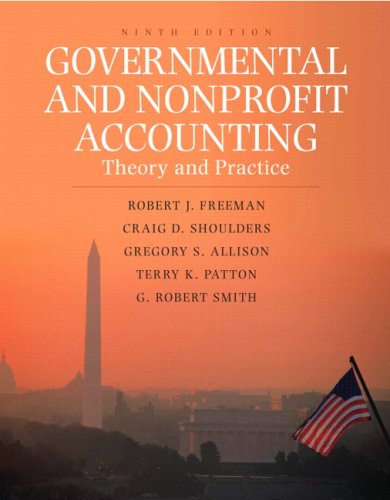
Governmental and Nonprofit Accounting: Theory and Practice (9th...
Authors:
Robert J. Freeman
Publisher:
Prentice Hall
Publication Date:
Not available
ISBN:
0136029515
This is a comprehensive textbook that is written through the eyes of the learner to prepare them for professional government and not-for-profit... accounting practice and the CPA exam. Governmental and non-profit accounting concepts, principles, and practices. For accountants who need an up-to-date textbook covering state and local government, federal government, and not-for-profit organization accounting
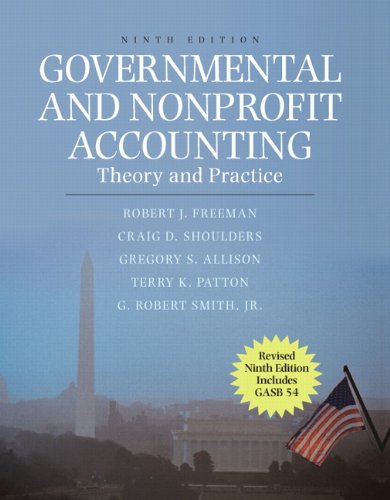
Governmental and Nonprofit Accounting: Theory and Practice, Update...
Authors:
Robert J. Freeman
Publisher:
Prentice Hall
Publication Date:
Not available
ISBN:
0132552728
This comprehensive textbook is written through the eyes of the learner to prepare them for professional government and not-for-profit accounting... practice and the CPA exam. The updated ninth edition now includes information on new GASB Statement 54, Fund Balance Reporting and Governmental Fund Type Definitions.
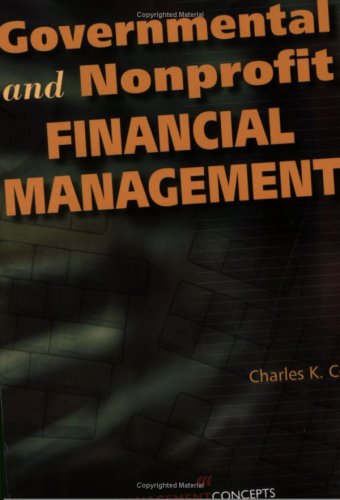
Governmental and Nonprofit Financial Management
Authors:
Charles K. Coe
Publisher:
Management Concepts
Publication Date:
Not available
ISBN:
1567261833
The first book to comprehensively discuss both governmental and nonprofit financial management! Governmental and Nonprofit Financial Management makes it... easy for both nonprofit and governmental managers to understand essential governmental and nonprofit financial management topics and their various subfields. Understand the similarities and differences between governmental and nonprofit financial management standards and procedures Learn multiple cost-saving techniques Explore highly technical financial management subfields, from auditing and financial analysis to capital budgeting and risk management Use over 40 applications to calculate everything from T-bill yield to lost cash discounts Benefit from the in-depth coverage an excellent primer for the non-accountant.
 '





