production
/viewbook/list/all/?page=5335
/
/static/
None
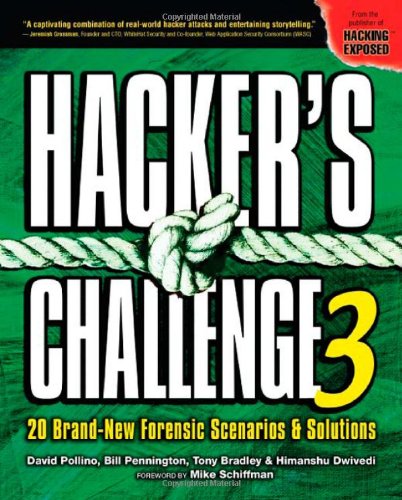
Hacker's Challenge 3: 20 Brand New Forensic Scenarios &...
Authors:
David Pollino
Publisher:
McGraw-Hill Osborne Media
Publication Date:
Not available
ISBN:
0072263040
The stories about phishing attacks against banks are so true-to-life, it’s chilling.” --Joel Dubin, CISSP, Microsoft MVP in Security Every... day, hackers are devising new ways to break into your network. Do you have what it takes to stop them? Find out in Hacker’s Challenge 3. Inside, top-tier security experts offer 20 brand-new, real-world network security incidents to test your computer forensics and response skills. All the latest hot-button topics are covered, including phishing and pharming scams, internal corporate hacking, Cisco IOS, wireless, iSCSI storage, VoIP, Windows, Mac OS X, and UNIX/Linux hacks, and much more. Each challenge includes a detailed explanation of the incident--how the break-in was detected, evidence and clues, technical background such as log files and network maps, and a series of questions for you to solve. In Part II, you’ll get a detailed analysis of how the experts solved each incident.
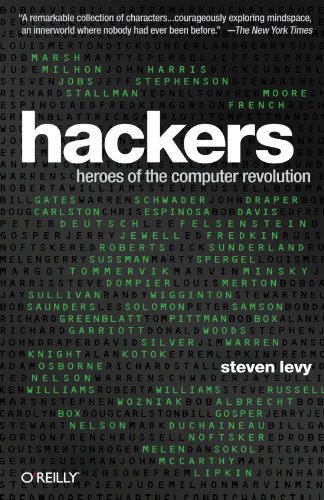
Hackers: Heroes of the Computer Revolution - 25th Anniversary Edition
Authors:
Steven Levy
Publisher:
O'Reilly Media
Publication Date:
Not available
ISBN:
1449388396
This 25th anniversary edition of Steven Levy's classic book traces the exploits of the computer revolution's original hackers -- those brilliant and... eccentric nerds from the late 1950s through the early '80s who took risks, bent the rules, and pushed the world in a radical new direction. With updated material from noteworthy hackers such as Bill Gates, Mark Zukerberg, Richard Stallman, and Steve Wozniak, Hackers is a fascinating story that begins in early computer research labs and leads to the first home computers. Levy profiles the imaginative brainiacs who found clever and unorthodox solutions to computer engineering problems. They had a shared sense of values, known as "the hacker ethic," that still thrives today. Hackers captures a seminal period in recent history when underground activities blazed a trail for today's digital world, from MIT students finagling access to clunky computer-card machines to the DIY culture that spawned the Altair and the Apple II. Amazon.com Exclusive: The Rant Heard Round the World By Steven Levy Author Steven Levy When I began researching Hackers--so many years ago that it’s scary--I thought I’d largely be chronicling the foibles of a sociologically weird cohort who escaped normal human interaction by retreating to the sterile confines of computers labs. Instead, I discovered a fascinating, funny cohort who wound up transforming human interaction, spreading a culture that affects our views about everything from politics to entertainment to business. The stories of those amazing people and what they did is the backbone of Hackers: Heroes of the Computer Revolution. But when I revisited the book recently to prepare the 25th Anniversary Edition of my first book, it was clear that I had luckily stumbled on the origin of a computer (and Internet) related controversy that still permeates the digital discussion. Throughout the book I write about something I called The Hacker Ethic, my interpretation of several principles implicitly shared by true hackers, no matter whether they were among the early pioneers from MIT’s Tech Model Railroad Club (the Mesopotamia of hacker culture), the hardware hackers of Silicon Valley’s Homebrew Computer Club (who invented the PC industry), or the slick kid programmers of commercial game software. One of those principles was “Information Should Be Free.” This wasn’t a justification of stealing, but an expression of the yearning to know more so one could hack more. The programs that early MIT hackers wrote for big computers were stored on paper tapes. The hackers would keep the tapes in a drawer by the computer so anyone could run the program, change it, and then cut a new tape for the next person to improve. The idea of ownership was alien. This idea came under stress with the advent of personal computers. The Homebrew Club was made of fanatic engineers, along with a few social activists who were thrilled at the democratic possibilities of PCs. The first home computer they could get their hands on was 1975’s Altair, which came in a kit that required a fairly hairy assembly process. (Its inventor was Ed Roberts, an underappreciated pioneer who died earlier this year.) No software came with it. So it was a big deal when 19-year-old Harvard undergrad Bill Gates and his partner Paul Allen wrote a BASIC computer language for it. The Homebrew people were delighted with Altair BASIC, but unhappy that Gates and Allen charged real money for it. Some Homebrew people felt that their need for it outweighed their ability to pay. And after one of them got hold of a “borrowed” tape with the program, he showed up at a meeting with a box of copies (because it is so easy to make perfect copies in the digital age), and proceeded to distribute them to anyone who wanted one, gratis. This didn’t sit well with Bill Gates, who wrote what was to become a famous “Letter to Hobbyists,” basically accusing them of stealing his property. It was the computer-age equivalent to Luther posting the Ninety-Five Theses on the Castle Church. Gate’s complaints would reverberate well into the Internet age, and variations on the controversy persist. Years later, when another undergrad named Shawn Fanning wrote a program called Napster that kicked off massive piracy of song files over the Internet, we saw a bloodier replay of the flap. Today, issues of cost, copying and control still rage--note Viacom’s continuing lawsuit against YouTube and Google. And in my own business—journalism--availability of free news is threatening more traditional, expensive new-gathering. Related issues that also spring from controversies in Hackers are debates over the “walled gardens” of Facebook and Apple’s iPad. I ended the original Hackers with a portrait of Richard Stallman, an MIT hacker dedicated to the principle of free software. I recently revisited him while gathering new material for the 25th Anniversary Edition of Hackers, he was more hard core than ever. He even eschewed the Open Source movement for being insufficiently noncommercial. When I spoke to Gates for the update, I asked him about his 1976 letter and the subsequent intellectual property wars. “Don’t call it war,” he said. “Thank God we have an incentive system. Striking the right balance of how this should work, you know, there's going to be tons of exploration.” Then he applied the controversy to my own situation as a journalism. “Things are in a crazy way for music and movies and books,” he said. “Maybe magazine writers will still get paid 20 years from now. Who knows? Maybe you'll have to cut hair during the day and just write articles at night.” So Amazon.com readers, it’s up to you. Those who have not read Hackers,, have fun and be amazed at the tales of those who changed the world and had a hell of time doing it. Those who have previously read and loved Hackers, replace your beat-up copies, or the ones you loaned out and never got back, with this beautiful 25th Anniversary Edition from O’Reilly with new material about my subsequent visits with Gates, Stallman, and younger hacker figures like Mark Zuckerberg of Facebook. If you don’t I may have to buy a scissors--and the next bad haircut could be yours! Read Bill Gates' letter to hobbyists
Hacker Techniques, Tools, and Incident Handling (Jones &...
Authors:
Sean-Philip Oriyano
Publisher:
Jones & Bartlett Learning
Publication Date:
Not available
ISBN:
0763791830
Hacker Techniques, Tools, and Incident Handling begins with an examination of the landscape, key terms, and concepts that a security professional needs... to know about hackers and computer criminals who break into networks, steal information, and corrupt data. It goes on to review the technical overview of hacking: how attacks target networks and the methodology they follow. The final section studies those methods that are most effective when dealing with hacking attacks, especially in an age of increased reliance on the Web. Written by a subject matter expert with numerous real-world examples, Hacker Techniques, Tools, and Incident Handling provides readers with a clear, comprehensive introduction to the many threats on our Internet environment and security and what can be done to combat them.
Hacking Cyberspace (Polemics)
Authors:
David J. Gunkel
Publisher:
Westview Press
Publication Date:
Not available
ISBN:
0813336694
In Hacking Cyberspace David J. Gunkel examines the metaphors applied to new technologies, and how those metaphors inform, shape, and drive the... implementation of the technology in question. The author explores the metaphorical tropes that have been employed to describe and evaluate recent advances in computer technology, telecommunications systems, and interactive media. Taking the stance that no speech is value-neutral, Gunkel examines such metaphors as "the information superhighway" and "the electronic frontier" for their political and social content, and he develops a critical investigation that not only traces the metaphors' conceptual history, but explicates their implications and consequences for technological development. Through Hacking Cyberspace, David J. Gunkel develops a sophisticated understanding of new technology that takes into account the effect of technoculture's own discursive techniques and maneuvers on the actual form of technological development.
Hacking Exposed 7: Network Security Secrets & Solutions,...
Authors:
Stuart McClure
Publisher:
McGraw-Hill Osborne Media
Publication Date:
Not available
ISBN:
0071780289
The latest tactics for thwarting digital attacks “Our new reality is zero-day, APT, and state-sponsored attacks. Today, more than ever, security... professionals need to get into the hacker’s mind, methods, and toolbox to successfully deter such relentless assaults. This edition brings readers abreast with the latest attack vectors and arms them for these continually evolving threats.” --Brett Wahlin, CSO, Sony Network Entertainment “Stop taking punches--let’s change the game; it’s time for a paradigm shift in the way we secure our networks, and Hacking Exposed 7 is the playbook for bringing pain to our adversaries.” --Shawn Henry, former Executive Assistant Director, FBI Bolster your system’s security and defeat the tools and tactics of cyber-criminals with expert advice and defense strategies from the world-renowned Hacking Exposed team. Case studies expose the hacker’s latest devious methods and illustrate field-tested remedies. Find out how to block infrastructure hacks, minimize advanced persistent threats, neutralize malicious code, secure web and database applications, and fortify UNIX networks. Hacking Exposed 7: Network Security Secrets & Solutions contains all-new visual maps and a comprehensive “countermeasures cookbook.” Obstruct APTs and web-based meta-exploits Defend against UNIX-based root access and buffer overflow hacks Block SQL injection, spear phishing, and embedded-code attacks Detect and terminate rootkits, Trojans, bots, worms, and malware Lock down remote access using smartcards and hardware tokens Protect 802.11 WLANs with multilayered encryption and gateways Plug holes in VoIP, social networking, cloud, and Web 2.0 services Learn about the latest iPhone and Android attacks and how to protect yourself
Hacking Exposed: Network Security Secrets and Solutions, Sixth Edition
Authors:
Stuart McClure
Publisher:
McGraw-Hill Osborne Media
Publication Date:
Not available
ISBN:
0071613749
The world's bestselling computer security book--fully expanded and updated"Right now you hold in your hand one of the most successful security books... ever written. Rather than being a sideline participant, leverage the valuable insights Hacking Exposed 6 provides to help yourself, your company, and your country fight cyber-crime." --From the Foreword by Dave DeWalt, President and CEO, McAfee, Inc."For security to be successful in any company, you must ‘think evil' and be attuned to your ‘real risk'...Hacking Expose 6 defines both." --Patrick Heim, CISO, Kaiser Permanente"The definitive resource to understanding the hacking mindset and the defenses against it." --Vince Rossi, CEO & President, St. Bernard Software"Identity theft costs billions every year and unless you understand the threat, you will be destined to be a victim of it. Hacking Exposed 6 gives you the tools you need to prevent being a victim." --Bill Loesch, CTO, Guard ID Systems"This book is current, comprehensive, thoughtful, backed by experience, and appropriately free of vendor-bias-prized features for any security practitioner in need of information." --Kip Boyle, CISO, PEMCO Mutual Insurance Company"The Hacking Exposed series has become the definitive reference for security professionals from the moment it was first released, and the 6th edition maintains its place on my bookshelf," --Jeff Moss, Founder of the popular Black Hat Security ConferenceMeet the formidable demands of security in today's hyperconnected world with expert guidance from the world-renowned Hacking Exposed team. Following the time-tested "attack-countermeasure" philosophy, this 10th anniversary edition has been fully overhauled to cover the latest insidious weapons in the hacker's extensive arsenal.New and updated material:New chapter on hacking hardware, including lock bumping, access card cloning, RFID hacks, USB U3 exploits, and Bluetooth device hijackingUpdated Windows attacks and countermeasures, including new Vista and Server 2008 vulnerabilities and Metasploit exploitsThe latest UNIX Trojan and rootkit techniques and dangling pointer and input validation exploitsNew wireless and RFID security tools, including multilayered encryption and gatewaysAll-new tracerouting and eavesdropping techniques used to target network hardware and Cisco devicesUpdated DoS, man-in-the-middle, DNS poisoning, and buffer overflow coverageVPN and VoIP exploits, including Google and TFTP tricks, SIP flooding, and IPsec hackingFully updated chapters on hacking the Internet user, web hacking, and securing code
Hacking Exposed Windows: Microsoft Windows Security Secrets and...
Authors:
Joel Scambray
Publisher:
McGraw-Hill Osborne Media
Publication Date:
Not available
ISBN:
007149426X
The latest Windows security attack and defense strategies"Securing Windows begins with reading this book." --James Costello (CISSP) IT Security... Specialist, Honeywell Meet the challenges of Windows security with the exclusive Hacking Exposed "attack-countermeasure" approach. Learn how real-world malicious hackers conduct reconnaissance of targets and then exploit common misconfigurations and software flaws on both clients and servers. See leading-edge exploitation techniques demonstrated, and learn how the latest countermeasures in Windows XP, Vista, and Server 2003/2008 can mitigate these attacks. Get practical advice based on the authors' and contributors' many years as security professionals hired to break into the world's largest IT infrastructures. Dramatically improve the security of Microsoft technology deployments of all sizes when you learn to: Establish business relevance and context for security by highlighting real-world risksTake a tour of the Windows security architecture from the hacker's perspective, exposing old and new vulnerabilities that can easily be avoidedUnderstand how hackers use reconnaissance techniques such as footprinting, scanning, banner grabbing, DNS queries, and Google searches to locate vulnerable Windows systems Learn how information is extracted anonymously from Windows using simple NetBIOS, SMB, MSRPC, SNMP, and Active Directory enumeration techniquesPrevent the latest remote network exploits such as password grinding via WMI and Terminal Server, passive Kerberos logon sniffing, rogue server/man-in-the-middle attacks, and cracking vulnerable servicesSee up close how professional hackers reverse engineer and develop new Windows exploitsIdentify and eliminate rootkits, malware, and stealth softwareFortify SQL Server against external and insider attacksHarden your clients and users against the latest e-mail phishing, spyware, adware, and Internet Explorer threats Deploy and configure the latest Windows security countermeasures, including BitLocker, Integrity Levels, User Account Control, the updated Windows Firewall, Group Policy, Vista Service Refactoring/Hardening, SafeSEH, GS, DEP, Patchguard, and Address Space Layout Randomization
Hacking Exposed Wireless, Second Edition
Authors:
Johnny Cache
Publisher:
McGraw-Hill Osborne Media
Publication Date:
Not available
ISBN:
0071666613
The latest wireless security solutions Protect your wireless systems from crippling attacks using the detailed security information in this... comprehensive volume. Thoroughly updated to cover today's established and emerging wireless technologies, Hacking Exposed Wireless, second edition reveals how attackers use readily available and custom tools to target, infiltrate, and hijack vulnerable systems. This book discusses the latest developments in Wi-Fi, Bluetooth, ZigBee, and DECT hacking, and explains how to perform penetration tests, reinforce WPA protection schemes, mitigate packet injection risk, and lock down Bluetooth and RF devices. Cutting-edge techniques for exploiting Wi-Fi clients, WPA2, cordless phones, Bluetooth pairing, and ZigBee encryption are also covered in this fully revised guide. Build and configure your Wi-Fi attack arsenal with the best hardware and software tools Explore common weaknesses in WPA2 networks through the eyes of an attacker Leverage post-compromise remote client attacks on Windows 7 and Mac OS X Master attack tools to exploit wireless systems, including Aircrack-ng, coWPAtty, Pyrit, IPPON, FreeRADIUS-WPE, and the all new KillerBee Evaluate your threat to software update impersonation attacks on public networks Assess your threat to eavesdropping attacks on Wi-Fi, Bluetooth, ZigBee, and DECT networks using commercial and custom tools Develop advanced skills leveraging Software Defined Radio and other flexible frameworks Apply comprehensive defenses to protect your wireless devices and infrastructure
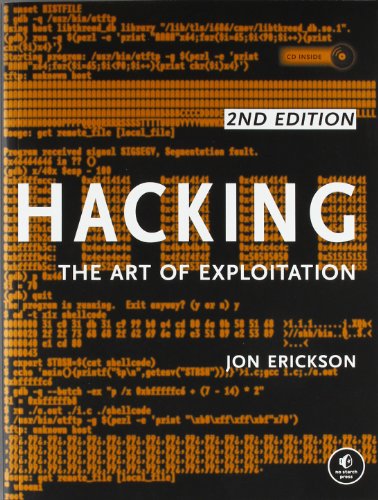
Hacking: The Art of Exploitation, 2nd Edition
Authors:
Jon Erickson
Publisher:
No Starch Press
Publication Date:
Not available
ISBN:
1593271441
Hacking is the art of creative problem solving, whether that means finding an unconventional solution to a difficult problem or exploiting holes in... sloppy programming. Many people call themselves hackers, but few have the strong technical foundation needed to really push the envelope. Rather than merely showing how to run existing exploits, author Jon Erickson explains how arcane hacking techniques actually work. To share the art and science of hacking in a way that is accessible to everyone, Hacking: The Art of Exploitation, 2nd Edition introduces the fundamentals of C programming from a hacker's perspective. The included LiveCD provides a complete Linux programming and debugging environment-all without modifying your current operating system. Use it to follow along with the book's examples as you fill gaps in your knowledge and explore hacking techniques on your own. Get your hands dirty debugging code, overflowing buffers, hijacking network communications, bypassing protections, exploiting cryptographic weaknesses, and perhaps even inventing new exploits. This book will teach you how to:Program computers using C, assembly language, and shell scripts Corrupt system memory to run arbitrary code using buffer overflows and format strings Inspect processor registers and system memory with a debugger to gain a real understanding of what is happening Outsmart common security measures like nonexecutable stacks and intrusion detection systems Gain access to a remote server using port-binding or connect-back shellcode, and alter a server's logging behavior to hide your presenceRedirect network traffic, conceal open ports, and hijack TCP connections Crack encrypted wireless traffic using the FMS attack, and speed up brute-force attacks using a password probability matrix Hackers are always pushing the boundaries, investigating the unknown, and evolving their art. Even if you don't already know how to program, Hacking: The Art of Exploitation, 2nd Edition will give you a complete picture of programming, machine architecture, network communications, and existing hacking techniques. Combine this knowledge with the included Linux environment, and all you need is your own creativity.
Hacking the Future
Authors:
Cole Stryker
Publisher:
Overlook Hardcover
Publication Date:
Not available
ISBN:
1590209745
How does anonymity enable free speech - and how is it a threat? "I think anonymity on the Internet has to go away," famously said by Randi Zuckerberg... (sister of Mark), has become the policy for some, while the Stop Online Piracy Act mobilized millions to write Congress in protest. Identity Wars is a broad look at how anonymity influences politics, activism, religion, and art. Stryker presents a strong defense of anonymity and explores some of the tools and organizations relating to this issue, especially as it has evolved with the ubiquity of the Internet. Cogent and compelling, his examination of online identities, both false and real, is an essential read for the social-networking age.
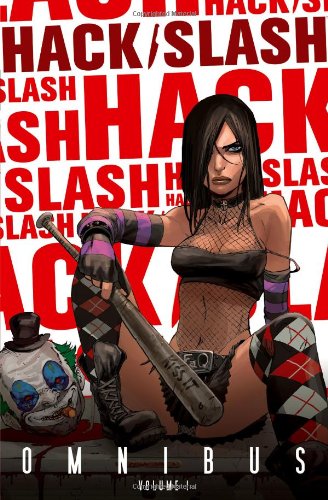
Hack/Slash Omnibus, Vol. 1
Authors:
Tim Seeley
Publisher:
Image Comics
Publication Date:
Not available
ISBN:
1607062739
At the end of every horror movie, one girl always survives... in this case, Cassie Hack not only survives, she turns the tables by hunting and... destroying the horrible slashers that would do harm to the innocent! Alongside the gentle giant known as Vlad, the two cut a bloody path through those who deserve to be put down... hard!

Hadewijch: The Complete Works (Classics of Western Spirituality)
Authors:
Hadewijch
Publisher:
Paulist Pr
Publication Date:
Not available
ISBN:
0809122979
Belonging to the early thirteenth century, Hadewijch brings us a spiritual message of extraordinary power. She was endowed in no less degree than St.... Teresa of Avila with the gifts of visionary mysticism and literary genius. She felt herself strongly a woman, as can be seen from her choosing to join the women's movement of her day, that of the Beguines, who dedicated themselves to a life of true spirituality without taking the veil. Hadewijch understood that she was called to communicate to others the profound knowledge of the things of God granted to her in her mystical life. She directed her apostolate to some younger Beguines, and nearly all her writings, both prose and poetry, were intended for them. She mentions other spiritual friends, some in distant countries. Her experiences and her message, however , however, remained hidden; she attained to no celebrity among her contemporaries. The way of immediate fame was for other women mystics. St. Hildegard (1098-1179), the visionary and writer, enjoyed high reputation Clairvaux, and crowned heads. Hadewijch's contemporary, St. Lutgard (1183-1246), was widely known for her visions of the Sacred Heart, which won her the friendship of persons like the Master General of the Dominican Order and Duchess Marie of Brabant (daughter of King Louis VIII of France), and after her death made her tomb a place of pilgrimage. Where Hadewijch was buried, however, no one knows and her writings, after passing through the hands of John of Ruusbroec and his circle, were lost to sight until the nineteenth century. Since the rediscovery of Hadewijch, her importance has been progressively appreciated, and the hidden dimension of her life is now open so that we may share it according to the particular needs of our own day.

Hadith: An Introduction
Authors:
Jonathan A.C. Brown
Publisher:
Oneworld Publications
Publication Date:
Not available
ISBN:
1851686630
Central to Islamic practice and law, the term hadith is applied to first-hand reports of the Prophet Muhammad's words and deeds, passed from generation... to generation. Informative and accessible, this wide-ranging introduction provides a detailed exploration of their collection, historical authenticity, and role in modern Islam. Complete with a glossary, extensive bibliography, and helpful diagrams, Hadith: An Introduction is perfectly suited to students, scholars, and the general reader.

Hadji Murad
Authors:
Leo Tolstoy
Publisher:
Dover Publications
Publication Date:
Not available
ISBN:
048647366X
A simmering feud between Russians and residents of Chechnya boils over into a bitter, bloody war. Sound familiar? In this case, the tumultuous events... took place more than a century ago. Tolstoy's little known but critically acclaimed novella draws upon the legends surrounding the Avar warrior chieftain known as Hadji Murád.

Hadji Murad
Authors:
Leo Tolstoy
Publisher:
Barnes & Noble
Publication Date:
Not available
ISBN:
076077353X
Fear has long served elites. They rely on fear to keep and expand their privileges and control the masses. In the current crisis of the capitalist world... system, elites in the United States, along with other central countries, promote fear of crime and terrorism. They shaped these fears so that people looked to authorities for security, which permitted extension of apparatuses of coercion like police and military forces. In the face of growing oppression, rebellion against elite hegemony remains possible. This book offers an analysis of the crisis and strategies for rebellion.
 '





