production
/viewbook/list/all/?page=5376
/
/static/
None
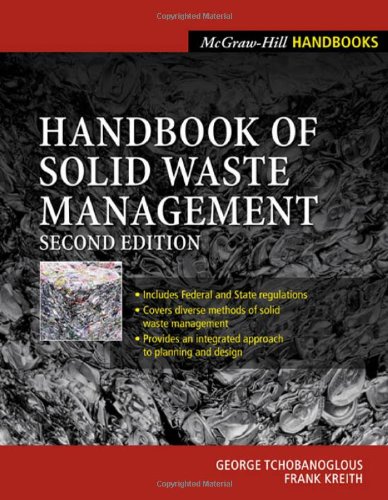
Handbook of Solid Waste Management
Authors:
Frank Kreith
Publisher:
McGraw-Hill Professional
Publication Date:
Not available
ISBN:
0071356231
In a world where waste incinerators are not an option and landfills are at over capacity, cities are hard pressed to find a solution to the problem of... what to do with their solid waste. Handbook of Solid Waste Management, 2/e offers a solution. This handbook offers an integrated approach to the planning, design, and management of economical and environmentally responsible solid waste disposal system. Let twenty industry and government experts provide you with the tools to design a solid waste management system capable of disposing of waste in a cost-efficient and environmentally responsible manner. Focusing on the six primary functions of an integrated system--source reduction, toxicity reduction, recycling and reuse, composting, waste- to-energy combustion, and landfilling--they explore each technology and examine its problems, costs, and legal and social ramifications.

Handbook of Solution-Focused Brief Therapy: Clinical Applications
Authors:
Not Available
Publisher:
Routledge
Publication Date:
Not available
ISBN:
0789023954
An invaluable guide to the history, descriptions of practice strategies, and applications of SFBT! The Handbook of Solution-Focused Brief Therapy is a... unique, comprehensive guide that assists clinicians, regardless of experience level, in learning and applying the concepts of Solution-Focused Brief Therapy (SFBT) to particular situations with clients. Noted experts discuss the therapy practices and various uses for the approach in detail, which focuses on encouraging clients to look at exceptions, times when the problem could have occurred and did not, and goals and future possibilities. A history of the practice model and its interventions is discussed, along with limitations, descriptions of practice strategies, applications to specific client populations, and clinical problems and concerns. This useful resource also includes an illustrative case study that uses the SFBT model. The Handbook of Solution-Focused Brief Therapy first lays a foundation of knowledge, providing chapters on the crucial assumptions and practices, history, and epistemology behind the approach. Further chapters use that basis to explain the application of the approach with several clinical issues and various populations, including couples, depression, domestic violence, schools, children, pastoral work, therapist burnout, and a few “outside therapy room” applications. Other chapters focus on the important issues in therapist training and supervision. Extensive references are provided at the end of each chapter. Topics discussed in the Handbook of Solution-Focused Brief Therapy include: assumptions within the SFBT tradition history of the SFBT approach epistemology SFBT with couples depression domestic violence offenders public schools children and young people SFBT in faith-based communities assessing and relieving burnout in mental health practice SFBT beyond the therapy room supervision of training possible limitations, misunderstandings, and misuses of SFBT a tribute to the late Steven de Shazer, co-founder of the SFBT approach The Handbook of Solution-Focused Brief Therapy is an invaluable reference for all types of therapists, including psychologists, counselors, social workers, and family therapists at any level of experience, including students, trainees, and experienced therapists.
Handbook of Special Education
Authors:
Not Available
Publisher:
Routledge
Publication Date:
Not available
ISBN:
0415800722
Special education is now an established part of public education in the United States—by law and by custom. However, it is still widely misunderstood... and continues to be dogged by controversies related to such things as categorization, grouping, assessment, placement, funding, instruction, and a variety of legal issues. The purpose of this 13-part, 57-chapter handbook is to help profile and bring greater clarity to this sprawling and growing field. To ensure consistency across the volume, chapter authors review and integrate existing research, identify strengths and weaknesses, note gaps in the literature, and discuss implications for practice and future research. Key features include: Comprehensive Coverage—Fifty-seven chapters cover all aspects of special education in the United States including cultural and international comparisons. Issues & Trends—In addition to synthesizing empirical findings and providing a critical analysis of the status and direction of current research, chapter authors discuss issues related to practice and reflect on trends in thinking. Categorical Chapters—In order to provide a comprehensive and comparative treatment of the twelve categorical chapters in section IV, chapter authors were asked to follow a consistent outline: Definition, Causal Factors, Identification, Behavioral Characteristics, Assessment, Educational Programming, and Trends and Issues. Expertise—Edited by two of the most accomplished scholars in special education, chapter authors include a carefully chosen mixture of established and rising young stars in the field. This book is an appropriate reference volume for anyone (researchers, scholars, graduate students, practitioners, policy makers, and parents) interested in the state of special education today: its research base, current issues and practices, and future trends. It is also appropriate as a textbook for graduate level courses in special education.

Handbook of Spirituality for Ministers, Volume 1
Authors:
Not Available
Publisher:
Paulist Pr
Publication Date:
Not available
ISBN:
0809135213

Handbook of Sport Marketing Research
Authors:
Nancy L. Lough
Publisher:
Fitness Information Technology (FiT)
Publication Date:
Not available
ISBN:
1935412396
Drawing from the seminal works published during the past two decades in Sport Marketing Quarterly, this collection edited by Nancy L. Lough and William... A. Sutton brings to light foundational theories that have guided some of the most pragmatic studies to date. The Handbook of Sport Marketing Research revisits trends, presents instruments designed to assess key constructs, and provides critical analysis of industry practices with regard to issues such as gender, race, and ethical practices. Each section of this handbook is designed to provide foundational work reflecting development of key conceptual areas: *Section I. Foundations of Sport Marketing *Section II. Building Brands *Section III. Understanding Sport Consumers *Section IV. Market Segmentation *Section V. Fan Identity and Spectator Motives *Section VI. Sponsorship *Section VII. Celebrity Athlete Endorsements *Section VIII. Ethical Issues The 28 chapters included serve as a reflection of the state of the industry through applied scholarly work during the past 20 years. Handbook of Sport Marketing Research is suitable for course adoptions or as a professional reference, and should be equally as intriguing to practitioners. The intent is to broaden the scope of interest and encourage a widening lens through which sport marketing is viewed.

Handbook of Sports and Media (Lea's Communication Series)
Authors:
Not Available
Publisher:
Lawrence Erlbaum Associates
Publication Date:
Not available
ISBN:
0805851895
This distinctive Handbook covers the breadth of sports and media scholarship, one of the up-and-coming topics bridging media entertainment, sports... management, and popular culture. Organized into historical, institutional, spectator, and critical studies perspectives, this volume brings together the work of many researchers into one quintessential volume, defining the full scope of the subject area. Editors Arthur Raney and Jennings Bryant have recruited contributors from around the world to identify and synthesize the research representing numerous facets of the sports-media relationship. As a unique collection on a very timely topic, the volume offers chapters examining the development of sports media; production, coverage, and economics of sports media; sports media audiences; sports promotion; and race and gender issues in sports and media. Unique in its orientation and breadth, the Handbook of Sports and Media is destined to play a major role in the future development of this fast-growing area of study. It is a must-have work for scholars, researchers, and graduate students working in media entertainment, media psychology, mass media/mass communication, sports marketing and management, popular communication, popular culture, and cultural studies.
Handbook of Statistical Methods: Single Subject Design
Authors:
Vinoth Jagaroo and David L. Maxwell Eike Satake
Publisher:
Plural Publishing Inc
Publication Date:
Not available
ISBN:
1597560987
In the behavioral and clinical sciences, single-subject designs have increasingly become important tools for determining a treatment efficacy. Despite a... large number of recommendations in recent years for more use of the designs, the majority of typical research methods textbooks still do not provide sufficient direction and information about single-subject designs. One of the main reasons is that data analysis of single-subject designs is still foreign to the vast majority of the investigators, practitioners, and students. The authors have developed a practical guide of the most commonly used approaches in analyzing and interpreting single-subject data. In doing so, they have arranged the methodologies used in a logical sequence using an array of research studies from the existing published literatures to illustrate specific applications. The handbook is also laid out for the readers in a highly lucid and straightforward manner, beginning with a brief discussion of each approach such as visual, inferential, and probabilistic model, the applications for which it is intended, and a step-by-step illustration of the test as used in an actual research study. Presented is a brief evaluation of the strengths and limitations of the test along with its suitability, or lack thereof, for particular scales of measurement. Also included are statistical applications of such computer programs as Minitab and SPSS for the analysis of statistical data. This new handbook provides the readers with a concise yet comprehensive approach to help them further understand the concepts as effectively and simply as possible.

Handbook of Stress, Trauma, and the Family (Routledge Psychosocial...
Authors:
Not Available
Publisher:
Routledge
Publication Date:
Not available
ISBN:
0415947545
The Handbook of Stress, Trauma, and the Family is broken down into three sections, compiling research, theory and practice. The first section focuses on... how traumatic stress affects intimate others, what familial characteristics affect individual susceptibility to trauma, as well as evaluation of the effectiveness of various interventions. The section on theory explores concepts of stress and intrapsychic processes underlying the intergenerational transmission of trauma, addressesing how families can buffer or enhance anxiety. The final section, entitled practice, covers assessment (presenting both the Circumplex Model and Bowenian family theory models), treatment models and treatment formats for specific populations. The major family treatment models applicable to stress and trauma are discussed, including contextual, object relations, emotionally focused and critical interaction therapy.
Handbook of Structural Equation Modeling
Authors:
Not Available
Publisher:
The Guilford Press
Publication Date:
Not available
ISBN:
1606230778
The first comprehensive structural equation modeling (SEM) handbook, this accessible volume presents both the mechanics of SEM and specific SEM... strategies and applications. The editor, contributors, and editorial advisory board are leading methodologists who have organized the book to move from simpler material to more statistically complex modeling approaches. Sections cover the foundations of SEM; statistical underpinnings, from assumptions to model modifications; steps in implementation, from data preparation through writing the SEM report; and basic and advanced applications, including new and emerging topics in SEM. Each chapter provides conceptually oriented descriptions, fully explicated analyses, and engaging examples that reveal modeling possibilities for use with readers' data. Many of the chapters also include access to data and syntax files at the companion website, allowing readers to try their hands at reproducing the authors' results.
Handbook of Survey Research, Second Edition
Authors:
Peter V. Marsden
Publisher:
Emerald Publishing Group Limited
Publication Date:
Not available
ISBN:
1848552246
'The Handbook of Survey Research, Second Edition' builds on its widely-recognized 1983 predecessor by updating its previous historical account of the... development of survey research and the evolution of social science before going on to examine new and expanded usages of survey research during the past half century. Editors Peter Marsden (Harvard University) and James D. Wright (University of Central Florida), long-time editor of Elsevier's Social Science Research, have created an authoritative reference book and an excellent starting point for anyone requiring a broad examination of the field. Detailed chapters include: sampling; measurement; questionnaire construction and question writing; survey implementation and management; survey data analysis; special types of surveys; and integrating surveys with other data collection methods. This handbook is distinguished from other texts by its greater comprehensiveness and depth of coverage including topics such as measurement models, the role of cognitive psychology, surveying networks, and cross-national/cross-cultural surveys. Timely and relevant it includes materials that are only now becoming highly influential topics.
Handbook of Teaching and Learning for Physical Therapists, 3e
Authors:
Gail M. Jensen PhD PT FAPTA
Publisher:
Saunders
Publication Date:
Not available
ISBN:
1455706167
Whether you are practicing in an in-patient or an out-patient facility, academic institution, or clinical residency program, this well-respected... handbook gives you the background and guidance you need to effectively educate individuals across the continuum of physical therapy practice. Practical, real-life examples show you how to: incorporate health literacy and needs of the learner; assess and adapt to the various learning styles of patients; use simulations in education; facilitate the development of clinical reasoning skills; and assess learning outcomes and the effectiveness of your teaching. Plus, four all-new chapters and major revisions of all content throughout the book keep you on top of the latest research and best practices.Coverage of the theory and application of educational principles across the continuum of PT practice provides the information you need to improve your skills in the educational process both in academic and clinical settings. Two section format divides content into two parts: designing academic and clinical education programs and teaching students in academic and clinical settings; and teaching patients and families in clinical and community settings. Variety of teaching and teaching assessment methods expands your teaching, learning, and assessment repertoires. Case stories at the beginning of each chapter allow you to see the relevance of the information in the chapter. Threshold concepts highlight key ideas that are important to know. Annotated bibliography at end of each chapter provides resources for further study. NEW! Chapter on Authentic Assessment: Simulation-Based Education reflects the new ways to facilitate student learning through the use of human simulation models. NEW! Chapter on Strategies for Planning and Implementing Interprofessional Education covers the fundamental concepts of team-based care and interprofessional learning. NEW! Chapter on What Makes a Good Clinical Teacher? translates current research on clinical teaching into clinical education and practice. NEW! Chapter on Facilitating the Teaching and Learning of Clinical Reasoning helps you apply current research on clinical reasoning in rehabilitation to clinical education and teaching. NEW! Two combined chapters on Patient Education and Health Literacy (previously chapters 8 and 12) and Applied Behavioral Theory and Adherence: Models for Practice (previously chapters 9 and 10) provide focused presentations on current thinking and practical strategies for addressing health literacy issues in the clinical environment. NEW! Expanded chapter on Post-Professional Clinical Residency and Fellowship Education offers more information on models and trends in residency education and mentoring.

Handbook of Teaching for Physical Therapists
Authors:
Katherine F. Shepard PhD PT FAPTA
Publisher:
Butterworth-Heinemann
Publication Date:
Not available
ISBN:
0750673095
* Written by leading educators in the field * Covers lecturing, laboratory instruction, working with patients and families, delivering in-service to... colleagues, and more * Clearly presented material on theory and application * Real-life, practical examples
Handbook of Technical Writing
Authors:
Gerald J. Alred
Publisher:
Bedford/St. Martin's
Publication Date:
Not available
ISBN:
0312477074
More than just a guide, the Handbook of Technical Writing places writing in a real-world context with quick access to hundreds of technical writing... topics and scores of sample documents and visuals. Its dedicated author team — with decades of combined academic and professional experience — has created a comprehensive reference tool for students and professionals alike. Always anticipating the needs of today’s writers, the ninth edition includes expanded coverage of audience and context, and reflects the impact that e-mail and technology have had on workplace communication. An integrated companion Web site works together with the text to offer expanded online resources with the same clarity and depth of instruction.

Handbook of Technical Writing
Authors:
Gerald J. Alred
Publisher:
Bedford/St. Martin's
Publication Date:
Not available
ISBN:
0312679459
More than just a guide, the Handbook of Technical Writing places writing in a real-world context with quick and easy access to hundreds of technical... writing topics and scores of sample documents. Its dedicated author team – with decades of combined academic and professional experience – has crafted the essential reference tool for students and professionals alike, with extensive coverage of grammar, usage, and style. Responding to today’s economic trends, the tenth edition features expanded coverage of the job search, including advice about the appropriate use of social media in the search, as well as new professionalism tips and guidance on how to adapt to ever-evolving technologies. An integrated companion Web site works with the text to offer additional resources and models reflecting the authors’ trademark clarity.
Handbook of Technical Writing, Ninth Edition
Authors:
Gerald J. Alred
Publisher:
St. Martin's Press
Publication Date:
Not available
ISBN:
0312575122
Now in its eighth edition, this classic book remains the complete technical-writing reference for students and professionals alike. Alphabetically... organized and easy to use, its nearly 400 entries provide guidance for the most common types of professional documents and correspondence, including reports, proposals, manuals, memos, and white papers. Abundant sample documents and visuals throughout the book demonstrate effective technical communication, reflecting current practices for formatting documents and using e-mail. In addition, advice on organizing, researching, writing, and revising complements thorough treatment of grammar, usage, style, and punctuation to provide comprehensive help with writing skills. This edition has been thoroughly revised to include expanded advice for analyzing the context of different writing situations, using and integrating visuals, and dealing with ethical concerns in technical writing. Improved coverage of research now includes guidelines for IEEE-style documentation as well as clearer explanations of copyright and plagiarism concerns. Entries throughout the book have been revised, updated, consolidated, and streamlined to provide the most accurate and accessible information. Comprehensive yet concise, the Handbook of Technical Writing remains the quick reference faithful users have come to appreciate.
 '





