production
/viewbook/list/all/?page=5389
/
/static/
None

Happier
Authors:
Not Available
Publisher:
Not available
Publication Date:
Not available
ISBN:
Not available
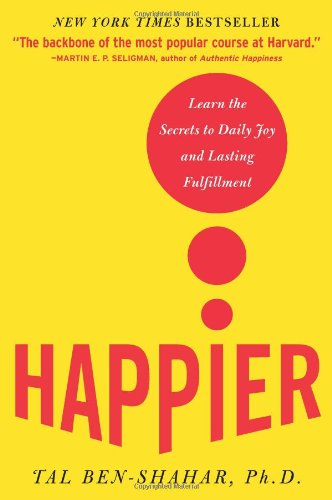
Happier: Learn the Secrets to Daily Joy and Lasting Fulfillment
Authors:
Tal Ben-Shahar
Publisher:
McGraw-Hill
Publication Date:
Not available
ISBN:
0071492399
Can You Learn to Be Happy? YES . . . according to the teacher of Harvard University’s most popular and life-changing course. One out of every five... Harvard students has lined up to hear Tal Ben-Shahar’s insightful and inspiring lectures on that ever-elusive state: HAPPINESS. HOW? Grounded in the revolutionary “positive psychology” movement, Ben-Shahar ingeniously combines scientific studies, scholarly research, self-help advice, and spiritual enlightenment. He weaves them together into a set of principles that you can apply to your daily life. Once you open your heart and mind to Happier ’s thoughts, you will feel more fulfilled, more connected . . . and, yes, HAPPIER. “Dr. Ben-Shahar, one of the most popular teachers in Harvard’s recent history, has written a personal, informed, and highly enjoyable primer on how to become happier. It would be wise to take his advice.” --Ellen J. Langer, author of Mindfulness and On Becoming an Artist “This fine book shimmers with a rare brand of good sense that is imbedded in scientific knowledge about how to increase happiness. It is easy to see how this is the backbone of the most popular course at Harvard today." --Martin E. P. Seligman, author of Authentic Happiness

Happily
Authors:
Lyn Hejinian
Publisher:
Post Apollo Press
Publication Date:
Not available
ISBN:
0942996380
Poetry. Hejinian's characteristic linguistic intensity and philosophical approach are present in this book-length poem. "Reading Lyn Hejinian's HAPPILY... can make one imagine a second, somewhat happier Stein telling stories in single long or short lines that are aware of one another as they go about their own affairs"--Bob Perelman.
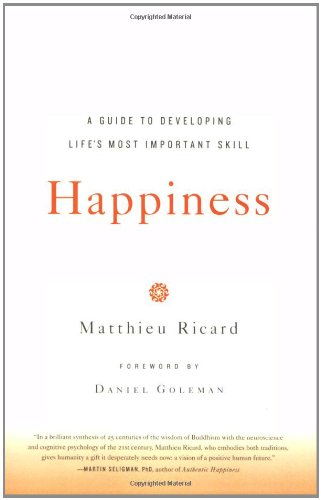
Happiness: A Guide to Developing Life's Most Important Skill
Authors:
Matthieu Ricard
Publisher:
Little, Brown and Company
Publication Date:
Not available
ISBN:
0316167258
A molecular biologist turned Buddhist monk, described by scientists as "the happiest man alive," demonstrates how to develop the inner conditions for... true happiness.
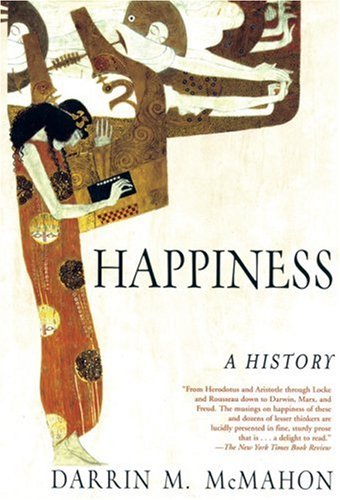
Happiness: A History
Authors:
Darrin M. McMahon
Publisher:
Grove Press
Publication Date:
Not available
ISBN:
0802142893
Today, human beings tend to think of happiness as a natural right. But they haven’t always felt this way. For the ancient Greeks, happiness meant... virtue. For the Romans, it implied prosperity and divine favor. For Christians, happiness was synonymous with God. Throughout history, happiness has been equated regularly with the highest human calling, the most perfect human state. Yet it’s only within the past two hundred years that human beings have begun to think of happiness as not just an earthly possibility but also as an earthly entitlement, even an obligation. In this sweeping new book, historian Darrin M. McMahon argues that our modern belief in happiness is the product of a dramatic revolution in human expectations carried out since the eighteenth century.In the tradition of works by Peter Gay and Simon Schama, Happiness draws on a multitude of sources, including art and architecture, poetry and scripture, music and theology, and literature and myth, to offer a sweeping intellectual history of man’s most elusive yet coveted goal.

Happiness and Contemplation
Authors:
Josef Pieper
Publisher:
St. Augustines Press
Publication Date:
Not available
ISBN:
1890318310
"The ultimate of human happiness is to be found in contemplation." In offering this proposition of Thomas Aquinas to our thought, Josef Pieper uses... traditional wisdom in order to throw light on present-day reality and present-day psychological problems. What, in fact, does one pursue in pursuing happiness? What, in the consensus of the wisdom of the early Greeks, of Plato and Aristotle, of the New Testament, of Augustine and Aquinas, is that condition of perfect bliss toward which all life and effort tend by nature? In this profound and illuminating inquiry, Pieper considers the nature of contemplation, and the meaning and goal of life.

Happiness and the Christian Moral Life: An Introduction to...
Authors:
Paul J. Wadell
Publisher:
Rowman & Littlefield Publishers
Publication Date:
Not available
ISBN:
1442209739
Happiness and the Christian Moral Life introduces students to Christian Ethics looking at ethics as a path to the "good life" and happiness, rather than... a strict set of rules or regulations. Revised and updated throughout, the second edition maintains the book's distinctive focus on happiness. Each chapter now features a list of suggested readings to point students and instructors towards further resources. Other changes to the second edition include a more fully developed account of Augustine's understanding of happiness, new discussions of how technology shapes relationships and happiness, and consideration of the relationship between the natural law and the virtues.

Happiness and the Good Life
Authors:
Mike W. Martin
Publisher:
Oxford University Press, USA
Publication Date:
Not available
ISBN:
0199845212
What is happiness? How is it related to morality and virtue? Does living with illusion promote or diminish happiness? Is it better to pursue happiness... with a partner than alone? Philosopher Mike W. Martin addresses these and other questions as he connects the meaning of happiness with the philosophical notion of "the good life." Defining happiness as loving one's life and valuing it in ways manifested by ample enjoyment and a deep sense of meaning, Martin explores the ways in which happiness interacts with all other dimensions of good lives--in particular with moral decency and goodness, authenticity, mental health, self-fulfillment, and meaningfulness. He interweaves a variety of examples from memoirs, novels, and films along the way, connecting his discussion of the philosophical issues to related topics that interest all of us: virtue, love, philanthropy, suffering, simplicity, balancing work and leisure, and much more. Drawing on wide-ranging and robust evidence, Martin also makes the case that we need a "politics of happiness" whereby government would apply the results of recent "happiness studies" in psychology to public policy.

Happiness and Virtue Beyond East and West: Toward a New Global...
Authors:
Bernice Lerner
Publisher:
Tuttle Publishing
Publication Date:
Not available
ISBN:
4805312297
Happiness and Virtue Beyond East and West presents an important series of essays from Japanese and American authors examining essential virtues shared... by both Eastern and Western cultures with the ultimate goal of allowing happiness to be realized in a globally and socially responsible manner.Each chapter examines one of nine virtues—Courage, Justice, Benevolence, Gratitude, Wisdom, Reflection, Respect, Responsibility and Temperance—and the importance of each in our lives.With clarity of purpose, the essays demonstrate that the virtues and happiness that living a good life can bring know no national boundaries. It is the sincere hope of the editors and authors that this book will help its readers re-examine the timeless question of what constitutes true happiness and a good life and will therefore play some part in increasing international cooperation and good will.
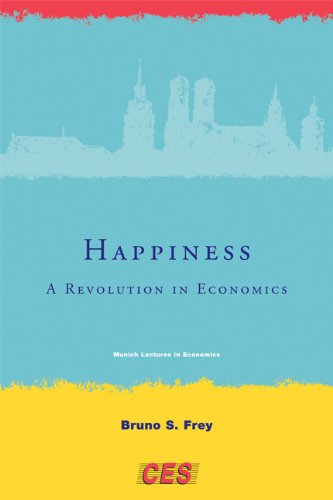
Happiness: A Revolution in Economics (Munich Lectures in Economics)
Authors:
Bruno S. Frey
Publisher:
The MIT Press
Publication Date:
Not available
ISBN:
0262514958
Revolutionary developments in economics are rare. The conservative bias of the field and its enshrined knowledge make it difficult to introduce new... ideas not in line with received theory. Happiness research, however, has the potential to change economics substantially in the future. Its findings, which are gradually being taken into account in standard economics, can be considered revolutionary in three respects: the measurement of experienced utility using psychologists' tools for measuring subjective well-being; new insights into how human beings value goods and services and social conditions that include consideration of such non-material values as autonomy and social relations; and policy consequences of these new insights that suggest different ways for government to affect individual well-being. In Happiness, emphasizing empirical evidence rather than theoretical conjectures, Bruno Frey substantiates these three revolutionary claims for happiness research. After tracing the major developments of happiness research in economics and demonstrating that we have gained important new insights into how income, unemployment, inflation, and income demonstration affect well-being, Frey examines such wide-ranging topics as democracy and federalism, self-employment and volunteer work, marriage, terrorism, and watching television from the new perspective of happiness research. Turning to policy implications, Frey describes how government can provide the conditions for people to achieve well-being, arguing that a crucial role is played by adequate political institutions and decentralized decision making. Happiness demonstrates the achievements of the economic happiness revolution and points the way to future research.Bruno S. Frey is Professor of Economics at the University of Zurich, Visiting Professor at the Swiss Federal Institute of Technology, and Research Director of CREMA (Center for Research in Economics, Management, and the Arts). He is co-editor of Economics and Psychology: A Promising New Cross-Disciplinary Field (MIT Press, 2007).

Happiness: Classic and Contemporary Readings in Philosophy
Authors:
Not Available
Publisher:
Oxford University Press, USA
Publication Date:
Not available
ISBN:
0195321405
Happiness has long been a focus of attention for philosophers as well as psychologists. This volume, the only collection devoted to the subject from the... standpoint of philosophy, offers twenty-seven classic and contemporary readings exploring the nature of happiness. Part I, a survey of the ways happiness has been treated throughout the history of ethics, includes writings by Plato, Aristotle, Epicurus, Seneca, Augustine, Thomas Aquinas, Thomas Hobbes, Joseph Butler, David Hume, Jeremy Bentham, Immanuel Kant, Arthur Schopenhauer, John Stuart Mill, Henry Sidgwick, Friedrich Nietzsche, and Jean-Paul Sartre. Part II explores the work of contemporary ethical theorists, including Julia Annas, John Kekes, Richard Kraut, Robert Nozick, and Richard Taylor. The book also includes an introduction by psychologist Daniel Nettle, headnotes for each selection, and essays by the editors. Ideal for ethics courses, Happiness: Classic and Contemporary Readings can also be used in courses in introductory philosophy and positive psychology.

Happiness House (A Story about God & Healing for Children of...
Authors:
Ph.D., MA. Jackie Magner Greedy
Publisher:
Sensual Media
Publication Date:
Not available
ISBN:
193260281X
This new book by the Center's executive director Melanie Lockwood Herman explores the topic of risk management in the nonprofit world and reflects the... author's view that "effective risk management is readily within the grasp of every nonprofit executive" and "sound risk management policies, activities and approaches can be adapted and adopted without delay and without undue burden." Subjects covered in this practical, how-to guide include risk identification, risk communication, the intersection of organizational culture change and risk awareness, risk financing, and much, much more. Learn how to gauge your nonprofit's appetite for risk as well as how to craft sound, durable approaches to the perennial challenges that arise when a nonprofit encounters or takes risk. This book offers the insight and tools nonprofit leaders need to increase their confidence about risk-taking and risk management. It is an essential addition to the enlightened CEO or board leader's library.
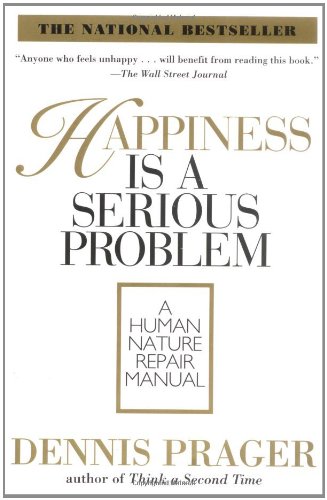
Happiness Is a Serious Problem: A Human Nature Repair Manual
Authors:
Dennis Prager
Publisher:
William Morrow Paperbacks
Publication Date:
Not available
ISBN:
0060987359
We are completely satisfied with nothing There is little correlation between the circumstances of people's lives and how happy they are. This is the... repair manual we should have been handed at birth When you ask people abouttheir most cherished values in life, "happiness" is always at the top of the list. However, unhappiness does not seem to be the exceptional order to be happy, we first have to battle ourselves. Happiness is an obligation--to yourself and to others Not only do we have a right to be happy, we have an obligation to be happy. Our happiness has an effect on the lives of everyone around us--it provides them with a positive environment in which to thrive and to be happy themselves.
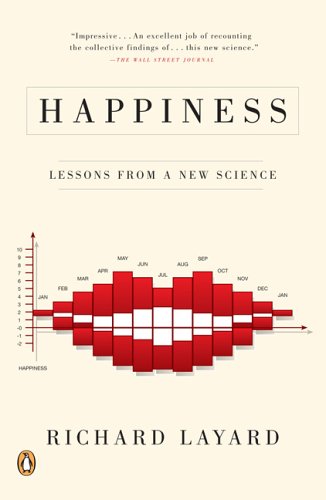
Happiness: Lessons from a New Science
Authors:
Richard Layard
Publisher:
Penguin Books
Publication Date:
Not available
ISBN:
0143037013
There is a paradox at the heart of our lives. We all want more money, but as societies become richer, they do not become happier. This is not... speculation: It's the story told by countless pieces of scientific research. We now have sophisticated ways of measuring how happy people are, and all the evidence shows that on average people have grown no happier in the last fifty years, even as average incomes have more than doubled. The central question the great economist Richard Layard asks in Happiness is this: If we really wanted to be happier, what would we do differently? First we'd have to see clearly what conditions generate happiness and then bend all our efforts toward producing them. That is what this book is about-the causes of happiness and the means we have to effect it. Until recently there was too little evidence to give a good answer to this essential question, but, Layard shows us, thanks to the integrated insights of psychology, sociology, applied economics, and other fields, we can now reach some firm conclusions, conclusions that will surprise you. Happiness is an illuminating road map, grounded in hard research, to a better, happier life for us all.

Happiness: The Science behind Your Smile
Authors:
Daniel Nettle
Publisher:
Oxford University Press, USA
Publication Date:
Not available
ISBN:
0192805592
Bringing together the latest insights from psychiatry, psychology, and philosophy, Daniel Nettle sheds light on happiness, the most basic of human... desires. Nettle examines whether people are basically happy or unhappy, whether success can make us happy, what sort of remedies to unhappiness work, why some people are happier than others, and much more. The book is packed with fascinating observations. We discover the evolutionary reason why negative thoughts are more powerful than positive ones. We read that happiness varies from country to country, for example, the Swiss are much more happy than Bulgarians. And we learn that, in a poll among people aged 42 years old--peak mid-life crisis time--more than half rated their happiness an 8, 9, or 10 out of 10, and 90% rated it above 5. Nettle, a psychologist, is particularly insightful in discussing the brain systems underlying emotions and moods, ranging from serotonin, to mood enhancing drugs such as D-fenfluramine, which reduces negative thinking in less than an hour; to the part of the brain that, when electrically stimulated, provides feelings of benevolent calm and even euphoria. In the end, Nettle suggests that we would all probably be happier by trading income or material goods for time with people or hobbies, though most people do not do so. Happiness offers a remarkable portrait of the feeling that poets, politicians, and philosophers all agree truly makes the world go round.
 '





