production
/viewbook/list/all/?page=5540
/
/static/
None

HISTORY 3006 COURSE PACKET
Authors:
Not Available
Publisher:
Not available
Publication Date:
Not available
ISBN:
Not available
HISTORY 3249 COURSE PACKET
Authors:
Not Available
Publisher:
Not available
Publication Date:
Not available
ISBN:
Not available
HISTORY 420 PACKAGE
Authors:
Not Available
Publisher:
Not available
Publication Date:
Not available
ISBN:
Not available
History 496 Course Pack
Authors:
Not Available
Publisher:
Not available
Publication Date:
Not available
ISBN:
5001100003
History (A Brief Insight)
Authors:
John H. Arnold
Publisher:
Sterling
Publication Date:
Not available
ISBN:
1402768923
Do historians reconstruct the truthor simply tell stories? Professor John Arnold suggests they do both, and that it’s the balance between the two... that matters. In a work of metahistory (the study of history itself), he takes us from the fabulous tales of Greek Herodotus to the varied approaches of modern-day professionals. Through fascinating and particular examplesincluding a medieval murderer, 17th-century colonist, and ex-slaveDr. Arnold illuminates our relationship to the past by making us aware of how the very nature of history” has changed.
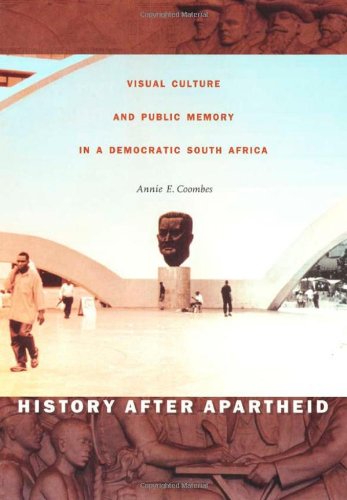
History after Apartheid: Visual Culture and Public Memory in a...
Authors:
Annie E. Coombes
Publisher:
Duke University Press Books
Publication Date:
Not available
ISBN:
0822330725
The democratic election of Nelson Mandela as president of South Africa in 1994 marked the demise of apartheid and the beginning of a new struggle to... define the nation’s past. History after Apartheid analyzes how, in the midst of the momentous shift to an inclusive democracy, South Africa’s visual and material culture represented the past while at the same time contributing to the process of social transformation. Considering attempts to invent and recover historical icons and narratives, art historian Annie E. Coombes examines how strategies for embodying different models of historical knowledge and experience are negotiated in public culture—in monuments, museums, and contemporary fine art.History after Apartheid explores the dilemmas posed by a wide range of visual and material culture including key South African heritage sites. How prominent should Nelson Mandela and the African National Congress be in the museum at the infamous political prison on Robben Island? How should the postapartheid government deal with the Voortrekker Monument mythologizing the Boer Trek of 1838? Coombes highlights the contradictory investment in these sites among competing constituencies and the tensions involved in the rush to produce new histories for the “new” South Africa.She reveals how artists and museum officials struggled to adequately represent painful and difficult histories ignored or disavowed under apartheid, including slavery, homelessness, and the attempted destruction of KhoiSan hunter-gatherers. Describing how contemporary South African artists address historical memory and the ambiguities uncovered by the Truth and Reconciliation Commission, Coombes illuminates a body of work dedicated to the struggle to simultaneously remember the past and move forward into the future.

History After Lacan (Opening Out: Feminism for Today)
Authors:
Teresa Brennan
Publisher:
Routledge
Publication Date:
Not available
ISBN:
0415011175
Lacan was not an ahistorical post-structuralist. Starting from this controversial premiss, Teresa Brennan tells the story of a social psychosis. She... begins by recovering Lacan's neglected theory of history which argued that we are in the grip of a psychotic's era which began in the seventeenth century and climaxes in the present. By extending and elaborating Lacan's theory, Brennan develops a general theory of modernity. Contrary to postmodern assumptions, she argues, we need general historical explanation. An understanding of historical dynamics is essential if we are to make the connections between the outstanding facts of modernity - ethnocentrism, the relationship between the sexes and ecological catastrophe.

History Ahead: Stories beyond the Texas Roadside Markers (Texas...
Authors:
Dan K. Utley
Publisher:
Texas A&M University Press
Publication Date:
Not available
ISBN:
1603441514
More than 13,000 historical markers line the roadsides of Texas, giving drivers a way to sample the stories of the past. But these markers tell only... part of the story.In History Ahead, Dan K. Utley and Cynthia J. Beeman introduce readers to the rich, colorful, and sometimes action-packed and humorous history behind the famous (Charles Lindbergh, Will Rogers, The Big Bopper, and jazz great Charlie Christian) and the not-so-famous (Elmer "Lumpy" Kleb, Don Pedro Jaramillo, and Carl Morene, the "music man of Schulenburg") who have left their marks on the history of Texas. They visit cotton gins, abandoned airfields, forgotten cemeteries, and former World War II alien detention camps to dig up the little-known and unsuspected narratives behind the text emblazoned on these markers.Written in an anecdotal style that presents the cultural uniqueness and rich diversity of Texas history, History Ahead includes nineteen main stories, dozens of complementary sidebars, and many never-before-published historical and contemporary photographs.History Ahead offers a rich array of local stories that interweave with the broader regional and national context, touching on themes of culture, art, music, technology, the environment, oil, aviation, and folklore, among other topics. Utley and Beeman have located these forgotten gems, polished them up to a high shine, and offered them along with convenient maps and directions to the marker sites.
History and Class Consciousness: Studies in Marxist Dialectics
Authors:
Georg Lukács
Publisher:
The MIT Press
Publication Date:
Not available
ISBN:
0262620200
This is the first time one of the most important of Lukács' early theoretical writings, published in Germany in 1923, has been made available in... English. The book consists of a series of essays treating, among other topics, the definition of orthodox Marxism, the question of legality and illegality, Rosa Luxemburg as a Marxist, the changing function of Historic Marxism, class consciousness, and the substantiation and consciousness of the Proletariat.Writing in 1968, on the occasion of the appearance of his collected works, Lukács evaluated the influence of this book as follows:"For the historical effect of History and Class Consciousness and also for the actuality of the present time one problem is of decisive importance: alienation, which is here treated for the first time since Marx as the central question of a revolutionary critique of capitalism, and whose historical as well as methodological origins are deeply rooted in Hegelian dialectic. It goes without saying that the problem was omnipresent. A few years after History and Class Consciousness was published, it was moved into the focus of philosophical discussion by Heidegger in his Being and Time, a place which it maintains to this day largely as a result of the position occupied by Sartre and his followers. The philologic question raised by L. Goldmann, who considered Heidegger's work partly as a polemic reply to my (admittedly unnamed) work, need not be discussed here. It suffices today to say that the problem was in the air, particularly if we analyze its background in detail in order to clarify its effect, the mixture of Marxist and Existentialist thought processes, which prevailed especially in France immediately after the Second World War. In this connection priorities, influences, and so on are not particularly significant. What is important is that the alienation of man was recognized and appreciated as the central problem of the time in which we live, by bourgeois as well as proletarian, by politically rightist and leftist thinkers. Thus, History and Class Consciousness exerted a profound effect in the circles of the youthful intelligentsia."George Lichtheim, also in 1968, writes that "...The originality of the early Lukács lay in the assertion that the totality of history could be apprehended by adopting a particular 'class standpoint': that of the proletariat. Class consciousness ;not indeed the empirical consciousness of the actual proletariat, which was hopelessly entangled with the surface aspects of objective reality, but an ideal-typical consciousness proper to a class which radically negates the existing order of reality: that was the formula which had made it possible for the Lukács of 1923 to unify theory and practice."
History and Cultural Theory
Authors:
Simon Gunn
Publisher:
Longman
Publication Date:
Not available
ISBN:
0582784085
History and Cultural Theory provides an introduction to the relationship between contemporary cultural theory and the study of history. Reflecting the... growing influence on history of theorists such as Pierre Bourdieu, Michel Foucault and Gayatri Spivak, it provides a clear and accessible guide to their thought and explains the implications of their ideas for historical studies. It offers specific examples of how historians apply the insights of cultural theory in their own work. Provides a guide to cutting-edge ideas in historical thought.
History and Culture of Ancient Western Asia and Egypt
Authors:
Bernard Knapp
Publisher:
Wadsworth Publishing
Publication Date:
Not available
ISBN:
0534106455
* Explores the cultures of ancient Near East civilizations from prehistoric times to the death of Alexander the Great..* Encompasses Western Asia and... Egypt, through the Eastern Mediterranean, to the borders of Greece..* Note: Knapp (unlike Jones, above) does not include coverage of Ancient Greece and Rome.
HISTORY AND FILM *CUSTOM ED FOR UNIVERSITY OF WATE
Authors:
Not Available
Publisher:
Not available
Publication Date:
Not available
ISBN:
Not available

History and Film: Moving Pictures and the Study of the Past
Authors:
Maarten Pereboom
Publisher:
Pearson
Publication Date:
Not available
ISBN:
0131938460
Moving pictures have had a great influence on human culture, and this book focuses on using moving images as historical evidence. ... Studying history means examining evidence from the past to understand, interpret and present what has happened in different times and places. We talk and write about what we have learned, hoping to establish credibility both for what we have determined to be the facts and for whatever meaning or significance we may attach to our reconstruction of the past. Studying history is a scientific process, involving a fairly set methodology. We tend to favor written sources, and we have tended to favor writing as a means of presenting our views of the past. But historians also use all kinds of other documents and artifacts in their work of interpreting the past, including moving pictures.

History and Freedom: Lectures 1964-1965
Authors:
Theodor W. Adorno
Publisher:
Polity
Publication Date:
Not available
ISBN:
074563012X
Despite all of humanity's failures, futile efforts and wrong turnings in the past, Adorno did not let himself be persuaded that we are doomed to suffer... a bleak future for ever. One of the factors that prevented him from identifying a definitive plan for the future course of history was his feelings of solidarity with the victims and losers. As for the future, the course of events was to remain open-ended; instead of finality, he remained committed to a Hölderlin-like openness. This trace of the messianic has what he called the colour of the concrete as opposed to mere abstract possibility.Early in the 1960s Adorno gave four courses of lectures on the road leading to Negative Dialectics, his magnum opus of 1966. The second of these was concerned with the topics of history and freedom. In terms of content, these lectures represented an early version of the chapters in Negative Dialectics devoted to Kant and Hegel. In formal terms, these were improvised lectures that permit us to glimpse a philosophical work in progress. The text published here gives us an overview of all the themes and motifs of Adorno's philosophy of history: the key notion of the domination of nature, his criticism of the existentialist concept of a historicity without history and, finally, his opposition to the traditional idea of truth as something permanent, unchanging and ahistorical.
History And Future Of Mass Media: An Integrated Perspective...
Authors:
David Demers
Publisher:
Hampton Pr
Publication Date:
Not available
ISBN:
1572738073
 '





