production
/viewbook/list/all/?page=560
/
/static/
None
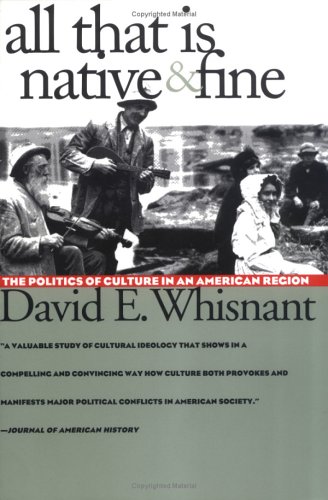
All That Is Native and Fine: The Politics of Culture in an American...
Authors:
David E. Whisnant
Publisher:
The University of North Carolina Press
Publication Date:
Not available
ISBN:
0807841439
In the American imagination, the word Appalachia designates more than a geographical region. It evokes fiddle tunes, patchwork quilts, split-rail... fences, and all the other artifacts that decorate a cherished romantic region of the American mind. David Whisnant challenges this view of Appalachia (and consequently this broader imaginitive tendency) by exploring connections between a comforting cultural myth and the troublesome complexities of cultural history. Looking at the work of some ballad hunters and collectors, handicraft revivalists, folk festival promoters, and other cultural missionaries, Whisnant discovers a process of intentional and systematic cultural intervention that had (and still has) far-reaching consequences.Why, Whisnant asks, did so many Bluegrass ladies and upper-class graduates of Seven Sisters colleges rush to erect cultural breakwaters around mountaineers? Why would a sophisticated New England woman build a Danish folk school in western North Carolina? Why did a classical musician from Richmond who hated blacks love southern mountain music? How did the notions and actions of all these cultural missionaries affect the lives of the mountaineers? And what do these episodes of intervention teach us about culture and cultural change—in Appalachia and elsewhere?Whisnant pursues these and other questions in closely documented case studies of the Hindman Settlement School in eastern Kentucky, the cultural work of Olive Dame Campbell throughout the mountains, and the White Top Folk Festival on the Virginia-North Carolina border. Moreover, he relates them to broader social and economic developments of the late nineteenth and early twentieth centuries: the coming of the railroads and the opening of the mines, the Depression, the advent of TVA, and more diffuse processes such as urbanization, the decline of agriculture, the movement of radio and the commercial recording industry into the mountains, and the implicit restrictions Victorian America placed on the political perspectives and activities of socially conscious upper-class women. "We must begin to understand the politics of culture," Whisnant writes, "especially the role of formal institutions and foreceful individuals in defining and shaping perspectives, values, tastes and agendas for cultural change."All That Is Native and Fine opens the way not only to a reexamination of the history of a single region but also to a more sophisticated understanding of the dynamics of cultural continuity and change in other regions and in the nation as a whole.
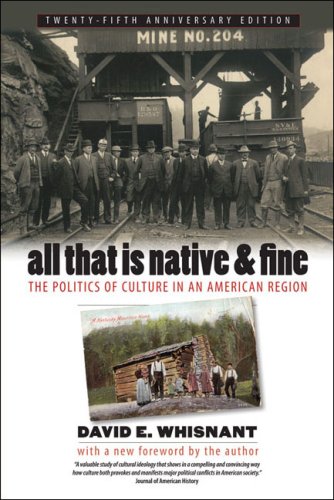
All That Is Native and Fine: The Politics of Culture in an American...
Authors:
David Whisnant
Publisher:
The University of North Carolina Press
Publication Date:
Not available
ISBN:
0807859648
In the American imagination, "Appalachia" designates more than a geographical region. It evokes fiddle tunes, patchwork quilts, split-rail fences, and... all the other artifacts that decorate a cherished romantic region in the American mind. In this classic work, David Whisnant challenges this view of Appalachia (and consequently a broader imaginative tendency) by exploring connections between the comforting simplicity of cultural myth and the troublesome complexities of cultural history. Looking at the work of ballad hunters and collectors, folk and settlement school founders, folk festival promoters, and other culture workers, Whisnant examines a process of intentional and systematic cultural intervention that had—and still has—far-reaching consequences. He opens the way into a more sophisticated understanding of the politics of culture in Appalachia and other regions. In a new foreword for this twenty-fifth anniversary edition, Whisnant reflects on how he came to write this book, how readers responded to it, and how some of its central concerns have animated his later work.
All That Is Solid Melts into Air: The Experience of Modernity
Authors:
Marshall Berman
Publisher:
Penguin Books
Publication Date:
Not available
ISBN:
0140109625
"A bubbling caldron of ideas . . . Enlightening and valuable." —Mervyn Jones, New Statesman. The political and social revolutions of the nineteenth... century, the pivotal writings of Goethe, Marx, Dostoevsky, and others, and the creation of new environments to replace the old—all have thrust us into a modern world of contradictions and ambiguities. In this fascinating book, Marshall Berman examines the clash of classes, histories, and cultures, and ponders our prospects for coming to terms with the relationship between a liberating social and philosophical idealism and a complex, bureaucratic materialism. From a reinterpretation of Karl Marx to an incisive consideration of the impact of Robert Moses on modern urban living, Berman charts the progress of the twentieth-century experience. He concludes that adaptation to continual flux is possible and that therein lies our hope for achieving a truly modern society.
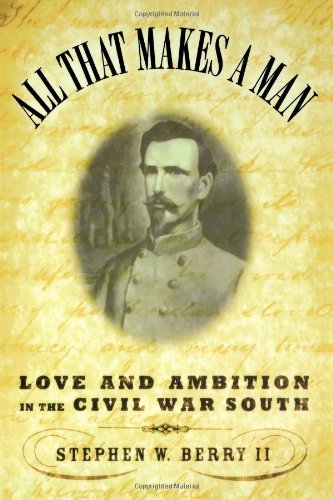
All that Makes a Man: Love and Ambition in the Civil War South
Authors:
Stephen W. Berry II
Publisher:
Oxford University Press, USA
Publication Date:
Not available
ISBN:
0195176286
In May 1861, Jefferson Davis issued a general call for volunteers for the Confederate Army. Men responded in such numbers that 200,000 had to be turned... away. Few of these men would have attributed their zeal to the cause of states' rights or slavery. As All That Makes a Man: Love and Ambition in the Civil War South makes clear, most southern men saw the war more simply as a test of their manhood, a chance to defend the honor of their sweethearts, fiancés, and wives back home. Drawing upon diaries and personal letters, Stephen Berry seamlessly weaves together the stories of six very different men, detailing the tangled roles that love and ambition played in each man's life. Their writings reveal a male-dominated Southern culture that exalted women as "repositories of divine grace" and treasured romantic love as the platform from which men launched their bids for greatness. The exhilarating onset of war seemed to these, and most southern men, a grand opportunity to fulfill their ambition for glory and to prove their love for women--on the same field of battle. As the realities of the war became apparent, however, the letters and diaries turned from idealized themes of honor and country to solemn reflections on love and home. Elegant and poetic, All That Makes a Man recovers the emotional lives of unsung Southern men and women and reveals that the fiction of Cold Mountain mirrors a poignant reality. In their search for a cause worthy of their lives, many Southern soldiers were disappointed in their hopes for a Southern nation. But they still had their women's love, and there they would rebuild.
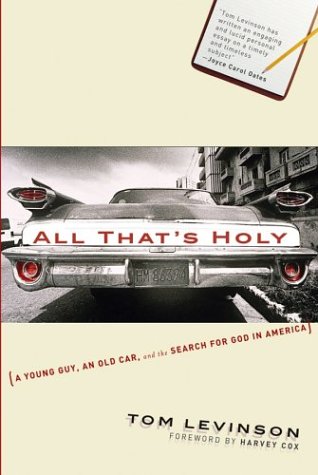
All That's Holy: A Young Guy, an Old Car, and the Search for God in...
Authors:
Tom Levinson
Publisher:
Jossey-Bass
Publication Date:
Not available
ISBN:
0787961663
There's nothing more American than a road trip— and a spiritual road trip at that. From mosque to synagogue to chapel to coffee shop, Tom Levinson's... entertaining and erudite stories of conversations with the faithful and the seeking get to the heart of religion in America today. All That's Holy is a fascinating conversational collage set against the backdrop of the author's deepening appreciation— both intellectually and spiritually— of his own religious roots."Tom Levinson has given us a spiritual Odyssey, an extended adventure in the new meaning of faith and hope. Eloquent, heartfelt, and true, this is a book America needs." — James Carroll, author, Constantine's Sword: The Church and the Jews and American Requiem, winner of the National Book Award"Tom Levinson has written an engaging and lucid personal essay on a timely and timeless subject." — Joyce Carol Oates, author, A Garden of Earthly Delights, Big Mouth & Ugly Girl, and I'll Take You There
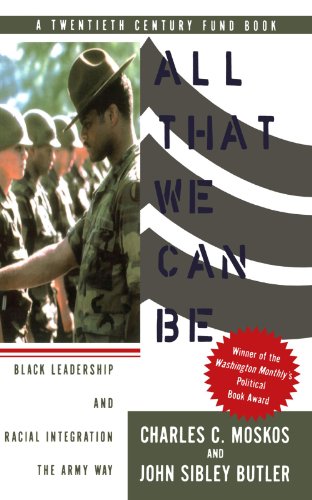
All That We Can Be: Black Leadership And Racial Integration The...
Authors:
Charles Moskos
Publisher:
Basic Books
Publication Date:
Not available
ISBN:
0465001130
The foremost autorities on race relations in the armed forces recount the previously untold success story of how the U.S. Army became the most... integrated institution in America. Charles C. Moskos and John Sibley Butler observe that the Army is the only place in America where blacks routinely boss around whites, and in this book they lay out the path by which the Army has promoted excellence across racial lines, while also showing how this military model can be adapted to fit the needs of civilian society. The Army way offers hope for our nation in a troubled time, and by following its example, Americans of all races can truly be all that we can be.
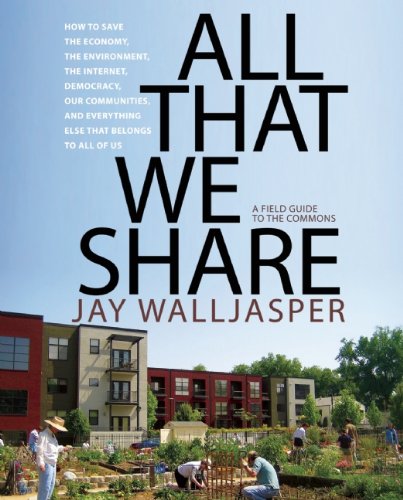
All That We Share: How to Save the Economy, the Environment, the...
Authors:
Jay Walljasper
Publisher:
New Press, The
Publication Date:
Not available
ISBN:
1595584994
How you see the world is about to change. All That We Share is a wake-up call that will inspire you to see the world in a new way. As soon as you... realize that some things belong to everyone—water, for instance, or the Internet or human knowledge—you become a commoner, part of a movement that's reshaping how we will solve the problems facing us in the twenty-first century.Edited by award-winning journalist Jay Walljasper, All That We Share is an indispensable introduction to fresh ideas that touch all of us. Filled with practical solutions for today's economic, political, and cultural issues, it's a much-needed and thoroughly accessible field guide to the new world of the commons. Including success stories from communities across the country and around the world, this book is for anyone seeking new ways of thinking about our shared values.All that we share is all we need to change the world.
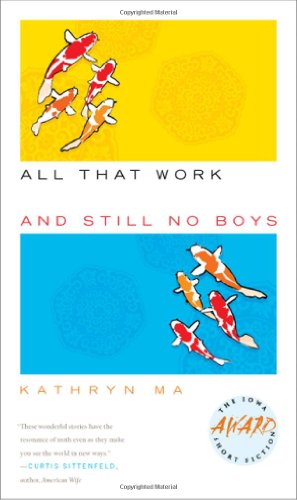
All That Work and Still No Boys (Iowa Short Fiction Award)
Authors:
Kathryn Ma
Publisher:
University Of Iowa Press
Publication Date:
Not available
ISBN:
1587298228
How do we survive our family, stay bound to our community, and keep from losing ourselves? InAll That Work and Still No Boys, Kathryn Ma exposes the... deepest fears and longings that we mask in family life and observes the long shadows cast by history and displacement. Here are ten stories that wound and satisfy in equal measure. Ma probes the immigrant experience, most particularly among northern California's Chinese Americans, illuminating for us the confounding nature of duty, transformation, and loss. A boy exposed to racial hatred finds out the true difference between his mother and his father. Two old rivals briefly lay down their weapons, but loneliness and despair won't let them forget the past. A young Beijing tour guide with a terrible family secret must take an adopted Chinese girl and her American family to visit an orphanage. And in the prize-winning title story, a mother refuses to let her son save her life, insisting instead on a sacrifice by her daughter. Intimate in detail and universal in theme, these stories give us the compelling voice of an exciting new author whose intelligence, insight, and wit impart a sense of grace to the bitter resentments and enduring ties that comprise family love. Even through the tensions Ma creates so deftly, the peace and security that come from building and belonging to one's own community shine forth.

All the Anxious Girls on Earth
Authors:
Zsuzsi Gartner
Publisher:
Not available
Publication Date:
Not available
ISBN:
0143186213
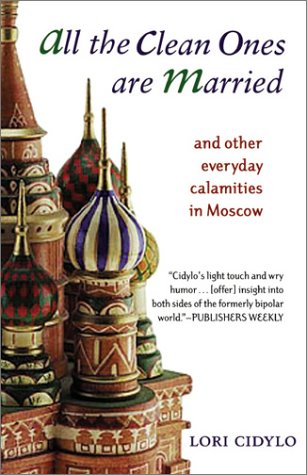
All The Clean Ones Are Married
Authors:
Lori Cidylo CIDYLO
Publisher:
Academy Chicago Publishers
Publication Date:
Not available
ISBN:
0897335015
In 1991, Lori Cidylo shocked her Ukrainian Polish-born parents when she told them she was leaving her reporter’s job on an upstate New York newspaper... to live and work in the rapidly dissolving Soviet Union. For six years she lived on a shoe-string budget in Moscow, in tiny, run-down apartments, struggling with broken toilets and indifferent landlords and coping with the daily calamities of life in Russia. Fluent in Russian, she rode on public transportation, did her own shopping and cooking, and shared the typical Muscovite’s life—unlike most Westerners who were still sequestered in the heavily guarded compounds reserved for diplomats and journalists. As the country experienced its most dramatic transformation since the Bolshevik Revolution, she realized she had stepped into a fantastical and absurd adventure. Cidylo’s wry, insightful account of what it is like for an American woman living in Russia is a dramatic tale full of insouciant laughter, in which the immediate sense of vivid experience shines on every page. With the sharp eye of an acute observer, she captures the momentous events no less than the everyday trivia: how do Russians address one another now that the familiar "comrade" is passé; or how do you find your way home in a city where the streets keep getting new names? As Russia even now continues to struggle with the Cold War’s aftermath, Cidylo gives a delightful, surprising, warmly human view of post-Soviet life.
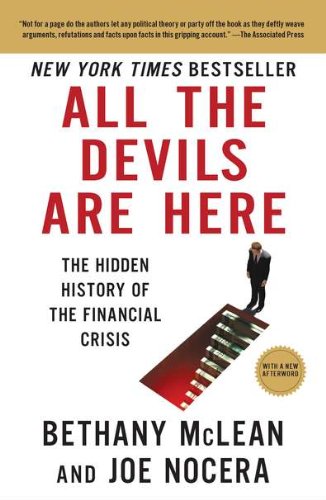
All the Devils Are Here: The Hidden History of the Financial Crisis
Authors:
Bethany McLean
Publisher:
Portfolio Trade
Publication Date:
Not available
ISBN:
159184438X
The New York Times bestseller hailed as "the best business book of 2010" (Huffington Post). As soon as the financial crisis erupted, the... finger-pointing began. Should the blame fall on Wall Street, Main Street, or Pennsylvania Avenue? On greedy traders, misguided regulators, sleazy subprime companies, cowardly legislators, or clueless home buyers?According to Bethany McLean and Joe Nocera, two of America's most acclaimed business journalists, the real answer is all of the above-and more. Many devils helped bring hell to the economy. And the full story, in all of its complexity and detail, is like the legend of the blind men and the elephant. Almost everyone has missed the big picture. Almost no one has put all the pieces together.All the Devils Are Here goes back several decades to weave the hidden history of the financial crisis in a way no previous book has done. It explores the motivations of everyone from famous CEOs, cabinet secretaries, and politicians to anonymous lenders, borrowers, analysts, and Wall Street traders. It delves into the powerful American mythology of homeownership. And it proves that the crisis ultimately wasn't about finance at all; it was about human nature.

All the Difference in the World: Postcoloniality and the Ends of...
Authors:
Natalie Melas
Publisher:
Stanford University Press
Publication Date:
Not available
ISBN:
0804731985
This book is about culture and comparison. Starting with the history of the discipline of comparative literature and its forgotten relation to the... positivist comparative method, it inquires into the idea of comparison in a postcolonial world. Comparison was Eurocentric by exclusion when it applied only to European literature, and Eurocentric by discrimination when it adapted evolutionary models to place European literature at the forefront of human development. This book argues that inclusiveness is not a sufficient response to postcolonial and multiculturalist challenges because it leaves the basis of equivalence unquestioned. The point is not simply to bring more objects under comparison, but rather to examine the process of comparison. The book offers a new approach to the either/or of relativism and universalism, in which comparison is either impossible or assimilatory, by focusing instead on various forms of “incommensurability”—comparisons in which there is a ground for comparison but no basis for equivalence. Each chapter develops a particular form of such cultural comparison from readings of important novelists (Joseph Conrad, Simone Schwartz-Bart), poets (Aimé Césaire, Derek Walcott), and theorists (Edouard Glissant, Jean-Luc Nancy).

All the Fish in the Sea: Maximum Sustainable Yield and the Failure...
Authors:
Carmel Finley
Publisher:
University Of Chicago Press
Publication Date:
Not available
ISBN:
0226249662
Between 1949 and 1955, the State Department pushed for an international fisheries policy grounded in maximum sustainable yield (MSY). The concept is... based on a confidence that scientists can predict, theoretically, the largest catch that can be taken from a species’ stock over an indefinite period. And while it was modified in 1996 with passage of the Sustained Fisheries Act, MSY is still at the heart of modern American fisheries management. As fish populations continue to crash, however, it is clear that MSY is itself not sustainable. Indeed, the concept has been widely criticized by scientists for ignoring several key factors in fisheries management and has led to the devastating collapse of many fisheries. Carmel Finley reveals that the fallibility of MSY lies at its very inception—as a tool of government rather than science. The foundational doctrine of the MSY emerged at a time when the US government was using science to promote and transfer Western knowledge and technology, and to ensure that American ships and planes would have free passage through the world’s seas and skies. Finley charts the history of US fisheries science using MSY as her focus, and in particular its application to halibut, tuna, and salmon fisheries. Fish populations the world over are threatened, and All the Fish in the Sea will help sound warnings of the effect of any management policies divested from science itself.
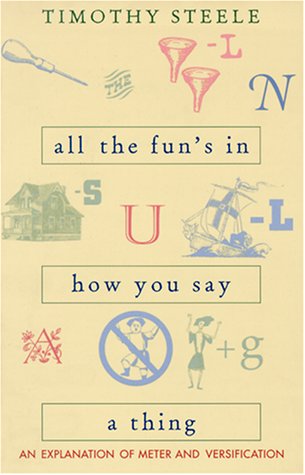
All The Fun's In How You Say A Thing: An Explanation Of Meter &...
Authors:
Timothy Steele
Publisher:
Ohio University Press
Publication Date:
Not available
ISBN:
0821412604
Perfect for the general reader of poetry, students and teachers of literature, and aspiring poets, All the Fun’s in How You Say a Thing is a lively... and comprehensive study of versification by one of our best contemporary practitioners of traditional poetic forms. Emphasizing both the coherence and the diversity of English metrical practice from Chaucer’s time to ours, Timothy Steele explains how poets harmonize the fixed units of meter with the variable flow of idiomatic speech. He examines the ways in which poets have used meter, rhyme, and stanza to communicate and enhance meaning. Steele illuminates as well many practical, theoretical, and historical issues in English prosody, without ever losing sight of the fundamental pleasures, beauties, and insights that fine poems offer us. Written lucidly, with a generous selection of helpful scansions and explanations of the metrical effects of the great poets of the English language, All the Fun’s in How You Say a Thing is not only a valuable handbook on technique; it is also a wide-ranging study of English verse and a mine of entertaining information for anyone wishing more fully to write, enjoy, understand, or teach poetry.
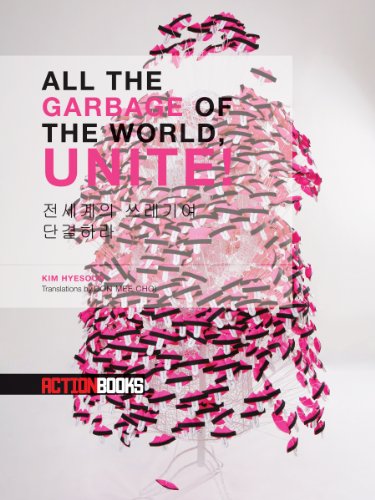
All the Garbage of the World, Unite!
Authors:
Kim Hyesoon
Publisher:
Action Books
Publication Date:
Not available
ISBN:
0983148015
Poetry. East Asia Studies. Translated from the Korean by Don Mee Choi. The celebrated Korean poet Kim Hyesoon writes from a radiant black zone where... matter becomes dark matter, human becomes trinket, garbage becomes god, a zero-point for our present moment's grotesque and spectacular inversions. This volume includes a selection of recent work, the landmark poem "Manhole Humanity," and the essay "In the Oxymoronic World." With fiercely incisive translations and a preface by Don Mee Choi. "As garbage, love and death accumulate in her poems, your world will be changed for real!"—Aase Berg
 '
'