production
/viewbook/list/all/?page=5622
/
/static/
None
How Buddhism Began: The Conditioned Genesis of the Early Teachings
Authors:
Richard Francis Gombrich
Publisher:
Munshiram Manoharlal Publishers
Publication Date:
Not available
ISBN:
8121508126
This book takes a fresh look at the earliest Buddhist texts and offers various suggestions how the teachings in them had developed. Two themes... predominate; firstly, it argues that we cannot understand the Buddha unless we understand that he was debating with other religious teachers, notably Brahmins. For example, he denied the existence of a "soul"; but what exactly was he denying? Another chapter suggests that the canonical story of the Buddha's encounter with a brigand who wore a garland of his victims' fingers probably reflects an encounter with a form of ecstatic religion. The other main theme concerns metaphor, allegory and literalism. By taking the words of the texts literally-despite the Buddha's warning not to-successive generations of his disciples created distinctions and developed doctrines far beyond his original intention. .One chapter shows how this led to a scholastic categorisation of meditation. Failure to understand a basic metaphor also gave rise to the later argument between the Mahayana and the older tradition. Perhaps most important of all, a combination of literalism with ignorance of the Buddha's allusions to Brahmanism led Buddhists to forget that the Buddha had preached that love, like Christian charity, could itself be directly salvific.
How Buffett Does It: 24 Simple Investing Strategies from the...
Authors:
James Pardoe
Publisher:
McGraw-Hill
Publication Date:
Not available
ISBN:
0071449124
A concise, no-nonsense rulebook for investors looking to achieve Buffett-like results Warren Buffett is one of the wealthiest investor in the... world. Millions of independent investors follow his every move. But why Buffett? What signs does he see that others miss? And more important, what can investors do to follow Buffett's path to investment and financial success? How Buffett Does It explores the 24 primary rules Buffett has followed from day one, and that people from market novices to seasoned veterans can use to strengthen their investing results. Drawing from literally hundreds of quotes and maxims, Buffett admirer and attorney James Pardoe has chosen those that encapsulate and explain the Buffett legend. This plain-talking and investor-friendly guidebook takes readers on an in-depth journey through strategies including: Focus on not losing money rather than making it Don't own any stock for 10 minutes that you wouldn't own for 10 years Be fearful when others are greedy and greedy when others are fearful
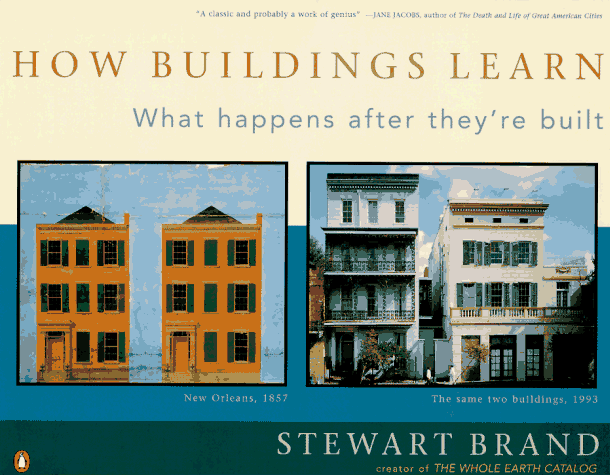
How Buildings Learn: What Happens After They're Built
Authors:
Stewart Brand
Publisher:
Penguin Books
Publication Date:
Not available
ISBN:
0140139966
Buildings have often been studies whole in space, but never before have they been studied whole in time. How Buildings Learn is a masterful new... synthesis that proposes that buildings adapt best when constantly refined and reshaped by their occupants, and that architects can mature from being artists of space to becoming artists of time. From the connected farmhouses of New England to I.M. Pei's Media Lab, from "satisficing" to "form follows funding," from the evolution of bungalows to the invention of Santa Fe Style, from Low Road military surplus buildings to a High Road English classic like Chatsworth—this is a far-ranging survey of unexplored essential territory. More than any other human artifacts, buildings improve with time—if they're allowed to. How Buildings Learn shows how to work with time rather than against it.
How Buildings Work: The Natural Order of Architecture
Authors:
Edward Allen
Publisher:
Oxford University Press, USA
Publication Date:
Not available
ISBN:
019516198X
Illustrated with hundreds of illuminating line drawings, this classic guide reveals virtually every secret of a building's function: how it stands up,... keeps its occupants safe and comfortable, gets built, grows old, and dies--and why some buildings do this so much better than others. Drawing on things he's learned from the many buildings he himself designed (and in some cases built with his own hands), Edward Allen explains complex phenomena such as the role of the sun in heating buildings and the range of structural devices that are used for support, from trusses and bearing walls to post-tensioned concrete beams and corbeled vaults. He stresses the importance of intelligent design in dealing with such problems as overheating and overcooling, excessive energy use, leaky roofs and windows, fire safety, and noisy interiors. He serves up some surprises: thermal insulation is generally a better investment than solar collectors; board fences are not effective noise barriers; there's one type of window that can be left open during a rainstorm. The new edition emphasizes "green" architecture and eco-conscious design and construction. It features a prologue on sustainable construction, and includes new information on topics such as the collapse of the World Trade Center, sick building syndrome, and EIFS failures and how they could have been prevented. Allen also highlights the array of amazing new building materials now available, such as self-cleaning glass, photovoltaics, transparent ceramics, cloud gel, and super-high-strength concrete and structural fibers. Edward Allen makes it easy for everyone--from armchair architects and sidewalk superintendents to students of architecture and construction--to understand the mysteries and complexities of even the largest building, from how it recycles waste and controls the movement of air, to how it is kept alive and growing.
HOW BUSINESS WORKS
Authors:
Not Available
Publisher:
Cognella Academic Publishing
Publication Date:
Not available
ISBN:
1609276140
Bright, eager business students deserve a rigorous, exciting introduction to the fundamentals of business. How Business Works: Making Profits, Taking... Risks and Creating Value in a Global Economy is a dynamic Introduction to Business textbook that offers a holistic, comprehensive, real-world approach, using practice and theory.The global business challenges facing today’s students are more complex than ever before. How Business Works presents a fresh, timely perspective on the way business is taught by organizing concepts around a unifying framework of value. This book prepares students to meet these challenges head-on and become successful learners and leaders. This is a serious textbook for serious business students. It addresses the quantitative and technical topics often glossed over in competing books, such as risk versus return, foreign exchange, and the time value of money.Adopting professors will have access to a robust set of teaching and learning resources that will enable faculty and students to examine each business concept in greater depth. These resources include:- An on-line test bank that includes over 1,900 questions, organized by chapter. Each question has a stated level of difficulty, a related lesson objective, and complete source information- PowerPoint lecture slides- Section and chapter video introductions by the author- Related web videos that reinforce chapter content- An Instructor’s Manual- A complete on-line Learning Management System with ancillaries fully loaded, including a gradebook and quizzes- An opportunity to engage in a collaborative teaching community with the author and other adopters through dialog and guest-lecturer appearancesAdopters can also access a supplemental website, www.kempbusiness.com, which is a resource for students and teachers alike. The website offers a student forum, a meet-the-author segment, information on book organization and features, and other events and multimedia.Written in a conversational, easy-to-read style, How Business Works is more than an outstanding textbook—it provides transformational learning and teaching experiences.Robert S. Kemp, DBA, CPA is the Ramon W. Breeden, Sr. Research Professor at the McIntire School of Commerce, University of Virginia. During his 30 years at the school, he has taught numerous undergraduate and graduate courses, as well as executives around the world. His scholarly works include over 70 completed projects, including books, monographs, articles, cases, and working papers. He has worked with and taught for organizations such as Navigant, Bank of America, Wellington Management, Ernst & Young, the Russian Bankers Association, and other prestigious organizations. He is a Certified Public Accountant and possesses a baccalaureate, masters, and doctorate in business administration.

How Canadians Govern Themselves
Authors:
Not Available
Publisher:
Not available
Publication Date:
Not available
ISBN:
1100200789

How Cancer Crossed the Color Line
Authors:
Keith Wailoo
Publisher:
Oxford University Press, USA
Publication Date:
Not available
ISBN:
0195170172
In the course of the 20th century, cancer went from being perceived as a white woman's nemesis to a "democratic disease" to a fearsome threat in... communities of color. Drawing on film and fiction, on medical and epidemiological evidence, and on patients' accounts, Keith Wailoo tracks this transformation in cancer awareness, revealing how not only awareness, but cancer prevention, treatment, and survival have all been refracted through the lens of race. Spanning more than a century, the book offers a sweeping account of the forces that simultaneously defined cancer as an intensely individualized and personal experience linked to whites, often categorizing people across the color line as racial types lacking similar personal dimensions. Wailoo describes how theories of risk evolved with changes in women's roles, with African-American and new immigrant migration trends, with the growth of federal cancer surveillance, and with diagnostic advances, racial protest, and contemporary health activism. The book examines such powerful and transformative social developments as the mass black migration from rural south to urban north in the 1920s and 1930s, the World War II experience at home and on the war front, and the quest for civil rights and equality in health in the 1950s and '60s. It also explores recent controversies that illuminate the diversity of cancer challenges in America, such as the high cancer rates among privileged women in Marin County, California, the heavy toll of prostate cancer among black men, and the questions about why Vietnamese-American women's cervical cancer rates are so high. A pioneering study, How Cancer Crossed the Color Line gracefully documents how race and gender became central motifs in the birth of cancer awareness, how patterns and perceptions changed over time, and how the "war on cancer" continues to be waged along the color line.

How Cancer Works
Authors:
Lauren Sompayrac
Publisher:
Jones and Bartlett Publishers, Inc.
Publication Date:
Not available
ISBN:
0763718211
How Can I Fix It?: Finding Solutions and Managing Dilemmas : An...
Authors:
Larry Cuban
Publisher:
Teachers College Press
Publication Date:
Not available
ISBN:
0807740497
With this highly accessible and unique little guide, Larry Cuban offers educators indispensable tools to make sense of the daily complexities they... encounter in their work. Teachers face dozens of classroom situations where conflicts occur. Similarly, principals wrestle with school issues that call for changes in attitudes, behaviours, and procedures. Because the process is so familiar, even expert teachers and principals often have difficulty in explaining what it is that they do and how they go about solving problems and coping with dilemmas in their classrooms and schools. Using concrete and varied examples drawn from the workplace, Cuban presents vivid and provocative case studies of practitioners’ experiences in urban and suburban schools that deal with the routine conflicts of school. He draws on his own extensive experience in public schools and his research into teaching and administration to set forth a practical framework for identifying, defining, and coping with both puzzling problems and tension-filled dilemmas. A much-needed resource for both new and experienced practitioners, How Can I Fix It? focuses on common skills that practitioners have, but seldom take time to consider, and applies these skills to concrete situations.

How Can I Help?
Authors:
Kolf
Publisher:
DaCapo Press
Publication Date:
Not available
ISBN:
1555611877
How do you help someone who is grieving? When do you call? How can you help with practical matters? What kind of emotions can you expect to encounter?... Here's a helping hand with these difficult issues.Listen to real-life stories that are easy to relate to, and benefit from concrete ideas to help others in each stage of grief.You just found out ... Responding to the news -- what to say and do, and what not toOne week after ... Listening and offering unconditional supportFirst six months ... Helping with practical matters -- belongings, finances, change in residenceOne-year anniversary ... Remembering their loved oneBeing a support for someone who is grieving can be draining. June also helps you to remember to take care of yourself so you can keep on giving.
How Can I Help? Stories and Reflection on Service
Authors:
Ram Dass
Publisher:
Knopf
Publication Date:
Not available
ISBN:
0394729471
Not a day goes by without our being called upon to help one another--at home, at work, on the street, on the phone. . . . We do what we can. Yet so... much comes up to complicate this natural response: "Will I have what it takes?" "How much is enough?" "How can I deal with suffering?" "And what really helps, anyway?"In this practical helper's companion, the authors explore a path through these confusions, and provide support and inspiration fo us in our efforts as members of the helping professions, as volunteers, as community activists, or simply as friends and family trying to meet each other's needs. Here too are deeply moving personal accounts: A housewife brings zoo animals to lift the spirits of nursing home residents; a nun tends the wounded on the first night of the Nicaraguan revolution; a police officer talks a desperate father out of leaping from a roof with his child; a nurse allows an infant to spend its last moments of life in her arms rather than on a hospital machine. From many such stories and the authors' reflections, we can find strength, clarity, and wisdom for those times when we are called on to care for one another. How Can I Help? reminds us just how much we have to give and how doing so can lead to some of the most joyous moments of our lives.

How Can I Talk If My Lips Don't Move?: Inside My Autistic Mind
Authors:
Tito Rajarshi Mukhopadhyay
Publisher:
Arcade Publishing
Publication Date:
Not available
ISBN:
1611450225
An astounding new work by the author of The Mind Tree that offers a rare insight into the autistic mind and how it thinks, sees, and reacts to the... world. When he was three years old, Tito was diagnosed as severely autistic, but his remarkable mother, Soma, determined that he would overcome the “problem” by teaching him to read and write. The result was that between the ages of eight and eleven he wrote stories and poems of exquisite beauty, which Dr. Oliver Sacks called “amazing and shocking.” Their eloquence gave lie to all our assumptions about autism. Here Tito goes even further and writes of how the autistic mind works, how it views the outside world and the “normal” people he deals with daily, how he tells his stories to the mirror and hears stories back, how sounds become colors, how beauty fills his mind and heart. With this work, Tito—whom Portia Iversen, co-founder of Cure Autism Now, has described as “a window into autism such as the world has never seen”—gives the world a beacon of hope. For if he can do it, why can’t others?“Brave, bold, and deeply felt, this book shows that much we might have believed about autism can be wrong.”—Boston Globe

How Can the Human Mind Occur in the Physical Universe? (Oxford...
Authors:
John R. Anderson
Publisher:
Oxford University Press, USA
Publication Date:
Not available
ISBN:
0195324250
"The question for me is how can the human mind occur in the physical universe. We now know that the world is governed by physics. We now understand the... way biology nestles comfortably within that. The issue is how will the mind do that as well."--Allen Newell, December 4, 1991, Carnegie Mellon University The argument John Anderson gives in this book was inspired by the passage above, from the last lecture by one of the pioneers of cognitive science. Newell describes what, for him, is the pivotal question of scientific inquiry, and Anderson gives an answer that is emerging from the study of brain and behavior.Humans share the same basic cognitive architecture with all primates, but they have evolved abilities to exercise abstract control over cognition and process more complex relational patterns. The human cognitive architecture consists of a set of largely independent modules associated with different brain regions. In this book, Anderson discusses in detail how these various modules can combine to produce behaviors as varied as driving a car and solving an algebraic equation, but focuses principally on two of the modules: the declarative and procedural. The declarative module involves a memory system that, moment by moment, attempts to give each person the most appropriate possible window into his or her past. The procedural module involves a central system that strives to develop a set of productions that will enable the most adaptive response from any state of the modules. Newell argued that the answer to his question must take the form of a cognitive architecture, and Anderson organizes his answer around the ACT-R architecture, but broadens it by bringing in research from all areas of cognitive science, including how recent work in brain imaging maps onto the cognitive architecture.

How Can We Solve Our Social Problems?
Authors:
James A. Crone
Publisher:
Sage Publications, Inc
Publication Date:
Not available
ISBN:
1412978106
Updated with recent issues such as the national debate on health care reform, this Second Edition of How Can We Solve Our Social Problems? gives... students a sense of hope by demonstrating specific, realistic steps we can take to solve some of the most pervasive social problems in America today. Author James Crone maintains a sense of sociological objectivity throughout and helps students realize that we can take steps to solve such key social problems as poverty, racial and ethnic inequality, unequal education, and environmental issues. The book's first two chapters define “social problem,,” provide a theoretical background, discuss the daunting barriers we face in attempting to solve social problems, and demonstrate how sociology can help.
How Capitalism Saved America: The Untold History of Our Country,...
Authors:
Thomas DiLorenzo
Publisher:
Three Rivers Press
Publication Date:
Not available
ISBN:
1400083311
Here’s the real history of our country. How Capitalism Saved America explodes the myths spun by Michael Moore, the liberal media, Hollywood, academia,... and the rest of the anticapitalist establishment.Whether it’s Michael Moore or the New York Times, Hollywood or academia, a growing segment in America is waging a war on capitalism. We hear that greedy plutocrats exploit the American public; that capitalism harms consumers, the working class, and the environment; that the government needs to rein in capitalism; and on and on. Anticapitalist critiques have only grown more fevered in the wake of corporate scandals like Enron and WorldCom. Indeed, the 2004 presidential campaign has brought frequent calls to re-regulate the American economy.But the anticapitalist arguments are pure bunk, as Thomas J. DiLorenzo reveals in How Capitalism Saved America. DiLorenzo, a professor of economics, shows how capitalism has made America the most prosperous nation on earth—and how the sort of government regulation that politicians and pundits endorse has hindered economic growth, caused higher unemployment, raised prices, and created many other problems. He propels the reader along with a fresh and compelling look at critical events in American history—covering everything from the Pilgrims to Bill Gates. And just as he did in his last book, The Real Lincoln, DiLorenzo explodes numerous myths that have become conventional wisdom. How Capitalism Saved America reveals:• How the introduction of a capitalist system saved the Pilgrims from starvation• How the American Revolution was in large part a revolt against Britain’s stifling economic controls• How the so-called robber barons actually improved the lives of millions of Americans by providing newer and better products at lower prices• How the New Deal made the Great Depression worse• How deregulation got this country out of the energy crisis of the 1970s—and was not the cause of recent blackouts in California and the Northeast• And much moreHow Capitalism Saved America is popular history at its explosive best.
 '





