production
/viewbook/list/all/?page=5643
/
/static/
None
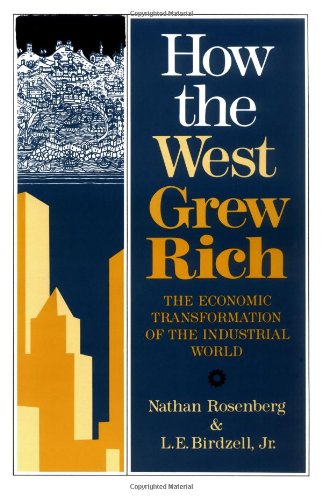
How The West Grew Rich: The Economic Transformation Of The...
Authors:
Nathan Rosenberg
Publisher:
Basic Books
Publication Date:
Not available
ISBN:
0465031099
How did the WestEurope, Canada, and the United Statesescape from immemorial poverty into sustained economic growth and material well-being when... other societies remained trapped in an endless cycle of birth, hunger, hardship, and death? In this elegant synthesis of economic history, two scholars argue that it is the political pluralism and the flexibility of the West’s institutionsnot corporate organization and mass production technologythat explain its unparalleled wealth.

How the West Was Lost: The Transformation of Kentucky From Daniel...
Authors:
Stephen Aron
Publisher:
The Johns Hopkins University Press
Publication Date:
Not available
ISBN:
0801861985
Eighteenth-century Kentucky was a place where Indian and European cultures collided—and, surprisingly, coincided. But this mixed world did not last,... and it eventually gave way to nineteenth-century commercial and industrial development. How the West Was Lost tracks the overlapping conquest, colonization, and consolidation of the trans-Appalachian frontier. Not a story of paradise lost, this is a book about possibilities lost. It focuses on the common ground between Indians and backcountry settlers which was not found, the frontier customs that were not perpetuated, the lands that were not distributed equally, the slaves who were not emancipated, the agrarian democracy that was not achieved, and the millennium that did not arrive. Seeking to explain why these dreams were not realized, Stephen Aron shows us what did happen during Kentucky's tumultuous passage from Daniel Boone's world to Henry Clay's.
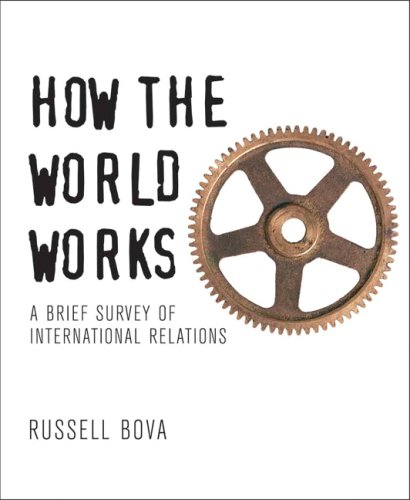
How the World Works: A Brief Survey of International Relations
Authors:
Russell Bova
Publisher:
Longman
Publication Date:
Not available
ISBN:
0321410009
How the World Works builds on students’ instincts about current world events and develops them into a more systematic and enduring understanding.... Introducing each of the field’s major theories, this brief text demonstrates how different conceptual tools are used to interpret patterns in international relations. How the World Works not only grounds students in the essentials of international relations but also helps students use them to see past the headlines.
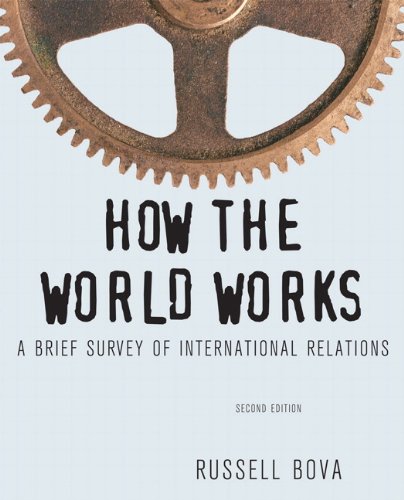
How the World Works: A Brief Survey of International Relations (2nd...
Authors:
Russell Bova
Publisher:
Pearson
Publication Date:
Not available
ISBN:
0205082408
How the World Works builds on students’ instincts about current world events and develops them into a more systematic and enduring understanding. ... This brief text introduces each of the field’s major theories and demonstrates how different conceptual tools are used to interpret patterns in international relations. How the World Works not only grounds students in the essentials of international relations but also helps students use them to see past the headlines.

How The World Works E-Book (Jumpbook)
Authors:
Not Available
Publisher:
Not available
Publication Date:
Not available
ISBN:
Not available
HOW THE WORLD WORKS & READINGS PKG
Authors:
Not Available
Publisher:
Not available
Publication Date:
Not available
ISBN:
Not available
HOW THE WORLD WORKS WITH POLISCIKIT
Authors:
Not Available
Publisher:
Not available
Publication Date:
Not available
ISBN:
Not available
HOW THE WRLD WRKS/RDGS HOW WRLD WRKS PK
Authors:
Not Available
Publisher:
Not available
Publication Date:
Not available
ISBN:
Not available
HOW THEY SEE YOU
Authors:
Not Available
Publisher:
Not available
Publication Date:
Not available
ISBN:
Not available
HOW THINGS WORK ]CUSTOM[
Authors:
Not Available
Publisher:
Not available
Publication Date:
Not available
ISBN:
Not available
HOW THINGS WORK:-LAB MANUAL
Authors:
Not Available
Publisher:
Not available
Publication Date:
Not available
ISBN:
Not available
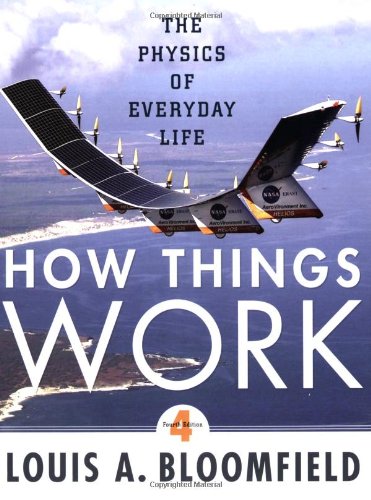
How Things Work: The Physics of Everyday Life
Authors:
Louis A. Bloomfield
Publisher:
Wiley
Publication Date:
Not available
ISBN:
0470223995
How Things Work uses familiar objects to introduce basic physics concepts, demonstrating the excitement and relevance to professionals in a variety of... technical fields. Because its structure is defined by real-life examples, this book explores concepts as they're needed and then revisits them later on when they reappear in other objects. It integrates case studies throughout the chapters to easily convey an understanding and appreciation for physics. For example, discussions of skating, falling balls, and bumper cars are included to explain the Laws of Motion. Air conditioners and automobiles are used to explore thermodynamics. Engineers, architects, and professionals in other technical fields will benefit from the material that connects science to our everyday world.
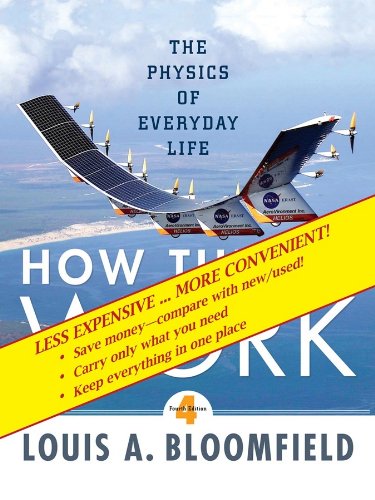
How Things Work: The Physics of Everyday Life, Fourth Edition...
Authors:
Louis A. Bloomfield
Publisher:
Wiley
Publication Date:
Not available
ISBN:
0470418206
In this provocative book, Susan Bordo untangles the myths, ideologies, and pathologies of the modern female body. Bordo explores our tortured... fascination with food, hunger, desire, and control, and its effects on women's lives.
How Things Work: The Physics of Everyday Life: Wiley Plus...
Authors:
Louis A. Bloomfield
Publisher:
John Wiley & Sons
Publication Date:
Not available
ISBN:
0470075414
This book provides an essential understanding of statistical concepts necessary for the analysis of genomic and proteomic data using computational... techniques. The author presents both basic and advanced topics, focusing on those that are relevant to the computational analysis of large data sets in biology. Chapters begin with a description of a statistical concept and a current example from biomedical research, followed by more detailed presentation, discussion of limitations, and problems. The book starts with an introduction to probability and statistics for genome-wide data, and moves into topics such as clustering, classification, multi-dimensional visualization, experimental design, statistical resampling, and statistical network analysis. Clearly explains the use of bioinformatics tools in life sciences research without requiring an advanced background in math/statisticsEnables biomedical and life sciences researchers to successfully evaluate the validity of their results and make inferencesEnables statistical and quantitative researchers to rapidly learn novel statistical concepts and techniques appropriate for large biological data analysisCarefully revisits frequently used statistical approaches and highlights their limitations in large biological data analysisOffers programming examples and datasetsIncludes chapter problem sets, a glossary, a list of statistical notations, and appendices with references to background mathematical and technical materialFeatures supplementary materials, including datasets, links, and a statistical package available onlineStatistical Bioinformatics is an ideal textbook for students in medicine, life sciences, and bioengineering, aimed at researchers who utilize computational tools for the analysis of genomic, proteomic, and many other emerging high-throughput molecular data. It may also serve as a rapid introduction to the bioinformatics science for statistical and computational students and audiences who have not experienced such analysis tasks before.
How Things Work: The Physics of Everyday Life [With Access Code]
Authors:
Louis A. Bloomfield
Publisher:
John Wiley & Sons
Publication Date:
Not available
ISBN:
0470437111
How can we motivate ourselves to do what we think we ought? How can we deliberate about personal values and priorities? Bennett Helm rejects the... standard philosophical answers to these questions, which presuppose a sharp distinction between cognition and impulse, and develops a detailed alternative theory both of emotions, desires, and evaluative judgments and of their rational interconnections. The result is an innovative theory of practical rationality and how we can control not only what we do but also what we value and who we are as persons.
 '





