production
/viewbook/list/all/?page=5711
/
/static/
None

HUMAN A&P W/ATLAS + ACC CODE + ICLICKER COUPON
Authors:
Not Available
Publisher:
Not available
Publication Date:
Not available
ISBN:
Not available
HUM ANAT+PHYS AC ONLY ]CUSTOM[
Authors:
Not Available
Publisher:
Not available
Publication Date:
Not available
ISBN:
Not available
HUM ANAT+PHYS AC W/EBOOK ]CUSTOM[
Authors:
Not Available
Publisher:
Not available
Publication Date:
Not available
ISBN:
Not available
HUM ANAT & PHYS ALC+MASTRG&L/M MAIN UPD&GET
Authors:
Not Available
Publisher:
Not available
Publication Date:
Not available
ISBN:
Not available
Hum Anatphysiol Looseleaf W/Mast S
Authors:
Not Available
Publisher:
Not available
Publication Date:
Not available
ISBN:
Not available
HUM. ANAT+PHYSIOLOGY LAB MAN.]CUSTOM[
Authors:
Not Available
Publisher:
Not available
Publication Date:
Not available
ISBN:
Not available
HUM ANAT+PHYS LAB MANUAL VOL 1 ]CUSTOM[
Authors:
Not Available
Publisher:
Not available
Publication Date:
Not available
ISBN:
Not available
HUM ANAT+PHYS W/AC(3-HOLE PUNCH)]CUSTOM
Authors:
Not Available
Publisher:
Not available
Publication Date:
Not available
ISBN:
Not available
HUM ANAT.+PHYS. W/AC (PACK) ]CUSTOM[
Authors:
Not Available
Publisher:
Not available
Publication Date:
Not available
ISBN:
Not available
HUM ANAT& PHYS W/MASTRG&L/M CAT UPD&GET RDY
Authors:
Not Available
Publisher:
Not available
Publication Date:
Not available
ISBN:
Not available
HUM ANATY&PHYS BK ALC ED&NEW MASTA&P ETX
Authors:
Not Available
Publisher:
Not available
Publication Date:
Not available
ISBN:
Not available
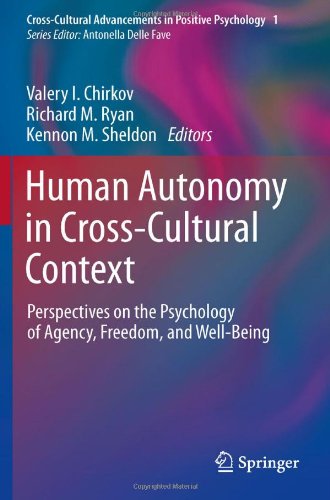
Human Autonomy in Cross-Cultural Context: Perspectives on the...
Authors:
Not Available
Publisher:
Springer
Publication Date:
Not available
ISBN:
9048196663
This volume presents the reader with a stimulating tapestry of essays exploring the nature of personal autonomy, self-determination, and agency, and... their role in human optimal functioning at multiple levels of analysis from personal to societal and cross-cultural. The starting point for these explorations is self-determination theory, an integrated theory of human motivation and healthy development which has been under development for more than three decades (Deci & Ryan, 2000). As the contributions will make clear, psychological autonomy is a concept that forms the bridge between the dependence of human behavior on biological and socio-cultural determinants on the one side, and people’s ability to be free, reflective, and transforming agents who can challenge these dependencies, on the other. The authors within this volume share a vision that human autonomy is a fundamental pre-condition for both individuals and groups to thrive, and that without understanding the nature and mechanisms of autonomous agency vital social and human problems cannot be satisfactory addressed. This multidisciplinary team of researchers will collectively explore the nature of personal autonomy, considering its developmental origins, its expression within relationships, its importance within groups and organizational functioning, and its role in promoting to the democratic and economic development of societies. The book is aimed toward developmental, social, personality, and cross-cultural psychologists, towards researchers and practitioners’ in the areas of education, health and medicine, social work and, economics, and also towards all interested in creating a more sustainable and just world society through promoting individual freedom and agency. This volume will provide a theoretical and conceptual account of the nature and psychological mechanisms of personal motivational autonomy and human agency; rich multidisciplinary empirical evidence supporting the claims and propositions about the nature of human autonomy and capacities for self-regulation; explanations of how and why different psychological and socio-cultural conditions may play a role in promoting or undermining people’s autonomous motivation and well-being, discussions of how the promotion of human autonomy can positively influence environmental protection, democracy promotion and economic prosperity.
Human Behavior and Social Environments: A Biopsychosocial Approach
Authors:
Dennis Saleebey
Publisher:
Columbia University Press
Publication Date:
Not available
ISBN:
0231112807
Human behavior is a subject so vast that it would seem to defy one's ability to comfortably and confidently grasp its varieties, nuances, shapes, and... dynamics. But in this wide-ranging and comprehensive survey of the contexts of human behavior, Dennis Saleebey examines the different social science approaches to understanding the way humans react to and are affected by their environment.Using a biopsychosocial perspective, this book demonstrates that there are many paths of knowledge, many methods of inquiry, and many perspectives that can guide one's understanding of human behavior. Resilience (how we cope with trauma) and meaning-making (how we see and make sense of the world around us) provide the conceptual framework of the book. Saleebey examines a number of specific theories relevant to the biopsychosocial approach: part/whole analysis, psychodynamic theory, ecological theory, cognitive theory, and radical/critical theory. Human development is presented as a continuing interaction between individual, family, community, social institutions, and culture. Pedagogical devices to aid the student include chapter overviews, case studies, and meaning-making dialogues at the end of each chapter that pose questions for further thought.
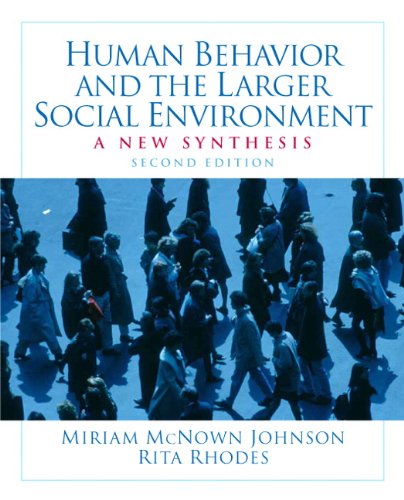
Human Behavior and the Larger Social Environment: A New Synthesis...
Authors:
Miriam McNown Johnson
Publisher:
Pearson
Publication Date:
Not available
ISBN:
0205763669
Human Behavior and the Larger Social Environment, Second Edition promotes critical thinking through extensive review and analysis of macro-level... systems and structures, highlighting both the positive and negative impacts they have on individuals and families.
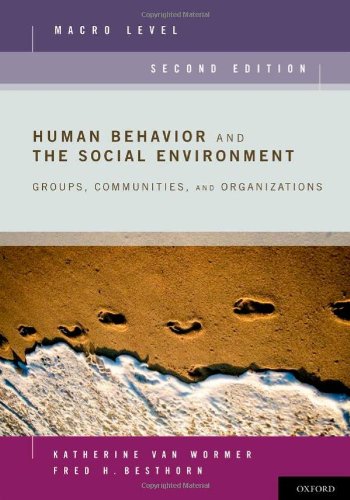
Human Behavior and the Social Environment, Macro Level: Groups,...
Authors:
Katherine van Wormer
Publisher:
Oxford University Press, USA
Publication Date:
Not available
ISBN:
0199740577
A timely revision in this global age, Human Behavior and the Social Environment, Macro Level develops a sophisticated and original view of the cultural,... global, spiritual, and natural worlds that people inhabit, and the impact of these worlds on human behavior. Its major new theme, sustainability, emerges as a key characteristic of contemporary practice. What is sustainable social work? What are the characteristics of a sustainable community? How is the present exploitation of environmental resources unsustainable for future generations? Following the greatest economic upheaval since the Great Depression, how can we envision a sustainable economy that will benefit all the people, not only the wealthy few?Human behavior results from biological, psychological, socio-economic, and cultural forces, but the mental health field has placed the most emphasis on intrapsychic factors to the near exclusion of socio-economic and cultural considerations. This significant collaboration seeks to correct this omission by helping students recognize patterns in the family, culture, and value systems in order to create safe and sustainable environments for their future clients. The emphasis on sustainable and unsustainable social welfare programs is geared to helping readers engage in advocacy for social justice.* Integrates up-to-date research findings, models, and government statistics* Enhanced discussions of theory, group dynamics, family, community, and the environment* Theoretical concepts and practice implications in each chapter* Highlights the importance of the natural environment and ecology--the "community of the earth"--to human and group behavior* Sets forth a refined understanding of the role of spirituality--the "community of faith"--in people's lives* Focuses on evidence-based theory and research* Teaches from a global, cross-cultural, perspective, highlighting themes of empowerment and social justice* Features dynamic readings, personal narratives, and photographs that highlight each chapter's topic* Accompanied by an online instructor's manual with lecture presentations, chapter summaries, key terms, suggested classroom activities, and a test bank with essay and multiple choice questions at www.oup.com/us/HBSE/Don't miss the companion volume, Human Behavior and the Social Environment, Micro Level, Second Edition, which offers an eye-opening view of how biological, psychological, and cultural forces influence individuals' behavior.
 '





