production
/viewbook/list/all/?page=5737
/
/static/
None

Humanity: A Moral History of the Twentieth Century, Second Edition
Authors:
Jonathan Glover
Publisher:
Yale University Press
Publication Date:
Not available
ISBN:
0300186401
Renowned moral philosopher Jonathan Glover confronts the brutal history of the twentieth century to unravel the mystery of why so many atrocities... occurred. In a new preface, Glover brings the book through the post-September 11 era and into our own time—and asks whether humankind can "weaken the grip war has on us."Praise for the first edition:“It is hard to imagine a more important book. Glover makes an overwhelming case for the need to understand our own inhumanity, and reduce or eliminate the ways in which it can express itself—and he then begins the task himself. Humanity is an extraordinary achievement.”—Peter Singer, Princeton University“This is an extraordinary book: brilliant, haunting and uniquely important. Almost 40 years ago a president read a best seller and avoided a holocaust. I like to think that some of the leaders and followers of tomorrow will read Humanity.”—Steven Pinker, New York Times Book Review
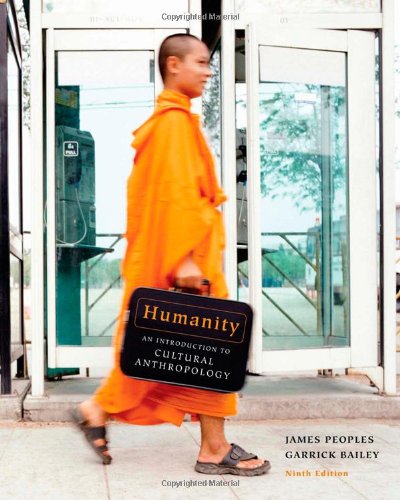
Humanity: An Introduction to Cultural Anthropology
Authors:
James Peoples
Publisher:
Wadsworth Publishing
Publication Date:
Not available
ISBN:
1111301522
Using engaging stories and clear writing, CENGAGE ADVANTAGE BOOKS: HUMANITY: AN INTRODUCTION TO CULTURAL ANTHROPOLOGY, Ninth Edition, introduces... cultural anthropology within a solid framework centered on globalization and culture change. Peoples and Bailey focus on the social and cultural consequences of globalization, emphasizing culture change and world problems. The book's engaging narrative provides new ways of looking at many of the challenges facing the world in this century. As you explore more contemporary issues, including recent debates on gay marriage, cultural and economic globalization, population growth, hunger, and the survival of indigenous cultures, you will gain a better understanding of the cultural information you need to successfully navigate in today's global economy. The authors emphasize the diversity of humanity and reveal why an appreciation and tolerance of cultural differences is critical in the modern world.

Humanity In Healthcare: The Heart And Soul Of Medicine
Authors:
Peter Barritt
Publisher:
Radcliffe Medical PR
Publication Date:
Not available
ISBN:
1857758366
Text offers a broad perspective on the potential contribution of the arts toward fostering a humane approach to the care of those who are ill or... suffering. Refers to range of literature from prose and poetry, sociology, history, philosophy, politics, religion, and spirituality. Topics include health, suffering, healing, and more. For healthcare professionals. Softcover.

Humanity's Burden: A Global History of Malaria (Studies in...
Authors:
James L.A. Webb Jr.
Publisher:
Cambridge University Press
Publication Date:
Not available
ISBN:
0521670128
Humanity's Burden provides a panoramic overview of the history of malaria. It traces the long arc of malaria out of tropical Africa into Eurasia, its... transfer to the Americas during the early years of the Columbian exchange, and its retraction from the middle latitudes into the tropics since the late nineteenth century. Adopting a broadly comparative approach to historical patterns and processes, it synthesizes research findings from the natural and social sciences and weaves these understandings into a narrative that reaches from the earliest evidence of malaria infections in tropical Africa up to the present. Written in a style that is easily accessible to non-specialists, it considers the significance of genetic mutations, diet, lifestyle, migration, warfare, palliative and curative treatment, and efforts to interrupt transmission on the global distribution of malaria.

Humanity's End: Why We Should Reject Radical Enhancement (Life and...
Authors:
Nicholas Agar
Publisher:
A Bradford Book
Publication Date:
Not available
ISBN:
0262014629
Proposals to make us smarter than the greatest geniuses or to add thousands of years to our life spans seem fit only for the spam folder or trash can.... And yet this is what contemporary advocates of radical enhancement offer in all seriousness. They present a variety of technologies and therapies that will expand our capacities far beyond what is currently possible for human beings. In Humanity's End, Nicholas Agar argues against radical enhancement, describing its destructive consequences. Agar examines the proposals of four prominent radical enhancers: Ray Kurzweil, who argues that technology will enable our escape from human biology; Aubrey de Grey, who calls for anti-aging therapies that will achieve "longevity escape velocity"; Nick Bostrom, who defends the morality and rationality of enhancement; and James Hughes, who envisions a harmonious democracy of the enhanced and the unenhanced. Agar argues that the outcomes of radical enhancement could be darker than the rosy futures described by these thinkers. The most dramatic means of enhancing our cognitive powers could in fact kill us; the radical extension of our life span could eliminate experiences of great value from our lives; and a situation in which some humans are radically enhanced and others are not could lead to tyranny of posthumans over humans.

Humanity's Law
Authors:
Ruti G. Teitel
Publisher:
Oxford University Press, USA
Publication Date:
Not available
ISBN:
0195370910
In Humanity's Law, renowned legal scholar Ruti Teitel offers a powerful account of one of the central transformations of the post-Cold War era: the... profound normative shift in the international legal order from prioritizing state security to protecting human security. As she demonstrates, courts, tribunals, and other international bodies now rely on a humanity-based framework to assess the rights and wrongs of conflict; to determine whether and how to intervene; and to impose accountability and responsibility. Cumulatively, the norms represent a new law of humanity that spans the law of war, international human rights, and international criminal justice. Teitel explains how this framework is reshaping the discourse of international politics with a new approach to the management of violent conflict. Teitel maintains that this framework is most evidently at work in the jurisprudence of the tribunals-international, regional, and domestic-that are charged with deciding disputes that often span issues of internal and international conflict and security. The book demonstrates how the humanity law framework connects the mandates and rulings of diverse tribunals and institutions, addressing the fragmentation of global legal order. Comprehensive in approach, Humanity's Law considers legal and political developments related to violent conflict in Europe, North America, South America, and Africa. This interdisciplinary work is essential reading for anyone attempting to grasp the momentous changes occurring in global affairs as the management of conflict is increasingly driven by the claims and interests of persons and peoples, and state sovereignty itself is transformed.
Humanize: How People-Centric Organizations Succeed in a Social World
Authors:
Jamie Notter
Publisher:
Que Publishing
Publication Date:
Not available
ISBN:
0789741121
A practical guide for realizing the true potential of social media—not for marketing, but for leadership. Knowing the tools of social media is... a must for successful marketing these days, but the real promise of social media is the way it can teach us a whole new way of doing business. Humanize takes the principles underlying social media’s growth and applies them to the way we lead and manage our organizations. Leading organizational consultants Jamie Notter and Maddie Grant help you change your organization, from the culture down to individual behavior, in ways that make it more human—and more effective. Drawing on their extensive experience, Notter and Grant help you make management innovation real and doable. Regardless of your title or position, this book can help you: · Build a more trustworthy, open, generative, and courageous organization by embracing social and human principles. · Change organizations from the inside out. · Address critical elements of organizational behavior, process, and culture. · Move beyond the social media buzzwords like transparent, decentralized, and open—and actually make them happen. · Promote forms of “generative” success that go beyond profit and loss. · Learn how to get started–you, personally, today, right now!
Humanizing the Economy: Co-operatives in the Age of Capital...
Authors:
John Restakis
Publisher:
New Society Publishers
Publication Date:
Not available
ISBN:
086571651X

Human Killing Machines: Systematic Indoctrination in Iran, Nazi...
Authors:
Adam Lankford
Publisher:
Lexington Books
Publication Date:
Not available
ISBN:
0739134167
They usually start out as ordinary people, doing their best to deal with mixed messages in a complex world. What they don't realize is that they may be... the targets of a violent system that is building an obedient workforce. One day they're enjoying a few laughs with buddies, and seemingly the next day, they wake up as human killing machines. And they allow it to happen.Addressing one of the most serious threats to the world today, Human Killing Machines applies the model of systematic indoctrination to case studies of brutality in Iran, Nazi Germany, Al Qaeda, and Abu Ghraib. The book reveals how these transformations take place--how systems redefine morality to turn ordinary people into torturers, terrorists, and genocidal killers. Adam Lankford also provides a side-by-side comparison of these cases across six critical variables, in order to identify key similarities and differences and the potential for strategic countermeasures. Based on this analysis, he offers recommendations for how we can begin to reduce Al Qaeda terrorists' commitment to their missions, reform the U.S. military and increase its accountability, and spark an awakening in Iran so that the oppressive regime goes out with a whimper--not with a bang.
Humankind: An Introductory Reader for Cultural Anthropology
Authors:
Loretta A. Cormier
Publisher:
Cognella Academic Publishing
Publication Date:
Not available
ISBN:
1609276329
Humankind: An Introductory Reader for Cultural Anthropology introduces students to a broad array of theoretical and ethnographic essays and articles in... the discipline. The editors selected papers that are engaging and relevant, yet accessible for undergraduates in introductory-level cultural anthropology courses. This text represents a diverse range of cultural contexts and includes papers that speak to important contemporary debates in anthropology. The section and chapter themes are consistent with those typically covered in Introductory Cultural Anthropology courses, including issues of anthropology’s subject, religious and symbolic behaviors, language, social identity, kinship, family, and economics. This reader also includes a section exploring the future of culture, culture survival and change, and the ethical responsibilities of anthropologists to the people we study. This text will complement any introductory cultural anthropology textbook. " Loretta A. Cormier, Ph.D., is an Associate Professor of Anthropology at the University of Alabama at Birmingham. Her research experiences include fieldwork among the Amazonian Guajá hunter-gatherers, the Navajo, the Alabama Choctaw, and recently in Fiji. Her specializations are in cultural anthropology, historical ecology, ethnoprimatology, and medical anthropology. She has been teaching introductory cultural anthropology courses for fifteen years. Sharyn R. Jones, Ph.D., is an anthropologist who studies marine resource exploitation, ethnoarchaeology, zooarchaeology, tropical island chiefdoms, and gender. She has conducted research in Fiji, Polynesia and the Caribbean Islands, North America, Japan, and Micronesia. Her current research deals with issues of foodways, marine ecology, and cannibalism in Fiji. Jones is an Associate Professor of Anthropology at the University of Alabama at Birmingham. Check out her blog at: http://sjonesarchaeology.blogspot.com/
Humankind Emerging (9th Edition)
Authors:
Bernard G. Campbell
Publisher:
Pearson
Publication Date:
Not available
ISBN:
0205423809
The most comprehensive, up-to-date, and readable introduction to the field of human evolution. The ninth edition of Humankind Emerging tells the... story of how, when, and why the human lineage developed from ape-grade ancestors. In Part I, Chapters 1 and 2 present a short history of the rise of evolutionary theory and the science of genetics, followed by a description of the various mechanisms that produce evolutionary change. In Part II, Chapters 3-5put humans in their proper context among the primates, first discussing those aspects of modern primate behavior that help to interpret human prehistory and then describing the fossil evidence for the early stages of primate evolution. In Part III,Chapters 6 and 7 describe the australopiths–members of the subtribe Australopithecina and the first representatives of humans’ zoological tribe, Hominini. Part IV consists of nine chapters that detail the anatomical, cognitive, and behavioral evolution of the genus Homo and its various premodern and modern species. Here the second hominin subdivision–the subtribe Hominina–is described and interpreted. The book ends with Part V in which Chapter 17 discusses modern human diversity, the question of biological races of humans, and the challenges facing humanity in the future. The current edition provides an absolutely up-to-date survey of the hominin fossil species including descriptions of the oldest members of the tribe–Sahelanthropus, Orrorin, and Ardipithecus kadabba (Chapters 6 and 7)–as well as the recently discovered dwarfed species from Indonesia, Homo floresiensis (expanded post-script in Chapter 15). Updates of the taxonomic scheme for the human lineage bring the text into agreement with current paleoanthropological usage. Australopiths are assigned to the subtribe Australopithecina, species of the genus Homo are placed in the subtribe Hominina, and the two subtribes are combined to form the tribe Hominini. Great apes and hominins now are combined in the family Hominidae. The newest edition also expands the fossil and behavioral descriptions of Homo heidelbergensis and identifies this species as the first hominin type to show the “hunting lifestyle.” Speculations about societal changes that may have accompanied the beginning of the hunting way of life (Chapter 12) are updated. The latest studies of the neural regions and connections responsible for human speech and language (Chapter 13) are described as well. In-text citations for all source materials are provides as well as a full bibliography–features that allow for in-depth study. Over 30% of the references are from 2000 or later.
Humankind Emerging, The Concise Edition
Authors:
Bernard G. Campbell
Publisher:
Pearson
Publication Date:
Not available
ISBN:
0205325092
Inspired by Humankind Emerging, 8th Edition , this brand new Concise Edition takes a chronological approach. It features an emphasis on student... learning through critical thinking and application and offers comprehensive coverage of human population genetics and human variation. One reviewer comments, “This is probably the best [text] I have seen for introducing students to the facts and interpretations in human evolution. It does a commendable job in integrating the paleontological and archaeological evidence [and] engages students with well-written and exciting expositions on some of the most important debates in the field.”
HUMANKIND EVOLVING: AN EXPLORATION OF THE ORIGINS OF HUMAN DIVERSITY
Authors:
FRISANCHO ROBERTO A
Publisher:
Kendall Hunt Publishing
Publication Date:
Not available
ISBN:
0757514081
A powerful report on the aftereffects of the genocide in Rwanda—and on the near impossibility of reconciliation between survivors and killers In two... acclaimed previous works, the noted French journalist Jean Hatzfeld offered a profound, harrowing witness to the unimaginable pain and horror in the mass killings of one group of people by another. Combining his own analysis of the events with interviews from both the Hutu killers who carried out acts of unimaginable depravity and the Tutsi survivors who somehow managed to escape, in one, based mostly on interviews with Tutsi survivors, he explored in unprecedented depth the witnesses’ understanding of the psychology of evil and their courage in survival; in the second, he probed further, in talks with a group of Hutu killers about their acts of unimaginable depravity.Now, in The Antelope’s Strategy, he returns to Rwanda seven years later to talk with both the Hutus and Tutsis he’d come to know—some of the killers who had been released from prison or returned from Congolese exile, and the Tutsi escapees who must now tolerate them as neighbors. How are they managing with the process of reconciliation? Do you think in their hearts it is possible? The enormously varied and always surprising answers he gets suggest that the political ramifications of the international community’s efforts to insist on resolution after these murderous episodes are incalculable. This is an astonishing exploration of the pain of memory, the nature of stoic hope, and the ineradicability of grief.
Human Knowledge: Classical and Contemporary Approaches
Authors:
Not Available
Publisher:
Oxford University Press, USA
Publication Date:
Not available
ISBN:
0195149661
Offering a unique and wide-ranging examination of the theory of knowledge, the new edition of this comprehensive collection deftly blends readings from... the foremost classical sources with the work of important contemporary philosophical thinkers. Human Knowledge: Classical and Contemporary Approaches, 3/e, offers philosophical examinations of epistemology from ancient Greek and Roman philosophy (Plato, Aristotle, Sextus Empiricus); medieval philosophy (Augustine, Aquinas); early modern philosophy (Descartes, Locke, Leibniz, Berkeley, Hume, Reid, Kant); classical pragmatism and Anglo-American empiricism (James, Russell, Ayer, Lewis, Carnap, Quine, Rorty); and other influential Anglo-American philosophers (Chisholm, Kripke, Moore, Wittgenstein, Strawson, Putnam). Organized chronologically and thematically, Human Knowledge, 3/e, features exceptionally broad coverage and nontechnical selections that are easily accessible to students. An ideal text for both undergraduate and graduate courses in epistemology, it is enhanced by the editors' substantial general introduction, section overviews, and up-to-date bibliographies. The third edition offers expanded selections on contemporary epistemology and adds selections by Thomas Reid, Richard Rorty, David B. Annis, Richard Feldman and Earl Conee, Ernest Sosa, Barry Stroud, and Louise M. Antony. Human Knowledge, 3/e, offers an unparalleled introduction to our ancient struggle to understand our own intellectual experience.
Human Learning
Authors:
Jeanne Ellis Ormrod
Publisher:
Pearson
Publication Date:
Not available
ISBN:
0132595184
This highly respected, market-leading textbook on learning theories applied to education prepares pre-service teachers and other educators with a unique... and meaningful learning experience. The sixth edition of Human Learning covers a broad-range of learning theories and key perspectives on learning related to education, including: behaviorist, cognitive, social cognitive, contextual, and developmental theories, always highlighting relationships between concepts. Additionally, the text details associationistic processes (e.g., classical and instrumental conditioning), and more complex and distinctly human processes (e.g. metacognition, self-regulated learning, critical thinking). Every chapter features key pedagogical concepts with specific applications to classroom practice, numerous concrete examples that illustrate key concepts, principles, and recommendations and dozens of proven examples help make the fundamentals of these theories comprehensible to students with little or no prior coursework in psychology. Significant updates to this textbook include: important updates to reflect the most current research and new theories in the field, expansion of the chapter on cognition and memory, re-organization of Piaget and Vygotsky content into two separate chapters, a core section on teaching critical thinking skills, and the discussion of technology-based instructed has been significantly revised and expanded in this edition.
 '





