production
/viewbook/list/all/?page=5851
/
/static/
None
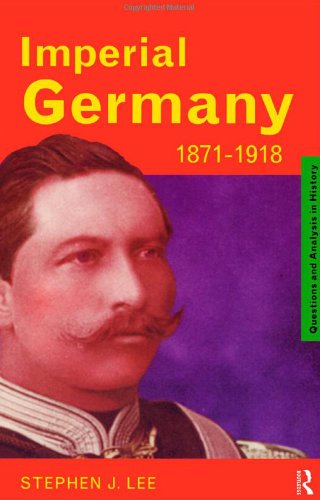
Imperial Germany 1871-1918 (Questions and Analysis in History)
Authors:
Stephen J. Lee
Publisher:
Routledge
Publication Date:
Not available
ISBN:
0415185742
Imperial Germany, 1871-1918 explores the rise of Germany as a nation state and a European power centre, through to the humiliation of the state in the... First World War. Covering both domestic and foreign policy, this key text combines historical detail, questions and analysis and evaluation of primary sources.

Imperial Germany 1871-1918 (The Short Oxford History of Germany)
Authors:
Not Available
Publisher:
Oxford University Press, USA
Publication Date:
Not available
ISBN:
019920487X
The German Empire was founded in January 1871 not only on the basis of Chancellor Otto von Bismarck's "blood and iron" policy but also with the support... of liberal nationalists. Under Bismarck and Kaiser Wilhelm II, Germany became the dynamo of Europe. Its economic and military power were pre-eminent; its science and technology, education, and municipal administration were the envy of the world; and its avant-garde artists reflected the ferment in European culture. But Germany also played a decisive role in tipping Europe's fragile balance of power over the brink and into the cataclysm of the First World War, eventually leading to the empire's collapse in military defeat and revolution in November 1918. With contributions from an international team of twelve experts in the field, this volume offers an ideal introduction to this crucial era, taking care to situate Imperial Germany in the larger sweep of modern German history, without suggesting that Nazism or the Holocaust were inevitable endpoints to the developments charted here.
Imperial Germany and the Great War, 1914-1918 (New Approaches to...
Authors:
Roger Chickering
Publisher:
Cambridge University Press
Publication Date:
Not available
ISBN:
0521547806
Unlike other existing surveys, this book explores the comprehensive impact of the First World War on Imperial Germany by offering a rich portrait of... life on the home front: the pervasive effects of 'total war' on wealthy and poor, men and women, young and old, farmers and city-dwellers, Protestants, Catholics, and Jews. Now appearing in a second edition, this accessible book reflects important new scholarship in the field and boasts an expanded and revised bibliography. It is essential reading for all students of German and European history, war and society. First Edition Hb (1998): 0-521-56148-5 First Edition Pb (1998): 0-521-56754-8
Imperial Germany and the Great War, 1914-1918 (New Approaches to...
Authors:
Roger Chickering
Publisher:
Cambridge University Press
Publication Date:
Not available
ISBN:
0521839084
Unlike other existing surveys, this book explores the comprehensive impact of the First World War on Imperial Germany by offering a rich portrait of... life on the home front: the pervasive effects of 'total war' on wealthy and poor, men and women, young and old, farmers and city-dwellers, Protestants, Catholics, and Jews. Now appearing in a second edition, this accessible book reflects important new scholarship in the field and boasts an expanded and revised bibliography. It is essential reading for all students of German and European history, war and society. First Edition Hb (1998): 0-521-56148-5 First Edition Pb (1998): 0-521-56754-8
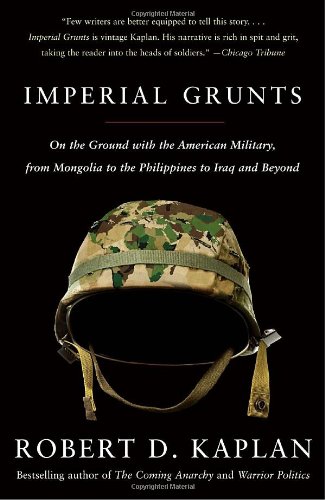
Imperial Grunts: On the Ground with the American Military, from...
Authors:
Robert D. Kaplan
Publisher:
Vintage
Publication Date:
Not available
ISBN:
1400034574
A fascinating, unprecedented first-hand look at the soldiers on the front lines on the Global War on Terror. Plunging deep into midst of some of the... hottest conflicts on the globe, Robert D. Kaplan takes us through mud and jungle, desert and dirt to the men and women on the ground who are leading the charge against threats to American security. These soldiers, fighting in thick Colombian jungles or on dusty Afghani plains, are the forefront of the new American foreign policy, a policy being implemented one soldier at a time. As Kaplan brings us inside their thoughts, feelings, and operations, these modern grunts provide insight and understanding into the War on Terror, bringing the war, which sometimes seems so distant, vividly to life.
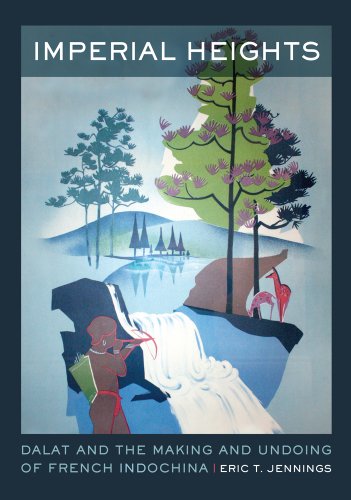
Imperial Heights: Dalat and the Making and Undoing of French...
Authors:
Eric T. Jennings
Publisher:
University of California Press
Publication Date:
Not available
ISBN:
0520272692
Intended as a reminder of Europe for soldiers and clerks of the empire, the city of Dalat, located in the hills of Southern Vietnam, was built by the... French in an alpine locale that reminded them of home. This book uncovers the strange 100-year history of a colonial city that was conceived as a center of power and has now become a kitsch tourist destination famed for its colonial villas, flower beds, pristine lakes, and pastoral landscapes. Eric T. Jennings finds that from its very beginning, Dalat embodied the paradoxes of colonialism--it was a city of leisure built on the backs of thousands of coolies, a supposed paragon of hygiene that offered only questionable protection from disease, and a new venture into ethnic relations that ultimately backfired. Jennings' fascinating history opens a new window onto virtually all aspects of French Indochina, from architecture and urban planning to violence, labor, métissage, health and medicine, gender and ethic relations, schooling, religion, comportments, anxieties, and more.
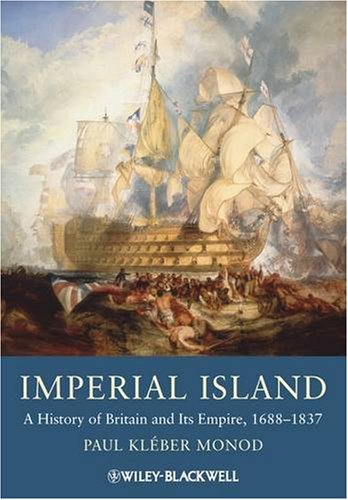
Imperial Island: A History of Britain and Its Empire, 1660-1837
Authors:
Paul Kléber Monod
Publisher:
Wiley-Blackwell
Publication Date:
Not available
ISBN:
1405134453
Imperial Island: A History of Britain and its Empire, 1660-1837 is a comprehensive account of Great Britain's imperial path from the Stuart Restoration... of 1660 to its emergence as a dominant global superpower. Suitable for students with no prior knowledge of British historyOrganized to help students and instructors: comprises 21 thematic chapters set within a clear, chronological frameworkIncludes over 30 illustrations and maps to help orient the readerAddresses the new generation of American and British students that are interested in global, environmental, and cultural history
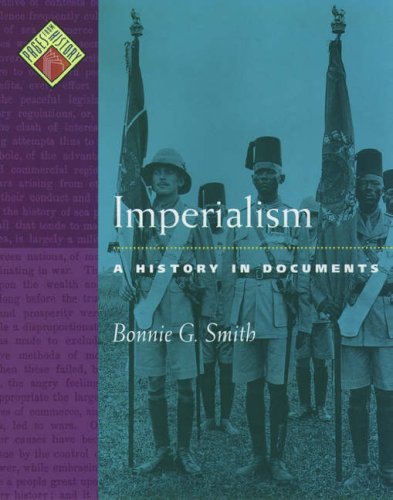
Imperialism: A History in Documents (Pages from History (Hardback))
Authors:
Bonnie G. Smith
Publisher:
Oxford University Press, USA
Publication Date:
Not available
ISBN:
0195108019
We talk about living in a global era, but the groundwork for it was laid more than a century ago. By the late 19th century, Europe, Japan, and the... United States had taken control of most of the world. Travel and trade between home countries and colonies sent goods and technology to even the most remote corners of the globe. An English lady's letter home on smallpox inoculations in Turkey, an American missionary's account of the forcible collection of rubber in Belgian Congo, and a Chinese official's regulations for European merchants are among the primary sources that Bonnie Smith has assembled to demonstrate the advantages and drawbacks of the new economy. Society, education, and the environment also underwent massive changes, as witnessed by the selection of excerpts from an exam in a German missionary school in Togo and British reports on the devastation of entire forests in Burma.Imperial growth did not come without a price. A Japanese document outlining governance in Korea and U.S. President Benjamin Harrison's defense of the annexation of Hawaii illustrate the militant nationalism, religious intolerance, and pseudo-scientific racist theories used to justify the brute force of colonial rule. The colonized nations fought back-a popular Chinese poem in praise of the Boxers' opposition to foreign rule attests to this rebellious spirit, and a Moroccan's shock at "barbaric" European mores illustrates the conquered's view of the conquerors. A picture essay, "Mixture," showcases the amalgamation of global cultures through photographs of buildings, furniture, advertisements, sporting events, and sculpture. Bonnie Smith vividly captures the booming expansion of a flawed political system and expertly links the documentary evidence with informed commentary and prefatory essays to each chapter.
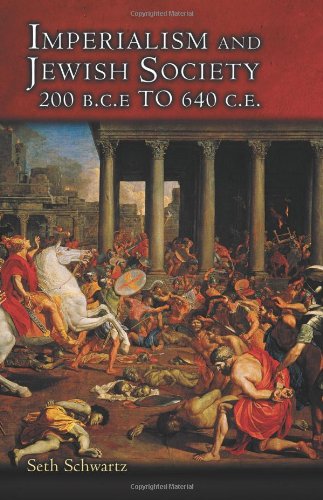
Imperialism and Jewish Society: 200 B.C.E. to 640 C.E. (Jews,...
Authors:
Seth Schwartz
Publisher:
Princeton University Press
Publication Date:
Not available
ISBN:
0691117810
This provocative new history of Palestinian Jewish society in antiquity marks the first comprehensive effort to gauge the effects of imperial domination... on this people. Probing more than eight centuries of Persian, Greek, and Roman rule, Seth Schwartz reaches some startling conclusions--foremost among them that the Christianization of the Roman Empire generated the most fundamental features of medieval and modern Jewish life.Schwartz begins by arguing that the distinctiveness of Judaism in the Persian, Hellenistic, and early Roman periods was the product of generally prevailing imperial tolerance. From around 70 C.E. to the mid-fourth century, with failed revolts and the alluring cultural norms of the High Roman Empire, Judaism all but disintegrated. However, late in the Roman Empire, the Christianized state played a decisive role in ''re-Judaizing'' the Jews. The state gradually excluded them from society while supporting their leaders and recognizing their local communities. It was thus in Late Antiquity that the synagogue-centered community became prevalent among the Jews, that there re-emerged a distinctively Jewish art and literature--laying the foundations for Judaism as we know it today.Through masterful scholarship set in rich detail, this book challenges traditional views rooted in romantic notions about Jewish fortitude. Integrating material relics and literature while setting the Jews in their eastern Mediterranean context, it addresses the complex and varied consequences of imperialism on this vast period of Jewish history more ambitiously than ever before. Imperialism in Jewish Society will be widely read and much debated.
Imperialism and the Corruption of Democracies (Radical Perspectives)
Authors:
Herman Lebovics
Publisher:
Duke University Press Books
Publication Date:
Not available
ISBN:
0822336979
In this important volume, Herman Lebovics, a preeminent cultural historian of France, develops a historical argument with striking contemporary... relevance: empire abroad inevitably undermines democracy at home. These essays, which Lebovics wrote over the past decade, demonstrate the impressive intellectual range of his work. Focusing primarily on France and to a lesser extent on the United Kingdom, he shows how empire and its repercussions have pervaded—and corroded—Western cultural, intellectual, and social life from the mid-nineteenth century to the present.Some essays explore why modern Western democratic societies needed colonialism. Among these is an examination of the seventeenth-century philosopher John Locke’s prescient conclusion that liberalism could only control democratic forces with the promise of greater wealth enabled by empire. In other essays Lebovics considers the relation between overseas rule and domestic life. Discussing George Orwell’s tale “Shooting an Elephant” and the careers of two colonial officers (one British and one French), he contemplates the ruinous authoritarianism that develops among the administrators of empire. Lebovics considers Pierre Bourdieu’s thinking about how colonialism affected metropolitan French life, and he reflects on the split between sociology and ethnology, which was partly based on a desire among intellectuals to think one way about metropolitan populations and another about colonial subjects. Turning to the arts, Lebovics traces how modernists used the colonial “exotic” to escape the politicized and contested modernity of the urban West. Imperialism and the Corruption of Democracies is a compelling case for cultural history as a key tool for understanding the injurious effects of imperialism and its present-day manifestations within globalization.
Imperialism (Ann Arbor Paperbacks)
Authors:
J. A. Hobson
Publisher:
University of Michigan Press
Publication Date:
Not available
ISBN:
0472061038
Imperialism: A Study
Authors:
J. A. Hobson
Publisher:
Cosimo Classics
Publication Date:
Not available
ISBN:
1596052503
In his Preface to the 1902 first edition of Imperialism: A Study, imperial critic J.A. Hobson demonstrates his prophetic talents by noting, just as the... Victorian age was ending and World War I was brewing, that "Imperialism has been adopted as a more or less conscious policy by several European States and threatens to break down the political isolation of the United States." Though the book speaks mostly of British imperialism of the period, Hobson inevitably explores the general principals-and hidden motives-of imperialist policy. Hobson covers: . the commercial value of imperialism . imperialism as an outlet for population . economic parasites of imperialism . imperialist finance . moral and sentimental factors . and much more. With imperialism again a hot topic in the political arena, Hobson's treatise continues to lend invaluable, necessary insight into a complex ideology. British writer JOHN ATKINSON HOBSON (1858-1940) was an historian and economist as well as a popular lecturer on the topics. His other books include The Evolution of Modern Capitalism (1894), The Economics of Distribution (1900), The Economics of Unemployment (1922), and the autobiographical Confessions of an Economic Heretic (1938).
Imperialism (Cambridge Library Collection - British and Irish...
Authors:
John Atkinson Hobson
Publisher:
Cambridge University Press
Publication Date:
Not available
ISBN:
1108025145
J. A. Hobson (1858-1940) was an English economist and early socialist, whose writings on capitalism and industrialism influenced Lenin and Trotsky, and... were highly regarded by John Maynard Keynes. Imperialism, published in 1902, is considered his most important work. Employed as a war correspondent by the Manchester Guardian to report on the Second Boer War, he became convinced that imperial expansion was driven by the desire to find new markets and investment opportunities, resulting in capitalistic exploitation of the colonies. He argued that imperial policies were a fundamental cause of international conflict, as greed led to aggression and militarism. While modern critics have seen weaknesses in his arguments, such as his failure to examine the development of the British Empire out of early private trading enterprises, Hobson was a very influential and prolific writer and social theorist, who helped shape British welfare policy in the twentieth century.
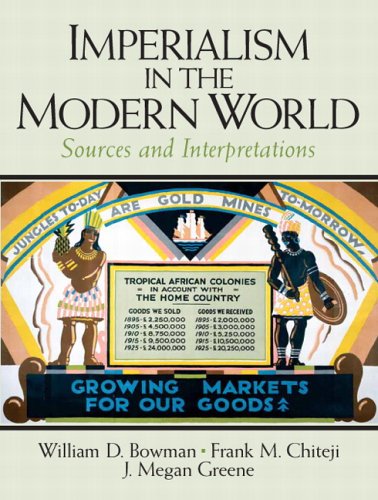
Imperialism in the Modern World: Sources and Interpretations
Authors:
William D. Bowman
Publisher:
Pearson
Publication Date:
Not available
ISBN:
0131899058
Imperialism in the Modern World combines narrative, primary and secondary sources, and visual documents to examine global relations in the nineteenth... and twentieth centuries. The three co-editors, Professors Bowman, Chiteji, and Greene, have taught for many years global history classes in a variety of institutions. They wrote Imperialism in the Modern World to solve the problem of allowing teachers to combine primary and secondary texts easily and systematically to follow major themes in global history (some readers use primary materials exclusively. Some focus on secondary arguments). This book is more focused than other readers on the markets for those teachers who are offering more specialized world history courses–one important trend in global history is away from simply trying to cover everything to teaching real connections in more chronologically and thematically focused courses. The reader also provides a genuine diversity of global perspectives and invites students to study seriously world history from a critical framework. Too many readers offer a smorgasbord approach to world history that leaves students dazed and confused. This reader avoids that approach and will therefore solve many problems that teachers have in constructing and teaching world history courses at the introductory or upper-division levels. The reader will allow show students how to read historical documents through a hands-on demonstration in the introduction. The book also incorporates images as visual documents. Finally, the book conceives of global history in the widest possible terms; it contains pieces on political, diplomatic, economic, and military history, to be sure, but it also has selections on technology, medicine, women, the environment, social changes, and cultural patterns. Other readers can not match this text’s breadth because they are chronologically and thematically so extended.
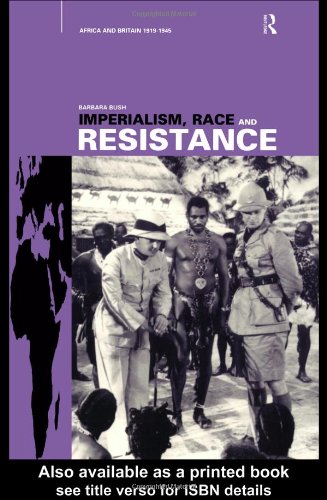
Imperialism, Race and Resistance: Africa and Britain, 1919-1945
Authors:
Barbara Bush
Publisher:
Routledge
Publication Date:
Not available
ISBN:
0415159733
Imperialism, Race and Resistance marks an important new development in the study of British and imperial interwar history.Focusing on Britain, West... Africa and South Africa, Imperialism, Race and Resistance charts the growth of anti-colonial resistance and opposition to racism in the prelude to the 'post-colonial' era. The complex nature of imperial power in explored, as well as its impact on the lives and struggles of black men and women in Africa and the African diaspora.Barbara Bush argues that tensions between white dreams of power and black dreams of freedom were seminal in transofrming Britain's relationship with Africa in an era bounded by global war and shaped by ideological conflict.
 '





