production
/viewbook/list/all/?page=5914
/
/static/
None
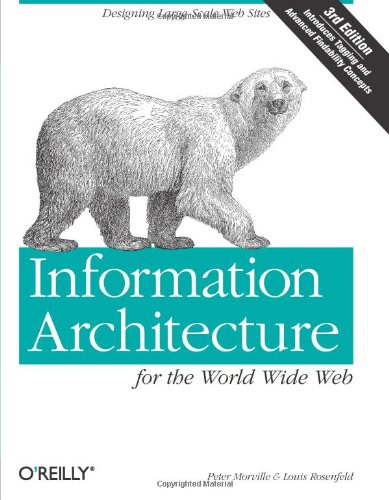
Information Architecture for the World Wide Web: Designing...
Authors:
Peter Morville
Publisher:
O'Reilly Media
Publication Date:
Not available
ISBN:
0596527349
The post-Ajaxian Web 2.0 world of wikis, folksonomies, and mashups makes well-planned information architecture even more essential. How do you present... large volumes of information to people who need to find what they're looking for quickly? This classic primer shows information architects, designers, and web site developers how to build large-scale and maintainable web sites that are appealing and easy to navigate.The new edition is thoroughly updated to address emerging technologies -- with recent examples, new scenarios, and information on best practices -- while maintaining its focus on fundamentals. With topics that range from aesthetics to mechanics, Information Architecture for the World Wide Web explains how to create interfaces that users can understand right away. Inside, you'll find:An overview of information architecture for both newcomers and experienced practitioners The fundamental components of an architecture, illustrating the interconnected nature of these systems. Updated, with updates for tagging, folksonomies, social classification, and guided navigationTools, techniques, and methods that take you from research to strategy and design to implementation. This edition discusses blueprints, wireframes and the role of diagrams in the design phaseA series of short essays that provide practical tips and philosophical advice for those who work on information architectureThe business context of practicing and promoting information architecture, including recent lessons on how to handle enterprise architectureCase studies on the evolution of two large and very different information architectures, illustrating best practices along the wayHow do you document the rich interfaces of web applications? How do you design for multiple platforms and mobile devices? With emphasis on goals and approaches over tactics or technologies, this enormously popular book gives you knowledge about information architecture with a framework that allows you to learn new approaches -- and unlearn outmoded ones.
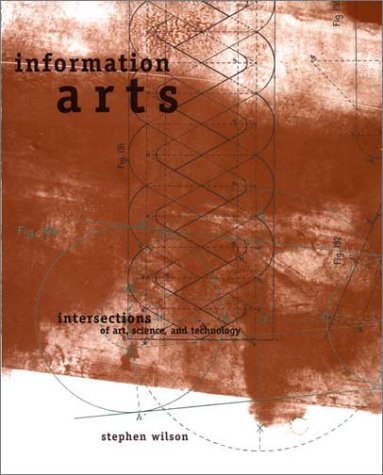
Information Arts: Intersections of Art, Science, and Technology...
Authors:
Stephen Wilson
Publisher:
The MIT Press
Publication Date:
Not available
ISBN:
0262731584
A new breed of contemporary artist engages science and technology--not just to adopt the vocabulary and gizmos, but to explore and comment on the... content, agendas, and possibilities. Indeed, proposes Stephen Wilson, the role of the artist is not only to interpret and to spread scientific knowledge, but to be an active partner in determining the direction of research. Years ago, C. P. Snow wrote about the "two cultures" of science and the humanities; these developments may finally help to change the outlook of those who view science and technology as separate from the general culture.In this rich compendium, Wilson offers the first comprehensive survey of international artists who incorporate concepts and research from mathematics, the physical sciences, biology, kinetics, telecommunications, and experimental digital systems such as artificial intelligence and ubiquitous computing. In addition to visual documentation and statements by the artists, Wilson examines relevant art-theoretical writings and explores emerging scientific and technological research likely to be culturally significant in the future. He also provides lists of resources including organizations, publications, conferences, museums, research centers, and Web sites.
Information Assurance for the Enterprise: A Roadmap to Information...
Authors:
Corey Schou
Publisher:
McGraw-Hill/Irwin
Publication Date:
Not available
ISBN:
0072255242
Going beyond the technical coverage of computer and systems security measures, Information Assurance for the Enterprise provides readers an overarching... model for information assurance for businesses, government agencies, and other enterprises needing to establish a comprehensive plan. All the components of security and how they relate are featured, and readers will also be shown how an effective security policy can be developed. Topics like asset identification, human factors, compliance with regulations, personnel security, risk assessment and ethical considerations are covered, as well as computer and network security tools and methods. This is one of the only texts on the market that provides an up-to-date look at the whole range of security and IA topics. In post-9/11 times, managers and IT professionals need to address a wide range of security-related issues, and develop security systems that take all these diverse factors into account. As someone who has worked extensively with the U.S. State Department and other governmental agencies, Corey Schou is uniquely positioned to write the definitive book on the subject; and Daniel Shoemaker is a professor and consultant to the Department of Homeland Security in matters of Information Assurance policy.

Information Assurance: Managing Organizational IT Security Risks
Authors:
Joseph Boyce Employee of the Department of Defense
Publisher:
Butterworth-Heinemann
Publication Date:
Not available
ISBN:
0750673273
Written by two INFOSEC experts, this book provides a systematic and practical approach for establishing, managing and operating a comprehensive... Information Assurance program. It is designed to provide ISSO managers, security managers, and INFOSEC professionals with an understanding of the essential issues required to develop and apply a targeted information security posture to both public and private corporations and government run agencies.There is a growing concern among all corporations and within the security industry to come up with new approaches to measure an organization's information security risks and posture. Information Assurance explains and defines the theories and processes that will help a company protect its proprietary information including: * The need to assess the current level of risk.* The need to determine what can impact the risk.* The need to determine how risk can be reduced. The authors lay out a detailed strategy for defining information security, establishing IA goals, providing training for security awareness, and conducting airtight incident response to system compromise. Such topics as defense in depth, configuration management, IA legal issues, and the importance of establishing an IT baseline are covered in-depth from an organizational and managerial decision-making perspective. * Experience-based theory provided in a logical and comprehensive manner.* Management focused coverage includes establishing an IT security posture, implementing organizational awareness and training, and understanding the dynamics of new technologies.* Numerous real-world examples provide a baseline for assessment and comparison.

Information: A Very Short Introduction
Authors:
Luciano Floridi
Publisher:
Oxford University Press
Publication Date:
Not available
ISBN:
0199551375
We live in a society that is awash with information, but few of us really understand what information is. In this Very Short Introduction, one of the... world's leading authorities on the philosophy of information and on information ethics, Luciano Floridi, offers an illuminating exploration of information as it relates to both philosophy and science. He discusses the roots of the concept of information in mathematics and science, and considers the role of information in several fields, including biology. Floridi also discusses concepts such as "Infoglut" (too much information to process) and the emergence of an information society, and he addresses the nature of information as a communication process and its place as a physical phenomenon. Perhaps more important, he explores information's meaning and value, and ends by considering the broader social and ethical issues relating to information, including problems surrounding accessibility, privacy, ownership, copyright, and open source. This book helps us understand the true meaning of the concept and how it can be used to understand our world.About the Series: Combining authority with wit, accessibility, and style, Very Short Introductions offer an introduction to some of life's most interesting topics. Written by experts for the newcomer, they demonstrate the finest contemporary thinking about the central problems and issues in hundreds of key topics, from philosophy to Freud, quantum theory to Islam.

INFORMATION BOOKLET FOR MISSOURI STATE UNDERGRAD PSY STUDENT
Authors:
Not Available
Publisher:
Not available
Publication Date:
Not available
ISBN:
Not available
Information Campaigns: Balancing Social Values and Social Change...
Authors:
Not Available
Publisher:
Sage Publications, Inc
Publication Date:
Not available
ISBN:
0803932197
Working from the premises that information campaigns and social marketing efforts represent attempts at planned social change and that it is... insufficient to examine inherently social phenomena in a social vacuum, the contributors to this volume provide a social context for examining these domains. Interdisciplinary in approach, this volume represents a merging of the traditions of marketing and strategic communication. The first section, Campaigns and Social Structure, pays particular attention to the social context in which campaigns are designed, implemented and analyzed. Each chapter addresses a set of concerns campaign organizers face and, as a whole, illustrate the broad range of social concerns which campaigns address
Information Dashboard Design: The Effective Visual Communication of...
Authors:
Stephen Few
Publisher:
O'Reilly Media
Publication Date:
Not available
ISBN:
0596100167
Dashboards have become popular in recent years as uniquely powerful tools for communicating important information at a glance. Although dashboards are... potentially powerful, this potential is rarely realized. The greatest display technology in the world won't solve this if you fail to use effective visual design. And if a dashboard fails to tell you precisely what you need to know in an instant, you'll never use it, even if it's filled with cute gauges, meters, and traffic lights. Don't let your investment in dashboard technology go to waste. This book will teach you the visual design skills you need to create dashboards that communicate clearly, rapidly, and compellingly. Information Dashboard Design will explain how to: Avoid the thirteen mistakes common to dashboard design Provide viewers with the information they need quickly and clearly Apply what we now know about visual perception to the visual presentation of information Minimize distractions, cliches, and unnecessary embellishments that create confusion Organize business information to support meaning and usability Create an aesthetically pleasing viewing experience Maintain consistency of design to provide accurate interpretation Optimize the power of dashboard technology by pairing it with visual effectiveness Stephen Few has over 20 years of experience as an IT innovator, consultant, and educator. As Principal of the consultancy Perceptual Edge, Stephen focuses on data visualization for analyzing and communicating quantitative business information. He provides consulting and training services, speaks frequently at conferences, and teaches in the MBA program at the University of California in Berkeley. He is also the author of Show Me the Numbers: Designing Tables and Graphs to Enlighten.
Information Design Workbook: Graphic approaches, solutions, and...
Authors:
Kim Baer
Publisher:
Rockport Publishers
Publication Date:
Not available
ISBN:
1592536271
New in paperback, this workbook is a methodical yet comprehensive approach to conveying the fundamentals of avant-garde, innovative, information design... by examining history, theory, criticism, technology and media, process, method, and practice. Opening with a very brief history followed by an instructive breakdown of the discipline, readers get an intimate understanding of the complexities of crafting information design to effectively improve communication both functionally and aesthetically. The back half of the book contains a wide range of case studies from design firms around the world so designers can see the techniques previously outlined in the first half of the book. The author also critiques and explains why the design is successful in terms of formal quality (Aesthetics) and function (How does it improve communication?).
Information Development: Managing Your Documentation Projects,...
Authors:
JoAnn T. Hackos
Publisher:
Wiley
Publication Date:
Not available
ISBN:
0471777110
A revolutionary new resource that brings documentation product management ideas up to dateThe 1994 bestselling classic Managing Your Documentation... Projects set the industry standard for technical documentation. However, since then, much has changed in the world of information development. With this new title, JoAnn Hackos looks beyond the structured project of the 1980s and 1990s. Instead, she focuses on the rapidly changing projects of the 21st century and addresses how to introduce agile information development without neglecting the central focus of planning information design and development around the needs of information users.As an information-development manager, you are expected to reduce costs and project time, do more work with fewer resources and less money, and increase the value of the information you deliver. Recognizing this, Hackos has carefully designed this book to help you do precisely that. She helps you make strategic decisions about information development and directs the discussion of project management toward smarter decision-making.An update of the original 1994 Information Process Maturity Model (IPMM) presents you with a method by which you can compare the state of your organization to others, evaluate your current status, and then consider what is necessary in order to move to the next level.Information Development offers a completely new look at best practices for all phases of the document development lifecycle, including:Managing a corporate information portfolioEvaluating process maturityPartnering with customers and developing user scenariosDeveloping team effectiveness and collaborationPlanning and monitoring information projectsManaging translation and productionEvaluating project performanceManaging for quality, efficiency, and cost-effectivenessThe companion Web site includes electronic versions of the templates and checklists featured in the book.Wiley Technology Publishing Timely. Practical. Reliable.Visit our Web site at www.wiley.com/compbooks/

Information Discovery on Electronic Health Records (Chapman &...
Authors:
Not Available
Publisher:
Chapman and Hall/CRC
Publication Date:
Not available
ISBN:
1420090380
Exploiting the rich information found in electronic health records (EHRs) can facilitate better medical research and improve the quality of medical... practice. Until now, a trivial amount of research has been published on the challenges of leveraging this information. Addressing these challenges, Information Discovery on Electronic Health Records explores the technology to unleash the data stored in EHRs. Assembling a truly interdisciplinary team of experts, the book tackles medical privacy concerns, the lack of standardization for the representation of EHRs, missing or incorrect values, and the availability of multiple rich health ontologies. It looks at how to search the EHR collection given a user query and return relevant fragments from the EHRs. It also explains how to mine the EHR collection to extract interesting patterns, group entities to various classes, or decide whether an EHR satisfies a given property. Most of the book focuses on textual or numeric data of EHRs, where more searching and mining progress has occurred. A chapter on the processing of medical images is also included. Maintaining a uniform style across chapters and minimizing technical jargon, this book presents the various ways to extract useful knowledge from EHRs. It skillfully discusses how EHR data can be effectively searched and mined.
Information Ecology: Mastering the Information and Knowledge...
Authors:
Thomas H. Davenport
Publisher:
Oxford University Press, USA
Publication Date:
Not available
ISBN:
0195111680
According to virtually every business writer, we are in the midst of a new "information age," one that will revolutionize how workers work, how... companies compete, perhaps even how thinkers think. And it is certainly true that Information Technology has become a giant industry. In America, more that 50% of all capital spending goes into IT, accounting for more than a third of the growth of the entire American economy in the last four years. Over the last decade, IT spending in the U.S. is estimated at 3 trillion dollars. And yet, by almost all accounts, IT hasn't worked all that well. Why is it that so many of the companies that have invested in these costly new technologies never saw the returns they had hoped for? And why do workers, even CEOs, find it so hard to adjust to new IT systems? In Information Ecology, Thomas Davenport proposes a revolutionary new way to look at information management, one that takes into account the total information environment within an organization. Arguing that the information that comes from computer systems may be considerably less valuable to managers than information that flows in from a variety of other sources, the author describes an approach that encompasses the company's entire information environment, the management of which he calls information ecology. Only when organizations are able to combine and integrate these diverse sources of information, and to take them to a higher level where information becomes knowledge, will they realize the full power of their information ecology. Thus, the author puts people, not technology, at the center of the information world. Information and knowledge are human creations, he points out, and we will never excel at managing them until we give people a primary role. Citing examples drawn from his own extensive research and consulting including such major firms as A.T. & T., American Express, Ford, General Electric, Hallmark, Hoffman La Roche, IBM, Polaroid, Pacific Bell, and Toshiba Davenport illuminates the critical components of information ecology, and at every step along the way, he provides a quick assessment survey for managers to see how their organization measures up. He discusses the importance of developing an overall strategy for information use; explores the infighting, jealousy over resources, and political battles that can frustrate information sharing; underscores the importance of looking at how people really use information (how they search for it, modify it, share it, hoard it, and even ignore it) and the kinds of information they want; describes the ideal information staff, who not only store and retrive information, but also prune, provide context, enhance style, and choose the right presentation medium (in an age of work overload, vital information must be presented compellingly so the appropriate people recognize and use it); examines how information management should be done on a day to day basis; and presents several alternatives to the machine engineering approach to structuring and modeling information. Davenport makes explicit what many managers already know in their gut: that useful information flow depends on people, not equipment. In Information Ecology he paves the way for all managers to build a more competitive, creative, practical information environment for their companies.

Information Economics (Routledge Advanced Texts in Economics and...
Authors:
Urs Birchler
Publisher:
Routledge
Publication Date:
Not available
ISBN:
041537345X
This new text book by Urs Birchler and Monika Butler is an introduction to the study of how information affects economic relations. The authors... provide a narrative treatment of the more formal concepts of Information Economics, using easy to understand and lively illustrations from film and literature and nutshell examples. The book first covers the economics of information in a 'man versus nature' context, explaining basic concepts like rational updating or the value of information. Then in a 'man versus man' setting, Birchler and Butler describe strategic issues in the use of information: the make-buy-or-copy decision, the working and failure of markets and the important role of outguessing each other in a macroeconomic context. It closes with a 'man versus himself' perspective, focusing on information management within the individual. This book also comes with a supporting website (www.alicebob.info), maintained by the authors.

Information Feudalism: Who Owns the Knowledge Economy?
Authors:
Peter Drahos
Publisher:
New Press, The
Publication Date:
Not available
ISBN:
1595581227
The definitive account of how multinational corporations have seized control of intellectual property rights.In a few short years, the battle over... intellectual property rights has emerged from obscurity to become front-page news. The continent-hopping, three-year court battle fought by activists to bring cheap versions of desperately needed AIDS drugs to South Africa is but one example of how this seemingly arcane area of international regulation has become a crucial battleground in the twenty-first century and is animating activists the world over.This powerful book is the definitive history of how the new global intellectual property regime—the rulebook for the knowledge economy—came to be. Drawing on more than five years of research and more than five hundred interviews with key figures—including negotiators for First and Third World countries, leaders of multinational corporations, and public-interest experts, Information Feudalism uncovers the story of how a small coterie of multi-national corporations wrote the charter for the global information order.Information Feudalism is an authoritative history of the demise of the world's intellectual commons, and a potent call for democratic property rights.
INFORMATION FOR ARTISTS: A PRACTICAL GUIDE FOR VIS
Authors:
Not Available
Publisher:
Not available
Publication Date:
Not available
ISBN:
Not available
 '





