production
/viewbook/list/all/?page=5928
/
/static/
None

In His Steps (Pure Gold Classics)
Authors:
Charles Monroe Sheldon
Publisher:
Bridge-Logos
Publication Date:
Not available
ISBN:
0882707825
Rev. Henry Maxwell, speaking slowly and eterminedly, yet not fully realizing the implications of what lay ahead of him, repeated his astounding... proposition, "I want volunteers from First Church who will pledge themselves, earnestly and honestly, for an entire year, not to do anything without first asking the question, 'What would Jesus do?'" Maxwell never dreamed that among those who responded would be the most influential members of his congregation, the wealthy heiress with her millions at stake, the newspaper editor with his job on the line, the president of the local college, the town beauty. But together they pledged themselves to a new step of faith that would change, not just a handful of people, but an entire town - for good.
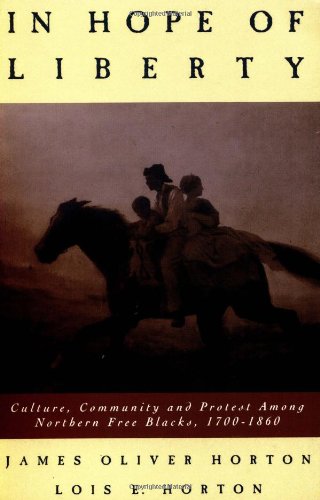
In Hope of Liberty: Culture, Community and Protest among Northern...
Authors:
James Oliver Horton
Publisher:
Oxford University Press, USA
Publication Date:
Not available
ISBN:
0195124650
Prince Hall, a black veteran of the American Revolution, was insulted and disappointed but probably not surprised when white officials refused his offer... of help. He had volunteered a troop of 700 Boston area blacks to help quell a rebellion of western Massachusetts farmers led by Daniel Shays during the economic turmoil in the uncertain period following independence. Many African Americans had fought for America's liberty and their own in the Revolution, but their place in the new nation was unresolved. As slavery was abolished in the North, free blacks gained greater opportunities, but still faced a long struggle against limits to their freedom, against discrimination, and against southern slavery. The lives of these men and women are vividly described in In Hope of Liberty, spanning the 200 years and eight generations from the colonial slave trade to the Civil War. In this marvelously peopled history, James and Lois Horton introduce us to a rich cast of characters. There are familiar historical figures such as Crispus Attucks, a leader of the Boston Massacre and one of the first casualties of the American Revolution; Sojourner Truth, former slave and eloquent antislavery and women's rights activist whose own family had been broken by slavery when her son became a wedding present for her owner's daughter; and Prince Whipple, George Washington's aide, easily recognizable in the portrait of Washington crossing the Delaware River. And there are the countless men and women who struggled to lead their daily lives with courage and dignity: Zilpha Elaw, a visionary revivalist who preached before crowds of thousands; David James Peck, the first black to graduate from an American medical school in 1848; Paul Cuffe, a successful seafaring merchant who became an ardent supporter of the black African colonization movement; and Nancy Prince, at eighteen the effective head of a scattered household of four siblings, each boarded in different homes, who at twenty-five was formally presented to the Russian court. In a seamless narrative weaving together all these stories and more, the Hortons describe the complex networks, both formal and informal, that made up free black society, from the black churches, which provided a sense of community and served as a training ground for black leaders and political action, to the countless newspapers which spoke eloquently of their aspirations for blacks and played an active role in the antislavery movement, to the informal networks which allowed far-flung families to maintain contact, and which provided support and aid to needy members of the free black community and to fugitives from the South. Finally, they describe the vital role of the black family, the cornerstone of this variegated and tightly knit community In Hope of Liberty brilliantly illuminates the free black communities of the antebellum North as they struggled to reconcile conflicting cultural identities and to work for social change in an atmosphere of racial injustice. As the black community today still struggles with many of the same problems, this insightful history reminds us how far we have come, and how far we have yet to go.
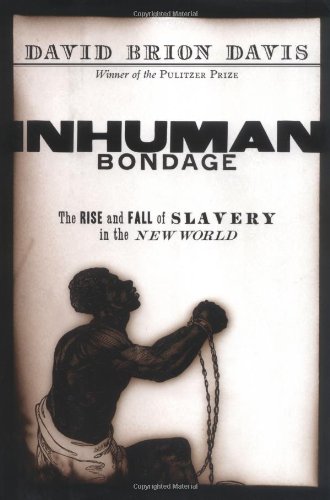
Inhuman Bondage: The Rise and Fall of Slavery in the New World
Authors:
David Brion Davis
Publisher:
Oxford University Press, USA
Publication Date:
Not available
ISBN:
0195140737
David Brion Davis has long been recognized as the leading authority on slavery in the Western World. His books have won every major history... award--including the Pulitzer Prize and the National Book Award--and he has been universally praised for his prodigious research, his brilliant analytical skill, and his rich and powerful prose. Now, in Inhuman Bondage, Davis sums up a lifetime of insight in what Stanley L. Engerman calls "a monumental and magisterial book, the essential work on New World slavery for several decades to come." Davis begins with the dramatic Amistad case, which vividly highlights the international character of the Atlantic slave trade and the roles of the American judiciary, the presidency, the media, and of both black and white abolitionists. The heart of the book looks at slavery in the American South, describing black slaveholding planters, the rise of the Cotton Kingdom, the daily life of ordinary slaves, the highly destructive internal, long-distance slave trade, the sexual exploitation of slaves, the emergence of an African-American culture, and much more. But though centered on the United States, the book offers a global perspective spanning four continents. It is the only study of American slavery that reaches back to ancient foundations (discussing the classical and biblical justifications for chattel bondage) and also traces the long evolution of anti-black racism (as in the writings of David Hume and Immanuel Kant, among many others). Equally important, it combines the subjects of slavery and abolitionism as very few books do, and it illuminates the meaning of nineteenth-century slave conspiracies and revolts, with a detailed comparison with 3 major revolts in the British Caribbean. It connects the actual life of slaves with the crucial place of slavery in American politics and stresses that slavery was integral to America's success as a nation--not a marginal enterprise. A definitive history by a writer deeply immersed in the subject, Inhuman Bondage offers a compelling narrative that links together the profits of slavery, the pain of the enslaved, and the legacy of racism. It is the ultimate portrait of the dark side of the American dream. Yet it offers an inspiring example as well--the story of how abolitionists, barely a fringe group in the 1770s, successfully fought, in the space of a hundred years, to defeat one of human history's greatest evils.
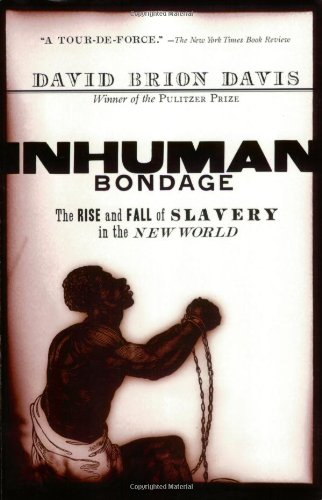
Inhuman Bondage: The Rise and Fall of Slavery in the New World
Authors:
David Brion Davis
Publisher:
Oxford University Press, USA
Publication Date:
Not available
ISBN:
0195339444
David Brion Davis has long been recognized as the leading authority on slavery in the Western World. His books have won every major history... award--including the Pulitzer Prize and the National Book Award--and he has been universally praised for his prodigious research, his brilliant analytical skill, and his rich and powerful prose. Now, in Inhuman Bondage, Davis sums up a lifetime of insight in what Stanley L. Engerman calls "a monumental and magisterial book, the essential work on New World slavery for several decades to come." Davis begins with the dramatic Amistad case, which vividly highlights the international character of the Atlantic slave trade and the roles of the American judiciary, the presidency, the media, and of both black and white abolitionists. The heart of the book looks at slavery in the American South, describing black slaveholding planters, the rise of the Cotton Kingdom, the daily life of ordinary slaves, the highly destructive internal, long-distance slave trade, the sexual exploitation of slaves, the emergence of an African-American culture, and much more. But though centered on the United States, the book offers a global perspective spanning four continents. It is the only study of American slavery that reaches back to ancient foundations (discussing the classical and biblical justifications for chattel bondage) and also traces the long evolution of anti-black racism (as in the writings of David Hume and Immanuel Kant, among many others). Equally important, it combines the subjects of slavery and abolitionism as very few books do, and it illuminates the meaning of nineteenth-century slave conspiracies and revolts, with a detailed comparison with 3 major revolts in the British Caribbean. It connects the actual life of slaves with the crucial place of slavery in American politics and stresses that slavery was integral to America's success as a nation--not a marginal enterprise. A definitive history by a writer deeply immersed in the subject, Inhuman Bondage offers a compelling narrative that links together the profits of slavery, the pain of the enslaved, and the legacy of racism. It is the ultimate portrait of the dark side of the American dream. Yet it offers an inspiring example as well--the story of how abolitionists, barely a fringe group in the 1770s, successfully fought, in the space of a hundred years, to defeat one of human history's greatest evils.

Inhuman Thoughts: Philosophical Explorations of Posthumanity
Authors:
Asher Seidel
Publisher:
Lexington Books
Publication Date:
Not available
ISBN:
0739123297
Inhuman Thoughts is a philosophical exploration of the possibility of increasing the physiological and psychological capacities of humans to the point... that they are no longer biologically, psychologically, or socially human. The movement is from the human through the trans-human, to the post-human. The tone is optimistic; Seidel argues that such an evolution would be of positive value on the whole. Seidel's initial argument supports the need for a comprehensive ethical theory, the success of which would parallel that of a large-scale scientific revolution, such as Newtonian mechanics. He elaborates the movement from the improved-but-still-human to the post-human, and philosophically examines speculated examples of post-human forms of life, including indefinitely extended life-span, parallel consciousness, altered perception, a-sociality, and a-sexuality. Inhuman Thoughts is directed at those interested in philosophical questions on human nature and the best life given the possibilities of that nature. Seidel's overall argument is that the most satisfactory answer to the latter question involves a transcendence of the present confines of human nature.

Inigo Jones
Authors:
John Summerson
Publisher:
Paul Mellon Centre BA
Publication Date:
Not available
ISBN:
0300082444
Inigo Jones, the first English classical architect, was famous in his own time and was the posthumous sponsor of the Palladian movement of the... eighteenth century. This authoritative and elegantly written book, first published in 1966, reassessed Jones's life and career, cleared away the myths of attribution that surrounded his work and reassigned to him projects that had disappeared from his oeuvre. Summerson's classic text is enhanced by a foreword and notes by Howard Colvin, a bibliography and illustrations. John Summerson, a brilliant writer and lecturer on British architectural history, was curator of Sir John Soane's Museum in London. Howard Colvin, emeritus fellow of St. John's College, Oxford, was the author of 'A Biographical Dictionary of British Architects 1600-1840', published by Yale University Press.

In Italia
Authors:
Graziella Martina
Publisher:
Emc Pub
Publication Date:
Not available
ISBN:
1899888071
The Want Bone, "It’s largely about making, which is also destroying. Civilization in all of its horror and ugliness and its beauty consists of, you... know, it’s really all the work of Shiva, the Hindu god with the hammer who makes and breaks any artifact you look at." -- Former U.S. Poet Laureate Robert Pinsky

Initial 1: Cahiers d'exercices - Méthode de langue
Authors:
Marina Sala
Publisher:
Cle Intl
Publication Date:
Not available
ISBN:
2090334592

Initial 1: Méthode de français - Entraînement individuel double...
Authors:
Sylvie Poisson-Quinton
Publisher:
Cle
Publication Date:
Not available
ISBN:
2090321814

Initial 1: Méthode de français (Livre de l'élève)
Authors:
Sylvie Poisson-Quinton
Publisher:
Cle
Publication Date:
Not available
ISBN:
2090334584

Initial Interviewing: What Students Want to Know
Authors:
Tricia McClam
Publisher:
Brooks Cole
Publication Date:
Not available
ISBN:
0495501484
INITIAL INTERVIEWING: WHAT STUDENTS WANT TO KNOW is designed for a variety of courses, particularly those in both human services and social services,... where interviewing knowledge and skills are a required area of competency. Found at both the undergraduate and graduate levels, these essential courses provide students with knowledge, techniques, and values needed to conduct effective interviews. Examples of topics covered in this concise text include observation, collection of information (listening, questioning and reflecting skills), and challenging and confrontation skills. Accompanying interactive video resources enhance learning by providing students with opportunities to review their knowledge, reinforce their comprehension, apply the principles presented, analyze the process, develop creative ways to use their understanding of the process, and evaluate interview situations. Course titles include: Helping Skills Interventions Interviewing and Counseling Introduction to Human Services The Helping Relationship Client Advocacy Case Management
Initiating and Sustaining the Clinical Nurse Leader Role: A...
Authors:
James L. Harris
Publisher:
Jones & Bartlett Publishers
Publication Date:
Not available
ISBN:
0763776319
Initiating and Sustaining the Clinical Nurse Leader Role: A Practical Guide by James L. Harris and Linda Roussel is the only resource to focus solely on... the Clinical Nurse Leader and is designed to teach both CNL students and faculty who lead CNL programs everything they need to know. The CNL designs, implements, and evaluates client care by coordinating, delegating and supervising the care provided by the health care team, including licensed nurses, technicians, and other health professionals. This text serves as a practice guide for preparing the CNL and provides real world tools and processes. Key features include: Chapter objectives; Summaries; Articles; Case Studies; Notes from the Field; Interviews with CNLs, CNL Students, Employers of CNLs and Educators

Initiation a LA Culture Francaise
Authors:
Claudie F. Hester
Publisher:
Heinle & Heinle Pub
Publication Date:
Not available
ISBN:
0838436862
INITIATION A LA PSYCHOLOGIE
Authors:
Not Available
Publisher:
Not available
Publication Date:
Not available
ISBN:
Not available

Initiation thématique à la sociologie
Authors:
Simon Laflamme
Publisher:
Not available
Publication Date:
Not available
ISBN:
289423130X
Clear, concise and immensely practical, this book is written for those who may be involved in obstetric emergencies at all levels of care --... obstetricians, trainees, family practitioners, midwives, and nurses. The book will be especially useful to those who infrequently encounter such problems and whose facilities and assistance may be limited but it is comprehensive enough to be valuable to those with abundant experience and resources. The advice drawn from the author's extensive experience is authoritative and unequivocal. The text is divided into twenty-eight brief, well-focused chapters. The book is illustrated and fully indexed with selected references to further reading.
 '





