production
/viewbook/list/all/?page=603
/
/static/
None
American Civil Procedure: An Introduction (Yale Contemporary Law...
Authors:
Professor Geoffrey C. Hazard Jr.
Publisher:
Yale University Press
Publication Date:
Not available
ISBN:
0300065043
Discussing both specifics and broader themes, this book describes and analyzes civil litigation in the United States. The book explains (without... legalese) jury trial, adversary system, the power of the courts to make law as well as to declare it, and the role of civil justice in government.

American Civil War
Authors:
Terry L. Jones
Publisher:
McGraw-Hill
Publication Date:
Not available
ISBN:
0077402944
This rich and balanced narrative of the American Civil War combines a chronological organization with a thematic approach to provide a comprehensive... introduction to this pivotal conflict in the nation's history. Chronologically organized chapters on military history allow readers to easily follow the ebb and flow of the battlefield, while other, more topical chapters interspersed throughout explore such subjects as Civil War medicine, politics, prisoners of war, diplomacy, and the role of African-Americans and women, providing strong social and political context for the war and a greater understanding of the lasting impact of the time period. Each chapter also includes high interest features that provide biographical sketches of important personalities, little known facts about the Civil War, the histories of famous fighting units, and eyewitness accounts of dramatic events.

AMERICAN CIVIL WAR
Authors:
Not Available
Publisher:
Not available
Publication Date:
Not available
ISBN:
Not available
American Cold War Strategy: Interpreting Nsc 68
Authors:
Ernest R. May
Publisher:
Bedford/St. Martin's
Publication Date:
Not available
ISBN:
0312066376
Written in 1950, NSC 68 laid out the rationale for American Cold War strategy. This volume includes the complete text of NSC 68, followed by... commentaries from former officials, specialists on American foreign policy, and American and foreign scholars. Ernest May's analytical essays discuss the many ways in which this historical document can be read, remembered, and understood.
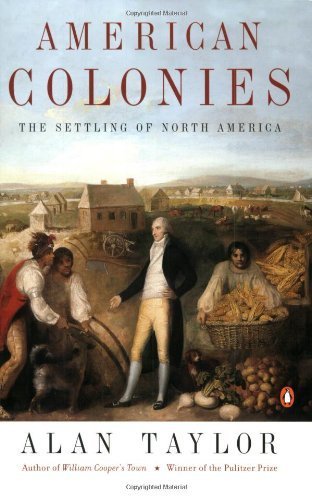
American Colonies: The Settling of North America (The Penguin...
Authors:
Alan Taylor
Publisher:
Penguin (Non-Classics)
Publication Date:
Not available
ISBN:
0142002100
With this volume, Alan Taylor challenges the traditional story of colonial history by examining the many cultures that helped make America. Transcending... the usual Anglocentric version of our colonial past, he recovers the importance of Native American tribes, African slaves, and the rival empires of France, Spain, the Netherlands, and even Russia in the colonization of North America. Moving beyond the Atlantic seaboard to examine the entire continent, American Colonies reveals a pivotal period in the global interaction of peoples, cultures, plants, animals, and microbes. In a vivid narrative, Taylor draws upon cutting-edge scholarship to create a timely picture of the colonial world characterized by an interplay of freedom and slavery, opportunity and loss.
American Colossus: The Triumph of Capitalism, 1865-1900
Authors:
H.W. Brands
Publisher:
Doubleday
Publication Date:
Not available
ISBN:
0385523335
In a grand-scale narrative history, the bestselling author of two finalists for the Pulitzer Prize now captures the decades when capitalism was at its... most unbridled and a few breathtakingly wealthy businessmen utterly transformed America from an agrarian economy to a world power. The years between the Civil War and the end of the nineteenth century saw the wholesale transformation of America from a land of small farmers and small businessmen into an industrial giant. Driven by unfathomably wealthy and powerful businessmen like J. P. Morgan, Andrew Carnegie and John D. Rockefeller, armies of workers, both male and female, were harnessed to a new vision of massive industry. A society rooted in the soil became one based in cities, and legions of immigrants were drawn to American shores. What’s more, in accomplishing its revolution, capitalism threatened to eclipse American democracy. “What do I care about the law?” bellowed Cornelius Vanderbilt. “Hain’t I got the power?” He did, and with it he and the other capitalists reshaped every aspect of American life. In American Colossus, H.W. Brands portrays the emergence, in a remarkably short time, of a recognizably modern America. The capitalist revolution left not a single area or aspect of American life untouched. It roared across the South, wrenching that region from its feudal past and integrating the southern economy into the national one. It burst over the West, dictating the destruction of Native American economies and peoples, driving the exploitation of natural resources, and making the frontier of settlement a business frontier as well. It crashed across the urban landscape of the East and North, turning cities into engines of wealth and poverty, opulence and squalor. It swamped the politics of an earlier era, capturing one major party and half of the other, inspiring the creation of a third party and determining the issues over which all three waged some of the bitterest battles in American history. Brands’s spellbinding narrative beautifully depicts the oil gushers of western Pennsylvania, the rise, in Chicago, of the first skyscraper, the exploration of the Colorado River, the cattle drives of the West, and the early passionate sparks of union life. By 1900 the America he portrays is wealthier than ever, yet prosperity is precarious, inequality rampant, and democracy stretched thin. American Colossus is an unforgettable portrait of the years when the contest between capitalism and democracy was at its sharpest, and capitalism triumphed.
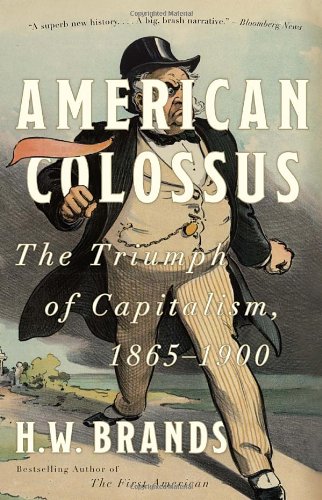
American Colossus: The Triumph of Capitalism, 1865-1900
Authors:
H.W. Brands
Publisher:
Anchor
Publication Date:
Not available
ISBN:
0307386775
In this grand-scale narrative history, two-time Pulitzer Prize finalist H. W. Brands brilliantly portrays the emergence, in a remarkably short time, of... a recognizably modern America. American Colossus captures the decades between the Civil War and the turn of the twentieth century, when a few breathtakingly wealthy businessmen transformed the United States from an agrarian economy to a world power. From the first Pennsylvania oil gushers to the rise of Chicago skyscrapers, this spellbinding narrative shows how men like Morgan, Carnegie, and Rockefeller ushered in a new era of unbridled capitalism. In the end America achieved unimaginable wealth, but not without cost to its traditional democratic values.
American Commodities in an Age of Empire
Authors:
Mona Domosh
Publisher:
Routledge
Publication Date:
Not available
ISBN:
0415945720
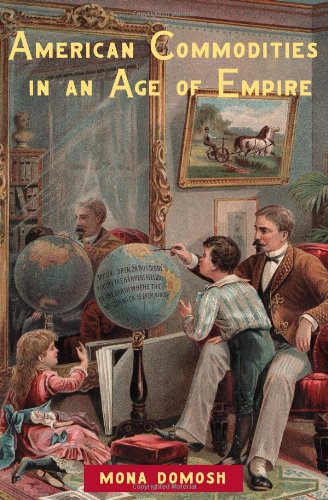
This is a novel interpretation of the relationship between consumerism, commercialism, and imperialism during the first empire building era of America... in the late nineteenth and early twentieth centuries. Unlike other empires in history, which were typically built on military power, the first American empire was primarily a commercial one, dedicated to pushing products overseas and dominating foreign markets. While the American government was important, it was the great capitalist firms of America – Heinz, Singer, McCormick, Kodak, Standard Oil – that drove the imperial process, explicitly linking the purchase of consumer goods overseas with 'civilization'. Their persistent message to America's prospective customers was, 'buy American products and join the march of progress'. Domosh also explores how the images of peoples overseas conveyed through goods elevated America's sense of itself in the world.
American Conflicts Law
Authors:
Robert L. Felix
Publisher:
Carolina Academic Press
Publication Date:
Not available
ISBN:
1594606528
American Conflicts Law is a comprehensive text designed to be used as a companion to all modern casebooks currently used in courses in Conflict of Laws... in United States' law schools. The sixth edition of American Conflicts Law continues the tradition of the first five editions in covering all important topics included in the Conflicts course. However, the text has been completely reorganized and shortened to achieve a succinct, but in-depth, treatment of this conceptually difficult subject. The revised and shortened version of the text will better meet the needs of law students for an informative and manageable study aid for the course in Conflict of Laws. Chapter One briefly introduces the subject and traces the historical evolution of Conflicts doctrine in the United States. Chapters Two and Three then establish the foundation for the exploration of conflict-of-laws in the United States by providing background in the modern law of personal jurisdiction and interstate judgment enforcement subjects that provide critical background for understanding choice-of-law theory. Chapter 4 introduces students to the choice-of-law systems currently prevailing in the United States, together with critical commentary on each system. Chapter 5 rounds out the coverage of choice-of-law systems with a discussion of numerous topics, such as Domicile and Proof of Foreign Law, that are common to all systems. Chapter 6 then explores the constitutional limits that exist on state conflict-of-laws doctrine in the United States, with special attention to the Due Process and Full Faith and Credit Clauses of the United States Constitution. Chapter 7 ends the general material with an examination of 'vertical choice of law,' the so-called Erie doctrine that governs the obligations of federal courts to apply state law in diversity and other actions. After this general background material, Chapters Eight through Twelve apply the general principles examined in Chapters One through Seven to particular topics. These chapters include coverage of conflict-of-laws problems in Torts (Chapter Eight), Contracts (Chapter Nine), Property (Chapter 10), Inheritance (Chapter 11), and Domestic Relations (Chapter 12). The revised text of the new sixth edition has, of course, been updated to include coverage of all modern developments since the fifth edition. This includes coverage in Chapter 4 of the Illinois Supreme Court's decision in Townsend v. Sears Roebuck & Co., 879 N.E.2d 893 (2007) and, in Chapter 7, the United States Supreme Court's decision under the Erie doctrine of Shady Grove Orthopedic Associates v. Allstate Insurance Co., 130 S. Ct. 1431(2010). The most important and relevant contemporary writing on Conflict of Laws has also been added to the footnotes. The authors believe that the revised sixth edition of American Conflicts Law will provide a useful tool with which to complete the understanding of modern choice-of-law doctrine in United States law schools.
American Conflicts Law: Cases and Materials
Authors:
Robert L. Felix
Publisher:
LEXISNEXIS
Publication Date:
Not available
ISBN:
1422470415
The Fifth Edition provides a comprehensive set of teaching materials for the course in Conflict of Laws as it is taught in most American law schools.... It includes some new cases, selected for their teaching value, while also retaining the best cases from the prior edition. It also includes problems in all chapters to test the students' understanding of each segment of material covered in the course.The first three chapters establish the historical background for the study of Conflict of Laws, introduce the students to all of the Conflicts systems existing in the United States, and explore the constitutional limits on the ability of the states to apply their law to multistate transactions and occurrences. With this background, the following four chapters examine the operation of the choice-of-law doctrines used in the areas of torts, contracts, property, and domestic relations. The grounding provided by the first three chapters allows teachers to choose those topics to teach in the following four chapters without necessarily covering the chapters in their entirety if time does not permit. The final three chapters deal with vertical choice of law (the Erie doctrine), interstate judgment enforcement, and personal jurisdiction. The book is organized so that these final three chapters can be covered out of order to suit a wide range of teaching preferences. Each chapter contains note material following the cases to help teachers explore the full range of issues raised by the doctrines being studied. The problems contained in each chapter increase the students' comprehension of the materials and provide a basis for more interesting classroom discussions.
American Confluence: The Missouri Frontier from Borderland to...
Authors:
Aron
Publisher:
Indiana University Press
Publication Date:
Not available
ISBN:
0253200113
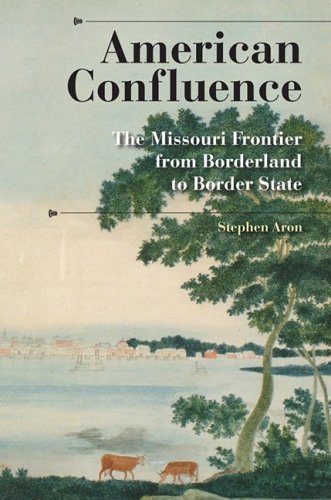
In the heart of North America, the Missouri, Ohio, and Mississippi rivers come together, uniting waters from west, north, and east on a journey to the... south. This is the region that Stephen Aron calls the American Confluence. Aron's innovative book examines the history of that region—a home to the Osage, a colony exploited by the French, a new frontier explored by Lewis and Clark—and focuses on the region's transition from a place of overlapping borderlands to one of oppositional border states. American Confluence is a lively account that will delight both the amateur and professional historian.
American Constitutional Interpretation
Authors:
Walter F. Murphy
Publisher:
Foundation Press
Publication Date:
Not available
ISBN:
159941242X
This undergaduate text uses original essays, cases and materials to study the very enterprise by which a constitution is interpreted and a... constitutional government created. It explores the American polity as both a constitutional and democratic entity. This volume is organized around a set of basic interrogatives: What is the constitution that is to be interpreted? Who are its authoritative interpreters? How do they go about their interpretive tasks?
American Constitutionalism: Volume I: Structures of Government
Authors:
Howard Gillman
Publisher:
Oxford University Press, USA
Publication Date:
Not available
ISBN:
0199751269
Constitutionalism in the United States is not determined solely by decisions made by the Supreme Court. Moving beyond traditional casebooks, renowned... scholars Howard Gillman, Mark A. Graber, and Keith E. Whittington take a refreshingly innovative approach in American Constitutionalism. Organized according to the standard two-semester sequence--in which Volume I covers institutions and Volume II covers Rights and Liberties-- this text is unique in that it presents the material in a historical organization within each volume, as opposed to the typical issues-based organization.FEATURES:* Covers all important debates in U.S. constitutionalism, organized by historical era* Incorporates readings from all of the prominent participants in those debates* Clearly lays out the political and legal contexts in chapter introductions* Integrates more documents and cases than any other text on the market, including decisions made by elected officials and state courts* Offers numerous pedagogical features, including topical sections within each historical chapter, bulleted lists of major developments, explanatory headnotes for the readings, questions on court cases, illustrations and political cartoons, tables, and suggested readingsCOMING SOON:American Constitutionalism: Volume II: Rights and Liberties (978-0-19-975135-8)
American Constitutional Law
Authors:
Louis Fisher
Publisher:
Carolina Academic Press
Publication Date:
Not available
ISBN:
1594609535
Now in its ninth edition, American Constitutional Law is the only book that develops constitutional law in the comprehensive sense. Along with... containing analyses and excerpts of court decisions, the book highlights the efforts of legislatures, executives, the states, and the general public to participate in an ongoing political dialogue rather than passively receive a series of unilateral judicial commands. It covers all new developments in case law, congressional statutes, presidential policies, and initiatives undertaken by states under their own constitutions. The book includes readings not only from cases but congressional floor debates, committee reports, committee hearings, presidential vetoes and other statements, state actions, Federalist papers, and professional journals. It also includes a chapter on equal protection that addresses immigration law and the rights of aliens.
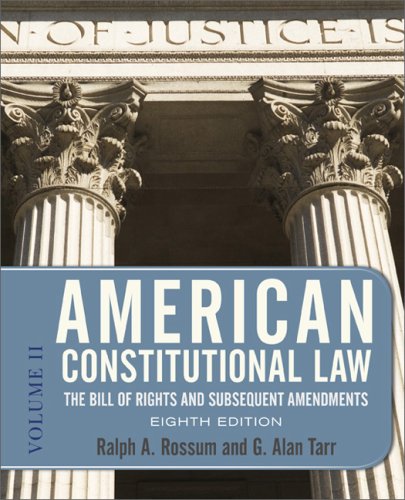
American Constitutional Law 8E, 2-VOL SET: 2-VOLUME SET
Authors:
Ralph A. Rossum
Publisher:
Westview Press
Publication Date:
Not available
ISBN:
0813344794
American Constitutional Law provides a comprehensive account of the nation’s defining document. Based on the premise that the study of the... Constitution and constitutional law is of fundamental importance to understanding the principles, prospects, and problems of America, the volumes in this set put current events in terms of what those who initially drafted and ratified the Constitution sought to accomplish. The authors examine the constitutional thought of the founders, as well as interpretations of the Constitution by the Supreme Court, Congress, the President, lower federal courts, and state judiciaries. Volume I focuses on federal rights and powers, and volume II focuses on individuals' rights and responsibilities. Available individually or as a two-volume set, they are perfect for a one- or two-semester course on constitutional law and civil liberties.
 '
'