production
/viewbook/list/all/?page=6038
/
/static/
None

Intermediate Algebra: Concepts and Graphs
Authors:
Charles P. McKeague
Publisher:
Brooks/Cole Pub Co
Publication Date:
Not available
ISBN:
0030351464

Intermediate Algebra: Concepts & Applications (Cus
Authors:
Not Available
Publisher:
Not available
Publication Date:
Not available
ISBN:
Not available
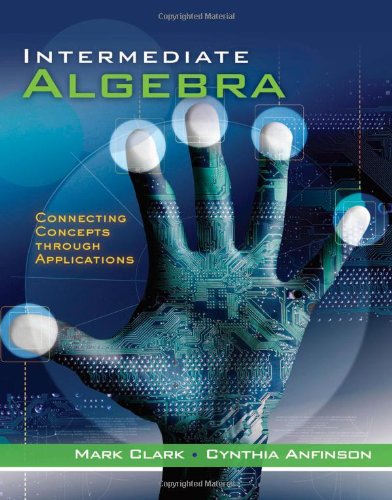
Intermediate Algebra: Connecting Concepts through Applications
Authors:
Mark Clark
Publisher:
Brooks Cole
Publication Date:
Not available
ISBN:
0534496369
INTERMEDIATE ALGEBRA: CONNECTING CONCEPTS THROUGH APPLICATIONS shows students how to apply traditional mathematical skills in real-world contexts. The... emphasis on skill building and applications engages students as they master concepts, problem solving, and communication skills. It modifies the rule of four, integrating algebraic techniques, graphing, the use of data in tables, and writing sentences to communicate solutions to application problems. The authors have developed several key ideas to make concepts real and vivid for students. First, the authors integrate applications, drawing on real-world data to show students why they need to know and how to apply math. The applications help students develop the skills needed to explain the meaning of answers in the context of the application. Second, they emphasize strong algebra skills. These skills support the applications and enhance student comprehension. Third, the authors use an eyeball best-fit approach to modeling. Doing models by hand helps students focus on the characteristics of each function type. Fourth, the text underscores the importance of graphs and graphing. Students learn graphing by hand, while the graphing calculator is used to display real-life data problems. In short, INTERMEDIATE ALGEBRA: CONNECTING CONCEPTS THROUGH APPLICATIONS takes an application-driven approach to algebra, using appropriate calculator technology as students master algebraic concepts and skills.

Intermediate Algebra Connecting Concepts Through Applications 1st...
Authors:
Clark
Publisher:
Cengage
Publication Date:
Not available
ISBN:
1111978735
INTERMEDIATE ALGEBRA CUSTOM
Authors:
Not Available
Publisher:
Not available
Publication Date:
Not available
ISBN:
Not available
INTERMEDIATE ALGEBRA CUSTOM
Authors:
Not Available
Publisher:
Not available
Publication Date:
Not available
ISBN:
Not available
INTERMEDIATE ALGEBRA CUSTOM
Authors:
Not Available
Publisher:
Not available
Publication Date:
Not available
ISBN:
Not available
INTERMEDIATE ALGEBRA ]CUSTOM[
Authors:
Not Available
Publisher:
Not available
Publication Date:
Not available
ISBN:
Not available
INTERMEDIATE ALGEBRA.]CUSTOM[
Authors:
Not Available
Publisher:
Not available
Publication Date:
Not available
ISBN:
Not available
Intermediate Algebra Custom Book Only
Authors:
Not Available
Publisher:
Not available
Publication Date:
Not available
ISBN:
1256428442
Intermediate Algebra (Custom Edition For Monroe Colege) Taken from...
Authors:
Not Available
Publisher:
Pearson Education
Publication Date:
Not available
ISBN:
0536299323
Intermediate Algebra: Custom Edition for Texas A&M...
Authors:
Not Available
Publisher:
Pearson Learning Solutions
Publication Date:
Not available
ISBN:
0558962300
Intermediate Algebra Customized Version for Stony Brook University
Authors:
Miller
Publisher:
University of Michigan Press/ESL
Publication Date:
Not available
ISBN:
0077459318
What does it mean to teach reading in the context of the middle and high school classroom? Don’t students already know how to read by the time they... get to secondary school? And how can a busy teacher take time away from the packed curriculum of science, history, mathematics, or language arts to teach reading? This book presents a linguistic approach to teaching reading in different subjects; an approach that focuses on language itself. Central to this approach is a view that knowledge is constructed in and through language and that language changes with changes in knowledge. As students move from elementary to secondary schools, they encounter specialized knowledge and engage in new contexts of learning in all subjects. This means that the language of secondary school learning is quite different from the language of the elementary years. While in the elementary years the subject matter of reading materials is often close to students’ everyday life experiences, the curriculum of secondary school deals with knowledge that is removed from students’ personal lives and everyday contexts. The language that constructs this more specialized knowledge thus tends to be more abstract, technical, information-laden, and hierarchically organized than the more familiar and friendly” language that students typically encounter during the elementary years. Students need to develop specialized literacies (literacy relevant to each content area) as well as a critical literacy they can use across subject areas to engage with, reflect on, and assess specialized and advanced knowledge. This functional language analysis approach is shown using actual secondary social studies, science, and math textbooks and using a literary text.
INTERMEDIATE ALGEBRA (CUSTOM W/ALEKS)
Authors:
Not Available
Publisher:
Not available
Publication Date:
Not available
ISBN:
Not available
INTERMEDIATE ALGEBRA CUSTOM W/MML
Authors:
Not Available
Publisher:
Not available
Publication Date:
Not available
ISBN:
Not available
 '





