production
/viewbook/list/all/?page=6071
/
/static/
None

International Law
Authors:
Valerie Epps
Publisher:
Carolina Academic Press
Publication Date:
Not available
ISBN:
1594605513
The fourth edition of this widely used text book combines narratives sections that explain the basic law with cases, questions, and problems that allow... students to read actual legal materials and apply them to other similar or distinguishable situations. These materials do not assume that undergraduates are less able than graduate students to grasp difficult issues, nor do they assume that undergraduates cannot deal with a variety of complex instruments that bear on a particular problem. Rather, Epps focuses on the central problems of international law, assuming no prior legal knowledge except that gained by living in a society organized under a legal system, and encourages students to work through a number of questions and and problems that are presented in a variety of international contexts. The book's coverage is comprehensive including recent materials on sources, treaties, jurisdiction, extradition, the law of the sea, the environment, international entities, human rights, international courts, terrorism and war.

INTERNATIONAL LAW
Authors:
Not Available
Publisher:
Not available
Publication Date:
Not available
ISBN:
Not available
International Law and International Relations: An International...
Authors:
Not Available
Publisher:
Cambridge University Press
Publication Date:
Not available
ISBN:
0521679915
This 2007 volume is intended to help readers understand the relationship between international law and international relations (IL/IR). As a testament... to this dynamic area of inquiry, new research on IL/IR is now being published in a growing list of traditional law reviews and disciplinary journals. The excerpted articles in this volume, all of which were first published in International Organization, represent some of the most important research since serious social science scholarship began in this area more than twenty five years ago. They are important milestones toward making IL/IR a central concern of scholarly research in international affairs. The contributions cover some of the main topics of international affairs to provide readers with a range of theoretical perspectives, concepts, and heuristics that can be used to analyze the relationship between international law and international relations.
International Law and International Relations (International...
Authors:
J. Craig Barker
Publisher:
Continuum
Publication Date:
Not available
ISBN:
0826450288
The disciplines of international law and international relations are inextricably linked. Both are concerned with the activities of states and with... predicting how states behave and on what basis.For the international lawyer, however, the key concern is the role of the law. On the other hand, political scientists have traditionally regarded international law with skepticism, if not contempt. In recent years new approaches in both disciplines have seen moves towards greater interdisciplinary collaboration. Indeed, at the start of the twenty-first century, theorists from both disciplines are talking actively about the development of a dual agenda of international law and international relations. This means that students of international relations need increasingly to be familiar with the terminology and methodology of international law.This essential introductory text examines the key concepts in international law with a view to illuminating them in the context of international relations. The first part of the book provides coverage of theoretical issues, addressing questions such as: How does international law work? How is international law made? and To whom does international law apply? The second part examines international law in context, focusing on the role of treaties and customary international law, the role of individuals in international law and the legal control of the use of force. It also uses case-study material including an examination of the Pinochet litigation.

International Law and International Relations (Themes in...
Authors:
David Armstrong
Publisher:
Cambridge University Press
Publication Date:
Not available
ISBN:
1107648246
In this fully updated and revised edition, the authors explore the evolution, nature and function of international law in world politics and situate... international law in its historical and political context. They propose three interdisciplinary 'lenses' (realist, liberal and constructivist) through which to view the role of international law in world politics and suggest that the concept of an international society provides the overall context within which international legal developments occur. These theoretical perspectives offer different ways of looking at international law in terms of what it is, how it works and how it changes. Topics covered include the use of force, international crimes, human rights, international trade and the environment. The new edition also contains more material on non-western perspectives, international institutions and non-state actors and a new bibliography. Each chapter features discussion questions and guides to further reading.
International Law and Litigation in the U.S.: 2008 Documents...
Authors:
Jordan J. Paust
Publisher:
West
Publication Date:
Not available
ISBN:
0314198903
International Law and Litigation in the U.S. (American Casebooks)
Authors:
Jordan J. Paust
Publisher:
West
Publication Date:
Not available
ISBN:
0314199845
This coursebook is unique because it provides a detailed focus on the use, and possibilities of use, of international law in U.S. domestic legal... processes. Attention is paid to various forms of incorporation of international law into U.S. federal and state legal processes, questions of federal and state jurisdictional competencies regarding civil and criminal sanctions, hurdles concerning actual litigation and prosecution, extradition, and cooperation in transnational law enforcement (civil and criminal). Covers traditional topics such as: the nature, sources, and evidences of international law; jurisdiction under international law; the law of the sea; and the use of armed force.
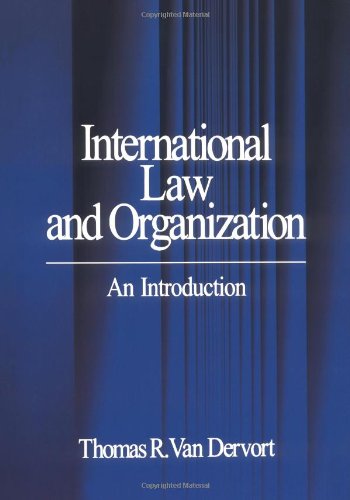
International Law and Organization: An Introduction
Authors:
Thomas R. Van Dervort
Publisher:
Sage Publications, Inc
Publication Date:
Not available
ISBN:
0761901892
The study of international law has, in recent times, appeared disconnected from real world politics. In this book, international law is introduced as a... dynamic process with an explicit connection to the contemporary realpolitik. Following an historical overview of the development of international law - starting with ancient Rome and continuing up to the present day - the author considers the basic principles of international law in specific fields, focusing on the application of international legal principles in domestic courts. Van Dervort concludes with an examination of law on an international plane, discussing disputes between sovereign nation-states.
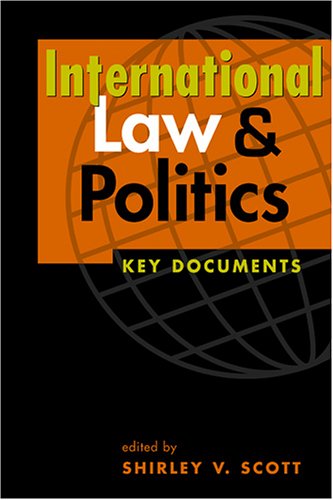
International Law And Politics: Key Documents
Authors:
Not Available
Publisher:
Lynne Rienner Pub
Publication Date:
Not available
ISBN:
1588264424
Starting in the 1970s, conservatives learned that electoral victory did not easily convert into a reversal of important liberal accomplishments,... especially in the law. As a result, conservatives' mobilizing efforts increasingly turned to law schools, professional networks, public interest groups, and the judiciary--areas traditionally controlled by liberals. Drawing from internal documents, as well as interviews with key conservative figures, The Rise of the Conservative Legal Movement examines this sometimes fitful, and still only partially successful, conservative challenge to liberal domination of the law and American legal institutions. Unlike accounts that depict the conservatives as fiendishly skilled, The Rise of the Conservative Legal Movement reveals the formidable challenges that conservatives faced in competing with legal liberalism. Steven Teles explores how conservative mobilization was shaped by the legal profession, the legacy of the liberal movement, and the difficulties in matching strategic opportunities with effective organizational responses. He explains how foundations and groups promoting conservative ideas built a network designed to dislodge legal liberalism from American elite institutions. And he portrays the reality, not of a grand strategy masterfully pursued, but of individuals and political entrepreneurs learning from trial and error. Using previously unavailable materials from the Olin Foundation, Federalist Society, Center for Individual Rights, Institute for Justice, and Law and Economics Center, The Rise of the Conservative Legal Movement provides an unprecedented look at the inner life of the conservative movement. Lawyers, historians, sociologists, political scientists, and activists seeking to learn from the conservative experience in the law will find it compelling reading.
International Law and the Third World: Reshaping Justice
Authors:
Not Available
Publisher:
Routledge-Cavendish
Publication Date:
Not available
ISBN:
0415574560
This volume is devoted to critically exploring the past, present and future relevance of international law to the priorities of the countries, peoples... and regions of the South. Within the limits of space it has tried to be comprehensive in scope and representative in perspective and participation. The contributions are grouped into three clusters to give some sense of coherence to the overall theme: articles by Baxi, Anghie, Falk, Stevens and Rajagopal on general issues bearing on the interplay between international law and world order; articles highlighting regional experience by An-Na’im, Okafor, Obregon and Shalakany; and articles on substantive perspectives by Mgbeoji, Nesiah, Said, Elver, King-Irani, Chinkin, Charlesworth and Gathii. This collective effort gives an illuminating account of the unifying themes, while at the same time exhibiting the wide diversity of concerns and approaches.
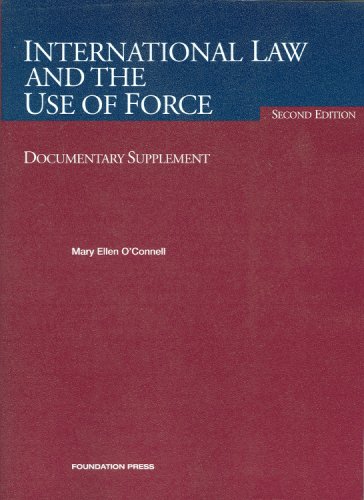
International Law and the Use of Force, 2nd, Documentary Supplement
Authors:
Mary Ellen O'Connell
Publisher:
Foundation Press
Publication Date:
Not available
ISBN:
1599415038
This is a compilation of treaties, conventions, statutes, and other materials covering the entire history of international law. Materials are arranged... chronologically, starting with the 1648 Treaty of Westphalia, and proceeding up to 21st-century U.N. Security Council Resolutions on terrorism and weapons proliferation.
International Law and the Use of Force, Cases and Materials...
Authors:
Mary Ellen O'Connell
Publisher:
Foundation Press
Publication Date:
Not available
ISBN:
159941340X
This casebook may get more attention today than ever before in its history. From the Russian invasion of Georgia to the on-going detentions at... Guantanamo Bay, the use of suicide bombs, to the workings of the United Nations Security Council in a crisis like Darfur, some of the most pressing legal issues of the day are found in this branch of international law. The book: Brings together cases and materials on both the law governing the resort to armed force (jus ad bellum) and the law governing the conduct of force (jus in bello) Provides a dynamic introduction for students, scholars, and practitioners. In addition to adding important new cases from the International Court of Justice, the United States Supreme Court, Israeli High Court of Justice, and others, the second edition adds a completely new chapter on prohibited weapons that begins with nuclear weapons and ends with suicide bombs.

International Law and the Use of Force (Foundations of Public...
Authors:
Christine Gray
Publisher:
Oxford University Press, USA
Publication Date:
Not available
ISBN:
0199239150
This book explores the whole of the large and controversial subject of the use of force in international law; it examines not only the use of force by... states but also the role of the UN in peacekeeping and enforcement action, and the growing importance of regional organizations in the maintenance of international peace and security. Since the publication of the second edition of International Law and the Use of Force the law in this area has continued to undergo a fundamental reappraisal. Operation Enduring Freedom carries on against Al Qaida and the Taliban in Afghanistan six years after the terrorist attacks of 11 September 2001. Can this still be justified as self-defense in the 'war on terror'? Is there now a wide right of pre-emptive self-defense against armed attacks by non-state actors? The 2006 Israel/Lebanon conflict and the recent intervention of Ethiopia in Somalia raise questions about whether the 'war on terror' has brought major changes in the law on self-defense and on regime change. The 2003 invasion of Iraq gave rise to serious divisions between states as to the legality of this use of force and to talk of a crisis of collective security for the UN. In response the UN initiated major reports on the future of the Charter system; these rejected amendment of the Charter provisions on the use of force. They also rejected any right of pre-emptive self-defense. They advocated a 'responsibility to protect' in cases of genocide or massive violations of human rights; the events in Darfur show the practical difficulties with the implementation of such a duty.
International Law and World Order: A Problem-oriented Coursebook
Authors:
Burns H. Weston
Publisher:
West Group
Publication Date:
Not available
ISBN:
0314251391
Poses four clusters of world order problems that require students to identify and frame legal issues in factual context. Enables students to determine... the relevance of information, organize relevant law and policy, test their analytical skills, and develop a critical understanding of the possibilities of international law. Focuses on the current work of the International Criminal Tribunals for the Former Yugoslavia and Rwanda. Comprises a series of hypothetical problems involving fictional countries in "real world" decision-making settings, organized around themes that conveniently cluster the principal challenges to the current world order.
International Law (Aspen Treatise)
Authors:
Mark Weston Janis
Publisher:
Aspen Publishers, Inc.
Publication Date:
Not available
ISBN:
0735570329
The ideal companion to any International Law casebook, or to casebooks on International Human Rights Law, International Business Transactions, or... International Environmental Law. The Fifth Edition offers: a clear and accessible writing style broad coverage of public international issues, complemented by some discussion of salient Constitutional Law and International Business Law topics a logical organization that poses three broad questions: What are the international legal rules? What is the international legal process? What role does international law play in international relations? an authoritative resource in a comprehensible context Thoroughly updated to reflect current International Law, the Fifth Edition covers: the Sosa Case on The Alien Tort Statute, cases on the Geneva Conventions and other U.S. Supreme Court cases deciding on issues of international import the rapidly expanding jurisprudence of the European Court of Human Rights and other new developments in International Human Rights Law the Preemptive-War Doctrine and new problems and prospects in the law of war the Precautionary Principle in International Environmental Law International Law, Fifth Edition, continues to live up to its excellent reputation as a clear, accurate, and timely overview of International Law.
 '





