production
/viewbook/list/all/?page=611
/
/static/
None

American Economic History (8th Edition) (Pearson Series in Economics)
Authors:
Jonathan Hughes
Publisher:
Pearson Education, Inc
Publication Date:
Not available
ISBN:
0137037414
America’s present economy, understood through its past. Rich in both quantitative techniques and economic theory, American Economic History... demonstrates how an understanding of our past can illuminate economic issues that face society today and in the future. In simple, elegant language, this text walks readers through four centuries of political, social, and economic history, focusing on laws and institutions and emphasizing current economic topics. The eighth edition has been updated and revised, and includes expanded discussions on population, health, and labor; education; the automobile industry; income and taxes; social security; unemployment; regulation and the financial industry; and the history of economic recessions.

AMERICAN ECON SYSTEM (ECON 180) (RENTAL)
Authors:
Not Available
Publisher:
Not available
Publication Date:
Not available
ISBN:
Not available

American Education
Authors:
Joel Spring
Publisher:
McGraw-Hill Humanities/Social Sciences/Languages
Publication Date:
Not available
ISBN:
007802434X
Clear, concise, and authoritative, American Education brings current issues and challenging perspectives to teacher educators’ classrooms. Revised... every two years, the text provides an up-to-date introduction to the historical, political, social, and legal foundations of education and to the profession of teaching in the United States.

American Education
Authors:
Joel Spring
Publisher:
McGraw-Hill Humanities/Social Sciences/Languages
Publication Date:
Not available
ISBN:
0073378682
Clear, concise, and authoritative—compact and affordable, too—with scholarship that is often cited as a primary source, American Education brings... up-to-date information and challenging perspectives to teacher educators’ classrooms. Revised every two years, American Education provides a fresh, concise, and up-to-date introduction to the historical, political, social, and legal foundations of education and to the profession of teaching in the United States. This edition introduces a new chapter reference guide to the No Child Left Behind Act, provides a fresh look at multiculturalism and multilingualism, and presents a new discussion of the link between schooling and the growing gap between rich and poor.

American Education: A History
Authors:
Wayne J. Urban
Publisher:
Routledge
Publication Date:
Not available
ISBN:
0415965292
American Education: A History, 4e is a comprehensive, highly-regarded history of American education from pre-colonial times to the present.... Chronologically organized, it provides an objective overview of each major period in the development of American education, setting the discussion against the broader backdrop of national and world events. The first text to explore Native American traditions (including education) prior to colonization, it also offers strong, ongoing coverage of minorities and women. Key points that define the fourth edition of this volume include: Balanced Perspective – The authors provide contrasting views of American educational traditions, reforms, and theories in order to maintain a balanced view of events. They focus on conflicts, compromises and outcomes (positive and negative) that have defined America’s educational past and that shape its future options. They also set discussions against the broader backdrop of national and world events. Pre-colonial Focus – A unique and much praised opening chapter discusses the educational traditions of Native Americans and the two-way learning exchanges that occurred between two distinct "old world" cultures, that is, between Native American and European cultures. The Indians taught as well as learned from the colonists. No other text has this feature. Cultural Conflict Focus – Throughout the text attention is paid to the cultural conflicts embedded in the majority-minority struggles of Native Americans and various immigrant groups throughout the nation’s history. Chapter 5: Class, Caste and Education in the South provides an in-depth analysis of the educational legacy of Southern culture throughout the 19th and 20th centuries. Readability – Reviewers have labeled this the "best written text on the market" in terms of style, clarity and interest. "It’s clarity and readability differentiate it from other books." Changes – The fourth edition will include more visual illustrations as well as substantial new material. A new epilogue adds closing comments on the present and future prospects for American education.
American Educational History: School, Society, and the Common Good
Authors:
William Jeynes
Publisher:
Sage Publications, Inc
Publication Date:
Not available
ISBN:
1412914213
American Educational History: School, Society, and the Common Good is an up-to-date, contemporary examination of historical trends that have helped... shape schools and education in the United States. Author William H. Jeynes places a strong emphasis on recent history, most notably post-World War II issues such as the role of technology, the standards movement, affirmative action, bilingual education, undocumented immigrants, school choice, and much more!

American Education and Corporations : The Free Market Goes to...
Authors:
Deron Boyles
Publisher:
Routledge
Publication Date:
Not available
ISBN:
0815328214
This work argues that private businesses use public schools as worker training sites, resulting in a devalued teaching force, students as uncritical... consumers, and schools as economic markets. Boyles analyzes school-business partnerships, revealing false philanthropy and the ulterior motives behind fast-food reading campaigns and supermarket "sales for schools" promotions. This important book criticizes the practice of privatization itself, revealing it to be a conservative gambit to secure class differences, and not a simple extension of free market business influence into the public sector.
American Education: Building a Common Foundation
Authors:
Leslie Kaplan
Publisher:
Wadsworth Publishing
Publication Date:
Not available
ISBN:
0495599395
With a focus on the future of American education--and the goals and nature of teaching in a global economy--this forward-thinking text provides you with... a comprehensive overview of the foundations of modern American schooling. The book's premise is that education in the 21st century must facilitate more complex, deeper, and more varied learning that will enable all citizens to survive and thrive in an ever-changing world. In presenting traditional topics and important educational issues--including diversity and equity, the accountability movement, effective schools, instructional best practices, and alternatives to public schools--the authors cultivate the very skills and knowledge base that they believe are critical for success in a "flat" world. With the overarching goal of furthering higher-order thinking, they model the principles of evidence-based practice and the critical-thinking process by examining issues and controversies in depth and presenting supporting research to validate their conclusions. Activities support the critical-thinking focus and promote your self-understanding, challenging you to weigh "common knowledge" against real evidence and form your own conclusions. Written in an appealing, conversational style, and using examples that immediately resonate with prospective student teachers, this thought-provoking new text provides a timely and insightful perspective of American education.

American Education in a Global Society, 2/E
Authors:
Gerald L. Gutek
Publisher:
Waveland Press
Publication Date:
Not available
ISBN:
1577664043
Gutek's rigorously updated second edition targets international education in today's dynamic, interconnected, and interdependent global society. This... two-part volume examines and compares educational systems in their national contexts. Part 1 is a blend of historical, philosophical, political, and sociological perspectives on a variety of foundational topics in international education, including the vital interests of developing and developed nation-states; the implications of ethnonationalism; political, economic, environmental, and educational relationships; transnational issues in a global society; and citizenship education. Part 2 first scrutinizes the concept of comparative education and then explores the essential elements of education in the U.S.--a sturdy departure point for analyses and comparisons of the national contexts and education in eight representative countries: the United Kingdom, France, Russia, Mexico, Japan, China, India, and Nigeria. UNESCO states that education for all is one of the biggest moral challenges of our times. One step toward propagating the universal right to education is making a conscious effort to understand the educational systems of other nations. New to this edition are chapters on France and India, with their enduring cultures and world presence. Each chapter in the book concludes with discussion questions, research topics, and suggestions for further reading. Titles of related interest from Waveland Press: Gutek, American Education 1945-2000: A History and Commentary (ISBN 9781577661009); Gutek, A History of the Western Educational Experience, Second Edition (ISBN 9780881338188); and Gutek, An Historical Introduction to American Education, Third Edition (ISBN 9781577667520).
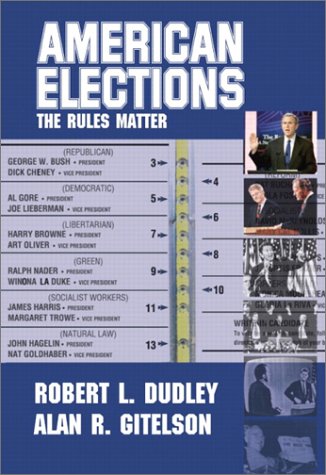
American Elections: The Rules Matter
Authors:
Robert Dudley
Publisher:
Pearson
Publication Date:
Not available
ISBN:
0321086848
A fascinating and necessary read for anyone wishing to better understand Election 2000, this unique new book by two renowned authors gives readers the... tools they need to examine our election system as it exists today. Examines elections in the context of the new institutionalism, arguing that an understanding of American elections requires more than knowledge of voting behavior. The importance of federalism in understanding the electoral systems is emphasized throughout. In order to gain a true understanding of U.S. elections, the effects of new institutionalism and federalism must be taken into account. For those interested in American government, voting and elections in the U.S.

American Elegy: The Poetry of Mourning from the Puritans to Whitman
Authors:
Max Cavitch
Publisher:
Univ Of Minnesota Press
Publication Date:
Not available
ISBN:
081664893X
The most widely practiced and read form of verse in America, elegies are poems about being left behind,” writes Max Cavitch. American Elegy is the... history of a diverse people’s poetic experience of mourning and of mortality’s profound challenge to creative living. By telling this history in political, psychological, and aesthetic terms, American Elegy powerfully reconnects the study of early American poetry to the broadest currents of literary and cultural criticism. Cavitch begins by considering eighteenth-century elegists such as Franklin, Bradstreet, Mather, Wheatley, Freneau, and Annis Stockton, highlighting their defiance of boundariesbetween public and private, male and female, rational and sentimentaland demonstrating how closely intertwined the work of mourning and the work of nationalism were in the revolutionary era. He then turns to elegy’s adaptations during the market-driven Jacksonian age, including more obliquely elegiac poems like those of William Cullen Bryant and the popular child elegies of Emerson, Lydia Sigourney, and others. Devoting unprecedented attention to the early African-American elegy, Cavitch discusses poems written by free blacks and slaves, as well as white abolitionists, seeing in them the development of an African-American genealogical imagination. In addition to a major new reading of Whitman’s great elegy for Lincoln, When Lilacs Last in the Dooryard Bloom’d,” Cavitch takes up less familiar passages from Whitman as well as Melville’s and Lazarus’s poems following Lincoln’s death. American Elegy offers critical and often poignant insights into the place of mourning in American culture. Cavitch examines literary responses to historical eventssuch as the American Revolution, Native American removal, African-American slavery, and the Civil Warand illuminates the states of loss, hope, desire, and love in American studies today. Max Cavitch is assistant professor of English at the University of Pennsylvania.
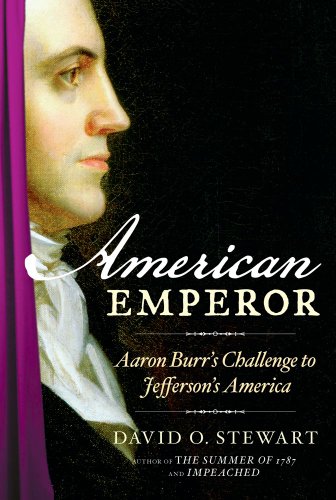
American Emperor: Aaron Burr's Challenge to Jefferson's America
Authors:
David O. Stewart
Publisher:
Simon & Schuster
Publication Date:
Not available
ISBN:
1439157189
In this vivid and brilliant biography, David Stewart describes Aaron Burr, the third vice president, as a daring and perhaps deluded figure who shook... the nation’s foundations in its earliest, most vulnerable decades. In 1805, the United States was not twenty years old, an unformed infant. The government consisted of a few hundred people. The immense frontier swallowed up a tiny army of 3,300 soldiers. Following the Louisiana Purchase, no one even knew where the nation’s western border lay. Secessionist sentiment flared in New England and beyond the Appalachians. Burr had challenged Jefferson, his own running mate, in the presidential election of 1800. Indicted for murder in the dueling death of Alexander Hamilton in 1804, he dreamt huge dreams. He imagined an insurrection in New Orleans, a private invasion of Spanish Mexico and Florida, and a great empire rising on the Gulf of Mexico, which would swell when America’s western lands seceded from the Union. For two years, Burr pursued this audacious dream, enlisting support from the General-in-Chief of the Army, a paid agent of the Spanish king, and from other western leaders, including Andrew Jackson. When the army chief double-crossed Burr, Jefferson finally roused himself and ordered Burr prosecuted for treason. The trial featured the nation’s finest lawyers before the greatest judge in our history, Chief Justice John Marshall, Jefferson’s distant cousin and determined adversary. It became a contest over the nation’s identity: Should individual rights be sacrificed to punish a political apostate who challenged the nation’s very existence? In a revealing reversal of political philosophies, Jefferson championed government power over individual rights, while Marshall shielded the nation’s most notorious defendant. By concealing evidence, appealing to the rule of law, and exploiting the weaknesses of the government’s case, Burr won his freedom. Afterwards Burr left for Europe to pursue an equally outrageous scheme to liberate Spain’s American colonies, but finding no European sponsor, he returned to America and lived to an unrepentant old age. Stewart’s vivid account of Burr’s tumultuous life offers a rare and eye-opening description of the brand-new nation struggling to define itself.
American Empire: A Debate
Authors:
Christopher Layne
Publisher:
Routledge
Publication Date:
Not available
ISBN:
0415952042
In this short, accessible book Layne and Thayer argue the merits and demerits of an American empire. With few, if any, rivals to its supremacy, the... United States has made an explicit commitment to maintaining and advancing its primacy in the world. But what exactly are the benefits of American hegemony and what are the costs and drawbacks for this fledgling empire? After making their best cases for and against an American empire, subsequent chapters allow both authors to respond to the major arguments presented by their opponents and present their own counter arguments.
American Empire: Roosevelt's Geographer and the Prelude to...
Authors:
Neil Smith
Publisher:
University of California Press
Publication Date:
Not available
ISBN:
0520243382
An American Empire, constructed over the last century, long ago overtook European colonialism, and it has been widely assumed that the new globalism it... espoused took us "beyond geography." Neil Smith debunks that assumption, offering an incisive argument that American globalism had a distinct geography and was pieced together as part of a powerful geographical vision. The power of geography did not die with the twilight of European colonialism, but it did change fundamentally. That the inauguration of the American Century brought a loss of public geographical sensibility in the United States was itself a political symptom of the emerging empire. This book provides a vital geographical-historical context for understanding the power and limits of contemporary globalization, which can now be seen as representing the third of three distinct historical moments of U.S. global ambition.The story unfolds through a decisive account of the career of Isaiah Bowman (1878-1950), the most famous American geographer of the twentieth century. For nearly four decades Bowman operated around the vortex of state power, working to bring an American order to the global landscape. An explorer on the famous Machu Picchu expedition of 1911 who came to be known first as "Woodrow Wilson's geographer," and later as Frankin D. Roosevelt's, Bowman was present at the creation of U.S. liberal foreign policy.A quarter-century later, Bowman was at the center of Roosevelt's State Department, concerned with the disposition of Germany and heightened U.S. access to European colonies; he was described by Dean Acheson as a key "architect of the United Nations." In that period he was a leader in American science, served as president of Johns Hopkins University, and became an early and vociferous cold warrior. A complicated, contradictory, and at times controversial figure who was very much in the public eye, he appeared on the cover of Time magazine.Bowman's career as a geographer in an era when the value of geography was deeply questioned provides a unique window into the contradictory uses of geographical knowledge in the construction of the American Empire. Smith's historical excavation reveals, in broad strokes yet with lively detail, that today's American-inspired globalization springs not from the 1980s but from two earlier moments in 1919 and 1945, both of which ended in failure. By recharting the geography of this history, Smith brings the politics--and the limits--of contemporary globalization sharply into focus.
American Empire: The Realities and Consequences of U.S. Diplomacy
Authors:
Andrew J. Bacevich
Publisher:
Harvard University Press
Publication Date:
Not available
ISBN:
0674013751
In a challenging, provocative book, Andrew Bacevich reconsiders the assumptions and purposes governing the exercise of American global power. Examining... the presidencies of George H. W. Bush and Bill Clinton--as well as George W. Bush's first year in office--he demolishes the view that the United States has failed to devise a replacement for containment as a basis for foreign policy. He finds instead that successive post-Cold War administrations have adhered to a well-defined "strategy of openness." Motivated by the imperative of economic expansionism, that strategy aims to foster an open and integrated international order, thereby perpetuating the undisputed primacy of the world's sole remaining superpower. Moreover, openness is not a new strategy, but has been an abiding preoccupation of policymakers as far back as Woodrow Wilson. Although based on expectations that eliminating barriers to the movement of trade, capital, and ideas nurtures not only affluence but also democracy, the aggressive pursuit of openness has met considerable resistance. To overcome that resistance, U.S. policymakers have with increasing frequency resorted to force, and military power has emerged as never before as the preferred instrument of American statecraft, resulting in the progressive militarization of U.S. foreign policy. Neither indictment nor celebration, American Empire sees the drive for openness for what it is--a breathtakingly ambitious project aimed at erecting a global imperium. Large questions remain about that project's feasibility and about the human, financial, and moral costs that it will entail. By penetrating the illusions obscuring the reality of U.S. policy, this book marks an essential first step toward finding the answers.
 '
'