production
/viewbook/list/all/?page=6165
/
/static/
None
Introduction to Bioinformatics
Authors:
Teresa Attwood
Publisher:
Benjamin Cummings
Publication Date:
Not available
ISBN:
0582327881
The book provides an undergraduate (final year) introduction to bioinformatics focussing on two key areas, genomics and protein sequence analysis. It... provides an overview of primary, composite and secondary databases, and gives a brief introduction to the Internet and the world wide web.
Introduction to Bioinformatics
Authors:
Arthur Lesk
Publisher:
Oxford University Press, USA
Publication Date:
Not available
ISBN:
0199208042
An Introduction to Bioinformatics introduces students to the immense power of bioinformatics as a set of scientific tools. The book explains how to... access the data archives of genomes and proteins, and the kinds of questions these data and tools can answer, such as how to make inferences from data archives and how to make connections among them to derive useful and interesting predictions.Blending factual content with many opportunities for active learning, An Introduction to Bioinformatics offers a truly reader-friendly way to get to grips with this subject, making it the ideal resource for anyone new to the field.Features- Strikes a careful balance between biology and computer science, introducing those aspects of computer science which underpin the subject without demanding detailed prior knowledge.- Contains numerous learning features, including exercises, problems, and WebLems.- Retains the eloquent style and clarity of explanation for which the author is renowned.- An Online Resource Centre includes figures from the book available to download to facilitate lecture preparation, as well as a variety of interactive resources, including web links, 3D structures, and data sets.ew to this Edition- New chapter on biological organization in space and reflects recent advances in genomics, transcriptomics, proteomics, and metabolomics.- New chapter on scientific publications and archives provides a state of the art inventory on sourcing scientific literature.- Expanded coverage of structural bioinformatics.- Enhanced Online Resource Centre, with new guided tours of key websites, and lab assignments to support the in-depth exploration of concepts and themes covered in the book.

INTRODUCTION TO BIOLOGICAL ANTHROPOLOGY (CUSTOM)
Authors:
Not Available
Publisher:
Not available
Publication Date:
Not available
ISBN:
Not available

Introduction to Biological Anthropology the Essentials
Authors:
Craig Stanford
Publisher:
Pearson
Publication Date:
Not available
ISBN:
0536464057
Is love "blind" when it comes to gender? For women, it just might be. This unsettling and original book offers a radical new understanding of the... context-dependent nature of female sexuality. Lisa Diamond argues that for some women, love and desire are not rigidly heterosexual or homosexual but fluid, changing as women move through the stages of life, various social groups, and, most important, different love relationships. This perspective clashes with traditional views of sexual orientation as a stable and fixed trait. But that view is based on research conducted almost entirely on men. Diamond is the first to study a large group of women over time. She has tracked one-hundred women for more than ten years as they have emerged from adolescence into adulthood. She summarizes their experiences and reviews research ranging from the psychology of love to the biology of sex differences. Sexual Fluidity offers moving first-person accounts of women falling in and out of love with men or women at different times in their lives. For some, gender becomes irrelevant: "I fall in love with the person, not the gender," say some respondents. Sexual Fluidity offers a new understanding of women's sexuality--and of the central importance of love. (20071029)
Introduction to Biological Chemistry
Authors:
Lehninger
Publisher:
Philip Allan Publishers Ltd
Publication Date:
Not available
ISBN:
1429256818
What do we mean by inequality comparisons? If the rich just get richer and the poor get poorer, the answer might seem easy. But what if the income... distribution changes in a complicated way? Can we use mathematical or statistical techniques to simplify the comparison problem in a way that has economic meaning? What does it mean to measure inequality? Is it similar to National Income? Or a price index? Is it enough just to work out the Gini coefficient?Measuring Inequality tackles these questions and examines the underlying principles of inequality measurement and its relation to welfare economics, distributional analysis, and information theory. The book covers modern theoretical developments in inequality analysis, as well as showing how the way we think about inequality today has been shaped by classic contributions in economics and related disciplines. Formal results and detailed literature discussion are provided in two appendices. The principal points are illustrated in the main text, using examples from US and UK data, as well as other data sources, and associated web materials provide hands-on learning. Measuring Inequality is designed to appeal to both undergraduate and post-graduate students, and academic economists. Its emphasis on practical application means that it will also be useful to policy analysts and advisors.

Introduction to Biological Physics for the Health and Life Sciences
Authors:
Kirsten Franklin
Publisher:
Wiley
Publication Date:
Not available
ISBN:
0470665939
This book aims to demystify fundamental biophysics for students in the health and biosciences required to study physics and to understand the... mechanistic behaviour of biosystems. The text is well supplemented by worked conceptual examples that will constitute the main source for the students, while combining conceptual examples and practice problems with more quantitative examples and recent technological advances.
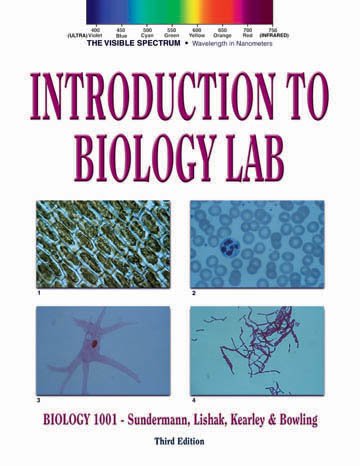
Introduction to Biology Lab; Auburn University Biology 1001...
Authors:
Christine Sundermann
Publisher:
Contemporary Publishing Compan
Publication Date:
Not available
ISBN:
0898923573
This lab manual is for the students' first lab course in college Biology. It is used at Auburn University in non-Biology major's introductory Biology... course.

Introduction to Biomechanics for Human Motion Analysis
Authors:
D. Gordon E. Robertson
Publisher:
Waterloo Biomechanics
Publication Date:
Not available
ISBN:
0969942028
In the 22 years since its publication, Japanese for Busy People has won acclaim worldwide as an effective, easy-to-understand textbook, either for... classroom use or for independent study. Now, more than a decade after its first revision, the series has been redesigned, updated and consolidated to meet the needs of todays students and businesspeople who want to learn natural, spoken Japanese as effectively as possible in a limited amount of time.The Kana Workbook teaches the reading and writing of the two most basic Japanese scripts, hiragana and katakana. These scripts are used all the time in written Japanese, and a mastery of them is essential for those who wish to study the language at any level above survival. As such, the book serves as a prerequisite to both Japanese for Busy People I: Kana Version and Japanese for Busy People II, and it is also recommended as review for those who have learned kana before but have forgotten some of the basics.This completely revised workbook features: · Lots of practice in recognition, reading, and writing; · Fun, picture-dictionary-like illustrations that help students build their vocabularies; · A free CD that gives learners a taste of the actual sounds of Japanese; · A bonus section introducing basic kanji.
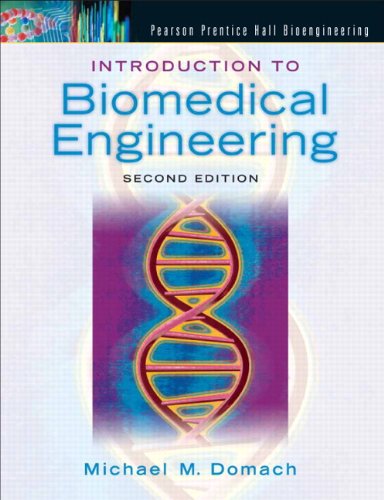
Introduction to Biomedical Engineering (2nd Edition)
Authors:
Michael M. Domach
Publisher:
Prentice Hall
Publication Date:
Not available
ISBN:
0136020038
KEY BENEFIT: Substantial yet reader-friendly, this introduction examines the living system from the molecular to the human scale–presenting... bioengineering practice via some of the best engineering designs provided by nature, from a variety of perspectives. Domach makes the field more accessible, helping readers to pick up the jargon and determine where their skill sets may fit in. KEY TOPICS: Cellular and Molecular Building Blocks of Living Systems; Mass Conservation, Cycling, and Kinetics; Requirements and Features of a Functional and Coordinated System; Bioenergetics; Molecular Basis of Catalysis and Regulation; Analysis of Molecular Binding Phenomena; Applications and Design in Biomolecular Technology; Metabolic and Tissue Engineering; Primer on Tissues and Organs; Biomechanics; Biofluid Mechanics; Biomaterials; Pharmacokinetics; Noninvasive Sensing and Signal Processing. MARKET: A useful resource for anyone interested in joining the field or learning more about bioengineering.
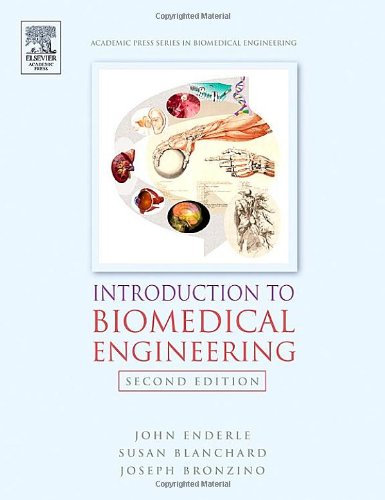
Introduction to Biomedical Engineering, Second Edition
Authors:
John Enderle
Publisher:
Academic Press
Publication Date:
Not available
ISBN:
0122386620
Under the direction of John Enderle, Susan Blanchard and Joe Bronzino, leaders in the field have contributed chapters on the most relevant subjects for... biomedical engineering students. These chapters coincide with courses offered in all biomedical engineering programs so that it can be used at different levels for a variety of courses of this evolving field. Introduction to Biomedical Engineering, Second Edition provides a historical perspective of the major developments in the biomedical field. Also contained within are the fundamental principles underlying biomedical engineering design, analysis, and modeling procedures. The numerous examples, drill problems and exercises are used to reinforce concepts and develop problem-solving skills making this book an invaluable tool for all biomedical students and engineers. New to this edition: Computational Biology, Medical Imaging, Genomics and Bioinformatics. * 60% update from first edition to reflect the developing field of biomedical engineering* New chapters on Computational Biology, Medical Imaging, Genomics, and Bioinformatics* Companion site: http://intro-bme-book.bme.uconn.edu/* MATLAB and SIMULINK software used throughout to model and simulate dynamic systems* Numerous self-study homework problems and thorough cross-referencing for easy use
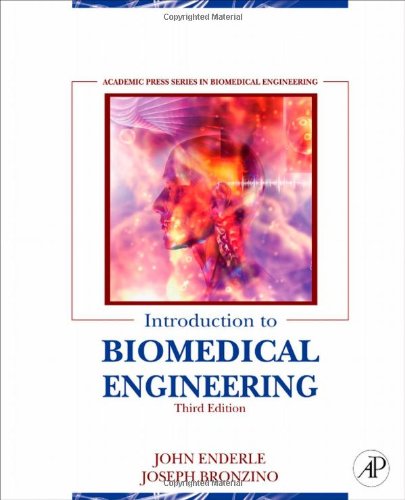
Introduction to Biomedical Engineering, Third Edition
Authors:
John Enderle
Publisher:
Academic Press
Publication Date:
Not available
ISBN:
0123749794
Introduction to Biomedical Engineering is a comprehensive survey text for biomedical engineering courses. It is the most widely adopted text across the... BME course spectrum, valued by instructors and students alike for its authority, clarity and encyclopedic coverage in a single volume. Biomedical engineers need to understand the wide range of topics that are covered in this text, including basic mathematical modeling; anatomy and physiology; electrical engineering, signal processing and instrumentation; biomechanics; biomaterials science and tissue engineering; and medical and engineering ethics. Enderle and Bronzino tackle these core topics at a level appropriate for senior undergraduate students and graduate students who are majoring in BME, or studying it as a combined course with a related engineering, biology or life science, or medical/pre-medical course. * NEW: Each chapter in the 3rd Edition is revised and updated, with new chapters and materials on compartmental analysis, biochemical engineering, transport phenomena, physiological modeling and tissue engineering. Chapters on peripheral topics have been removed and made avaialblw online, including optics and computational cell biology. * NEW: many new worked examples within chapters * NEW: more end of chapter exercises, homework problems * NEW: PowerPoint slides available to adopting instructors * Readers benefit from the experience and expertise of two of the most internationally renowned BME educators * Instructors benefit from a comprehensive teaching package including a fully worked solutions manual * A complete introduction and survey of BME * NEW: new chapters on compartmental analysis, biochemical engineering, and biomedical transport phenomena * NEW: revised and updated chapters throughout the book feature current research and developments in, for example biomaterials, tissue engineering, biosensors, physiological modeling, and biosignal processing. * NEW: more worked examples and end of chapter exercises * NEW: PowerPoint lecture available to adopting instructors * As with prior editions, this third edition provides a historical look at the major developments across biomedical domains and covers the fundamental principles underlying biomedical engineering analysis, modeling, and design *bonus chapters on the web include: Rehabilitation Engineering and Assistive Technology, Genomics and Bioinformatics, and Computational Cell Biology and Complexity.
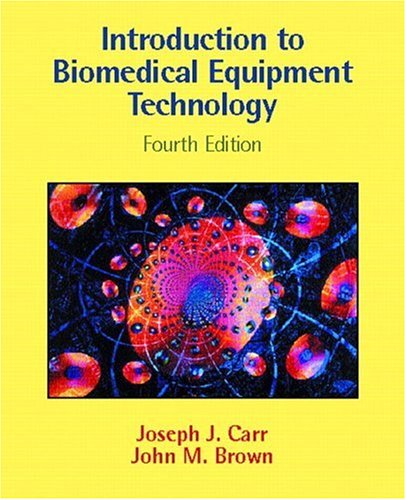
Introduction to Biomedical Equipment Technology (4th Edition)
Authors:
Joseph J. Carr
Publisher:
Prentice Hall
Publication Date:
Not available
ISBN:
0130104922
This industry standard on biomedical equipment is an important resource for providing a broad technological knowledge base, and deep coverage of... critical points. It serves as a handy reference on unfamiliar topics—organized so that users can easily look up topics of interest, study areas where they are weak or where they have not worked in some time. Chapter topics include an overview of the human body; an introduction to biomedical instrumentation and measurement; basic theories of measurement; signals and noise; electrodes, sensors, and transducers; bioelectric amplifiers; electrocardiograph equipment; respiratory therapy equipment; instrumentation for measuring brain parameters; care and feeding of battery operated equipment; computers in biomedical equipment; and quality assurance and continuous quality improvement. For working professionals in biomedical equipment, and for the engineers and technologists who design it.
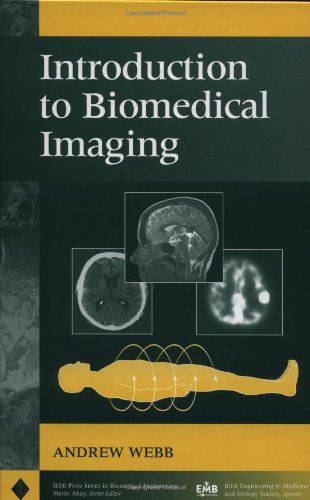
Introduction to Biomedical Imaging (IEEE Press Series on Biomedical...
Authors:
Andrew G. Webb
Publisher:
Wiley-IEEE Press
Publication Date:
Not available
ISBN:
0471237663
An integrated, comprehensive survey of biomedical imaging modalitiesAn important component of the recent expansion in bioengineering is the area of... biomedical imaging. This book provides in-depth coverage of the field of biomedical imaging, with particular attention to an engineering viewpoint.Suitable as both a professional reference and as a text for a one-semester course for biomedical engineers or medical technology students, Introduction to Biomedical Imaging covers the fundamentals and applications of four primary medical imaging techniques: magnetic resonance imaging, ultrasound, nuclear medicine, and X-ray/computed tomography.Taking an accessible approach that includes any necessary mathematics and transform methods, this book provides rigorous discussions of:The physical principles, instrumental design, data acquisition strategies, image reconstruction techniques, and clinical applications of each modalityRecent developments such as multi-slice spiral computed tomography, harmonic and sub-harmonic ultrasonic imaging, multi-slice PET scanning, and functional magnetic resonance imagingGeneral image characteristics such as spatial resolution and signal-to-noise, common to all of the imaging modalities
Introduction to Biometrics
Authors:
Anil K. Jain
Publisher:
Springer
Publication Date:
Not available
ISBN:
0387773258
Biometric recognition, or simply biometrics, is the science of establishing the identity of a person based on physical or behavioral attributes. It is... a rapidly evolving field with applications ranging from securely accessing one’s computer to gaining entry into a country. While the deployment of large-scale biometric systems in both commercial and government applications has increased the public awareness of this technology, "Introduction to Biometrics" is the first textbook to introduce the fundamentals of Biometrics to undergraduate/graduate students. The three commonly used modalities in the biometrics field, namely, fingerprint, face, and iris are covered in detail in this book. Few other modalities like hand geometry, ear, and gait are also discussed briefly along with advanced topics such as multibiometric systems and security of biometric systems. Exercises for each chapter will be available on the book website to help students gain a better understanding of the topics and obtain practical experience in designing computer programs for biometric applications. These can be found at: http://www.csee.wvu.edu/~ross/BiometricsTextBook/. Designed for undergraduate and graduate students in computer science and electrical engineering, "Introduction to Biometrics" is also suitable for researchers and biometric and computer security professionals.

Introduction to Biophotonics
Authors:
Paras N. Prasad
Publisher:
Wiley-Interscience
Publication Date:
Not available
ISBN:
0471287709
Paras Prasad’s text provides a basic knowledge of a broad range of topics so that individuals in all disciplines can rapidly acquire the minimal... necessary background for research and development in biophotonics. Introduction to Biophotonics serves as both a textbook for education and training as well as a reference book that aids research and development of those areas integrating light, photonics, and biological systems. Each chapter contains a topic introduction, a review of key data, and description of future directions for technical innovation. Introduction to Biophotonics covers the basic principles ofOpticsOptical spectroscopyMicroscopyEach section also includes illustrated examples and review questions to test and advance the reader’s knowledge. Sections on biosensors and chemosensors, important tools for combating biological and chemical terrorism, will be of particular interest to professionals in toxicology and other environmental disciplines. Introduction to Biophotonics proves a valuable reference for graduate students and researchers in engineering, chemistry, and the life sciences.
 '