production
/viewbook/list/all/?page=6189
/
/static/
None
Introduction to Environmental Engineering (McGraw-Hill Series in...
Authors:
Mackenzie Davis
Publisher:
McGraw-Hill Science/Engineering/Math
Publication Date:
Not available
ISBN:
0073401145
Introduction to Environmental Engineering, 5/e contains the fundamental science and engineering principles needed for introductory courses and used as... the basis for more advanced courses in environmental engineering. Updated with latest EPA regulations, Davis and Cornwell apply the concepts of sustainability and materials and energy balance as a means of understanding and solving environmental engineering issues. With over 720 end-of-chapter problems, as well as provocative discussion questions, and a helpful list of review items found at the end of each chapter, the text is both a comprehensible and comprehensive tool for any environmental engineering course. Standards and Laws are the most current and up-to-date for an environmental engineering text.
Introduction to Environmental Engineering - SI Version
Authors:
Dr. P. Aarne Vesilind
Publisher:
CL Engineering
Publication Date:
Not available
ISBN:
049529585X
This text presents a balanced treatment of environmental engineering by combining engineering concepts with the importance of environmental ethics. This... third edition highlights sustainable development and emphasizes the need for engineers to become even more environmentally responsible during this time of increasing awareness of environmental concerns. The authors challenge students with problems that require not only a technical solution but a thorough consideration of its ethical ramifications. The text also provides comprehensive exposure to all types of environmental problems, including ecosystem dynamics, wastewater treatment, and air pollution control.
Introduction to Environmental Geology (4th Edition)
Authors:
Edward A. Keller
Publisher:
Prentice Hall
Publication Date:
Not available
ISBN:
0132251507
As the human population increases, many decisions concerning our use of natural resources will determine our standard of living and the quality of our... environment. This reader-friendly book helps readers develop an understanding of how geology interacts with major environmental problems facing society. Included with every text, the Hazard City CD-ROM gives instructors meaningful, easy-to-assign, and easy-to-grade assignments based on the idealized town of Hazard City. Focuses on five fundamental concepts of environmental geology: Human Population Growth, Sustainability, Earth as a System, Hazardous Earth Processes, and Scientific Knowledge and Values. Features new chapters on Impacts of Extraterrestrial Objects and Waste as a Resource: Waste Management. Presents new or extensively revised discussion of human population growth, Alaska earthquake of 2002, emerging global water shortage, cleaning Boston Harbor, and much more. Revises many figures to more clearly illustrate the topics under discussion, based on user feedback. An informative reference for anyone interested in learning more about the environment.
Introduction to Environmental Geology (5th Edition)
Authors:
Edward A. Keller
Publisher:
Prentice Hall
Publication Date:
Not available
ISBN:
0321727517
This text focuses on helping non-science majors develop an understanding of how geology and humanity interact. Ed Keller—the author who first defined... the environmental geology curriculum—focuses on five fundamental concepts of environmental geology: Human Population Growth, Sustainability, Earth as a System, Hazardous Earth Processes, and Scientific Knowledge and Values. These concepts are introduced at the outset of the text, integrated throughout the text, and revisited at the end of each chapter. The Fifth Edition emphasizes currency, which is essential to this dynamic subject, and strengthens Keller’s hallmark “Fundamental Concepts of Environmental Geology,” unifying the text’s diverse topics while applying the concepts to real-world examples.
Introduction to Environmental Geology, Books a la Carte Edition...
Authors:
Edward A. Keller
Publisher:
Prentice Hall
Publication Date:
Not available
ISBN:
0321741943
This edition features the exact same content as the traditional text in a convenient, three-hole- punched, loose-leaf version. Books à la Carte also... offer a great value—this format costs 35% less than a new textbook. This text focuses on helping non-science majors develop an understanding of how geology and humanity interact. Ed Keller—the author who first defined the environmental geology curriculum—focuses on five fundamental concepts of environmental geology: Human Population Growth, Sustainability, Earth as a System, Hazardous Earth Processes, and Scientific Knowledge and Values. These concepts are introduced at the outset of the text, integrated throughout the text, and revisited at the end of each chapter. The Fifth Edition emphasizes currency, which is essential to this dynamic subject, and strengthens Keller’s hallmark “Fundamental Concepts of Environmental Geology,” unifying the text’s diverse topics while applying the concepts to real-world examples.
Introduction to Environmental Law: Cases & Materials on Water...
Authors:
Jeffrey G. Miller
Publisher:
Environmental Law Institute
Publication Date:
Not available
ISBN:
1585761257
The study of water pollution control regulation is a study of statutes and their administration. This casebook explores water pollution and the federal... statute chiefly designed to control it, the Clean Water Act, and examines how water pollution is addressed, first by the common law and then by statute. An introduction provides the student with an understanding of what constitutes water pollution, where it originates, and how it can be controlled.These materials were originally designed for the introductory course in environmental regulation/environmental law at Pace Law School. A Teachers Manual includes exercises that teach students advanced legal research, familiarity with administrative law mechanisms, and the ability to integrate what they have learned about the Clean Water Act.
Introduction to Environmental Management
Authors:
Not Available
Publisher:
CRC Press
Publication Date:
Not available
ISBN:
1420089072
It is hard to imagine an area of study or a discipline in which a basic knowledge of the issues would not be beneficial, since environmental... concerns are very much in the public consciousness. Written at a level that is accessible to students in all disciplines, Introduction to Environmental Management translates complex environmental issues into understandable terms. This book gives students and practitioners an understanding of regulations, pollutants, and waste management that they can take into whatever field or business they pursue. Sections include:Overview — introduces environmental issues, regulations, and types of pollutantsAir — covers issues related to air pollution, including how air pollution can be controlled and the quality of indoor air Water — discusses the problems of pollution in water and methods to control itSolid Waste — examines the different types of solid waste, such as hazardous, medical, and nuclear, as well as treatment techniques for each Pollution Prevention — focuses on pollution prevention in areas such as health, safety, and accident prevention; energy conservation; and waste reductionRisk — examines how environmental risks are perceived and communicated, and how individuals can be educated about themOther Areas of Interest — includes coverage of electromagnetic fields, environmental implications of nanotechnology, and ethical issues as they relate to the environment A complete teaching tool, this book offers a combination of insightful coverage, concise language, and convenient pedagogical features.
Introduction to Environmental Physics: Planet Earth, Life and Climate
Authors:
Peter Hughes
Publisher:
CRC Press
Publication Date:
Not available
ISBN:
0748407650
The changing climate and its affect on all of us is becoming increasingly apparent - ozone depletion, hurricanes, floods and extreme weather behaviour.... Introduction to Environmental Physics challenges the way we think about how and why environmental change occurs.This authoritative book aims to cover some of the more common and popular topics addressed in "physics of the earth", "physics of the environment" and "environmental physics" courses. It provides an essentially non- mathematical treatment suitable for a first year undergraduate level course. The principle topics covered are the physics of the built environment, the physics of human survival, energy for living, environmental health, revealing the planet, the sun and the atmosphere, the biosphere, the global climate and climate change.With contributions from well-respected experts on the subject, this textbook contains a summary, references and questions at the end of each chapter. This is an ideal textbook for first year undergraduates in a variety of courses, particularly physical geography, physics, environmental and earth science, with worked examples illustrating principles and vignettes from scientists who have made a significant contribution to the field enlightening the student along the way.As the authors say in the preface to this book, "At the outset of the 21st century there are many environmental challenges to be wrestled with, and though the environment is changing, the Physics is not!"
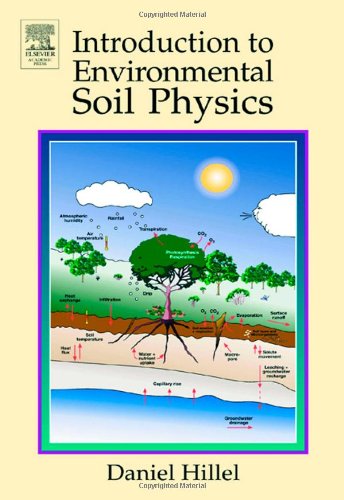
Introduction to Environmental Soil Physics
Authors:
Daniel Hillel
Publisher:
Academic Press
Publication Date:
Not available
ISBN:
0123486556
An abridged, student-oriented edition of Hillel's earlier published Environmental Soil Physics, this is a more succinct elucidation of the physical... principles and processes governing the behavior of soil and the vital role it plays in both natural and managed ecosystems. The textbook is self-contained and self-explanatory, with numerous illustrations and sample problems. Based on sound fundamental theory, the textbook leads to a practical consideration of soil as a living system in nature and illustrates the influences of human activity upon soil structure and function. Students, as well as other readers, will better understand the importance of soils and the pivotal possition they occupy with respect to careful and knowledgeable conservation. * Written in an engaging and clear style, posing and resolving issues relevant to the terrestrial environment.* Explores the gamut of the interactions among the phases in the soil and the dynamic interconnection of the soil with the subterranean and atmospheric domains.* Reveals the salient ideas, approaches, and methods of environmental soil physics.* Includes numerous illustrative exercises, which are explicitly solved.* Designed to serve for classroom and laboratory instruction, for self-study, and for reference.* Oriented toward practical problems in ecology, field-scale hydrology, agronomy, and civil engineering.* Differs from earlier texts in its wider scope and holistic environmental conception

Introduction to Environmental Studies (Bowling Green State University)
Authors:
Holly Myers
Publisher:
Hayden-McNeil Publishing
Publication Date:
Not available
ISBN:
073804718X
Introduction to Environmental Technology (Preserving the Legacy)
Authors:
Ann Boyce
Publisher:
Wiley
Publication Date:
Not available
ISBN:
0471287334
Here is the first and only text that helps beginning students master the foundation topics in the dynamic field of environmental technology, from basic... toxicology concepts and principles to comprehensive hazardous waste management strategies.Introduction to Environmental Technology organizes a wealth of current need-to-know information into a reader-friendly format that maximizes learning. Throughout, it features case studies that apply the text information to real-world environmental challenges, and highlights numerous career options through profiles of actual people working in various aspects of this broad field.This comprehensive, easy-to-understand text provides: An awareness of how the many facets of science, technology, and public policy are involved in environmental management protection. An understanding of the sources of pollution and the primary processes that control the fate of pollutants in air, water, and soil. Practical insights into the use of land, the benefits of wetlands, and the complex factors influencing land-use decisions. Comprehensive coverage of the main requirements of federal laws and regulations pertaining to hazardous waste, pollution prevention, and occupational health and safety. The basic principles needed to operate the latest pollution control and pollution monitoring equipment.Complete with a comprehensive glossary, Introduction to Environmental Technology provides you with the foundation concepts and vocabulary you need to succeed in this exciting, fast-changing field.
Introduction to Environmental Toxicology: Molecular Substructures...
Authors:
Wayne G. Landis
Publisher:
CRC Press
Publication Date:
Not available
ISBN:
1439804109
After fifteen years and three editions, Introduction to Environmental Toxicology: Molecular Substructures to Ecological Landscapes has become a standard... that defines the field of environmental toxicology, and the fourth edition is no exception. The authors take an integrated approach to environmental toxicology that emphasizes scale and context as important factors in understanding effects and management options. New in the Fourth Edition: New author, Dr. Ruth M. Sofield 8-page color insert New chapter on fate and transport of contaminants Emphasis on the use of all types of models in understanding how nature works Revised sections on synergy and atrazine toxicity Updated coverage of the analysis of impacts to populations, communities and ecosystems Enlarged risk assessment chapter with an in-depth description of a regional scale risk assessment This edition benefits from the insight of a new author, Dr. Ruth M. Sofield, who prepared the new chapter on the fate and transport of contaminants. The relationship between structure and toxicological properties has been a major theme of this book since its inception and this new chapter expands this fundamental concept to include fate and transport. In the early chapters the use of models in science is discussed and this theme carries throughout the rest of the book. So much has changed in the fifteen years since the publication of the first edition. The mid-1990s seem so long ago, when our understanding of environmental toxicology was very basic. Ecological risk assessment was in its very early stages and the consideration of the effects of toxicants on landscapes was only beginning. Computation was still hard, genes stayed put, and it was only becoming recognized that xenobiotics could have hormonal effects — developments that are taken for granted in this edition. Written by authors who teach this subject, a feature that is reflected in their straightforward style, the book provides a foundation for understanding environmental toxicology and its application.

Introduction to Enzyme and Coenzyme Chemistry
Authors:
T. D. H. Bugg
Publisher:
Wiley
Publication Date:
Not available
ISBN:
1119995949
Enzymes are giant macromolecules which catalyse biochemical reactions. They are remarkable in many ways. Their three-dimensional structures are highly... complex, yet they are formed by spontaneous folding of a linear polypeptide chain. Their catalytic properties are far more impressive than synthetic catalysts which operate under more extreme conditions. Each enzyme catalyses a single chemical reaction on a particular chemical substrate with very high enantioselectivity and enantiospecificity at rates which approach “catalytic perfection”. Living cells are capable of carrying out a huge repertoire of enzyme-catalysed chemical reactions, some of which have little or no precedent in organic chemistry.The popular textbook Introduction to Enzyme and Coenzyme Chemistry has been thoroughly updated to include information on the most recent advances in our understanding of enzyme action, with additional recent examples from the literature used to illustrate key points. A major new feature is the inclusion of two-colour figures, and the addition of over 40 new figures of the active sites of enzymes discussed in the text, in order to illustrate the interplay between enzyme structure and function.This new edition provides a concise but comprehensive account from the perspective of organic chemistry, what enzymes are, how they work, and how they catalyse many of the major classes of enzymatic reactions, and will continue to prove invaluable to both undergraduate and postgraduate students of organic, bio-organic and medicinal chemistry, chemical biology, biochemistry and biotechnology.

Introduction To Epidemiologic Research Methods In Public Health...
Authors:
Susan Bailey
Publisher:
Jones & Bartlett Learning
Publication Date:
Not available
ISBN:
1449627846
Epidemiologic Research Methods In Public Health Practice Is A Unique Book That Focuses On Quantitative Methods In The Field Of Epidemiology. This Book... Stands Out Among Other Quantitative Research Texts, As It Is One Of The Few To Focus On The Methods Specific To The Field Of Epidemiology, Including Procedures For Protecting Human Subjects, Sampling, Recruiting, And Research Question Formulation. It Also Contains Methods For Data Collection, Processing, And Analysis, As Well As Techniques For Publication, Presentation, And Funding. Epidemiologic Research Methods In Public Health Practice Offers Detailed Treatment Of The Research Steps Along With Tools To Enhance Students’ Comprehension Such As Learning Objectives, Chapter Outlines, Templates, Vocabulary, And Study Questions And Exercises. Written From A Real-World Perspective This Book Is Written From A Real-World Perspective, With A Focus On Threats To Validity And Reliability, As Well As Procedures To Prevent And Minimize Them. It Is A Excellent Guide For Students Of Research Methods In Public Health, And As A Reference For Both Students And Professionals As They Conduct Independent Research. Key Features: • Details Of Every Stage Of A Research Project—From Generating The Research Question To Publishing Results. • Study Questions And Exercises That Can Be Used In The Classroom Or In Independent Research Projects. • Lessons (Including Mistakes) Learned From Practical Experience. • A Comprehensive Treatment Of A Particular Stage Of Research In Every Chapter. • Specific Examples Of Epidemiologic Studies Are Used To Illustrate Procedures And Concepts. Instructor Resources: Instructors's Manual, Powerpoint Lecture Slides, Test Bank
Introduction to Epidemiology
Authors:
Ray M. Merrill
Publisher:
Jones & Bartlett Pub
Publication Date:
Not available
ISBN:
0763735825
An Introduction To Epidemiology, Fourth Edition Is Intended For Introductory Courses In Health-Related Programs At Both The Advanced Undergraduate And... Graduate Levels. It Is Also A Valuable Reference For Epidemiologists Working In The Field, Industrial Hygienists, Infectious Disease Nurses, And Staff Epidemiologists.
 '