production
/viewbook/list/all/?page=631
/
/static/
None
American Indian Nations: Yesterday, Today, and Tomorrow...
Authors:
George Horse Capture
Publisher:
AltaMira Press
Publication Date:
Not available
ISBN:
0759110956
American Indian Nations takes stock of Indian history, policy, and culture over the past 30 years. A distinctive contribution to the understanding and... interpretation of current Indian affairs, policies, and community development, this dynamic commentary of contemporary issues brings together a Who's Who of tribal leaders, scholars, and activists. No other collection offers such a thought-provoking and utterly current series of essays on the problems and achievements of modern Native peoples.
American Indian Oral History Manual: Making Many Voices Heard
Authors:
Charles Trimble
Publisher:
Left Coast Press
Publication Date:
Not available
ISBN:
1598741489
Oral history is a widespread and well-developed research method in many fields—but the conduct of oral histories of and by American Indian peoples has... unique issues and concerns that are too rarely addressed. This essential guide begins by differentiating between the practice of oral history and the ancient oral traditions of Indian cultures, detailing ethical and legal parameters, and addressing the different motivations for and uses of oral histories in tribal, community, and academic settings. Within that crucial context, the authors provide a practical, step-by-step guide to project planning, equipment and budgets, and the conduct and processing of interviews, followed by a set of examples from a variety of successful projects, key forms ready for duplication, and the Oral History Association Evaluation Guidelines. This vital manual will be the go-to text for everyone involved with oral history related to American Indians.
American Indian Politics and the American Political System...
Authors:
David E. Wilkins
Publisher:
Rowman & Littlefield Publishers
Publication Date:
Not available
ISBN:
1442203889
Now in its third edition, American Indian Politics is the most comprehensive study written from a political science perspective that analyzes the... structures and functions of indigenous governments (including Alaskan Native communities and Hawaiian Natives) and the distinctive legal and political rights these nations exercise internally, while also examining the fascinating intergovernmental relationship that exists between native nations, the states, and the federal government. The third edition contains a number of important modifications. First, it is now co-authored by Heidi Kiiwetinepinesiik Stark, who brings a spirited new voice to the study. Second, it contains ample discussion of how President ObamaOs election has altered the dynamics of Indian Country politics and law. Third, it contains more discussion of women's issues, several new vignettes, an updated timeline, new photographs, and updated charts, tables, and figures.
American Indians, American Justice
Authors:
Vine, Jr. Deloria
Publisher:
University of Texas Press
Publication Date:
Not available
ISBN:
029273834X
Baffled by the stereotypes presented by Hollywood and much historical fiction, many other Americans find the contemporary American Indian an enigma.... Compounding their confusion is the highly publicized struggle of the contemporary Indian for self-determination, lost land, cultural preservation, and fundamental human rights--a struggle dramatized both by public acts of protest and by precedent-setting legal actions. More and more, the battles of American Indians are fought--and won--in the political arena and the courts.American Indians, American Justice explores the complexities of the present Indian situation, particularly with regard to legal and political rights. It is the first book to present an overview of federal Indian law in language readably accessible to the layperson. Remarkably comprehensive, it is destined to become a standard sourcebook for all concerned with the plight of the contemporary Indian.Beginning with an examination of the historical relationship of Indians and the courts, the authors describe how tribal courts developed and operate today, and how they relate to federal and state governments. They define such key legal concepts as tribal sovereignty and Indian Country. By comparing and contrasting the workings of Indian and non-Indian legal institutions, the authors illustrate how Indian tribes have adapted their customs, values, and institutions to the demands of the modern world. Describing the activities of attorneys and Indian advocates in asserting and defending Indian rights, they identify the difficulties typically faced by Indians in the criminal and civil legal arenas and explore the public policy and legal rights of Indians as regards citizenship, voting rights, religious freedom, and basic governmental services.
American Indians and State Law: Sovereignty, Race, and Citizenship,...
Authors:
Deborah A. Rosen
Publisher:
University of Nebraska Press
Publication Date:
Not available
ISBN:
0803227981
American Indians and State Law examines the history of state and territorial policies, laws, and judicial decisions pertaining to Native Americans from... 1790 to 1880. Belying the common assumption that Indian policy and regulation in the United States were exclusively within the federal government’s domain, the book reveals how states and territories extended their legislative and judicial authority over American Indians during this period. Deborah A. Rosen uses discussions of nationwide patterns, complemented by case studies focusing on New York, Georgia, New Mexico, Michigan, Minnesota, Louisiana, and Massachusetts, to demonstrate the decentralized nature of much of early American Indian policy.This study details how state and territorial governments regulated American Indians and brought them into local criminal courts, as well as how Indians contested the actions of states and asserted tribal sovereignty. Assessing the racial conditions of incorporation into the American civic community, Rosen examines the ways in which state legislatures treated Indians as a distinct racial group, explores racial issues arising in state courts, and analyzes shifts in the rhetoric of race, culture, and political status during state constitutional conventions. She also describes the politics of Indian citizenship rights in the states and territories. Rosen concludes that state and territorial governments played an important role in extending direct rule over Indians and in defining the limits and the meaning of citizenship.

American Indians and the Fight for Equal Voting Rights
Authors:
Laughlin McDonald
Publisher:
University of Oklahoma Press
Publication Date:
Not available
ISBN:
0806142405
The struggle for voting rights was not limited to African Americans in the South. American Indians also faced discrimination at the polls and still do... today. This book explores their fight for equal voting rights and carefully documents how non-Indian officials have tried to maintain dominance over Native peoples despite the rights they are guaranteed as American citizens.Laughlin McDonald has participated in numerous lawsuits brought on behalf of Native Americans in Montana, Colorado, Nebraska, South Dakota, and Wyoming. This litigation challenged discriminatory election practices such as at-large elections, redistricting plans crafted to dilute voting strength, unfounded allegations of election fraud on reservations, burdensome identification and registration requirements, lack of language assistance, and noncompliance with the Voting Rights Act. McDonald devotes special attention to the VRA and its amendments, whose protections are central to realizing the goal of equal political participation.McDonald describes past and present-day discrimination against Indians, including land seizures, destruction of bison herds, attempts to eradicate Native language and culture, and efforts to remove and in some cases even exterminate tribes. Because of such treatment, he argues, Indians suffer a severely depressed socioeconomic status, voting is sharply polarized along racial lines, and tribes are isolated and lack meaningful interaction with non-Indians in communities bordering reservations.Far more than a record of litigation, American Indians and the Fight for Equal Voting Rights paints a broad picture of Indian political participation by incorporating expert reports, legislative histories, newspaper accounts, government archives, and hundreds of interviews with tribal members. This in-depth study of Indian voting rights recounts the extraordinary progress American Indians have made and looks toward a more just future.

American Indians and the Law (Penguin Library of American Indian...
Authors:
N. Bruce Duthu
Publisher:
Penguin Books
Publication Date:
Not available
ISBN:
0143114786
A perfect introduction to a vital subject very few Americans understand-the constitutional status of American IndiansFew American s know that Indian... tribes have a legal status unique among America's distinct racial and ethnic groups: they are sovereign governments who engage in relations with Congress. This peculiar arrangement has led to frequent legal and political disputes-indeed, the history of American Indians and American law has been one of clashing values and sometimes uneasy compromise. In this clear-sighted account, American Indian scholar N. Bruce Duthu explains the landmark cases in Indian law of the past two centuries. Exploring subjects as diverse as jurisdictional authority, control of environmental resources, and the regulations that allow the operation of gambling casinos, American Indians and the Law gives us an accessible entry point into a vital facet of Indian history.
American Indians and the Mass Media
Authors:
Not Available
Publisher:
University of Oklahoma Press
Publication Date:
Not available
ISBN:
0806142340
Mention “American Indian,” and the first image that comes to most people’s minds is likely to be a figment of the American mass media: A... war-bonneted chief. The Land O’ Lakes maiden. Most American Indians in the twenty-first century live in urban areas, so why do the mass media still rely on Indian imagery stuck in the eighteenth and nineteenth centuries? How can more accurate views of contemporary Indian cultures replace such stereotypes? These and similar questions ground the essays collected in American Indians and the Mass Media, which explores Native experience and the mainstream media’s impact on American Indian histories, cultures, and communities.Chronicling milestones in the relationship between Indians and the media, some of the chapters employ a historical perspective, and others focus on contemporary practices and new technologies. All foreground American Indian perspectives missing in other books on mass communication. The historical studies examine treatment of Indians in America’s first newspaper, published in seventeenth-century Boston, and in early Cherokee newspapers; Life magazine’s depictions of Indians, including the famous photograph of Ira Hayes raising the flag at Iwo Jima; and the syndicated feature stories of Elmo Scott Watson. Among the chapters on more contemporary issues, one discusses campaigns to change offensive place-names and sports team mascots, and another looks at recent movies such as Smoke Signals and television programs that are gradually overturning the “movie Indian” stereotypes of the twentieth century.Particularly valuable are the essays highlighting authentic tribal voices in current and future media. Mark Trahant chronicles the formation of the Native American Journalists Association, perhaps the most important early Indian advocacy organization, which he helped found. As the contributions on new media point out, American Indians with access to a computer can tell their own stories—instantly to millions of people—making social networking and other Internet tools effective means for combating stereotypes.Including discussion questions for each essay and an extensive bibliography, American Indians and the Mass Media is a unique educational resource.
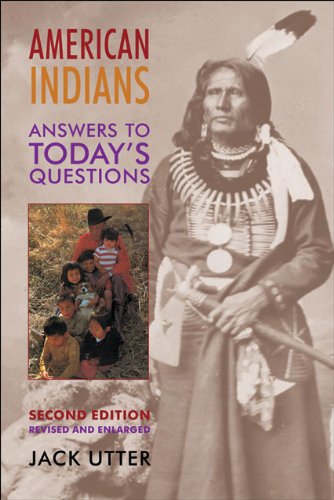
American Indians: Answers to Today's Questions (Civilization of the...
Authors:
Jack Utter
Publisher:
University of Oklahoma Press
Publication Date:
Not available
ISBN:
0806133090
Who is an Indian? Who is a Native American?What are Indian self-determination and sovereignty?What defines an Indian tribe?These and more than one... hundred other questions are asked and answered in this critically acclaimed overview of Indian country. The second edition of Jack Utter’s classic work covers the hottest issues facing American Indians today--tribal sovereignty, gaming, water rights, treaty rights, cultural rights, and the evolving history of federal Indian policy. Revised and updated with many new questions, eight new illustrations, historical and contemporary maps, three hundred new references, and informative tables, American Indians provides the best single source available today on a variety of Indian country issues, past and present.
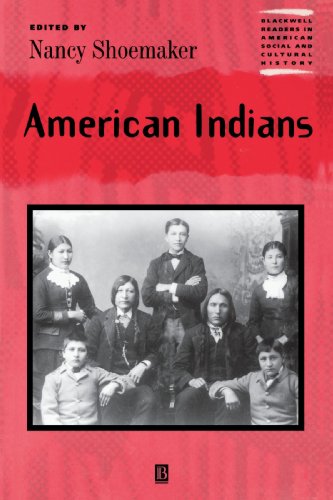
American Indians (Blackwell Readers in American Social and Cultural...
Authors:
Not Available
Publisher:
Wiley-Blackwell
Publication Date:
Not available
ISBN:
0631219951
This collection brings together the best recent essays covering over five hundred years of American Indian history. Attached to each essay are primary... historical documents that deal with issues of survival, resistance, accommodation, and adaptation, all of which illuminate the complexity and diversity of American Indian experiences.
American Indians in the Marketplace (Development of Western Resources)
Authors:
Brian C. Hosmer
Publisher:
University Press Of Kansas
Publication Date:
Not available
ISBN:
0700616586
Although it is usually assumed that Native Americans have lost their cultural identity through modernization, some peoples have proved otherwise. Brian... Hosmer explores what happened when cultural identity and economic opportunity converged among two Native American communities that used community-based industries to both generate income and sustain their cultures. Comparing a lumber business run by the Menominees of Wisconsin and a salmon cannery established by British Columbian and Alaskan Tsimshian communities known as Metlakatla, Hosmer reveals how each tribe responded to market and political forces over fifty years. Hosmer's innovative ethnohistory recounts how these Indians used the marketplace to maintain their distinctiveness to a far greater extent than those who became wage earners in the white man's world. Hosmer shows that by selectively incorporating elements of American capitalism into their cultural lives, the Menominees and Metlakatlans came to view modernization less as a threat to their tribal life than as a means for maintaining their independence. These tribes embraced the same market accused of hastening the demise of native societies and became comparatively successful in American terms even as they both honored fundamental values and forged new cultural identities. Over time, these peoples came to understand how the market worked, recognized that the broader economy operated according to market principles, and learned how to adjust to it. Hosmer reveals how their strategies of "purposeful modernization" brought relative economic independence and sometimes the respect and cooperation of local and federal governments, how it helped chart a middle course between unchecked individuality and a communal ethos that might stifle economic development, and how economic development and cultural values ultimately affected one another. American Indians in the Marketplace is a story of adaptation that acknowledges the hardship and suffering common to most Indian-white contact while emphasizing the benefits of selective modernization accompanied by a constant re-invention of tradition. It questions the victim thesis of Native American history and shows that native peoples can meet the challenges of surviving in the larger world.
American Indians in U.S. History (Civilization of the American...
Authors:
Roger L. Nichols
Publisher:
University of Oklahoma Press
Publication Date:
Not available
ISBN:
0806135786
This one-volume narrative history of American Indians in the United States traces the experiences of indigenous peoples from early colonial times to the... present day, demonstrating how Indian existence has varied and changed throughout our nation’s history. Although popular opinion and standard histories often depict tribal peoples as victims of U.S. aggression, that is only a part of their story. In American Indians in U.S. History, Roger L. Nichols focuses on the ideas, beliefs, and actions of American Indian individuals and tribes, showing them to be significant agents in their own history.Designed as a brief survey for students and general readers, this volume addresses the histories of tribes throughout the entire United States. Offering readers insight into broad national historical patterns, it explores the wide variety of tribes and relates many fascinating stories of individual and tribal determination, resilience, and long-term success. Charting Indian history in roughly chronological chapters, Nichols presents the central issues tribal leaders faced during each era and demonstrates that, despite their frequently changing status, American Indians have maintained their cultures, identities, and many of their traditional lifeways. Far from vanishing” or disappearing into the melting pot,” American Indians have struggled for sovereignty and are today a larger, stronger part of the U.S. population than they have been in several centuries.
American Indians of Milwaukee (Images of America (Arcadia Publishing))
Authors:
Antonio J. Doxtator
Publisher:
Arcdia Publishing
Publication Date:
Not available
ISBN:
0738582581
Milwaukee is an Algonquin word meaning "the gathering place." Wisconsin's 11 American Indian tribes have long gathered in the city, contributing to its... name and origins. American Indians continue to assist in Milwaukee's growth through nationally recognized innovations in education, gaming, and cultural representation. The city's "founding mother," a Menominee Indian, continued trading partnerships with the area's native residents until Indian removal in the 1830s. Over the next century, Indians returned to Milwaukee as visitors, creating villages at the state fair and lakefront grounds. By the 1930s, Indians again called the city home and expressed their common heritage through Pan-Indian organizations. Later the new ideals of the national Red Power movement helped transform those organizations into successful city institutions such as the Indian Community School, Potawatomi Bingo and Casino, and Indian Summer Festival.
American Indian Sovereignty and the U.S. Supreme Court : The...
Authors:
David E. Wilkins
Publisher:
University of Texas Press
Publication Date:
Not available
ISBN:
0292791097
"Like the miner's canary, the Indian marks the shift from fresh air to poison gas in our political atmosphere; and our treatment of Indians, even more... than our treatment of other minorities, reflects the rise and fall in our democratic faith," wrote Felix S. Cohen, an early expert in Indian legal affairs.In this book, David Wilkins charts the "fall in our democratic faith" through fifteen landmark cases in which the Supreme Court significantly curtailed Indian rights. He offers compelling evidence that Supreme Court justices selectively used precedents and facts, both historical and contemporary, to arrive at decisions that have undermined tribal sovereignty, legitimated massive tribal land losses, sanctioned the diminishment of Indian religious rights, and curtailed other rights as well.These case studies--and their implications for all minority groups--make important and troubling reading at a time when the Supreme Court is at the vortex of political and moral developments that are redefining the nature of American government, transforming the relationship between the legal and political branches, and altering the very meaning of federalism.
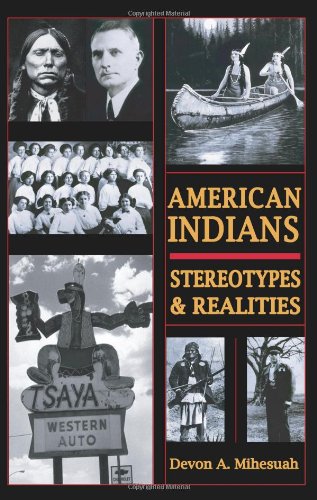
AMERICAN INDIANS: Stereotypes & Realities
Authors:
Devon A. Mihesuah
Publisher:
Clarity Press, Inc.
Publication Date:
Not available
ISBN:
0932863221
“Mihesuah’s work should be required reading for elementary and upper level teachers, college instructors and parents. Let us hope it finds a wide... readership in mainstream circles.” Joel Monture, Multicultural Review “Professor Mihesuah goes beyond simply providing responses to common stereotypes. She provides the reader with assistance in efforts to improve understanding of her peoples... a valuable contribution in bringing greater clarity to important issues.” Alejandro Garcia, Journal of Multicultural Social Work “Devon Mihesuah has provided precious insight into the racial identity and cultural struggles of American Indians... I applaud Devon Mihesuah for successfully confronting the literature of false portrayal and negative images of Indian people.” Dr. Donald L. Fixico, Professor of History Western Michigan University, Kalamazoo (Shawnee, Sac & Fox, Creek, Seminole) “A good sourcebook for dispelling misconceptions and negative stereotypes about American Indians. These beliefs and attitudes exist and these statements are made in academic settings. It is fortunate that there are professors like Devon Mihesuah in classrooms to present the “other side”, perhaps only once in the lifetime of some students...” Dr. Karen Swisher, Director, Center for Indian Education Arizona State University (Standing Rock Sioux) “This book will be a very useful reader for anyone truly trying to understand who American Indians really are. There is no other book on Indian images that provides the Indian “voice” that Devon maintains throughout the text.” Dr. Duane Champagne, Director UCLA American Indian Studies Center Editor, American Indian Culture and Research Journal (Turtle Mountain Chippewa) “Devon Mihesuah is one of the most gifted Native American scholars in the country today.” Robert A. Williams, Jr., Professor of Law University of Arizona, Tucson (Lumbee) “Amusing and a helpful guide to general readers not that familiar with the national Indian community” Dr. Terry P. Wilson, Native American Studies University of California, Berkeley (Potawatomie)
 '
'